Why ARiMR carries out inspections
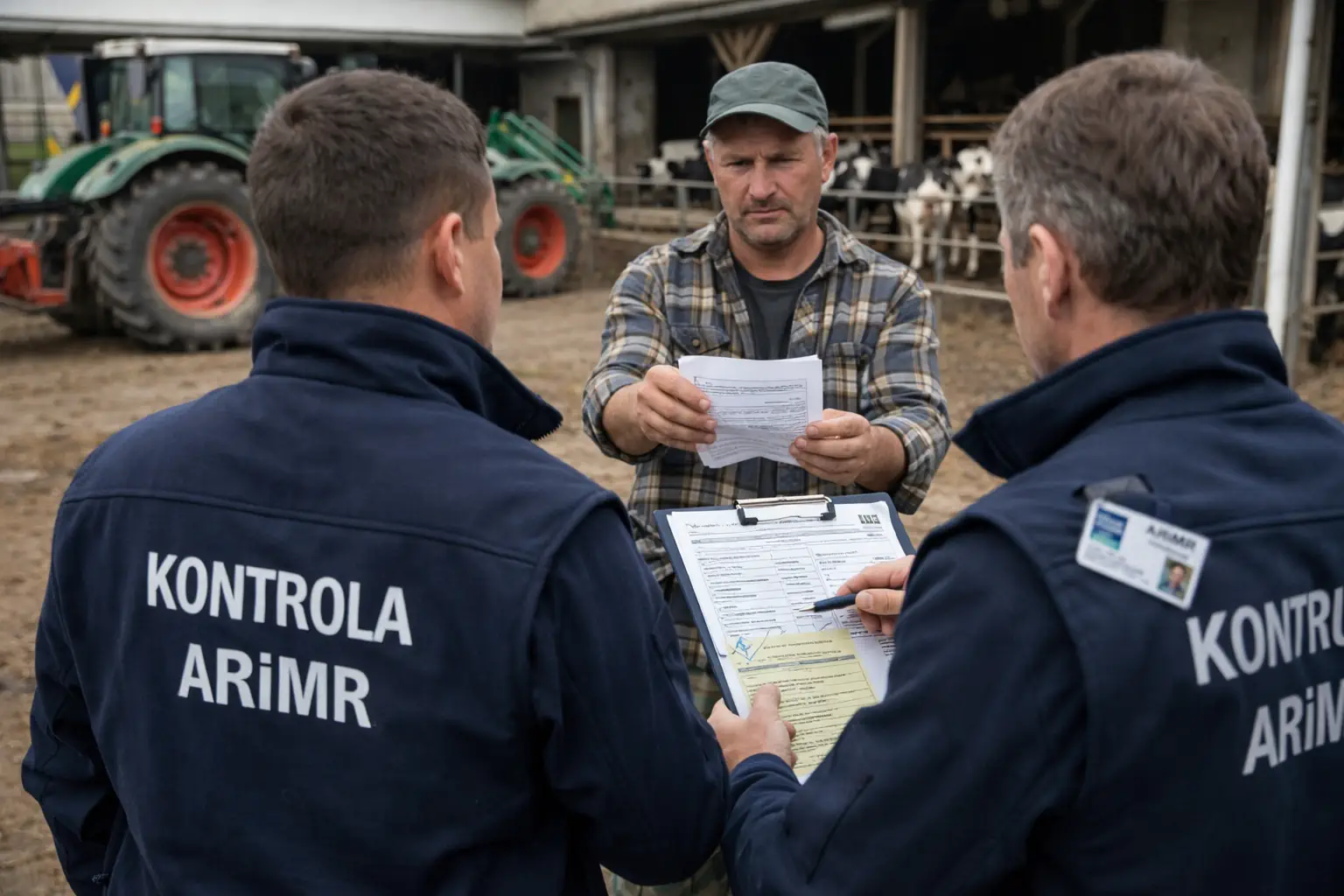
ARiMR carries out inspections to verify whether the data declared by the agricultural producer in the payment application is consistent with the actual situation and whether public funds are being used correctly. This is not just a "paperwork" check. It is part of the CAP payment management system, combining administrative checks, area monitoring, and on-the-spot inspections.
In practice, this means that the Agency verifies not only areas, crops, or livestock, but also evidence of completed actions, the completeness of registers, and whether the documentation complies with the programme rules. From the farm's point of view, the most important principle is simple: if something cannot be demonstrated in a coherent, organised, and timely manner, post-inspection risk increases, even if the activity itself was carried out correctly.

The main reasons for ARiMR inspections
- verification of payment applications and the data declared by the farmer,
- confirmation of the eligibility of land, practices, and commitments,
- verification of compliance with conditionality requirements,
- protection of public funds and reduction of application errors,
- monitoring of practices relevant to the environment, animal welfare, and food safety.
When ARiMR inspections are carried out
Inspections are carried out when required by the rules of a given intervention, by the monitoring system, or by the inspection sample selection process. There is no single universal date for all farms, because the scope and timing depend on the type of payment, the declared practices, the type of farm, and whether certain elements can be verified remotely or require a visit to the holding.
As a rule, on-the-spot inspections under the CAP should not be announced in advance. However, if the farmer's presence is necessary, ARiMR may notify the farmer with the minimum advance notice required. In some area-based or document-based inspections, the Agency may contact the farmer by phone, in writing, or directly.
| Stage | What happens on the ARiMR side | What the farmer should have ready |
|---|---|---|
| After submitting the application | Administrative check of data, comparison with registers and the geospatial system | A consistent application, areas, plots, and attachments |
| During the production season | Area monitoring, analysis of practice compliance and system signals | History of operations, treatment dates, documents confirming implementation |
| On-the-spot inspection | Field visit, verification of documents and the actual situation | Registers, invoices, agreements, plans, records, powers of attorney |
| After the inspection | Report, possible remarks, and financial consequences | Explanations, additional documents, objections submitted on time |
What ARiMR checks in practice
The scope of the inspection depends on the type of support, but several permanent risk areas can be identified. These usually include the consistency of declarations with reality, the completeness of documentation, confirmation that declared practices were actually carried out, and fulfilment of conditionality requirements and additional commitments.
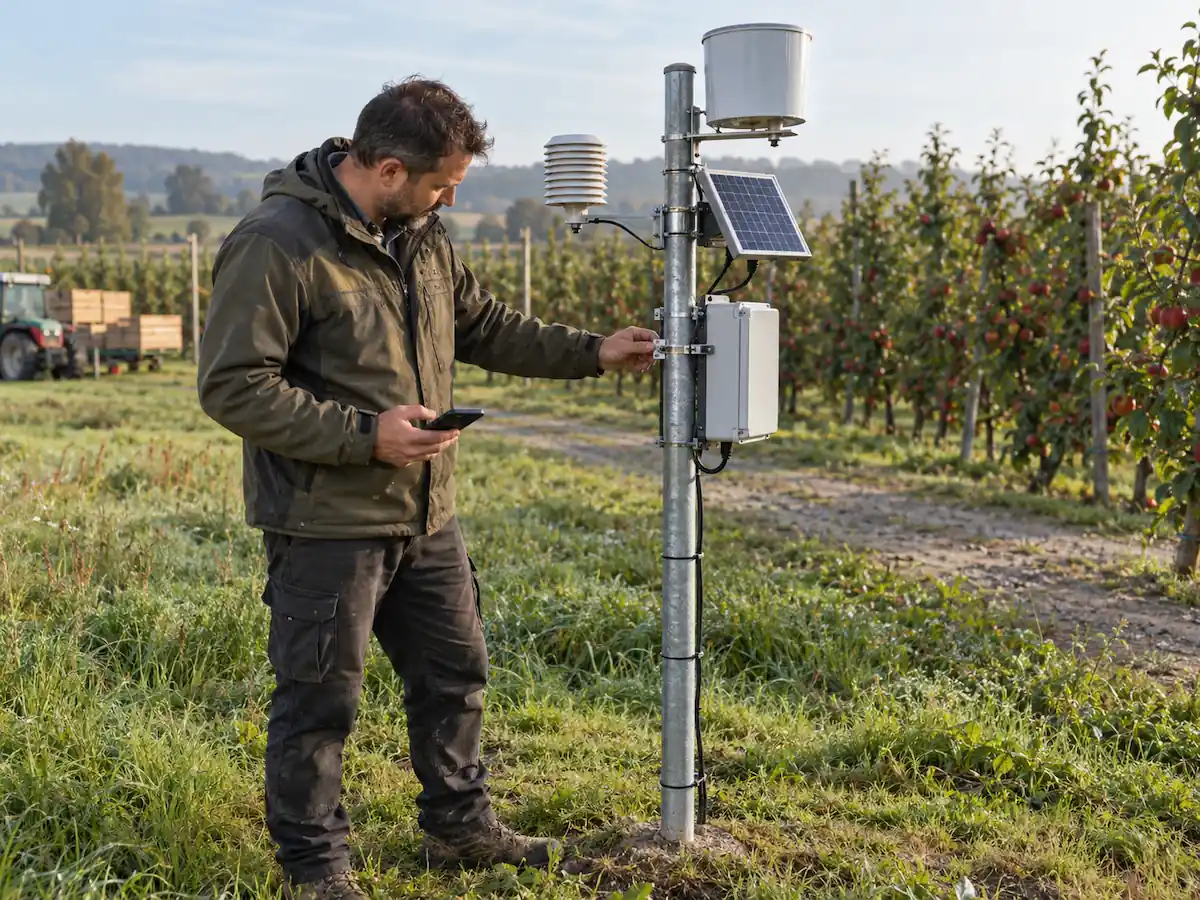
In orchards, vegetable farms, and mixed farms, particular importance is also attached to documents related to fertilisation, plant protection, field structure, plots, treatment dates, and the link between purchased inputs and their actual use.
ARiMR most often checks
- areas and plot boundaries,
- whether declared crops match reality,
- implementation of practices declared for payments or eco-schemes,
- fertilisation records and plant protection treatment records,
- lease agreements, land titles, and source documents,
- records required in organic farming, animal welfare, or other support schemes,
- data confirming the execution of treatments, routes, or operations.
What documentation ARiMR requires
There is no single universal binder "for every inspection", because the requirements depend on the programme, the type of production, and the interventions declared. In practice, however, it is possible to build a common documentation core that prepares the farm for most inspection scenarios.
The biggest problem is usually not the total absence of documents, but the fact that they are scattered. Invoices are in accounting, treatment records are in a notebook, photos are on a phone, maps are in emails, and fertilisation dates are in the operator's memory. This makes it much harder for the farm to defend its position during an inspection.
| Document group | Examples | Why it matters |
|---|---|---|
| Application documents | payment applications, corrections, attachments, submission confirmations | They are the baseline for administrative and field inspections |
| Land-related documents | lease agreements, maps, plot lists, change history | They help confirm area eligibility |
| Field operation records | dates, products, doses, operator, field, justification | They support compliance, safety, and reconstruction of production history |
| Fertilisation | fertilisation plans, fertiliser calculations, soil test results, dates and doses | They matter for conditionality, environmental obligations, and rational farm management |
| Purchases and costs | invoices for fertilisers, plant protection products, planting material, and services | They help link source documents to actual field activities |
| Execution data | field notes, machine data, telemetry, photos, reports | They help prove that a declared practice was actually carried out |
| Special documents | organic farming, animal welfare, environmental commitments, certification | Missing these documents often leads to the highest percentage sanctions |
Quick checklist: documents worth reviewing the day before the inspection
- whether the application and any corrections match what is actually in the fields,
- whether each plot has activities and dates assigned to it,
- whether treatments and fertilisation have dates, doses, and field assignment,
- whether invoices can be linked to the season and a specific crop,
- whether lease agreements, powers of attorney, and other formal documents are available,
- whether special documents for organic farming, animal welfare, or environmental actions are complete.
Top 10 mistakes found in farm documentation and organisation
Most post-inspection problems are not caused by one major violation, but by many small inconsistencies. In practice, the inspector then sees a farm where the documents do not form a logical whole. It is exactly this lack of continuity that most often costs the most time, stress, and money.
- No single, up-to-date version of documentation for each plot.
- Mismatch between the purchase invoice and the entry in the treatment record.
- Incomplete treatment descriptions: missing dose, date, operator, or field.
- Fertilisation plans detached from soil tests and actual execution.
- Documents stored in several places without a common structure.
- Records completed too late, often from memory.
- Errors in plot areas and change history.
- No proof that a declared practice was actually carried out.
- No person responsible for preparing documents for inspection.
- No internal documentation review before submitting the application.
How to prepare for an inspection step by step
Good inspection preparation does not begin on the day ARiMR calls, but with the first action taken during the season. The more the farm works according to a stable process, the less it depends on memory, paper notes, and last-minute searching.
Step 1. Organise data by plot, crop, and season
Every activity should be assigned to a specific field. This is the basic condition for quickly reconstructing the history of decisions and operations.
Step 2. Link the source document to execution
An invoice, a fertilisation plan, the purchase of a plant protection product, and the completed treatment should form one chain of information. Only then is the documentation defensible in practice.
Step 3. Check whether the application matches reality
Before the inspection, it is worth reviewing whether declarations, areas, crops, and practices still match the actual situation and any changes made during the season.
Step 4. Prepare one document package for the inspector
Instead of searching for documents in different places, prepare one working set: application, maps, records, plans, invoices, agreements, and execution reports.
Step 5. Appoint one person responsible for contact and explanations
In larger farms or producer organisations, the lack of a single owner of the documentation process is a common cause of chaos and misunderstandings.
Inspection checklist before an ARiMR visit
- application and any corrections,
- current list of plots and crops,
- fertilisation and treatment records,
- soil test results and fertiliser calculations,
- purchases of fertilisers and plant protection products,
- lease agreements and formal documents,
- machine reports, photos, notes, and telemetry,
- documents for organic farming, animal welfare, or other support schemes,
- the person responsible for explanations and access to documents.
Penalties, payment reductions, and financial risks
Farmers often ask about an "ARiMR penalty", but in practice there are several mechanisms: payment reductions, refusal of part of the support, repayment obligations, or sanctions resulting from repeated findings of the same non-compliance. Under conditionality, the basic payment reduction is generally 3%, but the actual level depends on the type, extent, severity, permanence, and whether the action was unintentional or deliberate.
In some support schemes, specific sanctions apply to specific documentation gaps. For example, under organic payments, the lack of an organic farming activity register, incomplete records, or the absence of an organic activity plan may lead to significant percentage reductions. This shows that documentation is not an add-on to production, but part of the financial requirement itself.
| Type of non-compliance | Possible consequence | Practical remarks |
|---|---|---|
| Breach of conditionality | payment reduction, often starting from 3% | The level depends on the weight and nature of the breach |
| Incomplete documentation of actions | payment reduction or inability to confirm a declared practice | The risk is higher for eco-schemes and environmental measures |
| Missing register or plan in special schemes | partial loss of support or correction requirement | Most severe in organic farming and schemes with dedicated documentation |
| Repeated finding of the same deficiency | additional increase in sanctions | Repeated errors significantly worsen the farm's position |
What is worth remembering
- not every non-compliance results in the same sanction,
- repeated and systemic errors are the most expensive,
- documentation gaps often trigger a bigger problem than a treatment performed late,
- the more organised the data, the greater the chance of clarifying doubts quickly.
Comparison of documentation methods
Many farms still rely on paper or spreadsheets. These solutions may work on a small scale, but they lose efficiency when the number of plots, treatments, operators, product batches, and compliance requirements increases. At that point, the issue is no longer the recording itself, but the reconstruction and linkage of information.
| Criterion | Paper | Spreadsheet | FarmPortal - FMS |
|---|---|---|---|
| Speed of data entry during the season | medium | medium | high |
| Assignment to plot and field history | limited | depends on user discipline | system-based |
| Linking purchases, treatments, and fertilisation | difficult | possible but time-consuming | easy and consistent |
| Preparation of documents for inspection | time-consuming | time-consuming at larger scale | faster and more organised |
| Cooperation with advisors and teams | weak | limited | very good |
| Plant protection product database | no | no | yes |
| Fertiliser calculations and fertiliser calculator | no | partly | yes |
| Usefulness for inspections and audits | low to medium | medium | high |
Who this article is for
An ARiMR inspection directly concerns the farmer, but its consequences are felt across the whole supply chain. That is why the topic matters not only to the farm owner, but also to the advisor, processor, distributor, and manufacturer of agricultural equipment or digital solutions.
Farmers
Problem: scattered documentation, seasonal time pressure, uncertainty about the inspection scope. Benefit: this article shows how to build a minimum documentation standard, which mistakes are the most costly, and how to create a simple process for defending farm data during an inspection.
Agricultural advisors
Problem: inconsistent data from the client and the need to manually reconstruct field history and operations. Benefit: the article provides a ready-made structure for documentation review and a list of risks worth checking before submitting the application and before the inspection.
Fruit and vegetable processors
Problem: incomplete supplier documentation makes compliance assessment, delivery planning, and audit handling more difficult. Benefit: the material shows how organised farm documentation translates into more predictable cooperation and fewer gaps in raw material batch data.
Fruit and vegetable distributors
Problem: difficulty collecting source data quickly from many farms. Benefit: the article helps define the minimum package of information worth requiring from suppliers in order to reduce operational and reputational risk.
Manufacturers of agricultural equipment and digital solutions
Problem: many tools support the execution of a treatment well, but are weaker when it comes to documenting the work afterwards. Benefit: the material shows that a real advantage lies not only in automation, but also in the ability to generate data useful for inspections, advisory work, and reporting.
How FarmPortal supports inspection readiness
FarmPortal does not replace regulations or administrative decisions, but it organises farm operational data in a way that makes it easier to use during inspections, audits, and day-to-day management. From the farm's point of view, the greatest value lies not in recording information itself, but in being able to reconstruct the history of a field, treatment, purchase, and decision quickly.
For farms running intensive crop production, functions related to field operation records, fertilisation planning, the plant protection product database, and reporting are particularly important. These are exactly the areas that most often arise when preparing for an inspection and when working with an advisor.
Key functions and benefits
- Field operation records: faster assignment of treatments to plots, crops, and seasons.
- Plant protection product database: easier organisation of applied products and treatment history.
- Plant protection product viewer: faster verification of a product and its use.
- Fertiliser calculations and fertiliser calculator: better linkage between soil tests, the plan, and execution.
- Reports and operation history: less manual compilation of data for inspections and seasonal analysis.
- Cooperation with advisors and teams: easier access to organised data with the farm's consent.
You can find a full description of the functions at FarmPortal - farm management system functions. In the context of documentation and inspections, it is also worth reading our article on smart farming and compliance-ready digital farm management and the article on FarmPortal as an integrated ERP system for agriculture.
Case study
78 ha orchard farm, apples and pears, Mazowieckie region
The farm ran intensive orchard production, cooperated with a producer group, and used several data sources: field notes, invoices, spreadsheets, and messages sent to the advisor. The main problem did not arise during the execution of operations, but during the reconstruction of their history and the linking of purchases to specific plots.
Before the process was organised, preparing documents for an internal review took on average 11-13 hours for one larger seasonal inspection package. After moving to one structured data environment in FarmPortal, this fell to 4-5 hours. This means that the document preparation time was reduced by around 60%.
| Indicator | Before process organisation | After process organisation | Change |
|---|---|---|---|
| Time needed to prepare a document package for review | 12 hours | 4.8 hours | -60% |
| Share of operations fully assigned to a specific plot | 71% | 96% | +25 pp |
| Documentation gaps found during internal review | 19 items | 6 items | -68% |
| Response time to advisor or buyer questions | average 2 working days | average 6 hours | significant improvement |
Conclusion: the greatest benefit did not come from "nicer records", but from closing the process loop: plot -> treatment -> source document -> report. This reduced the number of explanations required, shortened the owner's working time, and improved cooperation with both the advisor and the fruit buyer.
User testimonials - examples
"We manage 64 hectares of field vegetables, and previously the biggest problem was not the inspection itself but searching for data in several places. After organising treatment and fertilisation records, the time needed to prepare documents dropped by roughly half, and the advisor can immediately see what is missing."
"In our 92-hectare orchard, the hardest part was linking each treatment with the plot and the product purchase. Once we had that data in one environment, it became much easier to work with the producer group and much faster to prepare for inspections and audits. In our case, the number of gaps found during internal review fell by more than 60%."
Summary
An ARiMR inspection is not an event detached from daily farm management. It is a test of data quality, process quality, and work organisation. The larger the production scale and the more environmental, quality, or commercial requirements apply, the more important well-organised documentation becomes.
The most practical rule is simple: record data on an ongoing basis, assign it to the correct plot and season, link the source document with execution, and regularly run an internal review of gaps. This is exactly where a digital system such as FarmPortal - farm management software helps build an advantage by combining records, fertiliser calculations, the plant protection product database, and reporting in one environment.
FAQ
Can ARiMR carry out an inspection without prior notice?
Yes. As a rule, on-the-spot inspections under the CAP should not be announced in advance. However, if the farmer's presence is necessary, the Agency may provide the minimum advance notice required.
What documents usually have to be shown during an inspection?
These are most often documents related to the application, plots, treatment records, fertilisation, purchases of production inputs, and additional requirements arising from organic farming, animal welfare, or environmental measures.
Can the lack of one register reduce subsidies?
Yes, especially when that register is required under a specific intervention or commitment. In practice, the consequences depend on the programme and the type of non-compliance identified.
Can a farm below 10 hectares also be subject to inspection?
Yes, but special rules apply under conditionality. ARiMR information materials indicate that farms up to 10 hectares of utilised agricultural area are exempt from inspections and penalties within the scope of conditionality.
What should be done if documentation is stored in several places?
The first step is to organise it by plot, crop, and season, and then link source documents with the actual execution of operations. Without this, even a correctly completed practice may be difficult to defend during an inspection.
Do machine data and telemetry matter during an inspection?
They can be very useful as supporting evidence. They help reconstruct routes, dates, doses, and the history of operations, especially where the farm uses precision agriculture or works closely with an advisor.
Why is the inspection topic also important for processors and distributors?
Because organised farm documentation translates into more predictable deliveries, easier audit handling, and lower risk of missing data at raw material batch level.
Glossary
ARiMR
The Agency for Restructuring and Modernisation of Agriculture. The institution responsible, among other things, for handling many forms of support for agriculture and carrying out inspections.
Conditionality
A set of standards and requirements whose fulfilment affects eligibility for full payments. It includes environmental, soil, water, and selected statutory requirements.
GAEC
Good Agricultural and Environmental Conditions concerning the maintenance of land in good agricultural condition consistent with environmental protection.
SMR
Statutory Management Requirements arising from regulations and forming part of the conditionality system.
Area monitoring
A system using spatial observation and satellite imagery to assess agricultural activity and verify the consistency of declarations.
FMS
Farm Management System, meaning software used to manage a farm. In practice, it organises data on fields, crops, treatments, costs, and documents.
Fertiliser calculations
Calculations of fertiliser doses based on crop needs, soil fertility, target yield, and agronomic data.
Plant protection product database
A structured set of information about products and their uses, helpful in treatment planning and documentation.
Sources
Follow us!
See what we're doing and be inspired by positive changes.