Who this article is for and what you will gain
Spring frost events affect the whole crop value chain - from growers and advisors to processors and distributors. Each stakeholder faces a different operational and financial risk profile.
This article structures key decisions before the season and during frost nights, from active protection choices to post-event documentation and supply planning.
Farmers and orchard growers
- how to identify high-risk windows,
- how to match protection methods to frost type,
- how to reduce yield and margin losses.
Advisors, processors and distributors
- how to assess damage and raw material quality quickly,
- how to forecast supply gaps,
- how to use weather and production data for operational planning.
What spring frosts are and how they form
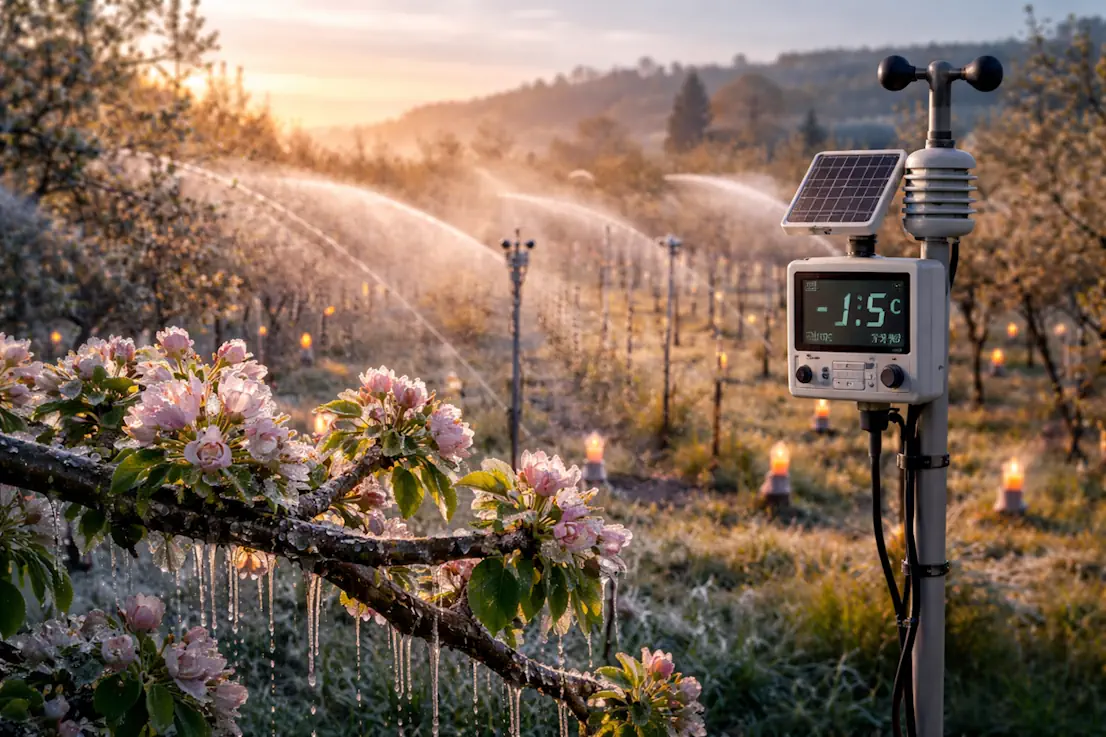
A spring frost is a temperature drop below 0 C during active crop growth, when plants lose winter hardiness. Even short cold episodes can damage flowers and fruitlets.
In practice, events are usually classified as radiative, advective, or mixed frost. That distinction directly affects the effectiveness of fans, sprinklers, and heating methods.

Two main event types
| Frost type | Mechanism | Typical conditions | Sprinkler effectiveness |
|---|---|---|---|
| Radiative | Night heat radiation from soil surface | Clear sky, low wind | High |
| Advective | Cold air mass inflow | Windy, prolonged cold | Moderate |
| Mixed | Combination of both mechanisms | Variable and dynamic | Variable |
7 crop groups most exposed to spring frosts
Exposure depends on phenological stage and local microclimate. Crops entering flowering or fruit set early are typically most vulnerable.
- Strawberries - highly sensitive flowers and strong local variability.
- Sweet and sour cherries - frequent overlap between bloom and late cold waves.
- Apples and pears - major economic crops with strong market impact.
- Winter oilseed rape - vulnerable in stem elongation and bud formation.
- Potatoes - sensitive emergence and delayed growth after damage.
- Maize - risk in early growth stages.
- Field vegetables - high sensitivity of seedlings and transplants.
Critical damage temperatures - comparison table
Critical values should be interpreted together with growth stage and event duration. Ground-level temperatures can be significantly lower than standard forecast values.
| Crop | Stage | 10% damage | 90% damage |
|---|---|---|---|
| Apple | Full bloom | -1.5 C | -2.8 C |
| Cherry | Full bloom | -1.5 C | -2.7 C |
| Strawberry | Flowering | -0.5 C | -2.0 C |
| Potato | Emergence | -1.0 C | -2.5 C |
Economic impact of spring frost events
Frost consequences go beyond direct yield loss. They increase emergency costs, liquidity pressure, and contract risk across the whole supply chain.
For processors and distributors, this usually means quality volatility, uncertain volume, and harder logistics planning.
Case study: apple orchard in Mazovia
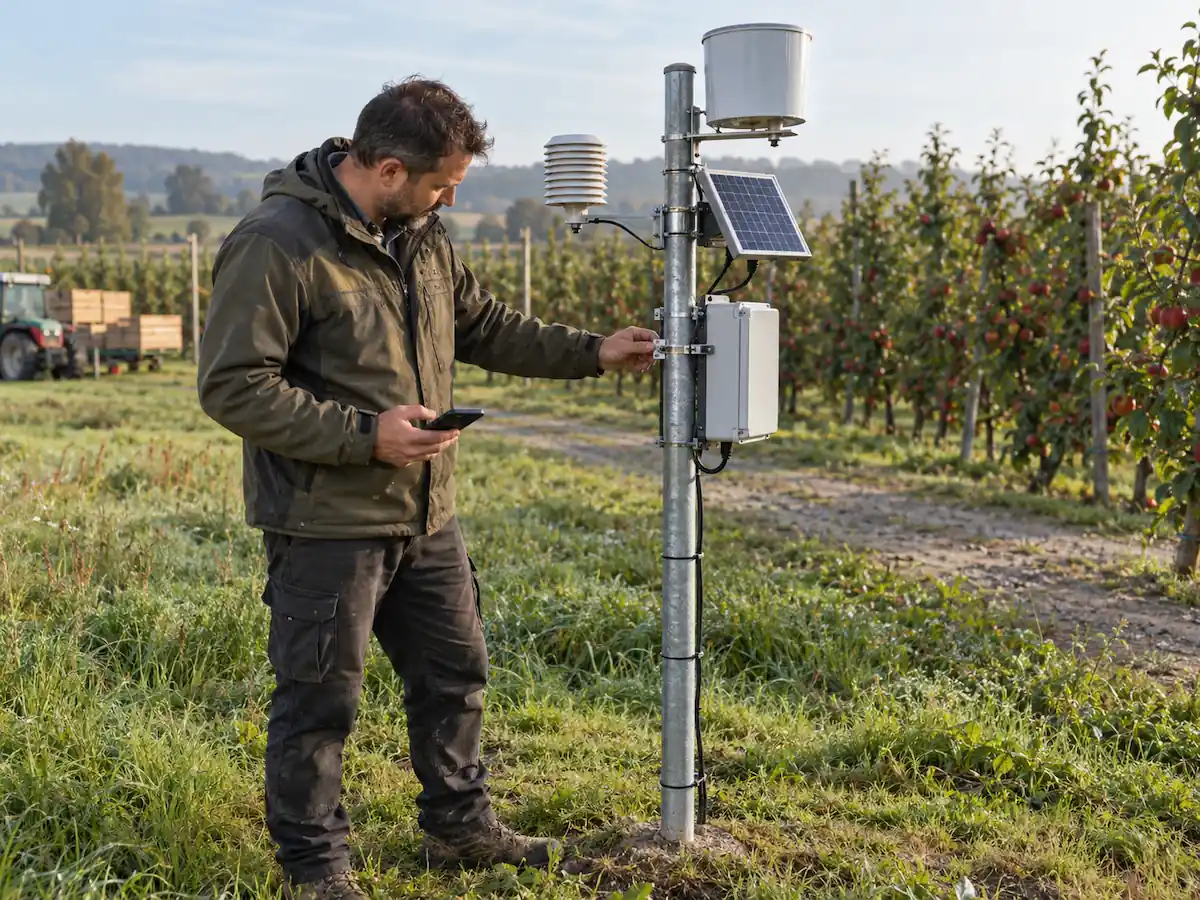
A Mazovian orchard implemented ground-level temperature monitoring and early alerts. This enabled earlier activation of protection before critical thresholds were reached.
| Indicator | Result |
|---|---|
| Estimated protected yield on sprinkler blocks | 78% |
| Estimated protected yield with frost candles | 41% |
| Estimated response lead time | about 110 min |
Frost protection methods
Best outcomes usually come from layered protection: local monitoring, event-type diagnosis, active methods, and clear operational procedures.
| Method | Typical effectiveness | Main limitation |
|---|---|---|
| Overhead sprinkling | High when correctly operated | Requires uninterrupted operation and water resources |
| Frost fans | Good under inversion conditions | Low effectiveness in advective frost |
| Frost candles and burners | Moderate | Labour and cost intensity |
| Covers and fleece | Good on smaller areas | Limited scalability |
Pre-frost checklist
48-24 hours before the event
- verify crop stage and critical threshold,
- check operational readiness of protection systems,
- assign overnight responsibilities.
During frost night
- activate protection according to local alert threshold,
- monitor ground and canopy temperatures,
- log activation times and readings.
24-48 hours after the event
- perform a structured damage assessment,
- capture photo documentation,
- update field records and claim-related data.
How FarmPortal supports frost risk management
FarmPortal combines weather data, operational records, and field documentation in one system, enabling faster and more auditable decisions during frost events.
- local weather alerts and custom thresholds,
- history of alerts and actions,
- mobile photo notes and event documentation,
- reporting for advisors and insurance processes.
See features: FarmPortal features. Related article: On-farm weather stations.
FarmPortal user testimonials
Early frost alerts helped activate protection before critical temperature was reached and preserve most yield potential.
Orchard grower, Mazovia region
A central multi-farm temperature view significantly improves advisory response and post-event prioritization.
Agricultural advisor, Subcarpathia
Summary
Spring frosts remain one of the most critical climate risks in crop production. Economic outcomes often depend on reaction lead time and local data quality.
Combining monitoring, fit-for-purpose protection methods, and structured documentation helps reduce losses and improve planning after the event.
Glossary
- Radiative frost - cooling caused by nighttime heat radiation from the surface.
- Advective frost - regional cooling caused by cold air mass inflow.
- Phenological stage - crop growth stage determining frost sensitivity.
- FMS - Farm Management System.
- DSS - Decision Support System.
Frequently asked questions
When should active frost protection be started?
Always by local alert threshold and crop stage, ideally before critical damage temperature is reached.
Is a regional weather forecast enough for decisions?
Usually not. Local measurements, especially near ground and bud level, are essential for accurate timing.
Does FarmPortal support frost damage documentation?
Yes. The system supports event logs, photo evidence, and operational history needed for follow-up and claims.
Sources
- Kozminski Cz., Michalska B. (eds.), Atlas of Climatic Risk for Crop Production in Poland, University of Szczecin.
- IUNG-based summaries and agricultural publications on spring frost losses and protection practice.
- FarmPortal educational materials on weather monitoring and climate risk management.
Follow us!
See what we're doing and be inspired by positive changes.