How advisor–farmer collaboration should work
In an ideal model, collaboration between an agricultural advisor and a producer is not something you reach for in a moment of crisis. It is a continuous relationship, planned from the start to the end of the season, built on mutual trust and – crucially – shared access to the same, up-to-date data from the farm. In practice, however, a reactive model still dominates: the farmer calls the advisor when they see a problem, and by then it is often too late for the best possible response.
According to European Court of Auditors Special Report No 13/2021, agricultural advisory systems in the European Union reach only 5–10% of active farmers on a regular and continuous basis. Most contacts are one-off or occasional, which significantly limits their agronomic and economic effectiveness. Furthermore, the same report notes that the quality of advisory provided is often difficult to verify precisely because there is no shared, documented data exchange system between the advisor and the farmer.
Effective collaboration requires foundations that – contrary to appearances – now have their technological counterparts. The point is not a complex system, but a platform on which both parties can work with the same data, exchange observations and make decisions without unnecessary delays.

7 key principles of effective agricultural advisory
Regardless of the scale of the farm and the type of crop, effective advisor–farmer collaboration rests on the same principles. Below they are presented in a form that can serve as a starting point for assessing the quality of the current advisory relationship.
- Continuity throughout the entire season – from planning fertilisation and sowing to evaluating results after harvest. Occasional advisory is reactive advisory, and reactive is always more expensive than proactive.
- Shared access to current data – the advisor and farmer work with the same field information, not notes from a visit a week ago or approximate regional forecasts.
- Clear division of roles – the farmer is responsible for carrying out field operations; the advisor is responsible for analysis, recommendations and decision support. Blurring these roles leads to misunderstandings and diffused accountability.
- Communication based on data, not assumptions – every recommendation should be linked to a specific field, the current crop stage and measurement data. A general piece of advice to "keep an eye on the field" is not advisory.
- Precision over generality – recommendations must be tailored to the specific variety, the field's phytosanitary history and current conditions, not to a regional average.
- Fast response at the right moment – the action window in agriculture is often narrow. A delay of one day when pathogen pressure is rising, or when a spray window opens, can cost the producer several percentage points of yield.
- Documentation of decisions and their outcomes – the history of recommendations, completed treatments and crop results is a knowledge asset that makes it possible to learn and improve practices in subsequent seasons.
What an agricultural advisor needs
A good agricultural advisor is someone who can provide a precise recommendation rather than a general piece of advice. To make that possible, they need specific data – and not from a visit two weeks ago, but from today or the last few days. The challenge is that when serving ten, twenty or thirty farms, they cannot physically be everywhere at once. Without a digital tool for remote data access, every additional farm erodes the quality of their work.
An agricultural advisor needs above all:
- Current data from specific fields – crop status, treatment history, fertilisation and crop protection broken down by individual parcels.
- Information on varieties, sowing or planting dates and the structure of crops in the current season and in previous years.
- Knowledge of the current state of the crop, supported by field photos, phenological observations and sensor data (soil moisture, ground-level temperature, leaf wetness).
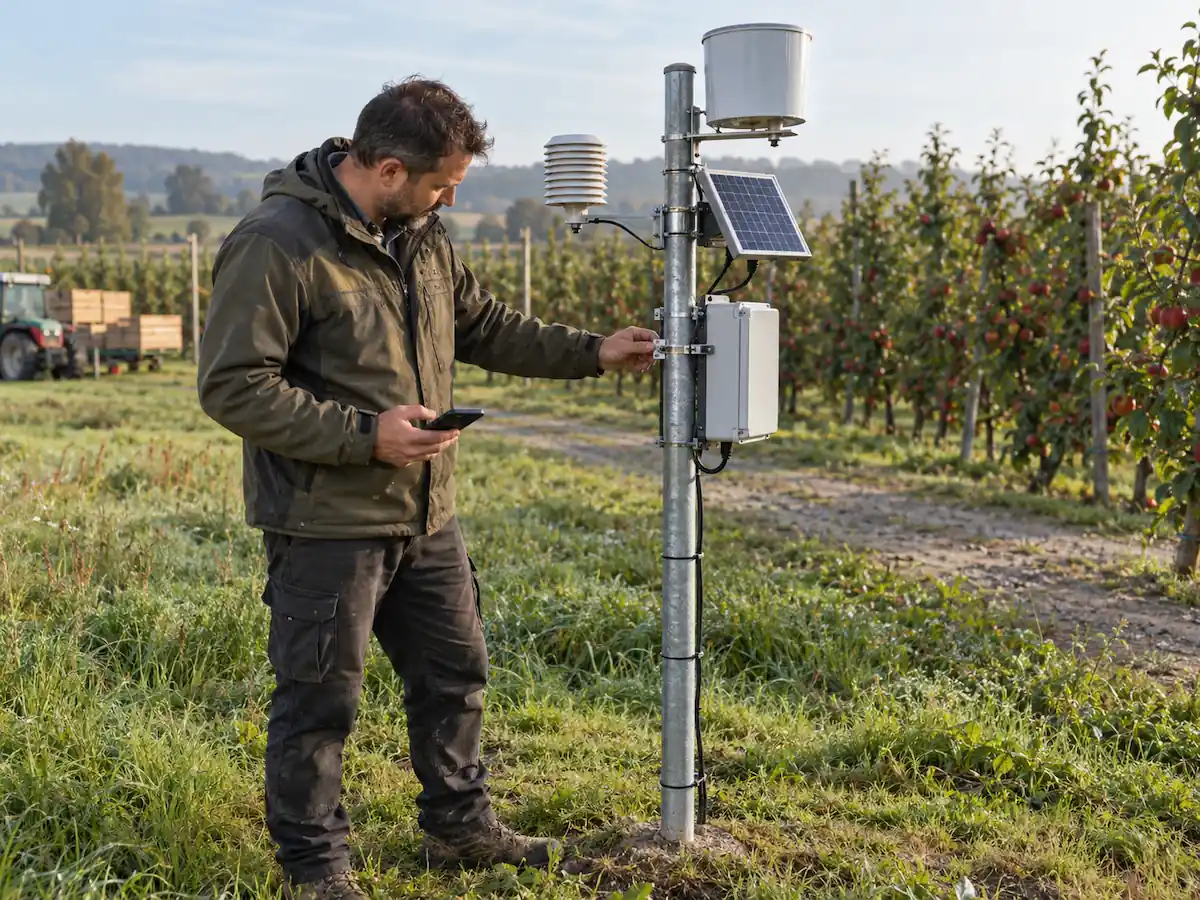
- Local weather data – not regional forecasts, but measurements from weather stations located directly at or near the crop.
- The history of problems on a given plantation: diseases, frosts, nutrient deficiencies, soil moisture problems, wildlife or hail damage.
- Tools for remote analysis and fast delivery of recommendations directly to the farmer, without the need for phone calls or emails.
- The ability to monitor many farms simultaneously from one place, without a proportional increase in time spent and travel costs.
- Organised access to documentation and historical data, enabling comparison of seasons, analysis of trends and drawing agronomic conclusions from a field's history.
The absence of this data does not mean the advisor does not advise – it simply means they advise on the basis of incomplete information. And that has a direct, measurable impact on the quality and effectiveness of the recommendations they issue.
What a farmer needs
From the farmer's perspective the need is straightforward: they want to know what to do and when, so they do not lose yield and do not spend money on unnecessary treatments. They want a recommendation tailored to their field – not a general model from a crop protection product leaflet. Under economic and climate pressure, this is not a comfort – it is a necessity.
A farmer expects from collaboration with an advisor:
- Fast, practical and clear recommendations – ideally in advance, not after the first symptoms of a problem have already appeared on the crop.
- Answers tailored to a specific field, variety, current growth stage and prevailing weather conditions.
- Easy contact with the advisor, without unnecessary delays – the ability to send a photo from the field and receive a response the same day.
- Decision support under time pressure – when there is a disease risk, frost risk, a spray window or a sudden water stress event.
- Confidence that recommendations are based on data – measurements, forecasting models and the history of the specific field, not solely on intuition or general norms.
- A simple way to send field observations – photos, geolocated notes, symptom descriptions – directly from a smartphone.
- Access to the history of the advisor's recommendations and actions taken, enabling assessment of effectiveness and planning for future seasons.
- Concrete business outcomes: reduced losses, optimised input costs and improved yield quality and volume.
Why data is the key to effective advisory
In intensive agriculture – particularly in fruit and vegetable production – the difference between profit and loss often lies within a margin of a few days, or even a few hours. Crop data is what makes it possible to use that margin well. This is not a metaphor – it is a well-documented agronomic fact.
A review of scientific literature published in the journal Agricultural Systems (Wolfert et al., 2017) found that implementing precision agriculture and data-driven advisory can reduce input costs by 10–20% while simultaneously improving yield quality and uniformity. The effect is particularly pronounced in early disease detection and the optimal timing of crop protection treatments. A key condition for achieving these results is a genuine flow of data between the farm management system and advisory tools.
Data serves several critical functions in agricultural advisory:
- A fact-based decision foundation. An advisor who sees a leaf wetness measurement and last night's temperature makes a different decision than one relying on an assumption or a regional weather forecast.
- Early threat detection. Sensor data and forecasting models make it possible to identify infection risk or water stress before visible symptoms appear on the plants – giving time for proactive action.
- Geographic precision. Data from zones within a single field makes it possible to assess whether a problem affects the whole plantation or only specific areas. This directly influences the scale and cost of intervention.
- Cross-season comparison. Historical data enables comparison of the effectiveness of actions across years, identification of patterns and optimisation of strategy for the next season.
- Documentation and certification. Structured data on treatments, inputs and doses is ready-made material for integrated production audits, GlobalG.A.P. and other quality systems.
- Operational advantage. Whoever sees a problem first can respond first – and incurs lower intervention costs. Data is the foundation of this advantage.
"An advisor without data is like a doctor without test results – they can examine, they can ask questions, but they cannot be certain of the diagnosis. And in agriculture, an uncertain diagnosis costs money." — Agnieszka Kołodziej, independent agricultural advisor, Kujawy region
Remote work as the standard for modern agricultural advisory
Just a few years ago, remote agricultural advisory sounded like a concept from the future. Today, with the availability of IoT sensors (Internet of Things – measurement devices connected to the internet), weather stations, satellite imagery and farm management systems, it has become a real and effective form of work. For the advisor, it means the ability to serve a significantly larger number of farms – without a proportional increase in time spent or travel costs.
An OECD report from 2022 on the digitalisation of agriculture indicates that the digitisation of advisory services can increase an advisor's work efficiency by 40–60%, while simultaneously raising producer satisfaction with the collaboration. The key condition is the availability of a shared data platform on which both parties can work in real time.
Remote agricultural advisory delivers concrete, measurable benefits for both parties:
- The advisor analyses the situation on the plantation without being physically present in the field – system access and current field data are sufficient.
- The time from problem detection to recommendation delivery is reduced from days to hours.
- The farmer can receive support exactly when they need it – the evening before a planned treatment, the morning after a frost, or at the weekend during a phytosanitary alert.
- Real-time consultation of field photos, sensor alerts, weather data and field observations sent by the farmer from the mobile app becomes possible.
- This reduces costs for both parties and radically increases the effectiveness of collaboration – the advisor is available when genuinely needed, not only according to a visit schedule.
Fast response – why timing matters in agriculture
In intensive crops, the speed at which a phytosanitary problem develops can surprise even an experienced producer. Late blight (Phytophthora infestans) can take over a significant part of a plantation within 3–5 days if weather conditions favour infection. Grey mould (Botrytis cinerea) on strawberries, at high humidity and temperatures between 15–25°C, can disqualify an entire batch of produce before harvest. The window for an effective protective treatment is often shorter than the time needed to organise an advisor's visit.
A fast response is critical for several reasons:
- A delay of 24–48 hours when pathogen pressure is rising can trigger a rapid escalation of losses and the need for more costly interventions.
- The effectiveness of crop protection treatments depends on the timing of application, not only on the choice of product and dose.
- When there is frost risk, water stress or a sharp rise in temperature, hours matter – not days.
- The earlier the advisor and farmer respond to a threat signal, the smaller its scale and the lower the cost of intervention – this is a fundamental principle of crop protection economics.
- Under conditions of climate variability, spray windows are becoming increasingly unpredictable, requiring even greater flexibility and readiness for fast action.
A collaboration model based solely on periodic advisor visits is structurally incapable of providing this level of responsiveness. A system that gives the advisor constant visibility into farm data and enables immediate dispatch of a recommendation to the farmer's phone – can.
Continuous crop monitoring – the foundation of proactive advisory
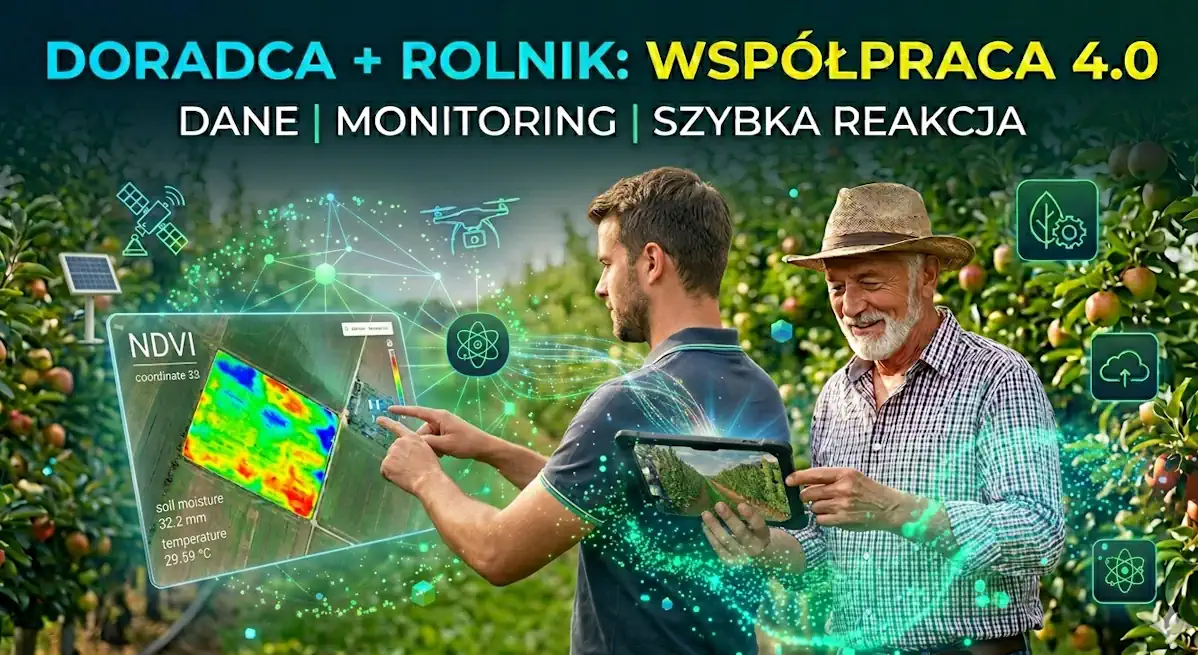
Crop monitoring is not a single soil moisture sensor. It is an integrated observation system combining data from IoT sensors, weather stations, satellite imagery (NDVI and LAI indices – indicators of vegetation health and density) and field observations submitted by the farmer from the mobile app. Such a system makes it possible not only to respond to problems, but to anticipate them – which shifts the nature of advisory from reactive to proactive.
An advisor who sees a trend of increasing water stress a week before it becomes visible to the naked eye can plan irrigation in advance and avoid yield losses. An advisor who analyses ground-level temperature trends and identifies radiation frost risk for the coming night can send an alert to the farmer that evening – not the next morning when the damage is already done. This is not the agronomy of the future – it is a standard that is available today.
Regular crop monitoring makes it possible to:
- Detect the first signs of threats before symptoms appear on the plants – sometimes several days earlier than visual observation would allow.
- Observe trends over time, rather than reacting solely to isolated, individual events.
- Plan treatments, irrigation, fertilisation and protection based on real data, not a fixed schedule set at the beginning of the season.
- Compare zones within a single field – particularly important on large plantations with heterogeneous soils or varied microtopography.
- Increase control over the entire production process and reduce the risk of missing important signals, especially on fields distant from the farm's headquarters.
Benefits for each stakeholder group
Farmers and fruit and vegetable producers
Producers who work with an advisor in a data-driven model gain above all confidence in their decisions. Instead of acting on intuition or habit, they have a concrete recommendation tailored to their field and current situation. This article answers the questions: how to demand more than general advice from an advisor, what tools are needed and what can realistically be expected from data-based advisory.
- Reduction of losses caused by diseases and pests thanks to earlier detection.
- Optimisation of input use – fewer unnecessary treatments, less fertiliser applied to fields that do not need it at a given moment.
- Higher yield quality and uniformity, which translates into a better purchase price or the ability to obtain certification.
- Ready production documentation required by processors, retail chains and quality systems.
Agricultural advisors
An advisor who uses digital tools can serve more farms more effectively and build a position as a data-backed expert. This article shows which tools enable high-quality remote advisory and how to structure work with many farms simultaneously without compromising the quality of recommendations.
- Shorter time from problem detection to recommendation delivery.
- Planning field visits only where they are genuinely needed.
- A CRM system for managing farm relationships and advisory history.
- Tools for fertilisation calculations and soil sampling planning directly within the app.
Fruit and vegetable processors
For processors, predictability of supply and uniformity of raw material are critical. Access to production data from suppliers enables better planning of purchasing and processing schedules. This article explains how to gain visibility into supplier data through the FoodPass platform and what that means for quality and risk management.
- Visibility into the history of treatments and crop protection products used by suppliers.
- Ability to document compliance with GlobalG.A.P., BRC or IFS standards without additional audit expenditure.
- Earlier forecasting of harvest volume and timing based on monitoring data.
Fruit and vegetable distributors
Distributors and trading companies need confidence that goods come from a verified producer who complies with standards. This article shows how documentation from a farm management system builds supply chain transparency and shortens supplier verification time.
- Access to documented production history as a commercial argument and a risk management tool.
- Faster supplier verification without costly physical audits.
- Stronger negotiating position with retail chains thanks to certified documentation.
How FarmPortal supports advisor–farmer collaboration
FarmPortal is a Farm Management System (FMS) that enables farmer-controlled collaboration with an agricultural advisor, processor or any other external party. The advisor receives access only to the data and features that the farmer chooses to share – and that access can be revoked at any time. The data belongs to the farmer. Always.
Through FarmPortal, the advisor gains access to selected information in the FoodPass application – a dedicated tool for agricultural advisors, advisory firms and quality controllers. This allows them to monitor crops on many farms simultaneously, provide remote advice, plan visits and inspections – all in one place, without the need for multiple independent systems.
The scope of data and features available to the advisor (controlled by the farmer) includes the following:
- Location of the farm, fields and crops with GPS position and TERYT number. The advisor can navigate precisely to a specific crop and see its position relative to other fields on the farm. This eliminates location misunderstandings and shortens travel time during field visits.
- Sowing history, crop rotation and current crops. Multi-year crop data for a given field allows the advisor to take into account its phytosanitary history and potential risks arising from previous seasons – something that is impossible in a model based solely on visit notes.
- Completed field and crop treatments, including input quantities and machinery used. The advisor sees what was done, when, which inputs were applied and at what rates. This is the foundation for precise recommendations and for avoiding pre-harvest interval breaches or overlapping active substance effects.
- Fertilisation calculations. The advisor can perform fertilisation calculations for the farmer directly in the system, indicating which fertilisers to purchase and at what rates to apply them. This is particularly valuable for optimising fertilisation costs and meeting the requirements of agri-environment schemes or conditionality rules.
- Planning soil sampling and delivering results to the system. The advisor can schedule soil sample collection and enter analysis results directly into FarmPortal, so that they form the basis for detailed, multi-year fertilisation plans and agronomic advisory.
- Access to the Crop Assistant – the crop digital twin. The Crop Assistant is a virtual model of a specific plantation, aggregating data from sensors, weather, treatment history and providing the advisor with a complete real-time picture of the situation. It includes a crop cost summary, spray recommendations, irrigation recommendations, a rain radar, greenhouse gas emission data and other production indicators. Read more in the article Crop digital twin.
- Field notes with photos, geolocation and weather history. The farmer sends a field observation directly from the mobile app – with photos, GPS location and the automatically attached weather history from the last few hours. The advisor, combining this with data from the system, can quickly send a recommendation specifying the inputs to be used. This is direct, two-way communication without unnecessary intermediaries or delays.
- File and document exchange. Invoices, laboratory analysis results, PDF recommendations, photos – everything can be shared directly through FarmPortal and FoodPass, without the need for external messaging apps or email.
What an advisor gains through the FoodPass application
FoodPass is a dedicated application for agricultural advisors, advisory firms and quality controllers. It allows the advisor to manage a portfolio of dozens of farms from a single interface, while maintaining full control over the visit plan, work schedule and advisory history.
- Managing, monitoring and supporting production across many farms simultaneously.
- Planning visits and audits, sample collection, route planning and schedule generation.
- A CRM system for agricultural advisors – personal notes, farm list, address and registration data.
- Navigation directly to a specific crop thanks to field geolocation – saves time and eliminates confusion over parcel locations.
- Sending recommendations with a PUSH notification to the farmer's mobile app – no delays, no need to call.
- Analysing soil analysis results and creating fertilisation calculations with recommendations directly for the farmer.
- Carrying out advisory activities on real data, including data from IoT sensors, weather stations, ISO-BUS loggers and GPS locators.
- Documenting compliance with standards and certifying agricultural production.
- Collecting product samples for food safety testing.
Case study: strawberry producer, 42 ha, Grodzisk County
Background
A family horticultural farm in Grodzisk County (Masovian Voivodeship), specialising in the production of dessert strawberries for export to Germany and Scandinavia. Total crop area: 42 ha, including 28 ha under low polythene tunnels. The producer had been working with an independent agricultural advisor for four years, but contact was limited to 2–3 visits per month at peak season and occasional phone calls. Protection decisions were made according to a fixed calendar or only after the first symptoms of disease appeared on the plantation.
In the 2022 season, losses from grey mould (Botrytis cinerea) and powdery mildew together reached 12% of the export-grade yield, and crop protection costs were above the industry average for this class of farm. The producer decided to implement digital farm management tools and modernise the collaboration model with their advisor.
FarmPortal and FoodPass implementation
From the 2023 season, the producer implemented FarmPortal as the main farm management platform. The agricultural advisor received data access within a scope defined by the farmer, using the FoodPass application. A weather station was installed on the farm with sensors for leaf wetness, soil moisture, soil temperature and air temperature at ground level. Weekly satellite crop monitoring was also introduced, with NDVI index updates for individual field blocks. The farmer began sending field photos through the FarmPortal mobile app, and the advisor responded with recommendations within a few hours of receiving the observation.
Results after one season
Table 1. Comparison of key indicators before and after FarmPortal implementation (2022 vs 2023 season), strawberry farm, 42 ha, Grodzisk County (Masovian Voivodeship). Source: farm's own data, FarmPortal – Agri Solutions analysis.
| Indicator | 2022 season (before implementation) | 2023 season (after implementation) | Change |
|---|---|---|---|
| Losses from fungal diseases (% of export-grade yield) | 12% | 5% | −58% |
| Number of fungicide applications per season | 11 | 8 | −27% |
| Crop protection cost per hectare | PLN 1,840 | PLN 1,390 | −24% |
| Average advisor response time (signal to recommendation) | 36–48 h | 3–6 h | −88% |
| Number of advisor field visits per season | 18 | 8 | −56% |
| Documented treatments (% of all applications) | approx. 40% | 100% | +150% |
| Estimated system ROI | approx. 4.1 : 1 in the first season | — | |
Conclusions
The key change was the shift from a reactive to a proactive model. Thanks to weather station alerts and Botrytis cinerea infection models, the advisor was able to issue a recommendation 18–24 hours before the optimal infection window – not after infection had already occurred. The reduction in the number of treatments alongside a decrease in yield losses is a direct result of precision and correct timing, not greater input use. Total estimated savings and gains from loss reduction in the 2023 season amounted to approximately PLN 90,500, against an annual system, sensor and licence cost of approximately PLN 22,000.
"Before, the advisor would come, look at the field and say it looked fine. Now they see the same thing I see – and they see it earlier. In July I received a recommendation an hour before a storm that would have favoured infection. That would not have been possible without real-time data." — Mariusz Krawczyk, strawberry producer, 42 ha, Grodzisk County
FarmPortal user testimonials
"I run an apple orchard covering 85 hectares. For years, working with an advisor meant they would come, take a look and write a recommendation – until the next visit they had no idea what was happening on the farm. Since I started using FarmPortal, my advisor sees live data from our weather station, soil analysis results and the history of all treatments. I received my first recommendation at 6 in the morning, before I stepped out onto the farm – it concerned a risk of apple scab detected by the model the day before. I finished the season with two fewer fungicide applications than the year before and lower losses. The numbers speak for themselves: −18% in crop protection costs and a 7 percentage point increase in the share of Class I apples."Tomasz Burczyński, organic apple producer, 85 ha, Lower Silesia. Key results: −2 fungicide applications per season, −18% crop protection costs, +7 pp share of Class I apples.
"I work with 38 farms, most of them fruit and vegetable producers in the Kujawy region. Before FoodPass, my day looked like this: phone calls, emails, handwritten notes from visits and a huge amount of time lost on logistics. Now I have all my farms in one place, I can see what is happening at each producer's farm and send a recommendation in a matter of minutes – and the farmer receives it immediately on their phone. Instead of driving everywhere, I focus on the farms that genuinely need a visit. Over the course of a year I took on 12 new clients without increasing my working hours, and the time I spent travelling fell by over 40%."Agnieszka Kołodziej, independent agricultural advisor, 38 farms under management, Kujawy region. Key results: +12 new farms without increasing working hours, −40% time spent travelling.
Traditional vs digital agricultural advisory – comparison
The table below compares the traditional advisory model with the digital model based on tools such as FarmPortal and FoodPass. The differences concern not only technology, but above all the practical agronomic and economic outcomes for both parties.
Table 2. Comparison of traditional and digital agricultural advisory models. Source: FarmPortal – Agri Solutions, own analysis, 2025.
| Aspect | Traditional advisory | Digital advisory (FarmPortal + FoodPass) |
|---|---|---|
| Frequency of advisor–farmer contact | 1–2 field visits per month | Permanent remote access, contact as needed |
| Advisor response time | 24–72 hours | 1–6 hours |
| Basis for recommendations issued | Visual observation during field visit | Sensor data, weather, treatment history and field observations |
| Number of farms effectively managed | 10–15 | 30–50+ |
| Production documentation | Partial, paper-based or spreadsheets | Complete, digital, automatic |
| Precision of recommendations | General – for the crop or region | Field-level – for a specific location and current conditions |
| Cost of advisory for the farmer | Higher (visit cost + waiting time for response) | Lower (fewer visits, higher advisory value) |
| Audit and certification readiness | Difficult to ensure, requires additional documentation | Automatic documentation, data audit-ready at any time |
| Farmer–advisor communication | Phone, email, visit – unsynchronised | Integrated system: field note → recommendation → PUSH notification |
Effective advisor–farmer collaboration checklist
The list below allows you to quickly assess whether the current collaboration between a farmer and advisor meets the conditions of a modern, effective model. It can serve as a starting point for a conversation about improving the relationship, or as a criterion for choosing an advisor or working tool.
Data and access foundation
- ☐ The advisor has access to current field data, not only data from the last visit.
- ☐ Both parties use a shared data platform – not separate spreadsheets and notes.
- ☐ The advisor knows the sowing history, treatment history and fertilisation for every field on the farm.
- ☐ Soil analysis results are available to the advisor and are current (no more than 3–4 years old).
- ☐ Local weather data from the crop's location is available, not only regional forecasts.
Communication and recommendations
- ☐ The advisor is able to send a recommendation within a few hours of detecting a threat.
- ☐ The farmer has a simple way to send a field photo and receive a response the same day.
- ☐ Recommendations are archived and linked to a specific field and date.
- ☐ The farmer receives a notification of a new recommendation without having to actively check the system.
Monitoring and response
- ☐ Crops are monitored continuously, not only during advisor visits.
- ☐ The system generates alerts when thresholds for disease risk, ground temperature or leaf wetness are exceeded.
- ☐ The irrigation, fertilisation and protection plan is updated continuously based on data, not fixed once at the start of the season.
Documentation and analysis
- ☐ All treatments are recorded in a digital system on the day they are carried out.
- ☐ It is possible to compare the effectiveness of actions across seasons.
- ☐ Documentation meets certification requirements (GlobalG.A.P., integrated production, processor standards).
- ☐ The farmer has permanent access to the history of the advisor's recommendations and actions taken.
Summary
Effective collaboration between an agricultural advisor and a farmer is not a question of good intentions or visit frequency. It is a question of the right tools and a working model built on data that is available in real time to both parties. Without constant access to up-to-date field data, without the possibility of remote analysis and without a system for fast delivery of recommendations, even the best advisor operates with limited effectiveness – and both sides pay for that, agronomically and financially.
Modern agricultural advisory rests on three pillars: constant access to data, remote crop monitoring and fast, documented communication. FarmPortal and FoodPass are designed to bring these three pillars together in one coherent ecosystem – while keeping the farmer in full control of their farm data and giving flexibility in defining the scope of collaboration.
In a single sentence: the farmer delivers current information from the field, the advisor analyses it and quickly translates it into concrete recommendations, and the whole process rests on continuous monitoring, remote collaboration and response at the right moment. In intensive agriculture – particularly in fruit and vegetable production – this is not a luxury. It is a necessity.
To find out how FarmPortal can support your farm's collaboration with an agricultural advisor, see the full list of features at farmportal.eu/functions.
Frequently asked questions
- How often should an agricultural advisor be in contact with a farmer?
- In a modern advisory model, contact should not be limited to a few field visits per season. Ideally, the advisor has permanent remote access to farm data and responds in real time – particularly when threats are detected, a spray window opens or there is a frost risk. Physical visits may be less frequent, but advisory support should cover the entire season, from planning to evaluating results after harvest.
- What data should a farmer share with their agricultural advisor?
- The advisor should have access to the sowing history and crop rotation, data on completed treatments and fertilisation, soil analysis results, current field observations (photos, notes), local weather data and information on varieties and sowing dates. In FarmPortal, the farmer independently decides which data to share and to what extent – and can revoke access at any time.
- How quickly can an advisor respond to a problem on my field?
- In the traditional model, response time is 24–72 hours. In the digital model, based on FarmPortal and FoodPass, the advisor can send a recommendation within 1–6 hours of detecting a threat – remotely, without a field visit. For critical threats such as infection risk under favourable weather conditions or a forecast frost, this response time can determine the scale of losses.
- Can an agricultural advisor advise remotely without field visits?
- Yes – with FarmPortal and FoodPass, the advisor can remotely monitor crops on many farms simultaneously. They have access to satellite imagery, IoT sensor data, weather stations and ISO-BUS loggers. Field visits become a complement to remote monitoring, not the only form of contact.
- Can a fruit and vegetable processor or distributor access my farm's production data?
- Yes, but only with your consent. Through the FoodPass app, a processor or distributor can monitor production quality and progress, track the history of treatments and fertilisation, and document compliance with quality standards. You, as the farmer, decide who can access your data and to what extent – and you can revoke that access at any moment.
- How many farms can an advisor manage simultaneously using FoodPass?
- In the traditional model, an advisor can effectively manage 10–15 farms. With FoodPass and remote data access, professional management of 30–50 or more farms is possible while maintaining high advisory quality. Field visits are scheduled where they are genuinely needed – not according to a fixed timetable.
- Is my farm data in FarmPortal secure?
- Data in FarmPortal belongs to the farmer. FarmPortal, developed by Agri Solutions, complies with GDPR and data protection standards applicable in the European Union. You decide who receives access and to what extent. Access can be revoked at any time.
Glossary
- FMS (Farm Management System)
- Software integrating production, financial, agrotechnical and environmental data in one place. FarmPortal is an example of an FMS tailored to Polish and European agricultural production conditions, with the ability to integrate with IoT sensors, weather stations and farm machinery.
- FoodPass
- A dedicated application for agricultural advisors, certification firms and processors. It enables remote monitoring of production across many farms simultaneously, visit planning, recommendation delivery and documentation of compliance with quality standards. The advisor uses FoodPass; the farmer uses the FarmPortal app – both platforms are integrated with each other.
- Crop digital twin
- A virtual model of a specific crop or plantation, built on the basis of real data from sensors, weather records, treatment history and satellite imagery. It enables forecasting of crop behaviour under different conditions and supports agronomic and business decisions. In FarmPortal this function is fulfilled by the Crop Assistant.
- NDVI (Normalized Difference Vegetation Index)
- A measure of vegetation health calculated from satellite or aerial imagery, using the near-infrared and red spectral bands. NDVI values allow assessment of crop condition, detection of weakened or water-stressed zones and monitoring of growth dynamics without the need to enter the field.
- IoT sensor (Internet of Things)
- An internet-connected measurement device that collects data in real time. In agriculture, IoT sensors can measure soil moisture, air and soil temperature, leaf wetness, solar radiation intensity, wind speed or CO₂ concentration in enclosed spaces. Sensor data flows automatically into the FarmPortal system.
- ISO-BUS logger
- A device that records data from agricultural machinery equipped with a CAN-bus interface compliant with the ISO 11783 (ISOBUS) standard. It enables automatic logging of machine operating parameters – spray rates, working speed, GPS position – and their direct transfer to the farm management system without manual data entry.
- Integrated production (IP)
- A system of agricultural production recognised under Polish law, based on combining biological, chemical and agrotechnical methods in a sustainable way, with a preference for non-chemical approaches. It requires detailed documentation of inputs and cultivation methods used. FarmPortal supports complete production documentation for IP certification and compliance with buyer quality system requirements.
- Crop rotation
- A planned sequence of crops grown on the same field in successive years or seasons. Proper crop rotation reduces disease and pest pressure, improves soil structure and reduces fertiliser requirements. Crop rotation history is a key piece of information for the advisor when assessing phytosanitary risk and planning fertilisation.
- Pre-harvest interval (PHI)
- The minimum period that must elapse between the last application of a crop protection product and harvest of produce intended for human consumption or sale. Breaching the pre-harvest interval results in product disqualification and may give rise to legal liability for the producer. FarmPortal automatically records treatment dates and products applied, enabling compliance monitoring.
References
- European Court of Auditors (2021). Farm advisory services in the EU: there are no mechanisms to ensure their effectiveness and value for money. Special Report No 13/2021. Luxembourg: ECA. ISSN 1977-5768.
- Wolfert, S., Ge, L., Verdouw, C., & Bogaardt, M.-J. (2017). Big Data in Smart Farming – A review. Agricultural Systems, 153, pp. 69–80. doi.org/10.1016/j.agsy.2017.01.023
- Klerkx, L., Jakku, E., & Labarthe, P. (2019). A review of social science on digital agriculture, smart farming and agriculture 4.0: New contributions and a future research agenda. NJAS – Wageningen Journal of Life Sciences, 90–91, article 100315.
Follow us!
See what we're doing and be inspired by positive changes.