In brief
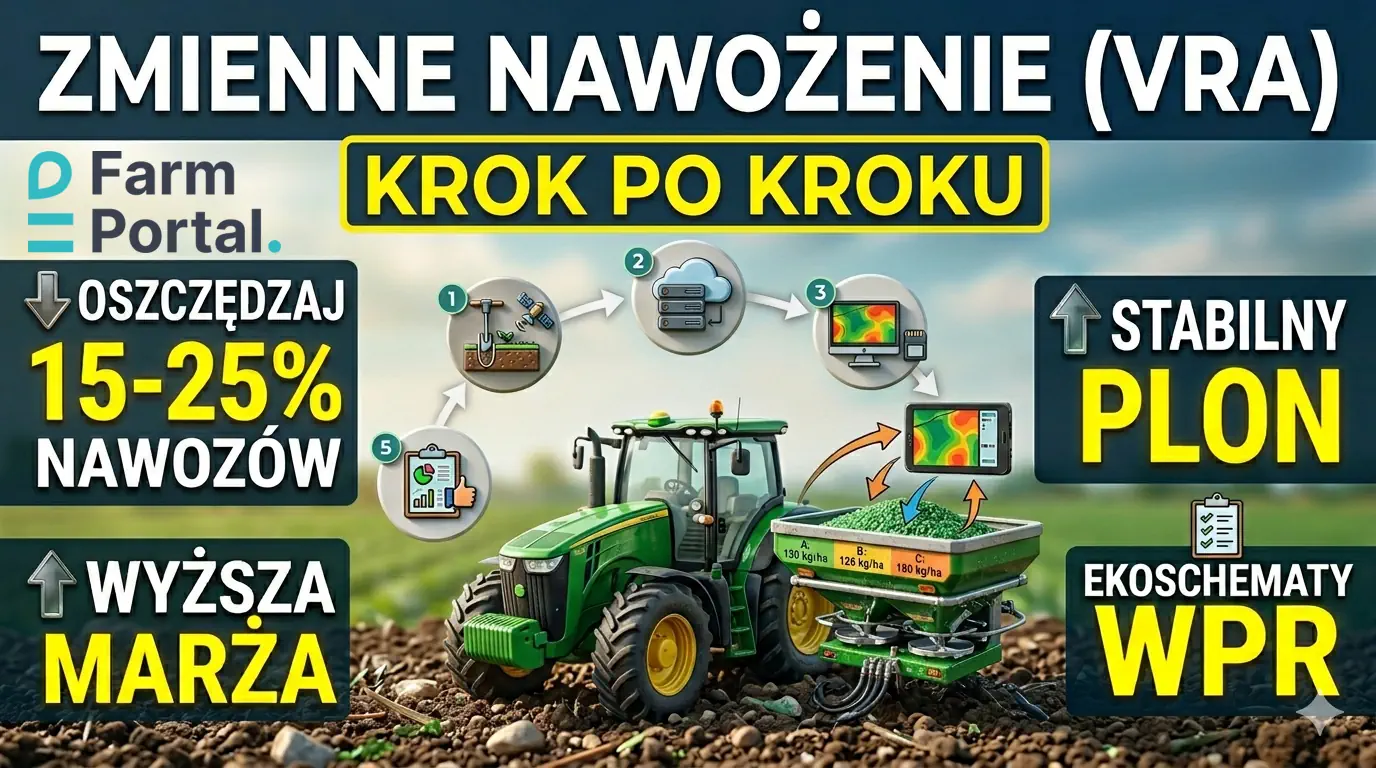
Variable Rate Application (VRA) is a precision agriculture method that adjusts the fertilizer rate to the current soil nutrient status and crop needs at every point of the field – instead of applying a single average rate per hectare. The technology allows fertilizer costs to be reduced by 10–25%, lowers the risk of nitrate contamination of water and helps document the environmental practices required by CAP agri-environment schemes. According to USDA data from 2023, as many as 45% of large farms worldwide already use VRT. Adoption is accelerating globally – 80% of fields are over-fertilized with potassium and phosphorus (soil laboratory data), meaning the savings potential is immediate and measurable.
1. What is Variable Rate Application (VRA) and why it matters
Variable Rate Application, or VRA, is a method of applying fertilizers used in precision agriculture in which the rate is not fixed across the entire field but changes according to local soil properties and crop condition. In practice this means the spreader automatically increases or decreases its output with every GPS position update – with a precision ranging from a few tens of centimetres to several metres depending on the technology used.
Traditional "per-hectare" fertilization is based on calculating an average rate for the whole field and applying it uniformly everywhere. This approach is convenient but agronomically inefficient. A 50 ha field can have phosphorus availability varying from Class A (very low) to Class D (high) within just 200 metres. A single average rate in such a case means one thing: over-fertilizing the good soil and under-feeding the poor areas – simultaneously.

The scale of the problem is well documented. According to soil analytical laboratory data, as many as 80% of arable fields show excessive potassium and phosphorus levels. At the same time, those very fields contain areas where these nutrients are deficient. Applying a uniform P/K rate causes financial losses where fertilizer is unnecessary and production losses where it is insufficient.
Globally, VRA technology is gaining traction driven both by rising fertilizer prices and by environmental regulations. According to USDA research from 2023, VRT adoption among large farms in the USA exceeded 45%. For small farms the figure is 5%, and for medium-sized farms – 32%.
2. Who this article is for – benefits by audience
Farmers and farm managers
This article answers how much you can realistically save, when the investment pays back and how to get started – without buying expensive equipment upfront. You will find calculations, break-even thresholds and a concrete case study from a working farm.
Agricultural advisers and agronomists
Sections on balance models, prescription map algorithms, management zones and calibration provide knowledge you can translate directly into recommendations for clients. The article also describes the typical data-quality pitfalls.
Fruit and vegetable processors
Variable rate application leads to predictable and consistent raw material quality – lower variability in nitrogen content, sugar level or acidity. The section on environment and regulations explains how VRA data fits into traceability systems and sustainability reports that are becoming a supply chain requirement.
Fertilizer distributors and equipment manufacturers
Understanding the mechanics of VRA helps you match products and services to customer needs. The section on equipment and ISOBUS, together with the comparison of sensor-based and map-based approaches, provides the foundation for informed technical advice.
3. Agronomic principles: soil variability within a single field
Before we look at the technology, it is worth appreciating the scale of natural soil variability. Scientific research from many countries shows that the difference in plant-available phosphorus between two samples taken 50 metres apart on the same field is often 30–80 mg P per 100 g of soil – the difference between the lowest and highest fertility class in standard methodologies. Similar variability applies to pH, potassium, magnesium and organic matter.
The causes are numerous: differences in soil texture and particle size, decades of fertilization history, topography that redistributes water and nutrients through erosion, and soil displacement during drainage work. These factors create distinctive nutrient "patches" clearly visible on soil maps.
The concept of management zones
A management zone is an area of the field with similar soil properties and yield potential, to which a single optimal fertilizer rate is applied. There are three main approaches to defining management zones:
- Sampling grid – regular sampling every 1–2 ha and geostatistical interpolation of results. High cost but high accuracy for P/K.
- Remote sensing approach – clustering NDVI map pixels from several years into homogeneous groups. Fast and cheap but susceptible to errors caused by year-to-year weather variation.
- Hybrid approach – combining soil electrical conductivity (EC) with NDVI data and yield history. Considered the most reliable.
Crop response to nutrient deficiency and excess
Crops respond to nutrient deficiency with yield reduction – this relationship follows a plateau curve: below the minimum yield drops sharply; above the optimum every additional unit of fertilizer produces a diminishing return until the economic break-even point is reached. Nitrogen is particularly sensitive: it has high soil mobility (leaching), so its optimal rate is strongly dependent on annual conditions.
Excess nutrients – especially nitrogen – cause excessive tillering in cereals, lodging, higher risk of fungal disease and a lower number of grains per ear. Excess potassium blocks the uptake of magnesium and calcium, reducing crop quality.
4. Technology and inputs: soil maps, NDVI, sensors
Soil nutrient maps – how to create and interpret them
The soil nutrient map is the fundamental document for VRA fertilization. It is created from the analysis of soil samples taken on a regular grid or within defined zones. Samples go to an accredited laboratory, where they are analysed for pH, P, K, Mg and – optionally – micronutrients, organic matter and mineral nitrogen (Nmin). The data, combined with the GPS coordinates of each sampling point, is interpolated into a continuous map using methods such as Kriging (a geostatistical interpolation technique that accounts for spatial correlations between samples).
Sampling density is critical to map accuracy. The minimum recommended density is one sample per 2–4 ha. On fields with high variability (light and heavy soils within the same area), one sample per hectare or even denser sampling is advisable.
Remote sensing and vegetation indices as inputs for prescription maps
Vegetation indices calculated from satellite or aerial imagery allow rapid, low-cost assessment of crop condition at every square metre of the field. The most important are:
| Index | Formula | Application in VRA | Limitations |
|---|---|---|---|
| NDVI | (NIR – RED) / (NIR + RED) | General crop condition, biomass; N rate maps early in the season | Saturation at dense canopy (LAI > 3) |
| NDRE | (NIR – RedEdge) / (NIR + RedEdge) | Nitrogen nutrition assessment mid-season; less prone to saturation | Requires satellite/drone with red-edge band (e.g. Sentinel-2) |
| RECI | (NIR / RedEdge) – 1 | Precise N rate corrections; very sensitive to chlorophyll changes | As above |
| MSAVI | Modified NDVI correcting for soil background | Early growth stages when soil cover is low | More complex calculation |
Source: authors' own compilation based on literature and FarmPortal documentation.
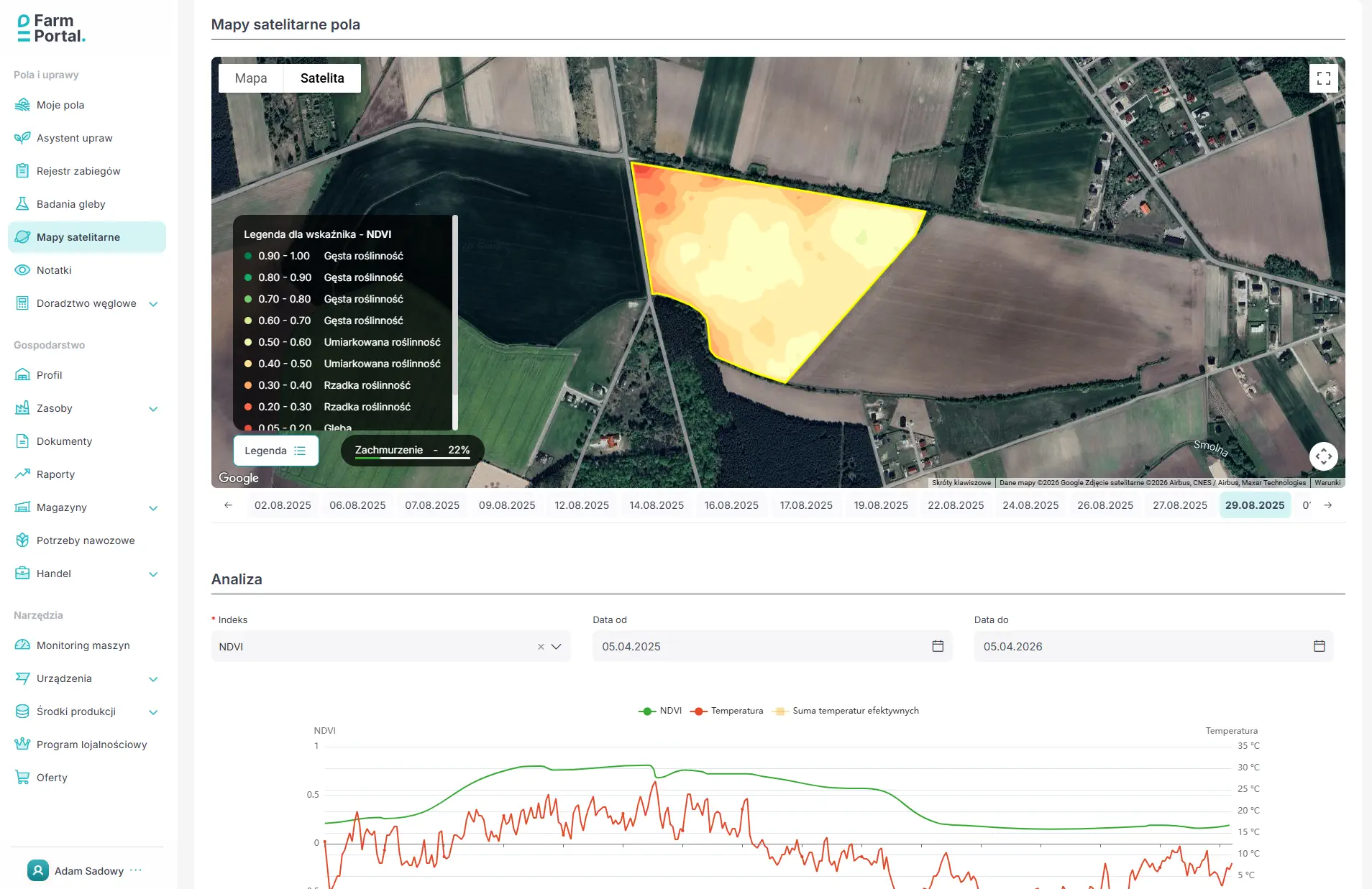
More on the practical use of vegetation indices in precision fertilization can be found in the article Vegetation indices and variable rate application in FarmPortal.
Historical yield data (yield maps) as an analytical layer
Yield maps collected by combine harvesters equipped with mass sensors and GPS show where the field yields well and where it does not – year after year. Several years of yield history integrated with soil data gives an extremely precise picture of the productive potential of each part of the field. This is one of the most valuable datasets for creating management zones, because it reflects the net effect of all environmental and soil factors.
On-the-go optical sensors: N-Sensor, Yara N-Tester, Crop Sensor
Optical sensors are another entry point into VRA – instead of a pre-prepared map, they measure crop condition in real time without the need to commission soil tests. The Yara N-Sensor, Claas Crop Sensor and similar devices scan plants in visible and near-infrared light at up to 2,000 readings per second, calculate a biomass and nitrogen nutrition index, and immediately adjust the spreader rate. Research and field tests show that sensors of this type reduce nitrogen fertilizer use by 3–10% while maintaining or improving crop parameters.
5. Equipment and field execution: spreaders, ISOBUS, ISOXML
The precision of VRA planning is wasted if the machine cannot execute the prescription map with adequate accuracy. The equipment dimension is therefore an inseparable part of the variable rate system.
Spreaders with section control and variable rate
Modern disc fertilizer spreaders (Amazone, Kuhn, Horsch, Kverneland and others) offer two levels of VRA integration. The basic level is changing the overall fertilizer output (by controlling drive shaft speed or hydraulic motor) based on the prescription map. The advanced level is independent control of the left and right discs, enabling boundary correction at the field edge and elimination of double application.
A key parameter is the response time of the rate control system. At a working speed of 12 km/h with a 5 m × 5 m map resolution, the machine must change its output within approximately 1.5 seconds. Modern spreaders achieve response times of 0.5–1 s, which in practice means a spatial error of less than one working width.
The role of ISOBUS and ISOXML in transferring prescription maps
ISOBUS (ISO 11783) is the standard digital communication protocol between a tractor and an agricultural machine. It allows a prescription map prepared in FMS software (such as FarmPortal) to be saved in ISO-XML format and sent directly to the spreader controller via the ISOBUS connection or an SD card, without manually re-entering data. The ISOBUS terminal displays the prescription map on screen and automatically advances the cursor as the machine moves across the field, adjusting the rate in each zone. A detailed guide to connecting your machine to the system is available in the article FarmPortal as a farm ERP system – machinery integrations.
Alternatively, SHP (Shapefile) format or manufacturer-proprietary formats (e.g. John Deere Shape, CNH ISOXML) are used. FarmPortal exports prescription maps in ISO-XML and SHP formats compatible with leading machine brands.
Execution precision vs. planning precision – where errors occur
Even a perfect prescription map can be poorly executed. The most common causes of discrepancy between the plan and the outcome are: insufficient soil sampling density, GPS errors during the application (RTK or SBAS accuracy is sufficient), spreader response lag, fertilizer caking in the hopper and uneven granule size distribution. The last cause is often underestimated – modern AI that recognizes fertilizer type and corrects granule trajectory is the industry's answer to this problem.
6. Rate planning: balance models, algorithms, calibration
Balance models vs. statistical models
A balance model is an agronomic approach in which the fertilizer rate is calculated as the difference between the crop's nutrient requirement (based on the target yield and nutrient content per unit of yield) and the amount of nutrient available in the soil. This approach requires accurate input data but is transparent and straightforward to verify with an agronomist.
Statistical and machine learning models analyse historical relationships between rate and yield on a given field or in a given region to predict the optimal rate at a specific location. They are particularly effective where historical data is rich (multi-year yield maps, multi-year soil test results) and conditions are repeatable. Their weakness is the difficulty of interpretation and sensitivity to the quality of historical data – input errors amplify proportionally on the output (the garbage in, garbage out principle).
Algorithms for creating prescription maps
In practice, prescription maps are most commonly created in three steps. First, data from soil tests or vegetation indices is interpolated onto a spatial grid using Kriging, IDW (Inverse Distance Weighting) or other geostatistical methods. The balance model results are then overlaid, assigning the calculated rate to each grid cell. Finally, the map is exported to the format supported by the machine.
Calibrating the model to local conditions
Calibration is crucial: conversion factors from national fertilization tables (issued by national agricultural research institutes) should be verified with data from your own field. Nitrogen recommendations in particular are sensitive to climate, variety and year. A good practice is to maintain several "control strips" each season with a fixed rate, which allow the effectiveness of the variable approach to be assessed and the model to be calibrated for the following year.
7. Economics of VRA: ROI calculation and break-even thresholds
The farmer's most common question is simple: does it pay? The answer depends on several variables, the most important of which are field variability, fertilizer price and farm area.
Typical cost and saving components
| Item | Cost / Saving (€/ha/year) | Notes |
|---|---|---|
| Soil tests (once every 4 years) | 7–10 (amortized) | 200 samples × €15 / 4 years / 200 ha |
| FMS software with VRA (subscription) | 4–8 | depending on platform |
| Spreader adaptation / GPS terminal | 3–6 (amortized over 5 years) | one-off investment €1,500–6,000 |
| Total implementation costs | 14–24 | |
| Fertilizer savings on P/K (over-fertilized field) | 25–65 | 15–25% rate reduction at typical P/K prices |
| Yield gain from eliminating deficiencies | 20–50 | 0.1–0.3 t/ha × market price per tonne of grain |
| Total benefits | 45–115 | |
| Net ROI (Year 1) | €20–90/ha | after deducting costs |
Source: authors' own calculations based on 2024/2025 fertilizer prices and scientific literature. Indicative values – results depend on the variability of the specific field.
Break-even thresholds by field variability
Scientific research published in Precision Agriculture (Springer, 2022) on winter wheat in Córdoba, Spain, showed that at standard grain and fertilizer prices the minimum area from which VRA becomes economically advantageous is approximately 567 ha/year. However, with rising fertilizer and energy prices the threshold falls to 68–177 ha/year. With agri-environment scheme payments it can fall to as little as 46 ha.
In practical farm conditions (variable fertilizer costs, agri-environment schemes, strong soil variability on mixed-texture soils) the return on VRA for P/K is visible from around 100–150 ha, provided the field has documented high nutrient variability. On-the-go nitrogen sensing (without maps – a simple sensor system) pays back faster, because the sensor cost is spread across many applications.
"Variable rate is not a gadget – it is a cost management tool. When urea prices exceed a certain level, every unit of fertilizer saved where it is genuinely not needed is a unit of margin saved. On one 80 ha field we had a zone where phosphorus was twice the optimum, and a zone where it was 30% deficient." — Krzysztof Śliwański, farmer, 350 ha, Greater Poland region, FarmPortal user
Yield effect – does VRA always increase yield or does it optimize margin?
Both effects are possible and do not necessarily exclude each other. In zones with a historical nutrient deficiency (e.g. acidic soil at pH 5.2 or very low phosphorus availability) VRA increases yield by supplying the limiting nutrient. In over-fertilized zones the effect is cost reduction without yield loss. Overall, research shows that precision fertilization – when accounting for large variability in texture and organic matter – leads to higher yields, better agronomic efficiency and higher margins compared with uniform nitrogen application (ScienceDirect, 2024).
8. Environment and regulations: N₂O, Nitrates Directive, agri-environment schemes
Reducing N₂O emissions
Nitrous oxide (N₂O) is a greenhouse gas with a global warming potential 265 times higher than CO₂ over a 100-year horizon. Most agricultural N₂O emissions originate from denitrification of fertilizer nitrogen in wet soils. Precision application – supplying nitrogen exactly where and when crops need it – limits the nitrogen available to denitrifying bacteria, which directly translates into lower emissions. Meta-analyses indicate that VRA can reduce N₂O emissions by 10–30% compared with uniform fertilization at the same total nitrogen rate.
Reducing nitrate leaching
Excess mineral nitrogen in the soil, particularly in the form of nitrates (NO₃⁻), is leached by rainfall into groundwater and surface water. By restricting nitrogen application in areas where the soil is already nutrient-rich or where yield potential is low, VRA reduces "surplus nitrogen" and thereby lowers the risk of nitrate concentrations exceeding permissible levels in groundwater.
The Nitrates Directive and national requirements
The EU Nitrates Directive obliges member states to designate Nitrate Vulnerable Zones and implement action programmes limiting nitrogen losses from agriculture. Farms above 100 ha are typically required to prepare nitrogen fertilization plans. VRA naturally fits these planning requirements – every prescription map is a digital record of precise application.
CAP agri-environment schemes 2023–2027 and carbon footprint
The current Common Agricultural Policy perspective rewards precision fertilization through eco-schemes. Farmers using technologies such as soil nutrient maps and VRA can apply for supplementary payments. In addition, MRV (Measurement, Reporting, Verification) systems required by an increasing number of supply chains and carbon offset programmes directly reward the N₂O emission reductions delivered by precision fertilization.
How FarmPortal supports variable rate application – features and benefits
FarmPortal is a Farm Management System (FMS) developed by Agri Solutions Sp. z o.o. that integrates crop planning, precision fertilization, crop protection and reporting in a single platform. The fertilization calculator in FarmPortal was developed in collaboration with the University of Agriculture in Kraków and implements the balance methodology for both field crops and horticulture.
In the context of variable rate application, FarmPortal offers in particular:
- Soil sampling module – defining sampling sectors and points using a grid or custom boundary; storing digital analytical results (pH, P, K, Mg, micronutrients, Nmin, organic matter).
- Fertilization calculator (nutrient calculations) – precise N, P, K and Ca/Mg rate calculations at grid or zone level, accounting for target yield, previous crop and organic manure applications.
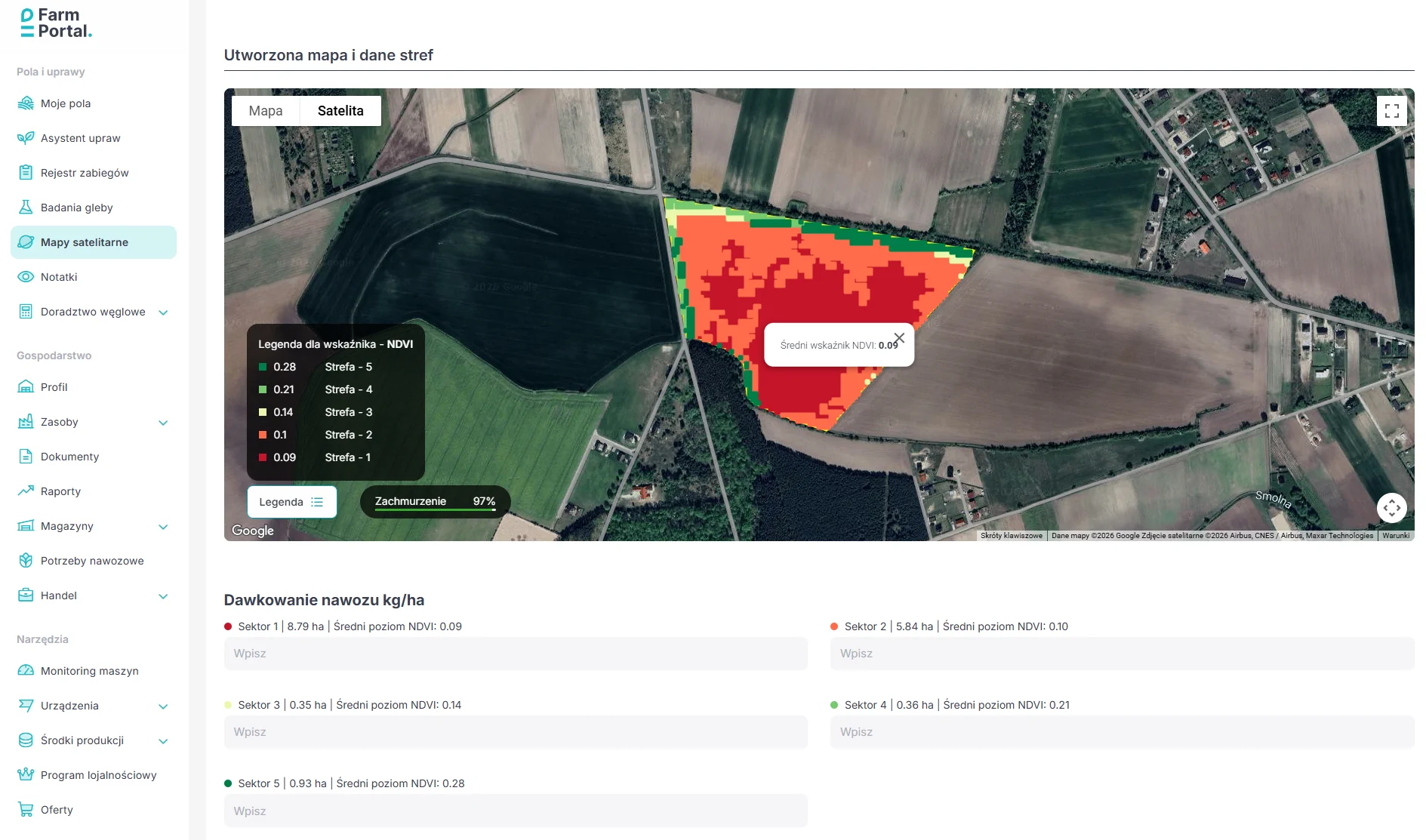
- Vegetation index maps (NDVI, NDRE, RECI, MSAVI) from Sentinel-2 satellite data; automatic generation of variable nitrogen prescription maps based on the NDVI index – without any manual data analysis.
- Prescription map export in ISO-XML and SHP formats compatible with leading machine brands – ready to load into the spreader terminal.
- Environmental reporting – automatic calculation of carbon footprint, water use and nutrient balance for agri-environment scheme compliance and food passport purposes.
For fruit and vegetable processors the system enables full traceability of fertilization history for every field, which is an increasingly common requirement for certification (GlobalG.A.P., Tesco Nurture, Regenagri).
Explore all system features: farmportal.eu/functions | Precision fertilization in FarmPortal | .
📊 Case Study: Zaborówek Farm, 580 ha – winter wheat + winter oilseed rape (Kujawy-Pomerania region, Poland)
Background: A family farm managed by Tomasz Wierzbicki (third generation). Mosaic soils: luvisols, cambisols and sandy soil patches within a single field complex. Historically, uniform fertilization based on a single average rate per field contour. In 2022, following the rise in fertilizer prices, the decision was made to implement VRA. FarmPortal became the planning tool.
Implementation steps:
- Collection of 320 soil samples (1.8 ha grid) and laboratory analysis.
- Import of results into FarmPortal and generation of P, K and pH availability maps for each field.
- Creation of phosphorus and potassium prescription maps using the balance method in the FarmPortal fertilization calculator.
- Export to ISO-XML and loading into the Amazone ZA-M ISOBUS spreader terminal.
- Growing season 2022/2023: first variable-rate applications (potassium and phosphorus in autumn 2022, nitrogen for cereals in spring 2023 using an optical sensor).
Results after 2 seasons (2022/2023 and 2023/2024):
| Nutrient | Uniform rate (before VRA) | VRA rate – nutrient-rich zones (Class D–E) | VRA rate – deficient zones (Class A–B) | Saving in nutrient-rich zones |
|---|---|---|---|---|
| P₂O₅ | 80 kg/ha | 20–30 kg/ha | 110–130 kg/ha | 50–60 kg P₂O₅/ha → approx. €24–29/ha |
| K₂O | 100 kg/ha | 30–40 kg/ha | 140–160 kg/ha | 60–70 kg K₂O/ha → approx. €19–24/ha |
| N (ammonium nitrate 34%) | 160 kg AN/ha (approx. 54 kg N) | 110–130 kg AN/ha (dense crop, sensor) | 180–200 kg AN/ha (thin crop) | 30–50 kg AN/ha → approx. €11–18/ha |
Indicative data based on soil test results and FarmPortal treatment reports. Fertilizer prices for 2023/2024 season: P₂O₅ ≈ €0.48/kg, K₂O ≈ €0.36/kg, ammonium nitrate ≈ €0.37/kg.
Commentary: The largest saving occurred on soils with a history of phosphorus over-fertilization (Class D–E), which made up approximately 38% of the farm area. The P₂O₅ rate was reduced by 50–60 kg/ha – equivalent to saving approximately 120 kg of triple superphosphate (or an equivalent multi-nutrient product) on every hectare of the nutrient-rich zone. At typical triple superphosphate prices this represents €23–28 saved on that single nutrient per hectare of the rich zone.
In zones with phosphorus deficiency (Class A–B, approximately 22% of the area) the rate was increased by 30–50 kg P₂O₅/ha above the previous uniform rate, which translated into noticeably better yields in those areas. The 4.3% average wheat yield gain comes primarily from those zones, where phosphorus was previously the limiting factor for growth. Across the whole farm (580 ha) total fertilizer cost savings amounted to approximately €30,000 per year, with implementation costs (soil tests + FarmPortal + spreader adaptation) amortized over 3 seasons.
Benchmark: For comparison, data from analytical laboratory reports indicates that the average P/K saving with VRA is 12–20% at field scale, which at 2024 P/K fertilizer prices gives €24–48/ha/year from fertilizer purchase reduction alone.
"I was afraid variable rate would be something complicated and expensive. It turned out that loading the map into the spreader through FarmPortal took me ten minutes. And after the first season the environmental auditor from our apple buyer said we had one of the best fertilization records in the region. That was an added benefit I hadn't expected."
— Piotr Walczak, apple and wheat producer, 210 ha, Łódź region, PolandResult after 1 season: –17% nitrogen use in wheat, traceability requirement fulfilled for GlobalG.A.P. certification.
"As an agricultural adviser I work with farms from 80 to 600 ha. VRA pays back on practically all of them – the starting point just differs. On smaller farms I begin with a pH map and variable-rate liming. That is the simplest step and already delivers a visible agronomic effect. Then we move on to P, K and nitrogen. FarmPortal helps me show the farmer a before-and-after map – that is more persuasive than any graph in a presentation."
— Agnieszka Kurek, agricultural adviser, advises 34 farms in the Masovian region, Poland
11. Challenges and barriers to implementation
Variable rate application is not without difficulties. Understanding the barriers lets you prepare for them rather than discover them mid-season.
Cost and complexity of soil data collection
Dense grid sampling (one sample per hectare) on a 300 ha farm costs €4,500–7,500 upfront, plus updating every 3–5 years. Laboratory costs are €15–20 per sample depending on the analysis scope. A cheaper alternative is indirect methods (EC conductivity, electromagnetic scanning EM38), which allow management zones to be defined without full grid coverage and then sampled only within each zone.
Operator competence and system integration
Loading an ISO-XML map into a spreader terminal takes a few minutes for someone who has done it before. For someone without experience it can be an insurmountable barrier without technical support. Operator training and choosing an FMS platform with a simple export workflow – such as FarmPortal, where the entire flow from soil map to ISO-XML file is handled in a few steps – are essential.
Data quality – garbage in, garbage out
VRA is only as good as the data it is based on. Nutrient maps from samples taken incorrectly (mixed sampling depths, wrong locations, incorrect GPS coordinates) produce prescription maps that actively damage the crop. Similarly, NDVI maps affected by cloud cover, shadows or taken at the wrong growth stage can generate misleading nitrogen rates.
Platform and data format interoperability
The precision agriculture market is fragmented. Machine manufacturers, soil software vendors and FMS platforms use different formats and protocols. ISO-XML is the standard, but its implementation varies between manufacturers. SHP is widely used but requires the correct attribute structure. Choosing an FMS platform that supports multiple export formats and has proven integrations with machinery is critical for avoiding field-side problems.
12. The future of VRA: AI, on-the-go sensing, MRV and precision management 360°
Variable rate application technology is evolving simultaneously in several directions, and this trend will accelerate over the next 5–10 years.
Real-time VRA without pre-prepared maps
The latest generation of optical sensors (e.g. Augmenta Field Analyzer, Fritzmeier ISARIA) combines multi-spectral 4K cameras with ISOBUS systems, allowing instant rate correction without any prior map preparation. Research published in Springer Precision Agriculture (2024) showed that an algorithm integrating agronomic data with on-the-go NDVI sensor readings saved 14 kg N/ha (–14%) compared with traditional fertilization while maintaining comparable crop growth indicators.
AI and predictive models in VRA
Machine learning models trained on multi-year field data (yield history, soil data, weather conditions, applied rates) are beginning to outperform balance models in recommendation accuracy, particularly under variable annual conditions. Early implementations are being developed by Agri Solutions (FarmPortal), building a module for predictive fertilizer recommendations based on satellite indices and historical data.
VRA as part of an MRV system and carbon footprint reporting
Automatic environmental reporting – carbon footprint calculations, nitrogen balances, N₂O emissions – is becoming a requirement for farmers entering carbon offset programmes and contracts with large retailers. FMS systems with built-in VRA generate these reports automatically from treatment data, eliminating manual calculations.
Integration with variable rate seeding and crop protection
Variable rate fertilization is increasingly just one element of precision field management. Variable rate seeding (VRS) adjusts plant populations to yield potential zones, while precision crop protection (spot spraying) applies herbicides only where weeds are present. Combining these three systems on a single data platform gives a complete picture of costs and outcomes.
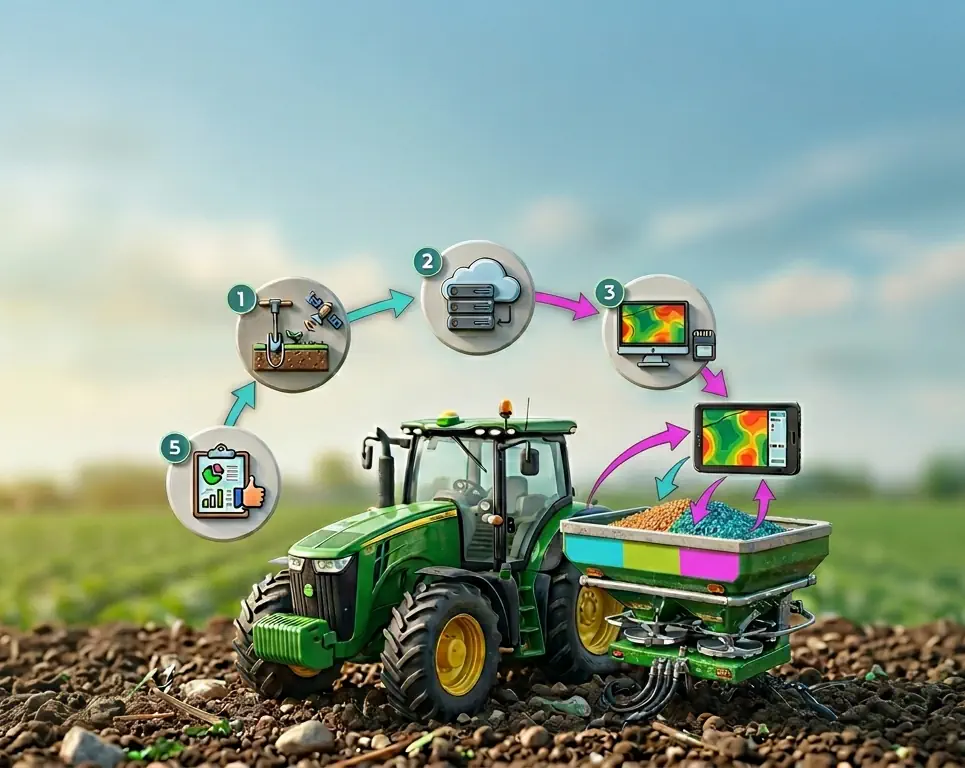
13. VRA implementation checklist – step by step
The following checklist organizes the actions needed to carry out your first VRA application. It can serve as a practical schedule for new users of the technology.
- Step 1: Define field boundaries and load them into the FMS system (FarmPortal, local cadastral portal, direct subsidy application data).
- Step 2: Plan the soil sampling grid – minimum density 1 sample per 2 ha; choose the method (regular grid or management zones).
- Step 3: Collect soil samples with GPS coordinates recorded for each point.
- Step 4: Send samples to an accredited laboratory – scope: pH, P, K, Mg.
- Step 5: Import results into FarmPortal and generate soil nutrient maps.
- Step 6: Open the fertilization calculator in FarmPortal – enter target yield, previous crop and organic manure applications.
- Step 7: Generate the prescription map (variable rates) and export to ISO-XML or SHP.
- Step 8: Load the map into the spreader terminal (SD card or Bluetooth/Wi-Fi via ISOBUS).
- Step 9: Carry out the application – monitor execution of the map in the terminal (deviations from the plan).
- Step 10: Download the application report (as-applied map) and save it in FarmPortal for documentation purposes.
- Step 11: After harvest, compare the yield map with the prescription map – draw conclusions and calibrate for the following year.
14. 7 most common mistakes in VRA implementation (and how to avoid them)
- Too few soil samples – result: a smoothed map that does not reflect real variability. Solution: minimum 1 sample per 2 ha; 1 per ha where variability is high.
- NDVI maps taken at the wrong growth stage – too early or too late does not reflect the real nitrogen nutrition status. Solution: for cereals, the optimal window is BBCH 30–55.
- No spreader calibration before the application – the spreader may apply 10–20% more or less than specified, negating the map's precision. Solution: carry out a calibration test before every application.
- Ignoring spreader response lag – large heavy spreaders have a different response time than light ones. Solution: configure the time offset in the FMS software to match the specific machine.
- Mixing methods (balance + NDVI without calibration) – two maps based on different assumptions can add together incorrectly. Solution: choose one primary method and use the other as a correction, not an independent input.
- No post-season verification – without comparing the prescription map with the yield map it is impossible to assess effectiveness and improve for the following year. Solution: collect combine data and analyse it in FarmPortal.
- Applying VRA on fields with low variability – if the coefficient of variation for P/K availability is below 15%, savings will be minimal. Solution: generate the map first and assess variability before committing to full VRA.
15. Comparison: uniform fertilization vs. VRA
| Criterion | Uniform fertilization | Variable rate application (VRA) |
|---|---|---|
| Application rate | Single rate across the whole field | Rate tailored to each zone / GPS point |
| Decision basis | Average from a sample or farmer experience | Soil nutrient map or NDVI/NDRE index |
| Fertilizer use | Often 10–25% above need in good zones | Reduced to the agronomic minimum |
| Effect in poor zones | Crop under-nutrition → yield loss | Higher rate → yield equalization |
| Implementation cost | None / minimal | Soil tests + software + terminal (€14–24/ha/year) |
| Documentation | Manual or none | Automatic as-applied map |
| Compliance with agri-environment schemes | Partial | Full – digital evidence of precision |
| Environmental risk | Higher (N/P excess in nutrient-rich zones) | Significantly lower |
| Operator skill required | Low | Moderate (1–2 days of training) |
| ROI (where variability >20 CV%) | No additional return | €20–90/ha/year (after implementation costs) |
Source: authors' own compilation. CV% – coefficient of variation of soil P or K availability within the field.
16. Summary
Variable Rate Application (VRA) is not a technology of the future – it is a tool available today, with documented effectiveness and a measurable return on investment. Scientific data and field experience clearly show that 80% of fields are over-fertilized with potassium and phosphorus, while simultaneous deficiency in poor zones costs the farmer twice: in fertilizer and in yield.
VRA technology – based on soil nutrient maps, NDVI/NDRE vegetation indices and the ISOBUS standard – is today accessible at every budget and farm size. The entry-level version (pH map + variable-rate liming) costs less than a tonne of ammonium nitrate. The advanced version with an on-the-go sensor and a full FMS provides a tool to manage the entire farm.
FarmPortal as a farm management system brings together in one place the fertilizer calculations developed with the University of Agriculture in Kraków, satellite index maps and prescription map export to machines. The journey from soil sample to VRA application is reduced to a few clicks.
With rising fertilizer prices, tightening environmental requirements and CAP agri-environment schemes, precision fertilization is ceasing to be a choice – it is becoming a condition of profitable production.
17. Frequently Asked Questions (FAQ)
How much can I save on fertilizers with VRA?
Depending on field variability and the technology used, savings range from 10 to 25% of phosphorus and potassium fertilization costs, and from 3 to 15% when using an optical sensor for nitrogen. With high soil variability and P/K fertilization, total savings can exceed 20% of the fertilizer budget.
From what farm size does VRA become cost-effective?
Scientific research (Springer Precision Agriculture 2022) indicates that at typical fertilizer and grain prices the break-even area is around 567 ha. With rising fertilizer prices and agri-environment scheme payments the threshold falls to 68–177 ha, or even 46 ha. In practice, returns are visible from around 100–150 ha when the field shows significant nutrient variability.
What do I need to start using VRA?
You need: (1) a soil nutrient map or NDVI/NDRE vegetation indices, (2) software that creates prescription maps (e.g. FarmPortal), (3) a spreader or sprayer supporting ISOBUS or a GPS terminal with VRA capability, (4) a prescription map file in ISO-XML or SHP format loaded into the machine's terminal.
Does VRA always increase yield, or does it only cut costs?
Both effects are possible and often occur simultaneously. On fields deficient in nutrients, VRA increases yield by supplying more fertilizer where it is needed. On over-fertilized fields the main benefit is cost reduction without yield loss. Research shows that accounting for soil variability leads to higher yields, better agronomic efficiency and higher margins compared with uniform nitrogen application.
How often do I need soil tests for VRA?
For P/K fertilization, tests every 3–5 years are sufficient, as soil nutrient levels change slowly. For pH – every 3–4 years. Mineral nitrogen (Nmin) should be tested annually, just before spring fertilization. Sampling is carried out on a regular grid (e.g. one sample per 1–2 ha) or within defined management zones.
What is ISOBUS and does my spreader support it?
ISOBUS (ISO 11783) is a communication standard between a tractor and an agricultural machine, allowing prescription maps to be transferred directly to the spreader controller. Most new spreaders (Amazone, Kuhn, Horsch, Kverneland) support ISOBUS. Older machines can be fitted with an external GPS controller. The map in ISO-XML or SHP format is prepared by software such as FarmPortal and loaded onto an SD card or transferred via Wi-Fi to the terminal.
Is variable rate application required by agri-environment schemes or the Nitrates Directive?
VRA itself is not explicitly required, but CAP agri-environment schemes 2023–2027 reward precision fertilization. The Nitrates Directive requires farms above 100 ha to prepare nitrogen fertilization plans. VRA is the natural tool for fulfilling and documenting these plans.
What is the difference between map-based VRA and sensor-based VRA?
Map-based VRA involves preparing a prescription map (from soil tests or NDVI indices) and loading it into the machine controller before the application. Sensor-based VRA (on-the-go) is a real-time response: an optical sensor measures crop condition in motion and instantly adjusts the application rate. The map-based approach is more accurate for P/K and liming; the sensor approach is best for top-dress nitrogen.
As a processor or distributor, how can I benefit from my suppliers' VRA data?
VRA data (prescription maps, soil test results, NDVI indices) translates into predictable, consistent raw material quality – lower variability in grain nitrogen content or sugar in beet. Through FMS platforms such as FarmPortal, processors can access treatment histories and field productivity data as part of a food passport system.
How much does implementing VRA on a farm cost?
Costs depend on the level of technology. Soil tests and a nutrient map: €20–40/ha (one-off). GPS terminal with VRA for a spreader: €1,200–5,000. FMS software subscription with a VRA module: from a few tens of euros per month. On-the-go nitrogen sensor: €3,500–7,500. On a 200 ha farm saving €35/ha/year on fertilizers, the investment in tests and software pays back within 1–2 seasons.
18. Glossary
- VRA (Variable Rate Application)
- A method of applying fertilizers or other crop inputs in which the rate is automatically adjusted to local field conditions based on a prescription map or a sensor signal.
- VRT (Variable Rate Technology)
- The hardware and software that enables VRA in practice – GPS terminal, rate controller, ISOBUS.
- ISOBUS (ISO 11783)
- International standard for digital communication between a tractor and an agricultural machine. Enables prescription map transfer, rate control and application data logging.
- ISO-XML / ISOXML
- Prescription map file format compliant with the ISOBUS standard. The file contains field zones with assigned rates and is read directly by an ISOBUS terminal.
- NDVI (Normalized Difference Vegetation Index)
- A vegetation index calculated from satellite or sensor imagery that indicates the quantity and condition of green plant biomass. Values closer to 1 = dense, healthy vegetation.
- NDRE (Normalized Difference Red Edge)
- A variant of NDVI using the red-edge band (680–740 nm), which is more sensitive to chlorophyll content changes than NDVI. Used for assessing nitrogen nutrition mid-season.
- Management zones
- Delineated areas of a field with similar soil properties and yield potential, to which a single shared fertilizer rate is applied. The basic planning unit in VRA.
- Prescription map
- A digital field map with rates assigned to each zone or grid cell, loaded into the machine terminal and executed automatically during the application.
- Kriging
- A geostatistical method of spatially interpolating soil sample data, accounting for spatial correlations between sampling points. Produces nutrient maps with reduced estimation error.
- Nmin (mineral nitrogen)
- Mineral nitrogen in the soil – the sum of ammonium (NH₄⁺) and nitrate (NO₃⁻) nitrogen in the soil profile, directly available to plants. Measured before spring fertilization as a key parameter for calculating the nitrogen rate.
- ROI (return on investment)
- The ratio of the net profit from an investment to its cost, expressed as a percentage or as the number of years required to recover the expenditure.
- MRV (Measurement, Reporting, Verification)
- A system for measuring, reporting and verifying greenhouse gas emissions and other environmental indicators, required in carbon offset programmes and sustainable agriculture certifications.
- FMS (Farm Management System)
- Farm management software integrating data on fields, treatments, machinery, staff and finances. Example: FarmPortal.
- Agri-environment schemes (eco-schemes)
- Voluntary environmentally beneficial practices funded under the Common Agricultural Policy 2023–2027, for which farmers receive supplementary area payments. Precision fertilization is one of the qualifying practices.
- Nitrates Directive
- EU Council Directive 91/676/EEC aimed at reducing water pollution caused by nitrates from agricultural sources. Requires member states to designate Nitrate Vulnerable Zones and implement action programmes limiting nitrogen losses.
19. Sources
This article is based on the following scientific publications and industry studies:
- Palmieri, N. et al. (2024). Integrating NDVI and agronomic data to optimize the variable-rate nitrogen fertilization. Precision Agriculture. Springer Nature. link.springer.com
- Ortega, R.A. et al. (2022). Opportunities for variable rate application of nitrogen under spatial water variations in rainfed wheat systems — an economic analysis. Precision Agriculture. Springer. link.springer.com
- Pawase P.P. et al. (2023). Variable rate fertilizer application technology for nutrient management: A review. International Journal of Agricultural and Biological Engineering, 16(4): 11–19. DOI: 10.25165/j.ijabe.20231604.7671.
- USDA Economic Research Service (2023). Precision Agriculture in the Digital Era: Recent Adoption on U.S. Farms. ERS Report.
- Soil analytical laboratory data: regional soil analytical stations and accredited private laboratories – soil nutrient monitoring reports.
Follow us!
See what we're doing and be inspired by positive changes.