Employing Workers in an Agricultural Farm – Obligations, Regulations, Qualifications and Penalties
Employing workers in an agricultural farm is subject to specific legal regulations that differ from those applicable to typical businesses. In practice, however, they impose a very broad scope of responsibility on the farmer or farm manager. The owner or managing person is responsible not only for the legality of employment, but also for occupational safety, the use of agricultural chemicals, protection of human health and the environment, as well as the financial and administrative consequences of any violations.
Forms of employment in an agricultural farm
Several basic forms of employment are used in agricultural farms, each involving a different scope of obligations.
Employment contract
An employment contract is intended for permanent work performed under supervision and within defined working hours. It requires registration with the social security system, maintaining full personnel documentation, recording working time, providing medical examinations and OHS training, paying at least the statutory minimum wage, and granting leave and other employee benefits.
Contract of mandate (civil law contract)
A contract of mandate is sometimes used for seasonal or auxiliary work, but it cannot replace an employment contract. It requires registration for social security contributions, keeping records of hours worked, and complying with the minimum hourly rate. In practice, it is often challenged by labour inspectors if the nature of work corresponds to an employment relationship.
Harvest assistance contract
A harvest assistance contract is a special form dedicated exclusively to specific activities such as harvesting, crop care, or sorting produce. It may be concluded for a maximum of 180 days per year with one person and requires registration with the agricultural insurance system. It is not subject to labour law, but it does not exempt the farm from occupational safety obligations or liability for accidents.
Workers' education – when is it required?
As a rule, the law does not require formal agricultural education for performing simple tasks such as manual harvesting or basic crop maintenance. However, the lack of formal education does not mean freedom in assigning tasks. The more specialised or hazardous the work, the more important proper training, qualifications, and experience become.
The farmer or farm manager is obliged to assess whether a given person has adequate competencies to perform assigned tasks and to ensure appropriate training.
Training and qualifications – the principle of farm responsibility
In agriculture, the key principle is that any work posing a risk to human health, the environment, food safety, or property requires appropriate training and qualifications. This applies in particular to work involving chemicals, machinery operation, and activities performed under increased risk conditions.
The lack of required training or allowing unqualified persons to work always falls on the employer, regardless of the form of employment.
Spraying and the use of plant protection products
The use of plant protection products is one of the most strictly regulated areas of agricultural activity. Spraying may only be carried out by persons holding valid training in the application of plant protection products, valid for five years. This training is required both for the farm owner and for every worker performing treatments.
Without such training, it is prohibited to carry out spraying, prepare spray solutions, clean sprayers, or neutralise product residues. Anyone working with chemicals must also receive job-specific OHS instruction and use appropriate personal protective equipment such as coveralls, gloves, masks, and protective eyewear.
Allowing untrained persons to perform spraying activities is one of the most common reasons for penalties and administrative sanctions.

Fertilisation and environmental responsibility
Mineral or organic fertilisation itself does not usually require a formal licence, but it does require training workers in safe fertiliser use and familiarity with applicable environmental regulations, including rules derived from nitrate programmes.
Errors in fertilisation, exceeding application rates, or improper storage of fertilisers may result in administrative penalties, reduction or withdrawal of subsidies, and environmental liability for the farm.
Chemical cleaning, machinery washing and disinfection
Work related to chemical cleaning, washing sprayers, disinfection, or the use of technical chemicals is considered hazardous work. It requires OHS instruction, familiarisation with safety data sheets, and the use of appropriate personal protective equipment.
Such tasks must not be assigned to untrained persons or treated as simple auxiliary work.
Operation of agricultural machinery and required qualifications
Operating agricultural machinery requires ensuring appropriate qualifications. Forklift trucks require certified operator licences, telescopic loaders and lifting platforms require dedicated operator authorisations, and driving tractors on public roads requires the appropriate driving licence category.
The absence of operator qualifications always places liability on the employer and may lead to serious consequences in the event of an accident.
Responsibilities of the farm owner and manager
The farm owner or manager is responsible for the legality of employment, assigning workers to appropriate tasks, ensuring training, protective equipment and supervision, as well as for the health, environmental and financial consequences of workers' actions. Arguments that a worker "did not know" or acted independently do not exempt the farm from responsibility.
Penalties and consequences of violations
Violations of employment regulations, occupational safety rules and chemical use requirements may result in financial penalties amounting to tens of thousands of euros, reduction or withdrawal of subsidies, civil liability in the event of accidents, and problems with certification and market access. In extreme cases, criminal liability may also apply.
The most common reasons for sanctions include the lack of pesticide application training, allowing seasonal helpers to perform spraying, missing OHS documentation, and illegal employment.
How FarmPortal supports farms in managing worker documentation and qualifications
FarmPortal helps organise employee documentation and prepare for inspections without searching through paper files. Within each employee profile, documents such as scanned contracts, declarations, medical certificates, OHS training records, registration confirmations, machinery licences, or pesticide certificates can be attached, ensuring that all required information is available in one place during inspections.
FarmPortal also allows assigning licences and qualifications to employees along with their validity periods. This makes it easy to verify who is authorised to carry out spraying, operate specific machinery, and whose qualifications are about to expire before the season starts.
In terms of work organisation, FarmPortal enables the generation of working time reports, supporting payroll settlements, hour tracking, and preparation of data for internal or inspection purposes.
Questions and answers – the most common concerns of farmers
Can a seasonal helper perform spraying if they "only assist"?
No. Performing spraying, preparing spray solutions, cleaning sprayers, or handling residues of plant protection products requires valid training in the application of such products. Lack of training is one of the most frequent violations and a key focus of inspections.
Is it enough that only the farm owner holds pesticide application training?
No. Training must be held by every person who actually performs plant protection treatments or prepares sprays. If a worker performs spraying and only the owner is trained, the farm remains exposed to sanctions.
Are any licences required for fertilisation?
In most cases, no formal licence is required. However, the worker should be trained in safe fertiliser application, correct dosing, and storage rules. In practice, fertilisation errors may lead to environmental, administrative, or financial consequences borne by the farm.
What documents should be prepared "for inspection"?
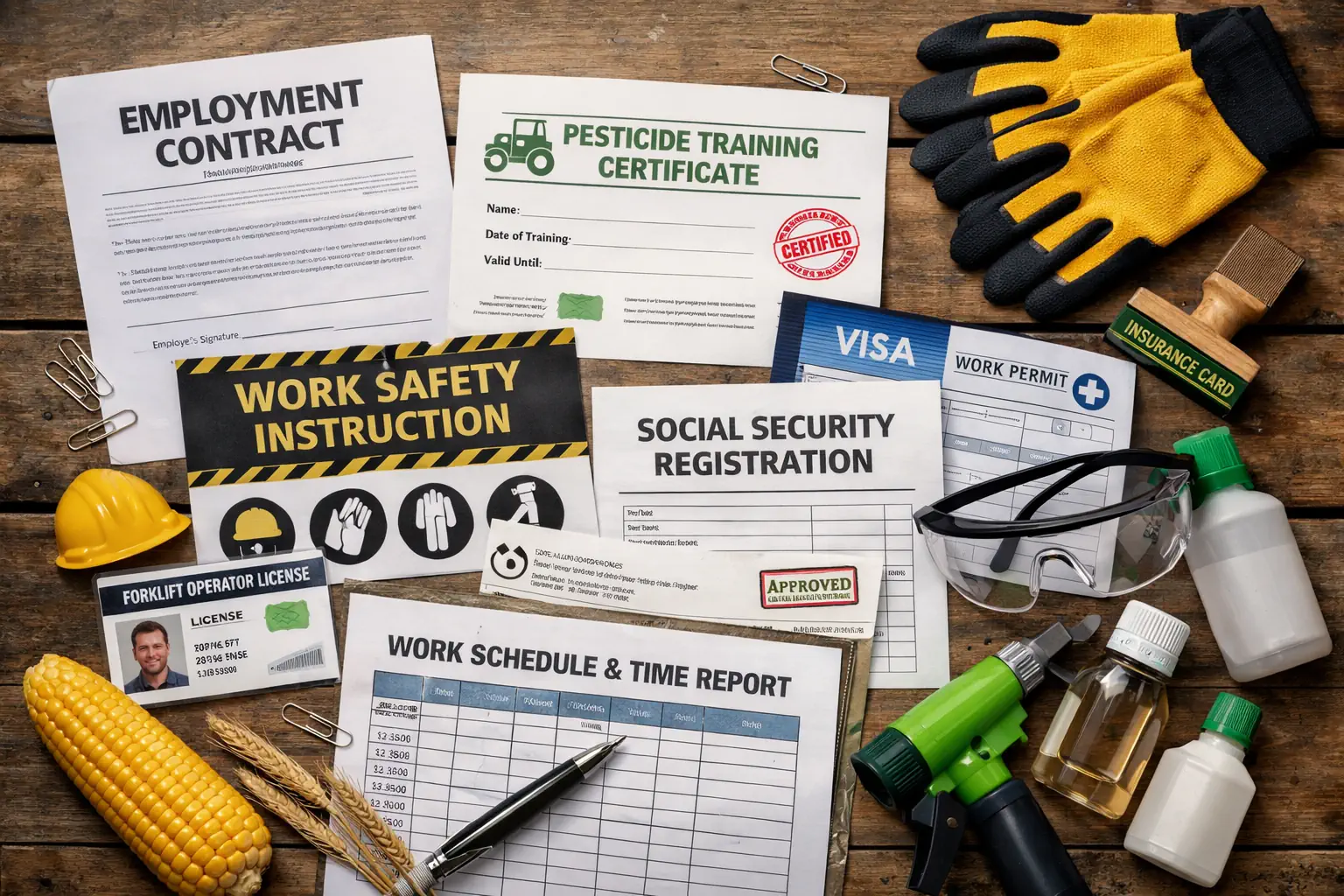
Inspectors most often verify employment contracts, social security registrations, working time or hour records, OHS instructions, training certificates (including pesticide training), machinery operator licences, and documents legalising the employment of foreign workers. A good practice is to keep copies of all documents in one place and monitor their validity dates.
What are the consequences if an accident occurs involving a worker without training or qualifications?
Consequences are usually multi-level, ranging from administrative penalties and decisions, through civil liability and compensation costs, to risks related to subsidies and future inspections. In accident cases, authorities typically assess whether the employer ensured proper training, protective equipment, and supervision.
Summary
Employing workers in an agricultural farm does not require formal agricultural education, but it does require knowledge, procedures, and conscious risk management. Particular attention should be paid to activities involving chemicals, spraying, and machinery operation, as these are the areas most frequently inspected and penalised. Ultimate responsibility always lies with the farm and its manager, regardless of the form of employment or the worker's experience.
Follow us!
See what we're doing and be inspired by positive changes.