Weather alerts for agriculture are most valuable when they go beyond telling you that “it will be windy” or “it might rain”. For a farm, the more important question is whether wind will exceed the safe threshold for spraying, whether rainfall will wash off a foliar treatment, whether frost will hit a sensitive BBCH stage and whether the field will still be trafficable the next day.
A weather alert for agriculture is an operational warning signal that links meteorological data with a specific field, crop, growth stage and planned task, helping the farmer bring work forward, stop it, postpone it or document an action on the farm.
In brief
A weather alert should not be just a message about regional risk. In agriculture, the threshold on a specific field matters: wind for spraying, rainfall for foliar treatments, frost for a sensitive growth stage, drought for fertilisation and field trafficability for work planning. This approach turns a forecast into an operational decision.
- A regional alert is useful, but too broad for deciding on a treatment on a specific field.
- The key sequence is: weather event → field threshold → decision → documentation → post-season analysis.
- Alerts should block or bring forward specific tasks: spraying, fertilisation, drilling, mowing, harvesting and transport.
- Historical field data helps assess working days, recurring drought, frost risk and the effects of damaging weather events.
- FarmPortal organises alerts, fields, treatments, photos, costs and decision history in one work system.

Why is a standard weather forecast not enough?
A standard weather forecast shows what may happen, but it does not directly say what decision the farm should make. The farmer is not interested only in information about rainfall, wind or temperature, but in how those conditions affect a treatment, field access, crop safety and the cost of work.
That is a big difference. A forecast may show rain overnight, but an operational alert should answer whether a spray applied in the afternoon will have enough time to work. Similarly, wind information only becomes useful when it is linked to spray drift risk and a specific treatment window.
In practice, the farmer makes decisions at the intersection of several data points: field, crop, BBCH stage, planned task, product, machine, operator, soil moisture, wind speed, temperature and rainfall total. The message “rain tomorrow” is too imprecise on its own.
The threshold matters. If a farm is planning a T2 treatment in wheat, the relevant factors are the hours with suitable wind, no rainfall after application and a temperature in line with the product label. If nitrogen fertilisation is planned, rainfall, soil moisture, field trafficability and the risk of nutrient losses all matter.
Which weather risks actually affect a farm?
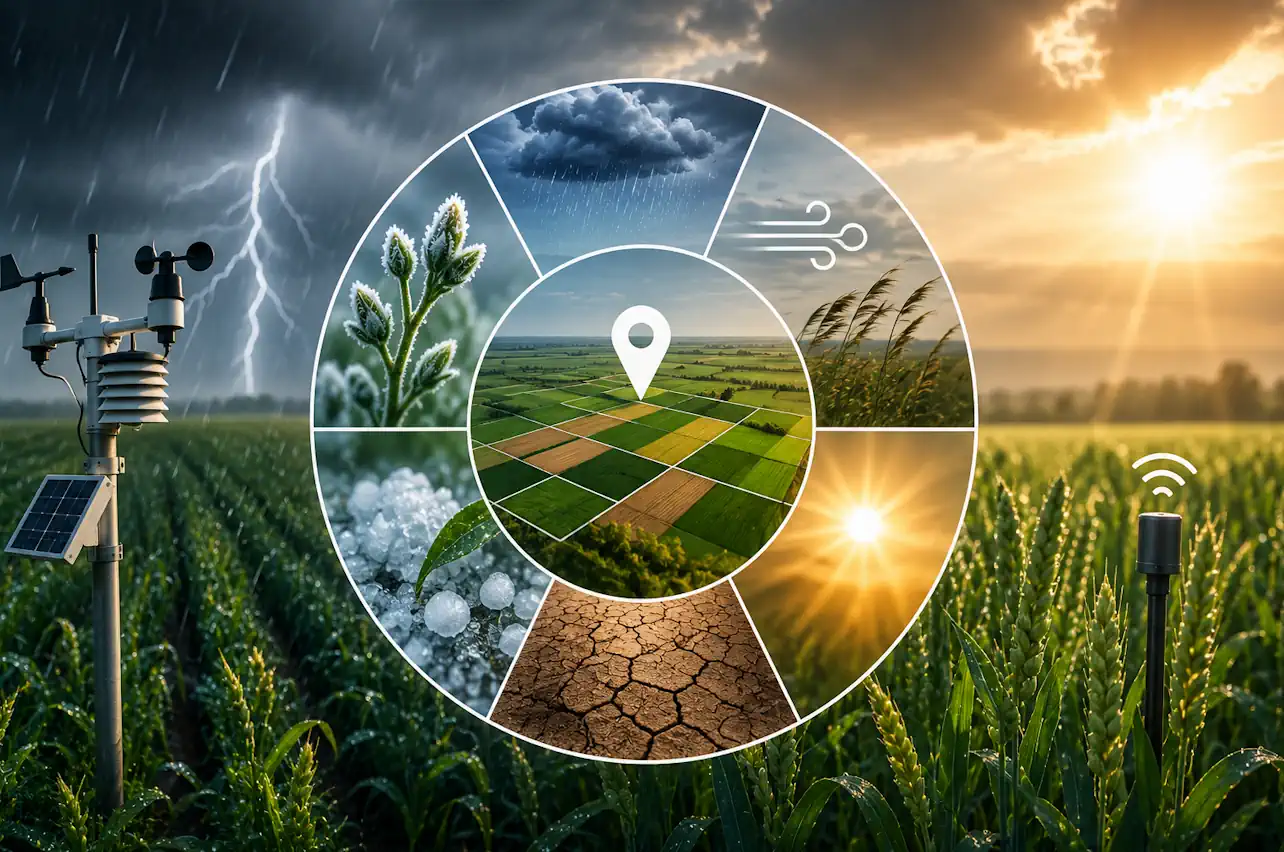
Weather risks on a farm should be described by their operational consequences, not only by the name of the event. Frost, hail, wind, drought, heavy rainfall and heat have different implications for treatments, fertilisation, harvesting, transport and damage documentation.
IMGW-PIB publishes criteria for meteorological warnings. For heavy rainfall, the first warning level includes, among other things, 30–40 mm within up to 12 hours or 40–60 mm within up to 24 hours. This is a useful reference point for regional risk, but a farm decision requires that warning to be translated into the field, soil and work plan. IMGW-PIB meteorological warning criteria
| Risk | What it really disrupts | Example decision | Data to check |
|---|---|---|---|
| Frost / freeze | Damage to flowers, leaves and young plants, plus stress after treatments | Stop stress-inducing treatments, scout the crop after the night | Minimum temperature, BBCH stage, field exposure |
| Hail | Mechanical damage to leaves, fruit, ears and stems | Document the damage, assess recovery, contact the insurer | Time of event, photos, damaged area |
| Heavy rainfall | Wash-off of treatments, lack of field access, waterlogging and erosion | Move the treatment or bring work forward before rainfall | Rainfall total, time until rainfall, soil moisture |
| Wind | Spray drift, uneven application and risk of damage | Stop spraying or change the treatment time | Wind speed, gusts, direction, neighbouring crops |
| Drought | Water stress, poorer nutrient uptake and reduced efficacy of some treatments | Review fertilisation, herbicides and whether another field pass makes sense | Rainfall, soil moisture, crop condition, IUNG-PIB SMSR data |
| Heat | Stress during flowering, phytotoxicity risk and shorter work windows | Move the treatment to the cooler part of the day | Temperature, humidity, Delta-T, crop stage |
| Storms | Risk of hail, strong wind, local flooding and work interruptions | Secure machinery, reschedule harvest or transport | Rainfall radar, warnings, local hourly forecast |
Why is a regional alert not enough for field-level decisions?
A regional alert warns about a weather event across a larger area, but it does not describe conditions on a specific field. For the farmer, the difference between a voivodeship and a field parcel is fundamental, because microclimate, soil and terrain can change risk within a few kilometres.
Cold air often accumulates in depressions, so frost may be stronger there than on a field located higher up. Light soil moves into water stress faster. A field sheltered by woodland behaves differently from an open plot exposed to wind.
An alert for the whole voivodeship is a signal to pay closer attention, not a ready-made instruction. The farmer should translate it into farm-specific thresholds: wind speed for spraying, minimum temperature for frost, rainfall total for trafficability and soil moisture for fertilisation.
This is where information becomes a decision. A local field alert takes into account the crop, BBCH stage, planned treatment, history of problems and real work schedule, so it is closer to everyday farm decisions than a regional warning.
How does a weather alert become a decision in daily work?
A weather alert becomes a decision only when it is linked to an operational threshold. That threshold tells the farm at what point it should stop spraying, bring fertilisation forward, move mowing or start documenting damage.
Every farm should have its own working thresholds, adapted to its machinery, crops, location and technology. One threshold may be appropriate for a boom sprayer, another for orchard treatments, and another for deciding whether a heavy machine set can enter a field after intense rainfall.
False precision should be avoided. A threshold is not a promise that a treatment will always be safe. It is a working rule that structures decisions and reduces situations in which the operator, agronomist and farm owner assess the same risk in three different ways.
| Weather event | Operational threshold | Decision | What to record in the system |
|---|---|---|---|
| Wind | Spray drift risk | Stop spraying or move it to the morning or evening | Wind speed, direction, treatment, field, operator |
| Rainfall in the next few hours | Risk of washing off a foliar treatment | Postpone the treatment or choose another weather window | Rainfall total, time from treatment to rainfall, product |
| Night frost | Sensitive crop stage | Stop stress-inducing treatments and plan crop scouting | Minimum temperature, BBCH, photos after the event |
| Heat | High temperature during treatment | Move the treatment to the cooler part of the day | Treatment time, temperature, humidity, product |
| Heavy rainfall | Risk of no field access | Bring work forward before rainfall or reschedule logistics | Work plan, rainfall, trafficability, delay |
| Drought | Low soil moisture and crop stress | Review fertilisation, herbicides and whether the pass makes sense | Rainfall, soil moisture, crop photos, agronomist’s decision |
| Hail | Damaging weather event | Prepare documentation, photos and damage assessment | Date, time, field, scale of damage, documents |
How should field work be planned around weather windows?
A weather window is a period of time in which conditions allow a specific task to be carried out with acceptable risk. For spraying, wind, temperature, humidity and rainfall after application matter. For fertilisation, rainfall, soil moisture, fertiliser form and field access are important.
In arable crops, weather alerts are particularly important for timings such as T1, T2, T3, N2, N3 and H2. Sometimes an alert means a treatment should be brought forward, because field access may be impossible for several days after rainfall. At other times it is better to wait, because wind or temperature increases the risk of poor results.
Good organisation starts the day before. The operator should know which fields are priorities, which treatments are ready to be carried out, which machine is available and whether the required product is in stock. An alert without a work plan is only a notification.
The same principle applies at harvest. If the forecast shows storms, priority may move from a field with lower grain moisture to a crop more exposed to lodging or shedding. Weather changes the order of work.
How do weather alerts affect crop protection treatments?
Weather alerts affect crop protection through application conditions and crop safety. Wind increases the risk of spray drift, rainfall may shorten the time a product has to work, and frost or heat can increase crop stress and the risk of phytotoxicity.
For spraying, the key is to combine several data points: product label, BBCH stage, wind speed and direction, temperature, humidity, plant condition and neighbouring crops. PIORiN reminds professional users of plant protection products that they must take integrated pest management requirements into account before using chemical protection. PIORiN requirements for users of plant protection products
In practice, most mistakes occur on the boundary between “it can still be done” and “it is no longer worth it”. Too much wind can reduce coverage and increase drift risk. Excessive temperature can shorten the safe treatment window. Drought weakens the activity of some foliar and soil-applied solutions.
An alert should therefore answer the question: is the planned treatment agronomically justified and technically safe today? If the answer is uncertain, changing the time, field order or working technology may be the better decision.
Why archive weather data from the field?
Historical field weather data shows whether a weather problem is an isolated incident or a recurring risk. One frosty night does not say much. Several seasons of data help assess which plots are most exposed, how many workable days are realistically available in spring and where drought limits yield first.
The archive should include the first and last frost of the season, the number of days when wind prevented spraying, rainfall before and after fertilisation, days without field access, hail episodes and periods of water stress. The IUNG-PIB Agricultural Drought Monitoring System is an example of a public source of information on agricultural drought in Poland, but operational decisions still require local data.
Such data helps with decisions for the next season: variety selection, drilling date, insurance level, investment in a weather station, soil moisture sensors or irrigation. It also helps when speaking to an adviser. Instead of saying “this field always dries out”, you can show rainfall patterns, crop photos and the yield response.
Post-season analysis should connect weather with results. Treatment dates, costs, yield, quality and weather events should be compared. Only then is it clear whether alerts helped improve decisions or were just another source of notifications.
How should you respond after hail, frost, heavy rainfall or drought?
After a weather event, quick crop scouting and good documentation are the priorities. Hail, frost, heavy rainfall or drought may require decisions about crop recovery, changes to the fertilisation plan, re-drilling, damage reporting or preparing material for the insurer.
Documentation should include the date, time, field, parcel, crop, growth stage, geolocated photos and a description of visible symptoms. It is useful to compare a damaged section with part of the field that was less affected. One photo is rarely enough.
ARiMR publishes materials on the register of agri-environmental, organic or agronomic activities for the CAP Strategic Plan 2023–2027. Such a register shows that documentation of farm work and events has not only technical, but also formal significance.
After an event, decisions should be made step by step: damage assessment, documentation, agronomic consultation, correction of the crop protection or fertilisation plan, and then recording the effects after several days. In many crops, assessment immediately after frost can be misleading, because some symptoms appear later.
Who benefits most from weather alerts on the farm?
Weather alerts have different value for different users. The farmer needs decisions about field work, the adviser needs data for recommendations, and the processor or producer group needs better documentation of quality risk and supply continuity.
| User group | Main problem | Data to collect | Better decision |
|---|---|---|---|
| Farmers with 50–300 ha | Difficulty finding the right treatment window across many fields | Wind, rainfall, temperature, BBCH, treatments | Field order, spray timing, moving fertilisation |
| Intensive farms of 300+ ha | Coordinating operators, machinery and short work windows | Work plan, machinery availability, local weather | Work priorities and fewer unnecessary passes |
| Fruit growers and vegetable producers | High sensitivity to frost, hail and heat | Minimum temperature, phenological stage, damage photos | Frost protection, damage documentation, harvest planning |
| Agronomic advisers | Lack of consistent data from clients’ fields | Weather history, treatments, photos, yield | Data-based recommendations, not just conversations |
| Producer groups and processors | Raw material quality risk and supply interruptions | Weather events, damage, batch traceability | Planning intake, sorting and supplier communication |
How does FarmPortal support work with weather alerts?
FarmPortal supports work with weather alerts by linking data about the field, crop, treatment, operator, machine and documentation. In this model, an alert is not an isolated notification, but part of the work plan and field history.
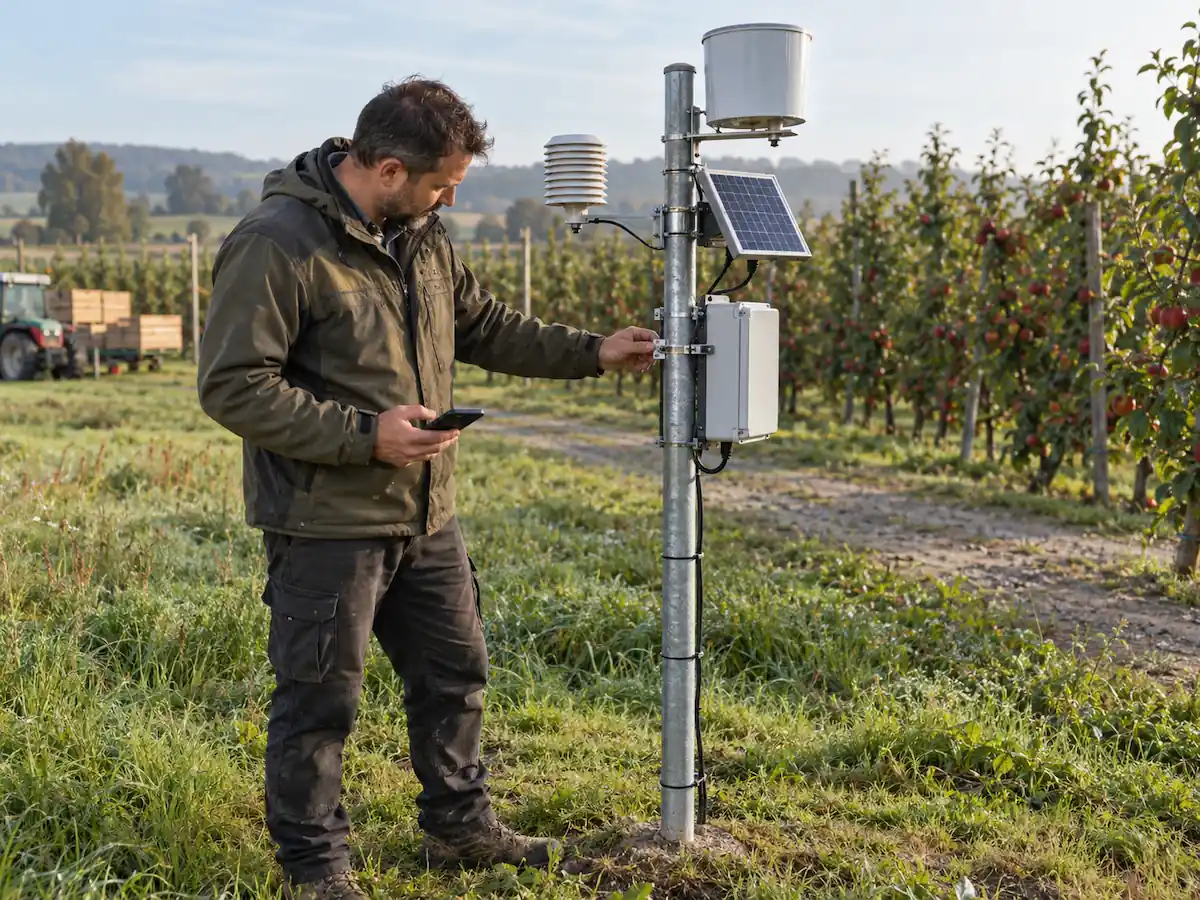
On the FarmPortal farm management features page, the system describes, among other things, field and crop records, treatment records, costs, employees, machines, inventory and reports. These elements are needed for a weather alert to become an operational decision.
In practice, an alert can be assigned to a field, crop, BBCH stage and planned treatment. If the system identifies wind risk before spraying, rainfall after a foliar treatment or frost during a sensitive stage, the farmer can move the task and record the reason for the decision.
In the treatment and production cost records module in FarmPortal such a record can be linked with the product, dose, operator, machine and cost. This is useful after the season, when the farm analyses how many treatments were moved because of weather, how many treatment windows were used and where the problem repeats each year.
FoodPass may be relevant where the farm supplies raw material to a processor or producer group. Data on weather events, damage and batch history can support traceability and quality communication in the supply chain, without mixing it with day-to-day field records.
Operational scenario: T2 moved because of a wind threshold
A farm in the Kujawsko-Pomorskie Voivodeship managed 220 ha of arable crops, including 85 ha of winter wheat. In May, a T2 flag leaf treatment was planned. The challenge was a short break between rainfall events, pressure from septoria tritici blotch and an increasing wind risk in the morning hours.
The treatment plan was entered into the system with the field, BBCH 39 stage, product, dose, operator and sprayer assigned. The weather alert showed that the next morning wind would exceed the farm’s operational threshold for spraying, while in the afternoon there would be a shorter window with lower wind speed and no rainfall.
The treatment was moved by a few hours. The operator sprayed in better conditions, and the field history recorded the reason for the change, application time, weather conditions, cost of the pass and a photo of the crop. After harvest, the farm compared fields with timely T2 against fields where the treatment was applied later because no suitable weather window was available.
The result should not be transferred mechanically to other farms. The effectiveness of the decision depended on local weather, disease pressure, variety, T1 timing, product choice and post-treatment conditions. The main conclusion was organisational: the alert had value because it was linked to a specific treatment, field and working threshold.
Checklist: how to set up weather alerts on the farm
Weather alerts should be configured from the perspective of farm tasks, not only weather events. First, the farm needs to know which decisions the alerts should support: spraying, fertilisation, drilling, mowing, harvesting, frost protection or damage documentation.
- Group fields by crop, soil, frost risk, drought risk and trafficability.
- Define weather-sensitive tasks: spraying, fertilisation, drilling, harvesting, transport and post-event scouting.
- Set operational thresholds for wind, rainfall, temperature, frost and lack of field access.
- Link alerts with the treatment plan, BBCH stage, operator and machine.
- Decide who receives notifications: owner, agronomist, operator, production manager.
- After an event, record photos, damage description, date, time, field and corrective decision.
- After the season, compare alerts with yield, quality, costs and work delays.
FAQ
How does a weather alert differ from a standard weather forecast?
A weather forecast says what event may occur, while an operational alert translates it into a farm decision. For the farmer, the key question is not only whether it will rain, but whether that rainfall will wash off a treatment, block field access or change the order of work.
Why is a voivodeship-level alert not enough for a farm?
A voivodeship-level alert covers a large area and does not reflect the microclimate of a specific field. A terrain depression, light soil, nearby woodland, exposure and local rainfall can mean that one field is safe while another requires a fast response.
What wind speed is too high for spraying?
The safe threshold depends on the product label, equipment, nozzles, crop, neighbouring fields and spray drift risk. For this reason, the farm should define its own operational threshold and check wind speed, direction and gusts before starting the treatment.
Can a treatment be applied before rain?
It depends on the product, treatment type, time until rainfall and rainfall intensity. With foliar treatments, rain too soon after application may reduce efficacy. The decision should be linked with the product label, hourly forecast and wash-off risk.
How does frost affect the treatment decision?
Frost can increase crop stress and the risk of damage, especially at sensitive growth stages. After a frosty night, it is worth planning crop scouting, assessing crop condition and being cautious with treatments that could place additional stress on plants.
How should hail or frost be documented?
Documentation should include the date, time, field, parcel, crop, growth stage, geolocated photos and a description of visible damage. A good practice is to compare damaged and less damaged sections and scout the crop again after a few days.
How does historical data help plan field work?
Historical data shows which fields more often suffer from drought, frost, lack of trafficability or wind preventing spraying. This helps plan varieties, drilling dates, insurance, work order and investments in weather stations or irrigation.
How does FarmPortal help with weather alerts?
FarmPortal helps link an alert with the field, crop, treatment, BBCH stage, operator, machine and documentation. As a result, a weather notification becomes part of the decision history, and after the season the farm can analyse the impact of weather on costs, timings and work quality.
Glossary
Weather alert
A message warning about the risk of a weather event. On a farm, it should be linked to an action threshold, such as stopping a spray operation or documenting damage.
Operational threshold
A defined weather value at which the farm changes its work plan. Examples include a wind threshold for spraying or a rainfall threshold for field trafficability.
Treatment window
A period of time in which weather conditions allow a treatment to be carried out safely and effectively. For spraying, wind, rainfall, temperature and humidity are among the key factors.
Spray drift
Movement of spray droplets outside the treatment area, usually caused by wind. It can reduce treatment efficacy and increase the risk of damage to neighbouring crops.
Field microclimate
Local weather conditions resulting from terrain, soil, exposure and the field’s surroundings. The microclimate may differ from the regional forecast.
Water stress
A condition in which the plant has limited access to water. It affects nutrient uptake, the efficacy of some treatments and yield potential.
Radiation frost
Frost that usually forms on a clear, calm night when the ground surface rapidly loses heat. It often affects terrain depressions more severely.
Growing degree days
A temperature-sum measure used to describe the development rate of crops or pests. In practice, it helps link weather more closely with crop biology.
Field trafficability
The ability to enter a field with machinery without excessive soil compaction or the risk of getting stuck. It depends on rainfall, soil type, moisture and machine set weight.
Summary
Weather alerts for agriculture make sense when they lead to decisions, not only to checking the forecast. The key is to translate a weather event into a field threshold, crop, BBCH stage and specific task.
A regional alert may be the first signal, but a farm needs local data and field history. Only then is it clear whether to bring T2 forward, move H2, stop fertilisation, change the mowing order or document hail damage.
FarmPortal structures this process by connecting alerts, treatments, fields, documents, photos, costs and decision history. As a result, weather becomes part of farm management rather than a separate piece of information checked outside the work plan.
Follow us!
See what we're doing and be inspired by positive changes.