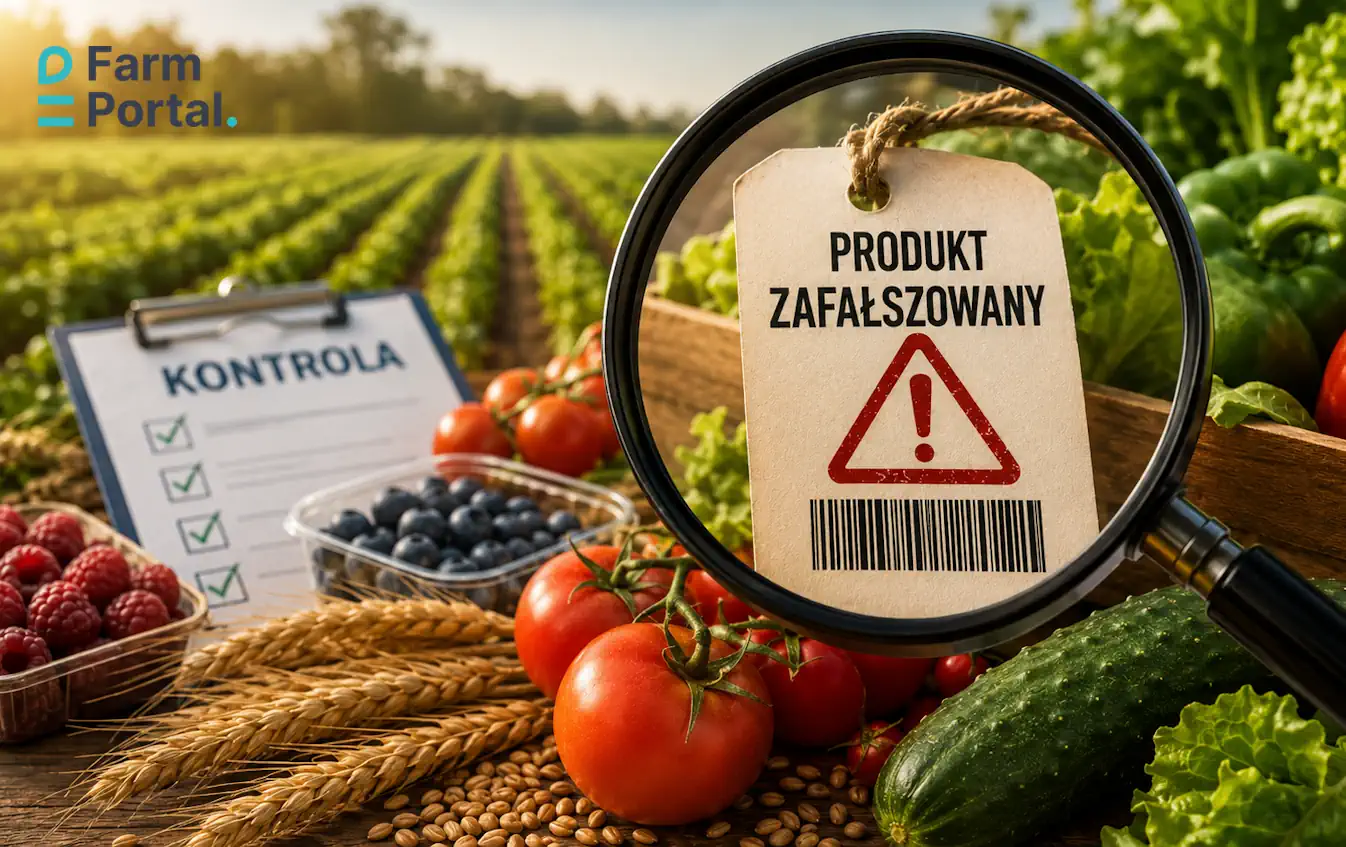
Food fraud is a category of deceptive practices involving the deliberate misleading of a buyer about a product’s composition, origin, quantity, characteristics or history in order to obtain a benefit.
In brief
The bill adopted by the government on 9 June 2026 strengthens supervision of adulterated food, but as at the publication date it is not yet binding law. The most important operational change is that inspections are expected to cover information in e-commerce, advertising and promotional materials. For a producer or processor, this means linking the label, invoice, origin declaration, quality results and batch history into one coherent data trail.
- Between January and April 2026, European Commission reports included a total of 739 cross-border non-compliance signals involving suspected fraud.
- In an IJHARS inspection from February 2025, irregularities affected around one in ten of 164 pork batches, and 5 batches were wrongly presented as Polish.
- Traceability reduces the risk of manipulation, but it does not replace laboratory testing, supplier qualification or audits.
- The best readiness test is to reconstruct one batch from the field or supplier through to the label and online store page.

What does the draft act against food fraud change?
The bill is intended to define food fraud for the first time as the deliberate placing of an adulterated product on the market for financial gain. It also extends IJHARS supervision to information published outside the packaging, strengthens import controls and provides for criminal sanctions. For businesses, data consistency across all sales channels becomes critical.
Legislative status as at 18 June 2026: the Council of Ministers adopted the bill on 9 June 2026, and on 11 June it was submitted to the Sejm as print no. 2695. The proposed obligations and sanctions should not yet be presented as binding law. The Chancellery of the Prime Minister indicates that the planned provisions would enter into force 14 days after publication of the act, which can happen only after the full legislative procedure has been completed.
The description of the changes is based on the announcement by the Ministry of Agriculture and Rural Development on the bill against food fraud and on the summary of the key measures adopted by the Council of Ministers.
| Area | What the bill provides for | Typical company risk | What to prepare |
|---|---|---|---|
| Definition of fraud | Deliberately placing an adulterated product on the market for financial gain. | No distinction between an error, negligence and intentional manipulation. | A register of decisions, approvals, specification changes and sources of claims. |
| Internet and advertising | Inspection of information in online shops, adverts, leaflets and promotional materials. | Different origin or composition on the label, website and campaign. | One product data source, a content owner and change versioning. |
| Imports | A more effective response to small consignments and questionable declarations. | Splitting deliveries, unclear purpose or incorrect classification. | Linking the consignment, batch, supplier, documents and inspection result. |
| Fruit and vegetables | Penalties for missing invoices or missing required data on invoices; a definition of trader. | Mismatch between the commercial document, quality class and batch origin. | Checks of invoice completeness and data consistency with goods receipt. |
| Liability | A fine, restriction of liberty or imprisonment; stricter liability for significant value. | No evidence of who approved the claim and on what basis. | Permissions, an audit trail and escalation of discrepancies before batch release. |
Adulterated product versus food fraud
These terms are not interchangeable. A product may be adulterated because of false information about its origin, composition or date, but establishing fraud also requires an assessment of intent and financial gain. This matters for the quality system as well: not every mistake should be called fraud, but every discrepancy should trigger a documented explanation.
This article is for information only and is not legal advice. Before changing internal procedures, companies should check the final text of the act, implementing regulations and the requirements applicable to the relevant product category.
What do food fraud statistics show?
The data do not indicate a single “percentage of fake food” on the market. Inspections are selected on the basis of risk, and EU reports include suspicion signals, not confirmed court judgments. They do, however, show where credibility most often breaks down: claims, documents, origin, composition, quantity and consistency of information across sales channels.
739 cross-border signals in four months of 2026
The European Commission publishes monthly reports on cross-border non-compliances with suspected fraud, obtained from the Alert and Cooperation Network (ACN). From January to April 2026, the reports contained a total of 739 signals selected from 3,055 iRASFF notifications. This is a FarmPortal editorial calculation based on four monthly reports.
| Month in 2026 | Suspicion signals | iRASFF notifications | How to read the data |
|---|---|---|---|
| January | 189 | 660 | Cross-border signals, not confirmed fraud cases. |
| February | 159 | 654 | Selected information for vulnerability analysis. |
| March | 203 | 882 | The number of entries does not equal the number of companies. |
| April | 188 | 859 | Signals may trigger investigations by authorities. |
| Total | 739 | 3,055 | Editorial sum, without calculating a “fraud rate”. |
In April 2026 alone, 133 out of 188 signals came from market controls, 21 from border controls, 15 from companies’ own checks, 12 from consumer complaints, 4 from media monitoring and 3 from whistle-blowers. Market controls therefore accounted for 70.7% of April entries. The conclusion is uncomfortable: if a company does not detect discrepancies internally, the market, a customer or an authority may do it instead.
What did selected IJHARS inspections reveal?
The results of domestic inspections are not a representative sample of the whole market. IJHARS selects products, entities and batches based on its inspection plan and risk, so a high percentage of questioned batches cannot be extrapolated to an entire category. The data are nevertheless very useful when building a vulnerability map and supplier control plan.
| Product and publication date | Scope of inspection | Selected results | Traceability significance |
|---|---|---|---|
| Pork, 20 February 2025 | 164 batches weighing 2.2 t in large-format retail stores. | Irregularities in around every tenth batch; 5 batches were wrongly labelled as Polish. | Origin must remain linked to the batch after unpacking and display. |
| Tea and herbal infusions, 9 April 2026 | 87 entities; 226 batches assessed for labelling; 148 laboratory samples. | 29 entities with irregularities, i.e. 33.3%; 27.9% of batches with incorrect labelling; 9.5% with a physicochemical non-compliance. | The declared composition and name require evidence in the specification and test result. |
| Olive oil, 7 May 2026 | 50 entities; assessment of labelling, organoleptic characteristics and parameters. | 44.4% of batches with labelling errors, 41.7% with organoleptic defects, 10.7% with a physicochemical non-compliance. | The label does not confirm the product category without testing and source data. |
| Organic fruit and vegetables, 3 June 2026 | 32 entities and 72 batches in retail sale. | 8 batches, or 11.11%, with labelling shortcomings; no infringements concerning the organic character of the samples. | A commercial error must be separated from a false organic declaration. |
Data sources: European Commission, “Monthly reports on EU Agri-Food Fraud suspicions”, reports for January, February, March and April 2026; IJHARS, announcements of 20 February 2025, 9 April, 7 May and 3 June 2026. All values relate to the scope indicated in the relevant announcement.
Where in the supply chain does the risk of adulteration arise?
The risk most often appears where the owner, identifier, document or commercial message changes. A batch may be correctly produced and still be incorrectly described at goods receipt, repacking, blending of raw materials or publication of an offer. Data flow therefore needs to be controlled as carefully as product flow.
Our position: a compliant label is no longer sufficient protection. Product credibility is assessed through the consistency of the label, invoice, specification, website, test result and batch history. Digitising the label alone, without organising source data, only spreads the same error faster.
Production and origin
At the start of the chain, the company needs to know which farm, field, plot, facility or herd the raw material came from. In crop production, variety, harvest date, treatments, withdrawal period and contract terms also matter. Missing data do not always mean adulteration, but they weaken the ability to prove that a claim is true.
Goods receipt, splitting and merging batches
The greatest friction appears when one delivery is split into several batches, or raw material from several sources enters a shared process. The number from the delivery document is then often copied onto a warehouse label, into a quality spreadsheet, into the ERP and into a sales document. One wrong digit can disconnect the product from its origin.
In practice, data on the same delivery are often created four times: by the grower, at the weighbridge, in the laboratory spreadsheet and in the commercial system. Every manual rewrite increases the chance that the country of origin disappears, the variety code changes or the document is attached to the wrong batch. The problem emerges only when the customer asks for a full evidence pack within a few hours.
Labelling and online sales
A product page in an online shop forms part of the information addressed to the consumer. Marketing cannot freely change “produced in Poland” into “Polish product”, add a quality claim without a source, or leave the old composition online after a recipe change. The proposed IJHARS powers make content management part of the quality system.
Documents and invoices
The invoice, delivery note, specification, quality protocol and certificate should point to the same batch and the same key characteristics. This is particularly important for fruit and vegetables covered by marketing standards. A discrepancy should not be corrected without a trace; it should be explained, approved and linked to the document version.
A broader analysis of quality and supply risks is available in the article on production risks for processors and distributors of fruit and vegetables.
How can food fraud be prevented step by step?
An effective programme starts with a vulnerability map, not with the purchase of QR codes. A company should identify economically attractive manipulations, define a single batch identity, reduce manual rewriting, approve claims and regularly test history reconstruction. The system must lead to decisions, not just collect documents.
- Select the most vulnerable products. Assess margin, price volatility, composition complexity, number of suppliers, imports, premium claims and the ease of substituting raw material.
- Define the traceable unit. Decide when a batch is created, when it is split, merged or repacked, and which identifier remains the master identifier.
- Set the minimum evidence record. It should include the source, date, quantity, commercial document, quality result, release status, recipient and claims used on the product.
- Separate content creation from content approval. Information on origin, composition, certification and properties should not enter sales without an identified owner and evidence.
- Link supplier control with batch control. A company certificate does not replace checking a specific delivery, and one correct sample does not confirm all future batches.
- Run a trial reconstruction and recall. Select a batch without prior notice and measure the time needed to obtain the list of raw materials, documents, results and recipients.
- Monitor exceptions. Count origin corrections, missing batch numbers, inconsistent descriptions, conditionally released batches and the time needed to close discrepancies.
Which KPIs make sense?
A good set does not need to be extensive. The percentage of batches with complete origin data, history reconstruction time, the share of documents requiring manual correction, the number of claims without a source and the time needed to close non-compliances are enough. Thresholds should follow the company’s risk, not a random industry benchmark.
An identifier is not a passport
A QR code, NFC or RFID points to a record, but it does not guarantee that the data are true. A product passport has value only when the record is linked to the field, delivery, inspection and documents and contains a change history. The practical differences between carriers are explained in the article on NFC, QR codes, RFID UHF and BLE in agriculture.
How do FarmPortal and FoodPass support traceability and fraud detection?
FarmPortal organises data created on the farm, FoodPass connects it with suppliers, batches, quality, documents and processor workflows, while FarmCloud provides the integration layer. This set-up can shorten the path from a discrepancy signal to source evidence, provided that identifiers and responsibilities are configured correctly.
FarmPortal as a source of production data
On the farm, the sources of truth are fields, crops, treatments, harvests, warehouses, workers, machines and documentation. A treatment record matters for food safety only when it can be linked to a specific plot and a later harvest batch. The available modules are presented on the page describing FarmPortal functions for production and farm management.
FoodPass as a batch, quality and collaboration layer
FoodPass can connect the supplier register, contracting, documents, batch identifiers, quality control, audits, certificates, statuses and flow history. For a processor, the key point is that the goods receipt result does not remain a separate spreadsheet, but can be linked to the delivery, raw material, product and downstream recipient.
Food passporting extends traceability by providing an organised presentation of data on origin, quality or production. Not every item of information needs to be public. Some data are intended for inspection and audit, some for a trading partner, while selected data can support the promotion of an agricultural product. The distinction between these concepts is explained in more detail in the guide to traceability in agriculture and food processing.
FarmCloud and integration with other systems
The integration layer is needed when batch data live in the FMS, ERP, laboratory, weighbridge, warehouse system and e-commerce platform. The aim is not to copy everything into one database, but to maintain a shared identifier, synchronisation rules and information about the source. Without this, two systems can simultaneously hold two “current” versions of origin.
The limitation is concrete: no system will detect a chemical substitution of an ingredient from documents alone. FarmPortal and FoodPass help indicate which batch should be tested, who supplied it, where it went and which claims were linked to it. Raw material authenticity may still require laboratory analysis and expert assessment.
What do farmers, producers, agronomists and processors gain?
Each group uses a different part of the same data trail. A farmer needs evidence of production and origin, an agronomist needs field history, the quality department needs batch controls, and a processor needs to identify suppliers and recipients quickly. A shared identifier reduces disputes over which document version is true.
Farmer and raw material producer
Structured records help demonstrate origin, treatment history, harvest date and compliance with contract terms. They also protect an honest supplier when an irregularity arose later in the warehouse or in trade. The condition is that data are entered during work, not reconstructed after the season.
Agronomist and adviser
An agronomist can see whether a recommendation was carried out on the correct plot and whether the batch meets the recipient’s requirements. Instead of searching for photographs in a messenger app and results in attachments, they can work on a history linked to the plantation. The system does not take responsibility for the agronomic decision, but it preserves its context.
Processor and quality department
A processor can compare a supplier’s declaration with the document, goods receipt result and specification more quickly. In the event of a complaint, the scope can be narrowed down to specific batches instead of blocking the entire stock. This reduces operational chaos, but requires reliable labelling every time raw material is split or merged.
Sales and marketing
The commercial team receives approved information on composition, origin, quality and certification. As a result, the description “Polish product” or a declaration of regional origin is not a creative shortcut, but a message based on a specific record. After a specification change, the system should indicate which product cards require updating.
How can a vegetable batch be secured from field to online shop?
The model shows what an implementation may look like at a processor working with a dozen or so farms. It is not the result of a real client project. The figures are used to test the logic of the process; they are not a promise of savings or a FarmCloud benchmark.
Context and scale
The plant contracts vegetables from 12 farms with a total area of 860 ha. During the season it receives around 6,400 t of raw material in 145 delivery batches. Data are created in four places: the grower’s records, the contracting spreadsheet, the weighbridge system and the quality control form.
Problem
During a trial history reconstruction, 30 batches were selected. In 6 cases there was no clear link between the delivery number and the plot, and in 4 documents the origin description required manual comparison with the invoice. Collecting the full evidence pack for one batch took 74 minutes.
Solution model
FarmPortal records farm, crop, treatment and harvest data. FoodPass assigns or takes over the delivery batch identifier, links the contract, goods receipt, quality result and documents, and then passes approved data into the commercial process. Every origin correction requires a reason and the approving person to be indicated.
Indicative test result after configuration
In the repeated simulation, 29 out of 30 batches had all required links in the first run, while one required a correction to the commercial description. The time needed to collect the history of the test batch fell from 74 to 12 minutes. This result follows from the model assumptions: shared identifiers, complete data feeding and trained employees.
Interpretation limits
The model does not account for integration failures, an incorrect laboratory sample, deliberate falsification in source data or seasonal variability. In a real plant, the result depends on the number of systems, the quality of supplier data, shift organisation and discipline during repacking. The greatest risk is not the software itself, but bypassing the process outside it.
What are the limitations and most common implementation mistakes?
A digital system will not fix a process in which nobody knows who is responsible for the batch, the claim and the release decision. It may even give faulty data an impression of precision. Implementation should therefore start with defining responsibilities and control points, and only then move to automation.
- Starting too broadly: trying to cover all products, suppliers and documents at once lengthens the project and hides the most important risks.
- A batch that is too general: one number for the whole production day is not enough when raw materials have different origins or quality results.
- QR without master data: an attractive label leads to a record with no owner, source or change history.
- No control over online content: the product card remains outdated after a recipe or supplier change.
- Trusting documentation alone: a complete set of files does not confirm composition when laboratory testing is needed.
- No recall test: the organisation discovers gaps only during a real incident.
Full integration does not always make sense. For a small farm with a few simple batches and one recipient, the first sufficient stage may be an organised register and consistent labelling. We recommend expanding the set-up when manual rewriting, the number of recipients, audit requirements or batch complexity begin to obstruct reliable history reconstruction.
FAQ: food fraud, new rules and traceability
What is food fraud?
Food fraud is a deliberate action intended to mislead the buyer about a product’s composition, origin, quantity, quality or history and to bring a benefit to the perpetrator. The June 2026 bill links food fraud with intentionally placing an adulterated product on the market. A non-compliance alone does not yet prove fraudulent intent.
What is the difference between an adulterated product and food fraud?
An adulterated product describes a non-compliant product or the way it is presented, for example a false country of origin, composition or date. Food fraud additionally requires an element of intent and financial gain. This distinction matters: an error on a label may lead to administrative liability, but not every error will meet the conditions of a criminal offence.
Are the new rules against food fraud already in force?
No. As at 18 June 2026, the Council of Ministers had adopted the bill on 9 June, and the document had been submitted to the Sejm as print no. 2695 of 11 June 2026. The rules will enter into force only after the legislative process has been completed and the act has been published. The bill provides for entry into force 14 days after publication.
What is IJHARS expected to inspect in online sales?
The bill extends supervision beyond the label and packaging. IJHARS is expected to be able to verify information about food published in online shops, advertisements, leaflets and promotional materials. For a company, this means agreeing one data source for the label, product page, campaign, specification and batch documentation.
How should a “Polish product” or Polish origin claim be documented?
An origin claim should follow from documents and data linked to a specific batch: the supplier, place of production or rearing, receipt document, invoice, batch identifier and the labelling rules applicable to the product category. A statement in a spreadsheet is not enough when the label, invoice and product page indicate different origins.
Does traceability prevent food fraud?
Traceability reduces the room for manipulation because it links the product with the batch, supplier, document, quality control and downstream recipient. It does not independently confirm the authenticity of the raw material or the honesty of an entry. Laboratory testing, supplier qualification, claim approval, audits and a procedure for responding to discrepancies are also needed.
What data should be collected in FoodPass?
The minimum set should include the batch identifier, supplier, origin, delivery date and quantity, linked contract or order, quality control results, commercial documents, batch release status and recipients. The scope should be tailored to the product and risk. Collecting data without an owner and update rules only creates digital clutter.
Does a small farm need an extensive system?
Not always. A farm selling a few uniform batches per year can start with a simple register using clear identifiers and a complete document set. Fuller integration makes sense when the number of plots, varieties, treatments, deliveries, recipients or audit requirements grows. First organise one process, then scale the solution.
Where should a company start preparing for the proposed changes?
Select one higher-risk product and trace one real batch from the source to the label and online shop. Identify where data are rewritten, who approves origin and claims, how long history reconstruction takes and how discrepancies are detected. This test usually exposes gaps faster than a general procedure.
Does FoodPass replace quality control, the laboratory or an audit?
No. FoodPass organises data, documents, batches, controls and the audit trail, but it does not replace taking a representative sample, applying the right test method or expert assessment. The system is an evidence and process layer. The credibility of the result still depends on input data quality, procedures, people’s competence and independent verification.
Glossary
- Food fraud
- A deliberate action intended to mislead the buyer and obtain an undue benefit; the bill links it to placing an adulterated product on the market.
- Adulterated product
- A product whose composition, origin, quantity, date or other material characteristics are presented in a way that is inconsistent with reality and infringes the buyer’s interest.
- Traceability
- The ability to trace a product, raw materials and batch flow at least to the immediate supplier and immediate recipient, and in a mature process also within the organisation.
- Food passporting
- The organisation and sharing of selected data on a product’s origin, production, quality and history in the form of a linked record or passport.
- Batch
- A defined quantity of product produced, processed or packed under comparable conditions, assigned an identifier used in documents and controls.
- Product master data
- An approved set of information on the name, composition, origin, units, specification and claims used by production, quality, sales and e-commerce.
- VACCP
- Vulnerability Assessment and Critical Control Points: an assessment of vulnerability to deliberate adulteration and the identification of actions limiting the risk of economically motivated fraud.
- IJHARS
- The Agricultural and Food Quality Inspection in Poland, which supervises commercial quality, labelling and product compliance within its statutory remit.
- FoodPass
- An Agri Solutions solution for managing supplier data, batches, quality controls, audits, documents and traceability in the agri-food supply chain.
- FarmPortal
- Agri Solutions’ FMS for managing farms, fields, crops, treatments, workers, machines and production documentation.
Summary and practical next step
The proposed rules shift the focus of inspection from the packaging alone to the entire product message, including the internet, advertising and documents. This is a logical response to a market in which batch information is copied between many systems and teams. The best protection for an honest producer is the ability to show quickly where the product comes from and who approved each material claim.
Over the next 30 days, select one higher-risk product batch. Reconstruct its path from the field or supplier to the invoice, label, quality result and website. Measure the time, note every manual rewrite and identify discrepancies. Only then define the scope of integration between FarmPortal, FoodPass and plant systems.
Do not wait for the act to enter into force before mapping data. The dates and wording of the rules may change, but the cost of an inconsistent batch is already being borne today by the supplier, quality department, sales team and brand.
Follow us!
See what we're doing and be inspired by positive changes.