What is traceability — definition and terminology
Key facts — traceability in agriculture
- Traceability is mandatory for all food producers operating on the EU market since 1 January 2005.
- The legal basis is Article 18 of Regulation (EC) No 178/2002 of the European Parliament and of the Council.
- Traceability covers tracking food in both directions: backward (where it came from) and forward (where it went).
- Absence of a traceability system may result in administrative sanctions and a penalty of €2 per hectare for farmers receiving direct payments.
- The GlobalGAP certificate requires the implementation of traceability — section AF.12 of GlobalGAP IFA V6 is a mandatory condition of certification.
- Food passporting (e.g. FoodPass) is one of the tools for implementing traceability, not an identical concept.
Traceability is the English term which in Polish legal and scientific terminology is translated as identyfikowalność (traceability). In industry practice — among farmers, processors and GlobalGAP certifiers — the English term is widely understood and commonly used.
The Codex Alimentarius defines traceability as the ability to follow the movement of food through specified stages of production, processing and distribution. Regulation (EC) No 178/2002 of the European Parliament and of the Council defines it as "the ability to trace and follow a food, feed, food-producing animal or substance intended to be, or expected to be incorporated into a food or feed, through all stages of production, processing and distribution." This definition has been legally binding for all operators in the EU food market since 1 January 2005.
In simple terms, traceability answers two questions simultaneously. First — where does this product come from Second — where did it go A traceability system must be able to answer both, quickly and on the basis of documented data.
Traceability vs. food passporting — what is the difference
These are two concepts that are often confused or used interchangeably. The distinction, however, has practical significance.

Traceability is the system — the set of procedures, data and tools that ensures the ability to track a product throughout the entire supply chain. It covers both backward traceability (where the product comes from, which treatments were carried out, which inputs were used) and forward traceability (which recipients received a specific batch).
Food passporting is a specific documentation mechanism: the creation of a product passport — digital or paper — containing a condensed production history linked to a given batch. It is one of the tools for implementing traceability. FarmPortal delivers this mechanism through the FoodPass module, which generates product passports ready to be shared with a recipient, certifier or IJHARS inspector.
Table 1. Comparison of concepts: traceability vs. food passporting. Own elaboration.
| Feature | Traceability | Food passporting |
|---|---|---|
| Scope | Entire system for tracking a product through the supply chain | Document (passport) for a specific product batch |
| Direction | Both ways: backward (where from) and forward (where to) | Mainly backward: production history |
| Form | System of processes and data | Document / record / QR code |
| Legal requirement | Yes — Reg. (EC) No 178/2002, Art. 18 | Depends on the standard (e.g. GlobalGAP, IFS) |
| Example in FarmPortal | Complete treatment register, harvest records, batch flows | FoodPass module — digital product passport |
Traceability vs. supply chain transparency
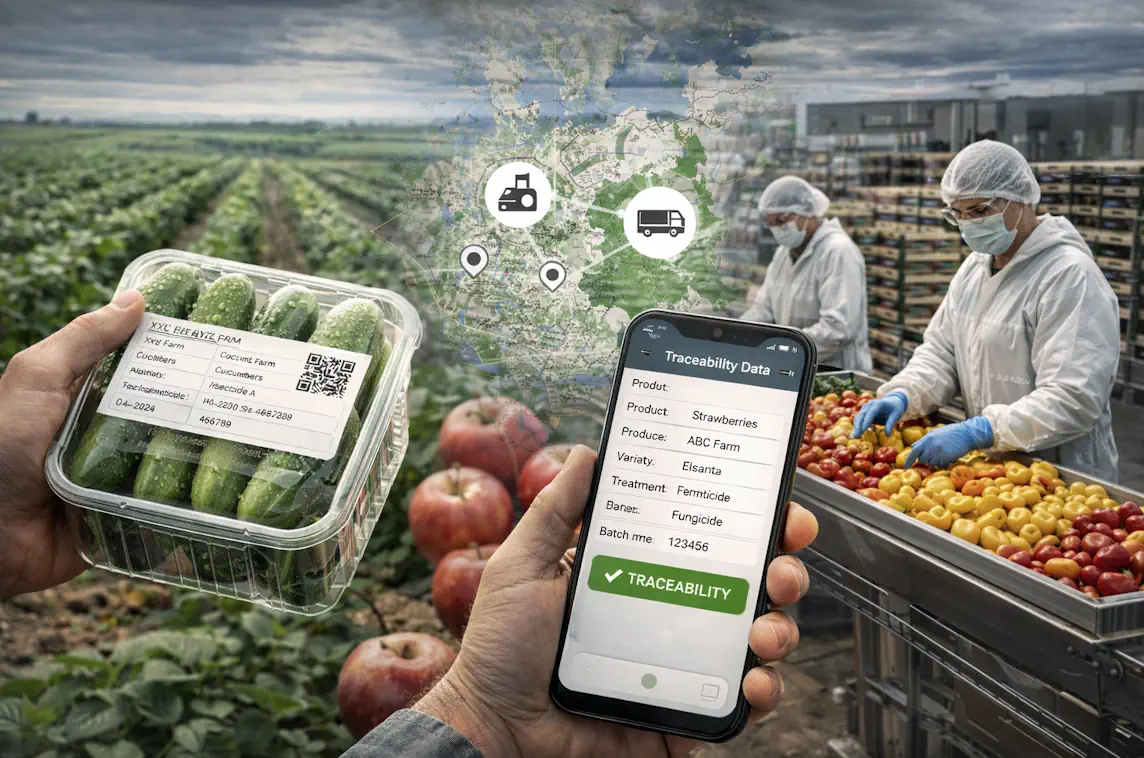
Traceability and transparency are related but not identical concepts. Traceability focuses on the technical ability to track a product — it must function even if the data are not publicly available. Transparency goes further: it means making information available to consumers, partners and supervisory authorities. A digital product passport with a QR code — an example of the solution available in FarmPortal/FoodPass — combines both approaches: data are collected for traceability purposes, and selected information reaches the recipient as proof of quality and origin.
Who does traceability apply to
The obligation and benefits of traceability apply to every link in the chain — from the primary producer (farmer) through the processor to the distributor. The table below identifies the specific problems traceability solves for each group.
Table 2. Traceability — target groups, their problems and benefits. Own elaboration.
| Target group | Main problem without traceability | Benefit of implementation |
|---|---|---|
| Farmers (fruit and vegetable producers) | Lack of documentation prevents GlobalGAP certification and access to retail chains; difficulty proving quality in the event of a complaint | Access to retail chains, price premium of 10–20%, faster audit process, stronger negotiating position for contracts |
| Fruit and vegetable processors | Inability to identify the source of a problem during a complaint or when an MRL exceedance is detected; risk of withdrawing an entire product line | Precise withdrawal of only the affected batch, brand protection, faster response to food safety incidents |
| Distributors (wholesale, logistics) | Inability to verify supplier documents; risk of trading products with unknown provenance | Reliable supplier verification, compliance with retail chain requirements (GlobalGAP CoC), own-brand development |
| Agricultural advisors and agronomists | Recommendations without hard data; no tool to compare seasons and results | Real-time access to farm data; precise recommendations based on crop history |
| Agricultural equipment manufacturers | Difficulty demonstrating the impact of treatment precision on end-product quality | Machine data integrated with batch documentation — proof of the value of precision for the end recipient |
Why traceability matters in agriculture
Traceability has long ceased to be a purely formal obligation. A study published in the journal Foods (MDPI, 2024) reviewing the state of digital traceability across OECD countries indicates that digital traceability systems have become a key tool for improving operational efficiency, ensuring food safety and building transparency throughout the supply chain. The value of the global food traceability systems market reached USD 41.6 bn in 2024 and is growing at an annual rate of 11.2% — reflecting the scale of investment the food sector is making in traceability.
EU and national regulations
The primary legal basis across the entire European Union is Regulation (EC) No 178/2002 of 28 January 2002 — the so-called "constitution of food law". Article 18 imposes a traceability obligation on all participants in the food chain, and its application has been mandatory since 1 January 2005. Commission Implementing Regulation (EU) No 931/2011 specifies the scope of information that must accompany each batch of food of animal origin, including: an accurate description of the food, its volume or quantity, supplier and recipient data, a batch number and the date of dispatch.
The Polish complementary act is the Act of 25 August 2006 on food safety and nutrition. It sets out sanctions for entities that fail to meet the traceability obligation — administrative and criminal liability enforced by IJHARS and the State Sanitary Inspectorate.
Food safety crises as an argument
Incidents such as the horsemeat scandal in Europe (2013) and the E. coli outbreak linked to sprouts (2011) revealed how high the costs of absent traceability can be — both financially and reputationally. As a scientific review published in Frontiers in Blockchain (2025) indicates, such events eroded consumer trust and forced regulators to tighten farm-to-fork documentation requirements. The FAO estimates that unsafe food causes illness in 600 million people annually and is responsible for 420,000 deaths worldwide — creating enormous pressure to implement systems for early detection and source tracing.
Expectations of retail chains and processors
Beyond legal requirements, traceability has become a de facto condition of entry into many sales channels. European retail chains — Lidl, Kaufland, Auchan — increasingly require suppliers of fresh fruit and vegetables to hold a GlobalGAP certificate or provide equivalent documentation. GlobalGAP CoC (Chain of Custody) certification is mandatory for all companies purchasing GGN-labelled products and reselling them. This means that a distributor without a traceability system loses access to these buyers.
When is full traceability required When is the minimum enough
Not all producers need to implement traceability at the same level of detail. The law sets a certain minimum — but it is the buyer and the certification standard that determine how far you actually need to go. The grid below provides a clear breakdown to help you assess what applies to your farm.
Full implementation is required when you
- Supply retail chains that require GlobalGAP or an equivalent standard
- Export fruit and vegetables to EU countries or beyond
- Want to obtain a GlobalGAP IFA or CoC certificate
- Have a buyer with IFS Food or BRC certification who requires full supplier documentation
- Produce under a retailer's or processor's own brand
- Participate in quality programmes or EU quality schemes (PDO, PGI)
The legal minimum may be sufficient when you
- Sell exclusively locally — at markets, to buying groups, directly to consumers
- Are not seeking quality certification and do not supply certified processing plants
- Operate a few hectares with no plans to expand into retail chains
- Sell to regional collection points with no documentation requirements
Legal minimum (Reg. 178/2002) — what every EU food producer must be able to do
- Every food business operator must be able to identify from whom they purchased any food, feed, or ingredient used in the production of food.
- Every food business operator must be able to identify to whom they supplied the food they produced.
- The traceability obligation covers every stage: production, processing and distribution.
- A primary producer (farmer) does not need to track the product beyond their own point of sale — but must document to whom they sold.
- Food placed on the market must be labelled or marked in a way that allows it to be traced (batch number, date).
In practice, the boundary between the "minimum" and "full implementation" shifts quickly as the scale of sales grows. A producer who today delivers to a collection point may be negotiating with a retail chain next year — and at that point the absence of documentation from previous seasons becomes an insurmountable obstacle. Implementing basic record-keeping in FarmPortal before a planned expansion avoids the situation where production history has to be reconstructed retrospectively from notebooks.
From field to table — traceability in practice
Traceability does not begin on the label in the shop. It begins the moment a producer decides to sow or plant a crop. Every agronomic activity, every input applied and every harvested batch must be recorded with an assignment to a specific field and period. Only then is it possible to reconstruct the full history of the product — which is what a GlobalGAP auditor, IJHARS inspector or retail chain buyer requires.
Minimum data required in a traceability system (fruit and vegetables)
- Identification of plots and crops (number, area, location, season)
- Register of applied plant protection products (name, dose, treatment date, PPP batch number, pre-harvest interval / PHI)
- Fertilisation register (fertiliser type, dose, date, target field)
- Soil analysis results and any irrigation water test results
- Seed and planting material supplier data
- Harvest register: date, volume, batch number, assigned field
- Recipient data: name, address, volume and batch number for each delivery
- Storage documentation (temperature, time, location) for chilled products
A practical example: a strawberry grower in central Poland harvests from 35 plots. Without a digital system it is impossible to quickly match a specific crate to a plot, harvest date and the plant protection products used. When an MRL (maximum residue level) exceedance is detected in a batch delivered to a retailer, the distributor must withdraw the entire delivery — even if the problem affected only one plot. With digital traceability in FarmPortal, the affected batch can be identified within minutes, not hours.
Table 3. Traceability flow in strawberry production — stages and key data. Own elaboration based on GlobalGAP IFA V6 requirements.
| Stage | Participant | Data to record | FarmPortal tool |
|---|---|---|---|
| Primary production | Farmer | Treatments, PPPs, fertilisers, soil pH, planting material, harvest, batch | Treatment register, crop records, FoodPass |
| Harvest & sorting | Farmer / collection point | Batch number, date, weight, source plot, worker | Harvest settlement module, crates/pallets |
| Transport & cold chain | Distributor / logistics | Temperature, time, vehicle, delivery note number, recipient | FoodPass integration (data passed by producer) |
| Processing | Processing plant | Input batches, recipes, production dates, quality checks | FoodPass + plant systems (integration) |
| Distribution / retail | Distributor / retail chain | EAN/GS1 code, batch number, best-before date | Product passport with QR code |
Traceability and certifications: GlobalGAP, IFS, BRC
Traceability is a component of virtually every certification scheme in the food industry. The standards differ in the level of detail required and their intended scope — but all treat traceability as a foundation. Section AF.12 of the GlobalGAP IFA V6 (Integrated Farm Assurance) standard directly requires traceability and segregation of certified from non-certified products, and compliance with this section is a necessary condition for obtaining the certificate.
Table 4. Comparison of traceability requirements across major certification standards. Own elaboration based on normative documents.
| Standard | Entity type | Traceability requirements | Digital required |
|---|---|---|---|
| GlobalGAP IFA V6 | Primary producer (farmer) | Section AF.12: batch traceability, segregation, GGN numbers | No, but preferred |
| GlobalGAP CoC | Distributor, wholesaler | Full traceability of certified products throughout the chain | Recommended |
| IFS Food 8 | Processing plant | Traceability of input materials, finished products and semi-finished products; withdrawal tests | De facto yes |
| BRC Food 9 | Production facility | Required traceability of raw materials and finished products; withdrawal test within 4 h | De facto yes |
| ISO 22000 | Any entity in the chain | Traceability system as part of the food safety management system | No, any form acceptable |
For a fruit and vegetable producer who wants to enter a major retail chain or work with a processing plant holding an IFS or BRC certificate, implementing traceability is not optional — it is a prerequisite for any discussion. FarmPortal supports the collection of documentation required for GlobalGAP certification, including maintaining a crop treatment register and generating batch passports.
Digital vs. paper traceability — 7 differences that matter
The vast majority of fruit and vegetable producers still maintain documentation in paper form or in spreadsheets. This approach formally meets the minimum legal requirements, but in practice it creates a range of problems: errors in dates and doses, lost notebooks, hours of preparation before an audit and the impossibility of instantly reconstructing a batch history.
Table 5. Paper vs. digital traceability — comparison. Own elaboration.
| Criterion | Paper / spreadsheet documentation | Digital system (e.g. FarmPortal) |
|---|---|---|
| Audit preparation time | Many hours sorting and completing data | Report generated in minutes |
| Error risk | High — manual transcription, no validation | Low — validation at point of entry, integration with PPP register |
| Speed of batch withdrawal | Hours (searching documents, phone calls) | Minutes — search by batch number or date |
| Data availability | Only in the office / with the person who keeps the notebook | Anywhere: mobile app, browser |
| Integration with PPP register | None — product names entered manually | Automatic update from the Ministry of Agriculture register |
| Product passport generation | Not possible without additional work | Automatic, based on collected data |
| Long-term costs | Seemingly low, but high costs of errors, audits and withdrawals | Lower through automation and risk reduction |
How FarmPortal supports traceability on your farm
FarmPortal is a farm management software (FMS — Farm Management System) developed by Agri Solutions Sp. z o.o. It combines production record-keeping, precision agriculture and food passporting in a single environment — accessible via browser and mobile app. The system is free for the basic tier and integrates with public registers (Ministry of Agriculture, ARiMR/subsidy application, GeoPortal).
In the context of traceability, FarmPortal is not limited to a treatment register. The system stores the full production context — from the plot through planting material, treatments, harvest to logistics data and certificates — and makes it available as a digital product passport (FoodPass). The table below lists the functions relevant to traceability.
Table 7. FarmPortal functions supporting traceability. Own elaboration based on product documentation.
| # | Function | What it delivers in the context of traceability |
|---|---|---|
| 1 | GeoPortal integration — automatic plot import | Plots with their cadastral TERYT numbers are imported automatically from GeoPortal — no manual entry required. Every treatment and every batch is immediately linked to a precisely identified cadastral plot, satisfying the location requirement in GlobalGAP documentation. |
| 2 | Complete crop treatment history | Every treatment is recorded with the date, location, product applied, dose, reason for use (disease, pest, preventive), BBCH growth stage, operator and machine. This is exactly the data scope that a GlobalGAP AF.12 auditor and a PIORIN plant health inspector verify during an inspection. |
| 3 | Farm registration and commercial data | The system stores the full operator profile: location, area, tax ID, ARiMR registration number, GlobalGAP GGN number. These data flow automatically into every generated product passport, eliminating the need to manually complete documents with each delivery. |
| 4 | Farm profile and product marketing support | FoodPass allows the passport to include the farm's story (storytelling), photos from production and a business profile. A consumer or buyer scanning the QR code sees not only the technical batch data, but also the context — who produced it, where and how. This is a brand-building and market differentiation tool. |
| 5 | Product testing results, PIORIN inspections and lab reports | Laboratory test results (PPP residues, heavy metals), PIORIN inspection protocols and other inspection documents can be attached directly to a batch or production season. Everything in one place — ready to be presented to an auditor or buyer at the first request. |
| 6 | Advisor and collection point data | Agricultural advisors, agronomists and collection point representatives can access crop data, export it and add recommendations directly in the system. Collection points can review batch history before receiving goods, shortening verification time and speeding up settlement. |
| 7 | Origin of certified seed and planting material | The system stores data on seed and planting material: supplier, plant passport number, certified material batch number, variety. Documentation of the input material is part of the GlobalGAP standard and a condition of full backward traceability. |
| 8 | Logistics and packaging data — packed for whom | Each batch records the recipient, packaging type, net weight, EAN/GS1 code, delivery note number and transport data. This ensures forward traceability — essential for product withdrawal procedures and for GlobalGAP CoC requirements. |
| 9 | Farm certificates held | FarmPortal stores scans and expiry dates of certificates (GlobalGAP IFA, CoC, Integrated Production, organic, etc.). A buyer or auditor can verify the current validity of certification at any time without having to contact the producer by phone. |
| 10 | Worker records and PPP application licences | The system records workers together with their plant protection product application licences. Each treatment is assigned to a specific operator holding a current licence — which is a GlobalGAP requirement and a national requirement under integrated pest management regulations. |
| 11 | MRV — automated sensor data collection | FarmPortal supports integration with IoT sensors (soil moisture, temperature, weather stations). Sensor data are automatically stored in the crop context — without manual transcription. This is the foundation for MRV (Measurement, Reporting, Verification) reporting required in ESG reporting and carbon reduction programmes. |
| 12 | Simplified documentation — ARiMR subsidy application import | Fields can be imported directly from the ARiMR direct payments application. Plot, area and crop data are ready from day one — without manual entry. The entire system is designed to minimise data entry time and maximise accuracy. |
| 13 | Protection against food fraud | A digital passport with an immutable batch number linked to a specific plot and recorded treatments makes it harder to falsify data on product origin. FoodPass enables authenticity verification by the buyer or inspector — without contacting the producer. This is a response to the growing risk of fraud in the fruit and vegetable supply chain. |
The solution is available for small farms (a few hectares) as well as for large plantations with multiple plots and dozens of seasonal workers. Data entered by a worker in the mobile app are instantly available in the system — with no risk of losing notes and no need to transcribe anything.
Agri Solutions is implementing the FoodPass project — food passporting based on data integration, an expert system and sensor technologies (POIR.01.01.01-00-2267/20). FarmPortal and FoodPass are part of the FarmCloud ecosystem, which also supports ESG reporting in agriculture.
Explore all FarmPortal features5 measurable benefits of implementing traceability
Traceability is often treated as a mere compliance requirement — yet for an informed producer or processor it is above all a business tool. Below are five benefits with a measurable impact on farm or business performance.
- Access to retail chains and processing plants. A GlobalGAP certificate or equivalent documentation is a prerequisite for working with most large buyers. The producer who is first in their area to implement a traceability system gains an advantage over competitors who lack such documentation.
- Price premium for verified origin. Premium retailers and export-oriented processors pay higher prices for products with a documented provenance. Strawberry producers with GlobalGAP certification and digital batch documentation obtain a market premium estimated at 10–20% compared to undocumented products.
- Reduced risk and cost of product withdrawal. With precise batch documentation, a withdrawal affects only the affected batch — not the entire delivery or a week's production. In an industry where the cost of a single product withdrawal can run into hundreds of thousands of zlotys, this is a purely financial argument.
- Time saved on audits and reporting. Producers who have implemented digital record-keeping in FarmPortal report a 50–60% reduction in the time needed to prepare documentation for an audit. Instead of several days collecting papers — a few minutes generating reports.
- Brand building and direct sales. A digital product passport with a QR code allows a consumer to scan the label and view the production history. This is a trust-building tool for a local producer's brand — especially in direct sales channels such as online shops, farmers' markets and subscription boxes.
How much does traceability cost
The cost of traceability depends on what the producer wants to achieve: whether meeting the legal minimum is sufficient, or whether full documentation for GlobalGAP or IFS certification is needed. Costs fall into three categories: time (own and employee work), tools (software, hardware) and any certification fees.
Table 6. Indicative costs of implementing traceability on a horticultural farm (fruit and vegetables). Estimates based on market offers 2024–2025.
| Option | Tool | Tool cost | Implementation time | For whom |
|---|---|---|---|---|
| Legal minimum (paper) | Notebook, Excel | Free | Ongoing — a few minutes daily | Small farm, local sales |
| Legal minimum (digital) | FarmPortal (free plan) | Free / year | 1–2 weeks to set up | Any producer planning to scale |
| Full digital records + FoodPass | FarmPortal + FoodPass module | Depends on plan — contact Agri Solutions | 4–6 weeks | Exporting producer or supplier to retail |
| GlobalGAP IFA certification | FarmPortal + certification body | approx. €350–1,050 / year (certification fee; varies by farm size and body) | 3–6 months | Retail chain supplier, exporter |
| GlobalGAP CoC certification | Plant systems + certification body | approx. €470–1,880 / year | 3–9 months | Distributor, wholesaler of certified products |
What drives the total cost
The GlobalGAP certification fee is just one element. In practice the largest cost item is working time — preparing documentation for an audit consumed 2 to 5 working days per year under paper-based models. Digital record-keeping in FarmPortal reduces this to a few hours, which represents a real saving at any rate of own or employee labour.
Producers participating in PROW (Rural Development Programme) support schemes or accessing digitalisation grants (e.g. the "Farm Modernisation" measure) may be able to cover the cost of digital tool implementation through subsidies. FarmPortal is listed as an example of a system meeting the eligibility conditions for digital farm management grants.
Case study: strawberry farm in the Masovian region
Context: Tomasz Wiśniewski, strawberry producer — 35 ha, Masovian Voivodeship
Tomasz Wiśniewski has been running a strawberry and raspberry farm in the Masovian region since 2009. In 2022 he lost a contract with one of Poland's domestic processing plants, which had begun requiring digital traceability documentation and proof of compliance with GlobalGAP requirements. Paper documentation, maintained in notebooks and Excel spreadsheets, did not meet the requirements — the plant was unable to verify batch history within the required timeframe.
Implementation: In February 2023 Tomasz implemented FarmPortal with the FoodPass module. The process took 6 weeks: field import from the ARiMR subsidy application, configuring the treatment register, and training 4 workers to use the mobile app.
before audit
from retail chains
(GlobalGAP premium)
passed first time
Results after 12 months: Tomasz regained the processing plant contract and secured two new buyers — a regional retail chain and a German exporter. The price premium for fruit with GlobalGAP certification and FoodPass documentation averaged 14% above the purchase price for undocumented fruit from the same region in the 2023 season. The time needed to prepare documentation for the annual audit fell from approximately 3 days to approximately 6 hours.
"I thought it was just bureaucracy. It turned out that digital documentation opened doors to buyers I had previously had no chance of reaching. The best investment of the last 3 years." — Tomasz Wiśniewski, strawberry grower, 35 ha, Masovian region
FarmPortal user testimonials
I run a 45-hectare apple orchard in the Lublin region. Before implementing FarmPortal, every GlobalGAP audit started with a frantic search for notebooks from the whole season. Now I open the app, select a date range and export a ready treatment report. The auditor was surprised at how smoothly the section AF.12 documentation check went. Preparation time dropped from three days to a few hours.
As a processing plant we process fruit from several dozen suppliers every year. The key problem was verifying batch history in the event of a complaint or a RASFF alert. With suppliers using FoodPass, the time to establish batch history dropped from several hours of phone calls to a few minutes — the supplier simply grants us access to the relevant module. For us this means reduced risk and a real argument when negotiating terms with retail chains that require full traceability documentation from our suppliers.
How to implement traceability — step by step
Implementing traceability does not have to mean an immediate switch to full digitalisation. Below is a realistic path that any fruit or vegetable producer can follow — from basic documentation to GlobalGAP certification.
- Inventory your fields and crops. Create a list of all plots with their cadastral numbers, areas and crops grown. In FarmPortal you can import fields directly from the ARiMR subsidy application or from a KML file.
- Set up a crop treatment register. Every application of a plant protection product or fertiliser must be recorded: date, product, dose, field, operator. FarmPortal integrates with the Ministry of Agriculture's PPP register — you do not need to enter product names manually.
- Record harvests with batch numbers. Each harvested batch (a set of fruit or vegetables from a given plot and day) should receive a unique number. This number will serve as the basis of identification throughout the product's journey.
- Record seed/planting material suppliers and product recipients. Assign batch numbers and recipient data to each delivery. This provides forward traceability required by Regulation 178/2002.
- Generate a product passport for the first batch. Check whether the system collects all data needed for a complete passport. Send a sample passport to your recipient and ask whether it meets their expectations.
- Conduct an internal withdrawal test. Choose a random batch from the last 3 months and check whether you can reconstruct its full history within 30 minutes. If not — identify which data are missing and fill the gaps.
- Apply for GlobalGAP certification (optional). Once documentation covers at least one full season, you can apply to an accredited certification body. FarmPortal generates reports compliant with the documentation requirements of section AF.12 GlobalGAP IFA V6.
Frequently asked questions
Do I need to implement traceability if I sell fruit to a collection point or directly at a market?
Yes. Regulation (EC) No 178/2002 imposes a traceability obligation on all participants in the food chain, including producers selling to collection points, retail chains and directly to consumers. The obligation covers the ability to identify the supplier of ingredients and the recipient of the product. The specific scope depends on the scale and channels of sale.
What is the difference between food passporting and traceability?
Traceability is a broader system for tracking a product through all stages of the supply chain — from field to table. Food passporting is a specific documentation mechanism: creating a digital or paper product passport containing data on the production history of a given batch. Passporting is one of the tools for implementing traceability.
Is traceability required to obtain a GlobalGAP certificate?
Yes. Section AF.12 of the GlobalGAP IFA standard explicitly requires the implementation of a traceability and product segregation system. Without meeting this requirement it is not possible to obtain or maintain a GlobalGAP certificate.
How long must I keep traceability documentation?
Regulation No 178/2002 does not specify a minimum retention period. Industry standards (GlobalGAP, IFS) require documentation covering at least the current production season. In practice, a minimum of 3 years of archiving is recommended, and longer for products subject to special regulations.
Is paper documentation sufficient, or do I need to switch to a digital system?
The law does not impose a specific form — both paper and digital records are acceptable. In practice, however, GlobalGAP and IFS auditors increasingly prefer digital systems due to faster verification and data integrity. Systems such as FarmPortal with the FoodPass module automate data collection and generate audit-ready reports.
What do I need to record to comply with traceability requirements in fruit and vegetable production?
Minimum requirements include: identification of plots and crops, a register of applied plant protection products and fertilisers (with dates, doses and batch numbers), harvest dates and volumes broken down by batch, and supplier and recipient data. GlobalGAP and IFS standards additionally require documentation of pre-harvest intervals (PHI) for plant protection products and residue test results.
What penalties apply for the absence of a traceability system?
In Poland, the legal basis for sanctions is the Act of 25 August 2006 on food safety and nutrition. Entities that do not maintain the required documentation are subject to administrative and criminal liability. The supervisory authority (IJHARS or the State Sanitary Inspectorate) may impose financial penalties or order the withdrawal of products from the market.
As a fruit and vegetable distributor, do I also need to implement traceability, or only producers?
The traceability obligation applies to every participant in the food chain — producer, processor and distributor. A distributor must be able to identify the supplier of each product batch and its recipients. The GlobalGAP Chain of Custody (CoC) standard is specifically aimed at companies trading and distributing GlobalGAP-certified agricultural products.
How can I implement traceability on a small farm without large financial outlays?
FarmPortal offers a free starter plan that allows basic production record-keeping, a crop treatment register and harvest documentation. This is a sufficient tool for small farms that want to meet minimum legal requirements and prepare for eventual GlobalGAP certification.
Does traceability help in negotiations with retail chains?
Yes. Retail chains and large processing plants in Poland and Europe increasingly require traceability documentation from suppliers as a prerequisite for entering into cooperation. A producer who can instantly provide the history of product batches is perceived as a reliable and professional partner — which translates into better contract terms and the possibility of obtaining a price premium.
Glossary
- Traceability — The ability to trace the history, application or location of a product at every stage of production, processing and distribution. Defined inter alia in the ISO 9000 standard and Regulation (EC) No 178/2002.
- Food passporting / product passport — The creation of a document (digital or paper) containing a condensed production history linked to a specific product batch. FarmPortal delivers this mechanism through the FoodPass module.
- Production batch — A defined quantity of product produced under specified conditions (from the same plot, on the same day or week), identified by a common number. The basic unit in traceability systems.
- GlobalGAP IFA — Integrated Farm Assurance — an international Good Agricultural Practice standard covering food safety, traceability, the environment and worker welfare. Voluntary, but required by most major retail chains from fruit and vegetable suppliers.
- GlobalGAP CoC (Chain of Custody) — A GlobalGAP standard for distributors, wholesalers and intermediaries selling GlobalGAP-certified products. Guarantees segregation and traceability from producer to retail shelf.
- MRL (Maximum Residue Level) — The maximum quantity of a plant protection product residue that may be present in or on a food product. Exceeding an MRL results in withdrawal of the product from the market.
- PHI (Pre-Harvest Interval) — The minimum period that must elapse between the last application of a plant protection product and harvest. Recording the PHI is a mandatory element of traceability documentation.
- RASFF — Rapid Alert System for Food and Feed — the EU early warning system for unsafe food and feed. The effectiveness of RASFF depends directly on the quality of traceability systems at producers and processors.
- FoodPass — The food passporting module in the FarmPortal / FarmCloud ecosystem, developed by Agri Solutions. Generates a digital product passport based on data from the agricultural production register.
- IJHARS — Inspectorate of Trade Quality of Agri-Food Products — the Polish supervisory authority enforcing quality and documentation requirements in agricultural product trading (Polish: Inspekcja Jakości Handlowej Artykułów Rolno-Spożywczych).
Summary
Traceability — agricultural product traceability — is today not only a requirement of Regulation (EC) No 178/2002, but the foundation of modern, professional agriculture. It applies to every farmer, processor and distributor of fruit and vegetables, regardless of the scale of operations. Its absence closes the door to GlobalGAP certification, cooperation with IFS- and BRC-certified processors, and increasingly to deliveries to retail chains across Poland and Europe.
Digital traceability in FarmPortal — based on the crop treatment register, harvest records and the FoodPass module — allows legal and certification requirements to be met without spending hours preparing paper documentation. Producers who have implemented the system report a 50–60% reduction in audit preparation time, access to new sales channels and a price premium of 10–20% for products with a verified production history.
Implementing traceability is a process — not a one-off action. It starts with simple field and treatment record-keeping, and leads to a digital product passport ready for the buyer, auditor and consumer. FarmPortal supports this process at every stage, whether you run a five-hectare strawberry plantation or a hundred-person orchard business.
Sources
- Aung, M.M. & Chang, Y.S. (2014). Traceability in a food supply chain: Safety and quality perspectives. Food Control, 39, 172–184. Available at: PMC NCBI — Digital Traceability in Agri-Food Supply Chains (OECD)
- Regulation (EC) No 178/2002 of the European Parliament and of the Council of 28 January 2002 laying down the general principles and requirements of food law. OJ L 31, 01.02.2002, p. 1. Available at: Frontiers in Blockchain — Digitalization in the European agri-food supply chain (2025)
- Śmiechowska, M. (2014). The traceability system in ensuring identity and food safety. Annales Academiae Medicae Gedanensis, 44, 125–132. Medical University of Gdańsk.
About the publisher
FarmPortal is a free farm management application (FMS) developed by Agri Solutions Sp. z o.o., based in Ligota Wielka, Poland. Agri Solutions creates Agriculture 4.0 solutions for food producers, processors and distributors — combining production record-keeping, food passporting (FoodPass), precision agriculture and ESG reporting (FarmCloud).
Follow us!
See what we're doing and be inspired by positive changes.