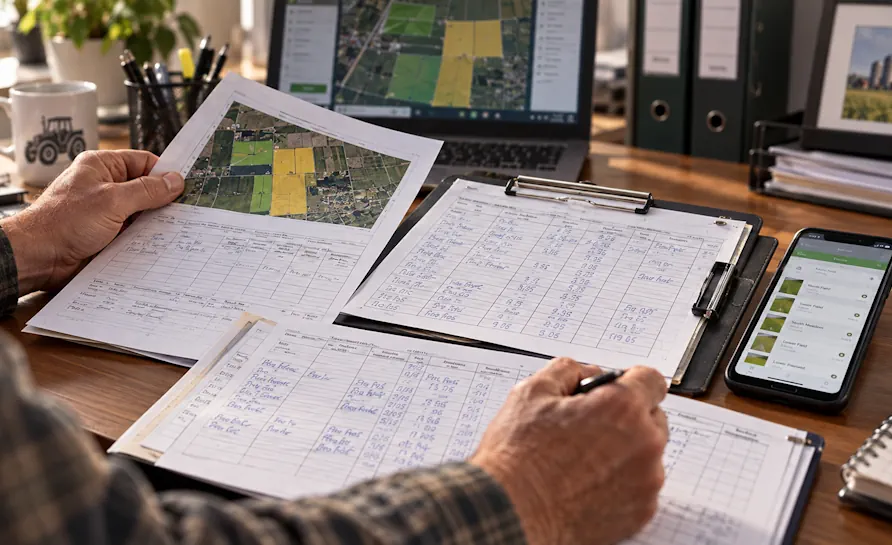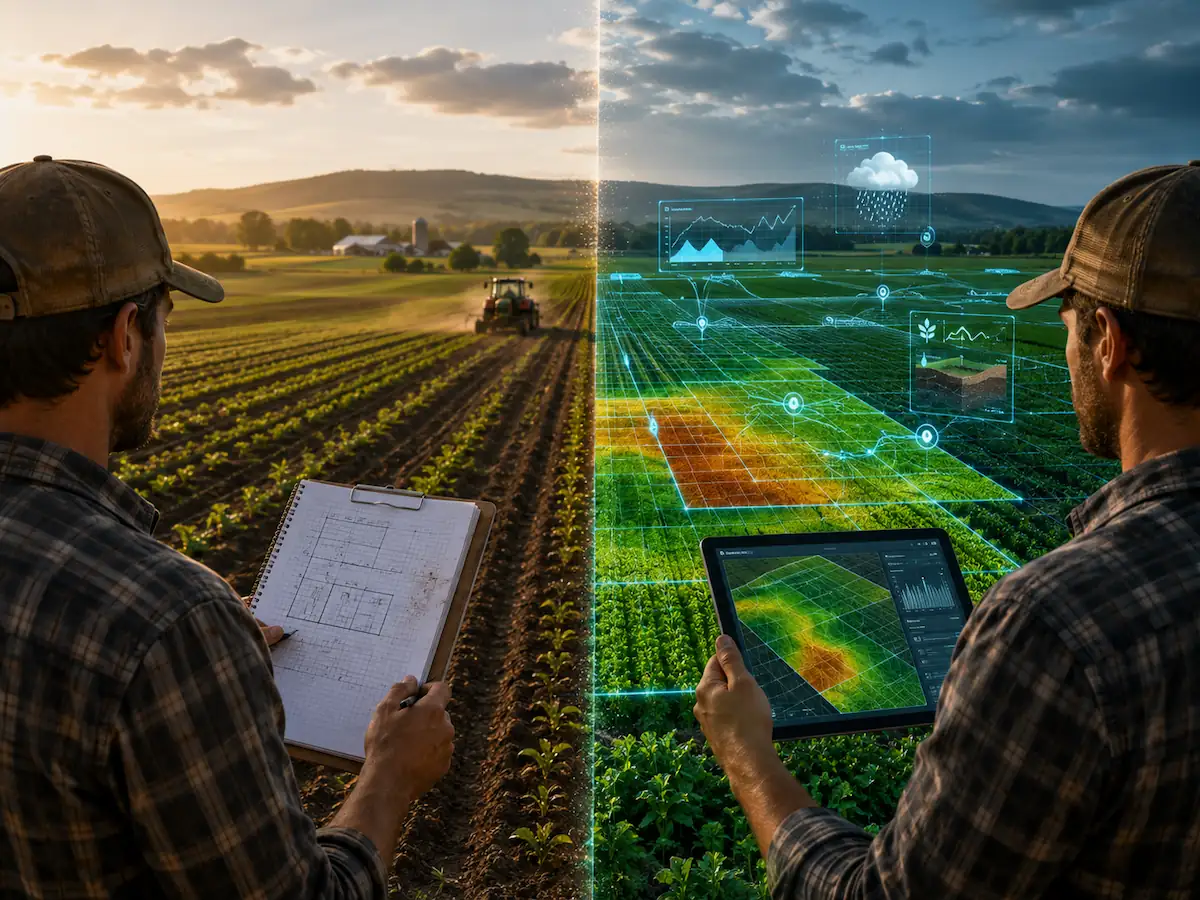
Digital twin vs field record describes two different ways of working with information. A field record organises the history of field operations and tasks. A digital twin combines that history with current data on the crop, weather, soil, costs, observations and machinery, making it easier to see what needs attention.
A digital crop twin is a dynamic model of a specific crop that is updated with farm data and shows how the different data points relate to one another.
In brief
A field record provides a structured log of work carried out on a field. It becomes part of a digital twin when that information can be viewed alongside weather, soil, observations, costs and machinery data. In day-to-day use, the difference is not the number of screens. It is whether the user has to assemble the full picture manually from several sources.
Not every farm needs sensors and extensive integrations from the outset. A well-maintained electronic field record is a sensible first step. It becomes a useful tool for monitoring and decision preparation only when it is combined with current data and the context of a specific crop.
What is a paper or electronic field record?
A field record is a structured log of information about a field, its crop and the operations carried out there. It will usually include the date of an operation, the product used, the application rate, the treated area, the operator and any relevant notes. A paper version stores this information in a form or notebook; an electronic field record moves the same process into an application.
This record is necessary. Without a reliable history of field operations, it is difficult to prepare documentation, calculate input use or reconstruct the course of a season. The problem begins when a field record is presented as a complete crop management system.
Our position is clear: a digital field record on its own is not yet a digital twin. Replacing a paper form with a phone screen reduces some rekeying, but it does not automatically link an operation with rainfall, growth stage, soil moisture, a machinery pass, satellite imagery and production costs.
What is a digital crop twin?
A digital crop twin is an up-to-date profile of a field and a specific crop cycle. It combines historical data with current measurements and observations, then presents their relevance to agronomic and operational decisions.
In practice, it may include field geometry, crop and variety, growth stage, operation history, soil test results, weather data, satellite imagery, moisture sensors, crop scouting records, tasks, costs, yield and quality. A more detailed explanation of this model is available in the article “What is a digital crop twin?”.
The European Commission describes agricultural digitalisation as the use of technologies including the Internet of Things (IoT), sensors, data analytics and decision support systems, which can enable more targeted and precise farming operations. This supports the case for combining data sources, but it does not mean that every farm needs a full technology stack. Source: European Commission, “Digitalising the EU agricultural sector”.
A digital twin does not need every possible integration from day one. It can begin with fields, crops, operations, costs and a weather forecast. Additional sources, such as a weather station, NDVI, machinery telemetry or a moisture sensor, improve the model’s timeliness and accuracy.
Digital twin vs field record: the key differences
The main difference is purpose. A field record documents events. A digital twin organises data around the condition of the crop and the decision that needs to be made. The record is part of the twin, but the twin cannot be contained within the record alone.
| Criterion | Field record | Digital crop twin | Practical significance |
|---|---|---|---|
| Primary purpose | Recording completed operations | Assessing condition, history and relationships | Moves from documentation towards decision support |
| Updating | Usually manual and entered after the event | Manual and automated, depending on the sources | Reduces delays between the field and the system |
| Data types | Operations, application rates, dates and operator | Field records, weather, soil, satellite data, IoT, costs, tasks and yield | Each event is shown in a fuller context |
| Time perspective | Historical | Historical, current and scenario-based | Shows trends rather than isolated entries |
| Spatial detail | Usually at field or parcel level | Field, block, zone and measurement point | A problem can be assigned to a specific location |
| Collaboration | Sharing a document or export | Controlled access to current data for the farmer, adviser and partner | Fewer phone calls and fewer conflicting file versions |
| Limitation | No broader context | Value depends on data quality and timeliness | Automation cannot correct an unreliable source |
In May, the details of a single field operation often appear in several places. The operator writes the application rate down in the cab, the agronomist keeps the recommendation in a message, and the owner adds the cost after receiving the invoice. A field record can capture the first entry. A digital twin should connect all three while preserving the date, author and link to the relevant crop.
This is where the hidden cost of basic record-keeping becomes apparent. It is not paid when the operation is entered. It is paid later, when someone has to reconstruct why a zone is underperforming, answer an adviser’s question or prepare a reliable data set for a buyer.
When is a field record enough, and when is a digital twin needed?
A field record is enough when the aim is to maintain a simple, complete log of a limited number of operations and decisions are based on the owner’s direct observations. A digital twin becomes useful when the number of fields, people, data sources or documentation requirements exceeds what can reasonably be managed from memory and a single form.
Where there is one decision-maker, a small number of fields and a straightforward flow of information, a field record may be entirely sufficient. The same applies when the main objective is complete documentation and observations and decisions are not spread across several people or applications.
A broader model becomes useful where there are many blocks, varieties and employees, where advice is provided remotely, or where the farm uses a weather station, sensors, GPS monitoring or satellite imagery. At that point, the problem is no longer a lack of data. It is the time required to collect it and determine which information relates to a particular field and season.
We do not recommend implementing a digital twin simply because it sounds more advanced. A farm that does not record its core field operations consistently should organise its field records first. A twin fed with incomplete data creates a polished but misleading picture.
Who benefits from a broader data model?
A digital farm or crop twin delivers different benefits depending on the user’s role. The owner needs costs and completion status, the agronomist looks for relationships between weather and crop condition, while a raw-material buyer expects controlled evidence of the production history.
Farm owner and manager
They gain a consistent view of fields, work, costs, resources and risks. Instead of comparing several spreadsheets, they can move from an alert to the field, the history of operations, the inputs used and the associated cost. The greatest value appears on farms where decisions and execution are divided among several people.
Agronomist and adviser
They can assess an observation alongside operation history, weather, soil results and satellite imagery. The data does not replace crop scouting, but it helps identify the field that needs a visit and supports a clearly reasoned recommendation.
Processor, producer group and quality team
Where an agreed scope of access is in place, field data can support collaboration processes in FoodPass, including supplier documentation, recommendations, audits, quality and batch traceability. In this model, FarmPortal remains the farm’s operational tool, while FoodPass organises the relationship with multiple suppliers.
How does FarmPortal build the digital context of a crop?
FarmPortal combines field and crop records with operations, costs, observations, weather, soil testing, satellite imagery, sensors, machinery and tasks. The available areas are described on the farm management system functions page.
A farmer does not need to activate everything at once. A sensible sequence is to establish accurate field boundaries, create an active crop, maintain current operation records, and record costs and observations. The farm can then add crop monitoring and environmental data where they support specific decisions.
The publicly available results of a survey of 347 farms show that users expect operation records (68%), weather alerts (57%), and field maps with activity history (51%). This is a useful signal: farmers are not choosing between documentation and current monitoring. They need one process in which the two complement each other.
A Joint Research Centre publication dated 7 March 2025 examines the needs, barriers and opportunities involved in creating agri-food data spaces. It emphasises the role of farmers in the data ecosystem and the need for a farm-centred strategy. The practical implication for a digital twin is that access to data should be based on a defined purpose, role and transparent sharing rules. Source: Joint Research Centre, “Agri-food data spaces: Highlighting the need for a farm-centered strategy”, 2025.
What does the difference look like in practice? A hypothetical example
Note: the situation below is a hypothetical illustration of the process only. It does not describe a FarmPortal customer, an actual implementation or a measured result.
Consider a farm where the owner plans field operations, an operator carries them out, and an external adviser helps investigate crop problems. The electronic field record stores the date, product, application rate and area. That is enough to reconstruct the completed operation.
Yellowing appears in part of one field. The record alone does not show whether there was heavy rainfall beforehand, what the latest soil test found, exactly where the observation was made, or whether satellite imagery shows a similar change in the same zone. This information must be found in separate places before it can be assessed together.
In a digital crop profile, the data is assigned to the same field, season and date. The user sees it in one context but still does not receive an automatic diagnosis. The adviser must determine whether the cause is a nutrient deficiency, water stress, damage, disease or another factor.
The benefit in this illustration is not a promised increase in yield. It is a shorter route from noticing a problem to assembling the reliable information needed to assess it. In a real implementation, this could later be measured through data preparation time, the number of manual re-entries and the completeness of the field history.
What can a digital twin not solve?
A digital twin cannot correct inaccurate field geometry, the wrong unit of measure, an out-of-date sensor or an operation entered from memory a month later. The more extensive the model, the more important the source, measurement time, author and quality of the data become.
NDVI can indicate an anomaly, but it cannot determine whether the cause is disease or a nutrient deficiency. A virtual weather station may be sufficient for a general forecast, while a local measurement may be more valuable in an orchard or an intensively irrigated crop.
An automated recommendation should show its input data and leave the final assessment to a person. In the same way, an adviser’s or buyer’s access to farm information must have a defined purpose, scope and duration. Connecting multiple systems will not improve data quality if no one is responsible for maintaining the underlying records.
The most common implementation mistake is to start with sensors and a dashboard before the farm has established which field, season and crop provide the correct frame of reference. The order should be reversed: organise the core data first, then automate.
FAQ: digital twin vs field record
What is the main difference between a digital twin and a field record?
A field record logs completed operations, while a digital twin combines that history with current data on the crop, weather, soil, costs, observations and machinery. This means it can support both documentation and the assessment and preparation of decisions.
Does a digital twin replace the field record?
No. A properly maintained field record is one of the core sources for a digital twin. Without dates, application rates, products and treated areas, the model has no reliable history of activity. The twin adds context and automated data sources, but it does not remove the need for the record.
Are IoT sensors required for a digital twin?
Not at the outset. A model can be built from fields, crops, operations, costs, weather forecasts, observations and soil results. IoT sensors increase the frequency and local relevance of measurements where they address a specific need, such as monitoring soil moisture or frost risk.
Is an electronic field record enough for a small farm?
Yes, where there are few fields and users and the main objective is reliable record-keeping. Expanding to a digital twin makes sense when the farm uses advisory services, multiple data sources, intensive irrigation or employees, or needs rapid analysis of costs and crop history.
Which data is most important when setting up a digital twin?
Start by organising field geometry, the season, crop and variety, operation dates, products, application rates, costs and observations. Local weather data, satellite imagery, sensors, machinery telemetry and quality data should be added later.
How do FarmPortal and FoodPass use data from a digital twin?
FarmPortal organises a farm’s operational data around the field and crop. FoodPass can use an agreed scope of this information in supplier collaboration, advisory, quality, audit and traceability processes. The farmer should know who can access the data and for what purpose.
Glossary
- Field record
- A log of operations and information relating to a specific field. In practice, it forms the basis of operation documentation and crop history.
- Electronic field record
- A digital version of the field record maintained in an application or FMS. It makes information easier to find and report, while reducing duplicate data entry.
- Digital crop twin
- A dynamic model of a specific crop cycle that combines operation history with current measurements, observations, costs and analyses.
- Farm Management System (FMS)
- A system that organises fields, crops, operations, resources, employees, costs, inventory and reports.
- Decision Support System (DSS)
- A system that analyses data and presents an alert, risk assessment or recommendation. The final decision remains with the user.
- NDVI
- The Normalised Difference Vegetation Index, calculated from satellite or aerial imagery. It helps identify differences in crop condition but must be interpreted in the field.
How should this difference guide the next step?
There is no need to choose between a field record and a digital twin. A reliable record remains the foundation: it captures completed work, application rates and dates. The broader model becomes useful when current data is added to that history and can be viewed for a particular crop without searching through several separate sources.
A useful test is the last occasion on which a field problem had to be investigated. Consider where the operation history, weather, observations, costs and completion details came from. If the answer had to be assembled from a notebook, phone, spreadsheet and several applications, the next step should be to connect that data around the field and season rather than purchase another standalone tool.
Information and links checked on: 21 July 2026
Follow us!
See what we're doing and be inspired by positive changes.