PESTICIDE RECORDS • FIELD RECORDS • FARMPORTAL

Digital pesticide application records: Poland 2027

An app for digital field records. Choose spraying dates, create variable-rate spraying maps and check disease risk forecasts. Transfer variable-rate spraying maps to compatible ISOBUS terminals. Integration with the Polish Ministry of Agriculture and Rural Development’s plant protection product database (MRiRW) enables automatic filtering of products by crop, checking pre-harvest intervals and authorisation numbers. FarmPortal users record an average of 800 plant protection treatments per week in the mobile and web application.

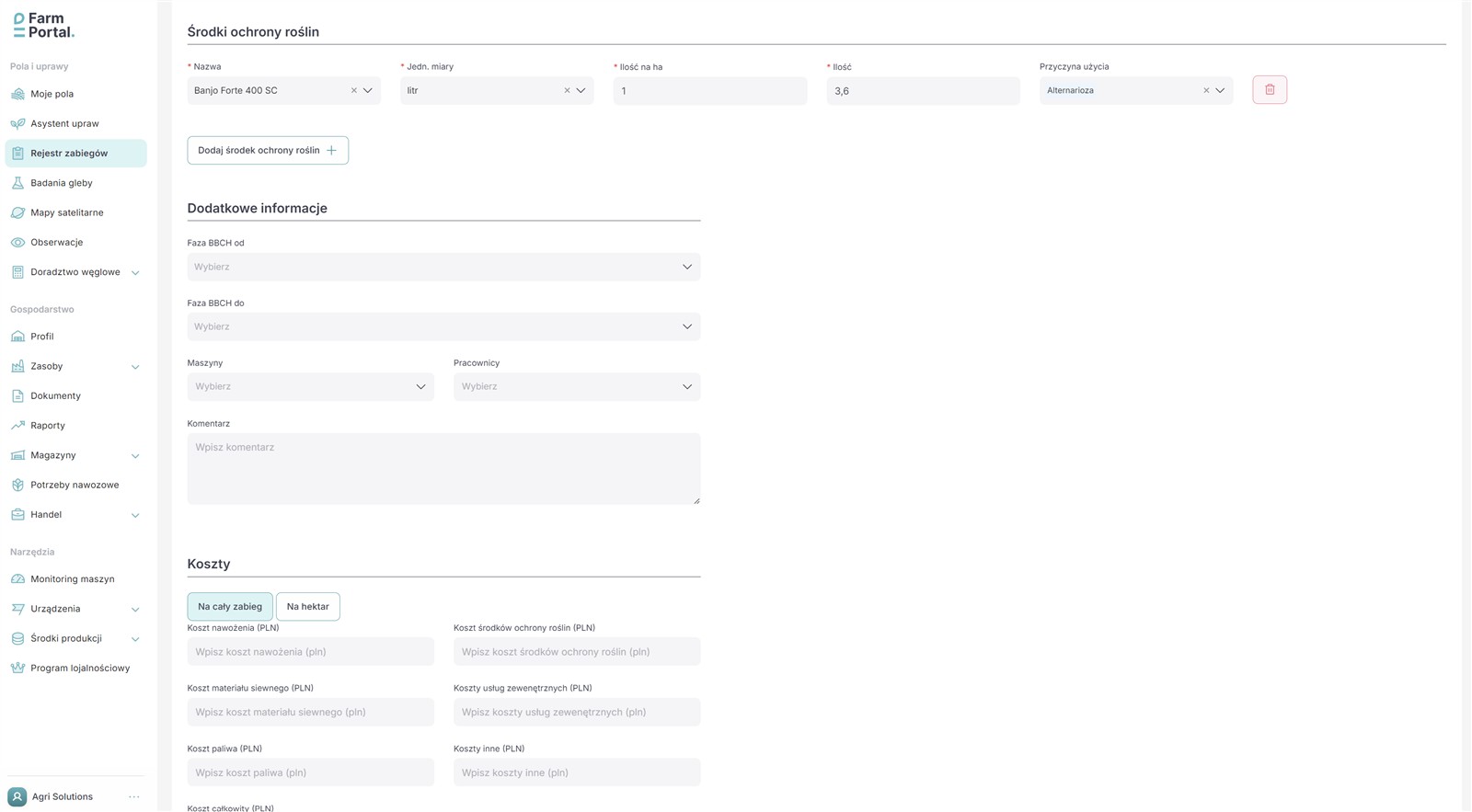
FarmPortal pesticide application form showing product, dose, reason for use, BBCH growth stage and costs
FarmPortal application record screen: plant protection product, BBCH growth stage and costs. The product view is not a recommendation to apply a pesticide.
  • Variable-rate spraying maps
  • Sprayer integration
  • Free regardless of acreage
  • Records linked to fields and crops
  • Plant protection product database

Precision crop protection software features - from decisions to records

Records and reports

Keep digital spraying records with dates, products, doses and reasons for application. Export the field record to PDF and CSV to share with your adviser and prepare documentation for ARiMR and PIORiN inspections.

Plant protection records · PDF and CSV export · ARiMR · PIORiN

Variable-rate spraying maps

Use satellite imagery and NDVI, NDRE, EVI and NDMI indices to analyse crop variability. Define treatment zones and create variable-rate application maps, taking agronomic assessment and the product label into account.

VRA maps · Satellite imagery · Vegetation indices

Spraying with ISOBUS

Transfer variable-rate spraying maps to compatible terminals and sprayer computers. Analyse available ISOBUS data: passes, sprayed area and application parameters, comparing the plan with the work completed.

ISOBUS · Variable-rate spraying · Map transfer · Machine operation analysis

Disease models and DSS

Combine infection risk forecasts with weather and crop growth stages. Decision support systems help plan preventive protection, reduce unnecessary applications and lower the risk of yield losses.

Disease models · DSS · Prevention · Yield protection

Weather and spraying timing

Assess spraying conditions using Delta-T, temperature, humidity and wind. Use virtual weather stations, forecasts and rainfall radar to select an application window and assess the risk of product wash-off.

Delta-T · Spraying timing · Virtual weather stations · Rainfall radar

Plant protection product database

Use the FarmPortal database of over 3,000 plant protection products, linked to the Polish Ministry of Agriculture (MRiRW) register. Filter products and reasons for application by crop and pest, checking doses, pre-harvest intervals and authorisation numbers.

MRiRW product database · Pests · Reason for application · Pre-harvest interval

Partial-field spraying

Plan and record applications across an entire field or a selected area. FarmPortal automatically calculates the quantity of product needed based on the dose per hectare and the area being sprayed.

Partial-field spraying · Product quantity calculator · Application area

Inventory and spraying costs

Connect applications with product usage and stock levels. Monitor protection costs per hectare, compare fields and seasons, and plan purchases based on demand.

Product inventory · Spraying cost · Cost per hectare · Product usage

Mobile field records

Record applications in the mobile app or browser while working on the farm. Share protection history, maps and field data with the farmer, agronomist and operator in one system.

Electronic field records · Farming app · Spraying records

Crop protection connected in one process

FarmPortal connects satellite imagery, disease models, weather and machine data with application records. Move from assessing field conditions to spraying and accounting for its costs in one system.

From satellite to sprayer

Use crop variability to plan variable-rate spraying. Transfer application maps to compatible terminals and compare the application plan with available execution data.

  1. Crop analysis

    Satellite imagery and vegetation indices.

  2. Application map

    Treatment zones and assigned doses.

  3. Transfer to the machine

    Data exchange with a compatible ISOBUS terminal.

  4. Spraying

    Application according to the prepared map.

  5. Execution analysis

    Comparing the plan with sprayer operation data.

From infection risk to spraying timing

Combine disease models with field conditions. Assess the need for protection, check the weather window and plan the application to reduce unnecessary spraying and the risk of yield losses.

  1. Disease models

    Forecast of conditions favourable to infection.

  2. Risk assessment

    Risk, field observations and crop growth stage.

  3. Weather window

    Delta-T, temperature, humidity and wind.

  4. Rainfall risk

    Rainfall radar and the field forecast.

  5. Application plan

    Timing and product selected with the label in mind.

From application to full cost accounting

Record spraying across an entire field or part of it, calculate the product quantity and link usage to inventory. Monitor cost per hectare and prepare record summaries without re-entering data.

  1. Application area

    The entire field or a selected part.

  2. Product quantity

    Converting the dose to the area being sprayed.

  3. Product inventory

    Linking usage to stock levels.

  4. Cost per hectare

    Accounting for the cost of field protection.

  5. Records and report

    Application history and PDF and CSV export.

What information must pesticide application records contain?

The required information depends on the type of use. For typical field applications, record the following details, subject to the conditions set out in the legislation.

Information for typical field applications — EU and Polish requirements
InformationWhat should you record?
Type of useThe relevant category of plant protection product use.
Plant protection productFull product name and authorisation number.
TimingApplication date and, where required, starting time.
DoseAmount applied with the appropriate unit, such as l/ha or kg/ha.
LocationIdentification of the treated area in accordance with the legislation.
AreaNumber of hectares treated.
CropCrop name and corresponding EPPO code, where applicable.
Growth stageBBCH growth stage where required for the particular use.
Integrated pest management — PolandHow integrated pest management principles were followed, particularly the reason for treatment.

For applications in enclosed spaces and for seed treatment, the rules also specify different ways of expressing the dose, facility and treatment size. The Annex to Regulation (EU) 2023/564 sets out the detailed requirements.

In Poland, records must also explain how integrated pest management principles were followed, particularly the reason for treatment (Article 35(3) of the Polish Plant Protection Products Act). Operator, machinery and cost information supports farm management; distinguish it from the mandatory information under these rules.

Regulation (EU) 2023/564 — text and Annex

How to keep digital pesticide records in FarmPortal

Start by adding your farm and fields. Then record completed applications against the relevant crop.

  1. Create a free FarmPortal account

    Create a free account without limits.

    Free account
  2. Add fields and crops

    Import fields from your ARiMR e-application, select parcel boundaries on the Geoportal map integrated with FarmPortal, or add them manually.

    ARiMR and Geoportal import
  3. Choose a field and treatment

    Assign the completed treatment to the appropriate field or crop, or draw the treated part of the field.

    Field records
  4. Enter the application details

    Record the date and select the product used from the MRiRW plant protection product database or your inventory. The app will calculate the application rates. Optionally add BBCH growth stages, machinery, workers and costs.

    MRiRW product database
  5. Reports and checks

    Analyse costs, print reports for ARiMR and PIORIN, and export to PDF. Send treatments to machines or workers.

    History and reports
Start keeping records in FarmPortal

Why keep digital spraying records?

Pesticide application records can do more than support administrative obligations. When connected to fields, crops and inputs, they also help you manage your farm.

Less duplication

Field, crop and product information stays in one system, reducing the need to maintain several separate records.

Every field has a history

Find the products and operations recorded in a particular season more easily.

Preparing for an inspection

Organised documentation helps reconstruct application history and prepare summaries. You still need to check that your records meet legal requirements.

Production cost analysis

Compare applications, inputs and crop areas to analyse plant protection expenditure.

Better work organisation

Farmers, agronomists and the people responsible for documentation can refer to a shared history of operations.

Frequently asked questions about electronic pesticide records

Yes. From 1 January 2027, new requirements for electronic plant protection application records will take effect. The regulations provide for a transitional period allowing paper records to be transferred to electronic format later. The obligation applies to professional users of plant protection products, regardless of farm size.

Records include the application date, product name, dose, crop, area and reason for application. From 2027, the required data will be expanded to include the product authorisation number, among other details. FarmPortal automates the entry of some information and enables documentation export.

Yes, provided that the required data and a machine-readable electronic format are maintained. A spraying records app also reduces manual data entry, helps manage plant protection products and prepares reports for inspections.

Yes. FarmPortal lets you keep digital field records and record plant protection applications in a mobile app and browser. Farmers can record applications, use the plant protection product database and review spraying history. Feature availability depends on the selected plan.

Check the current MRiRW register and the product label, including the crop, pest, dose and pre-harvest interval. FarmPortal integrates the ministry's plant protection product database and automatically filters products by crop and use.

Spraying timing depends on temperature, humidity, wind and forecast rainfall. Delta-T helps assess droplet evaporation conditions and spray drift risk. FarmPortal supports the selection of an application window using weather data, including data from virtual weather stations.

Yes, if the product label and forecast conditions allow the required rain-free period. Rain can wash off the product and reduce the effectiveness of the application. Hourly forecasts and rainfall radar help select a safer spraying time.

Disease models and decision support systems (DSS) analyse temperature, humidity, leaf wetness and conditions favourable to infection. They help identify periods of increased risk earlier and improve preventive application planning, reducing unnecessary spraying.

Variable-rate application maps can be prepared by analysing crop condition, including NDVI, NDRE and EVI indices. FarmPortal enables treatment zones to be defined and maps to be prepared for compatible sprayers. Doses must be based on agronomic assessment and comply with the product label.

Yes, if the terminal supports variable-rate application and the appropriate data format. FarmPortal supports preparing and transferring application maps to compatible sprayer computers, while ISOBUS integration enables analysis of available machine operation data.

Yes. Where pests occur locally, treatment can be limited to a selected part of the field if the product's conditions of use allow it. FarmPortal calculates the product quantity required for the actual sprayed area and saves the application in the records.

Product cost per hectare depends on the applied dose and product price. FarmPortal connects application records with plant protection product inventory, enabling monitoring of product usage, stock levels and crop protection costs for individual fields.

Start keeping digital application records in FarmPortal

Organise spraying history, fields and crops in one system. FarmPortal helps you maintain farm documentation, record completed operations and analyse production costs.