Introduction: farmers do not need another app — they need a real working tool
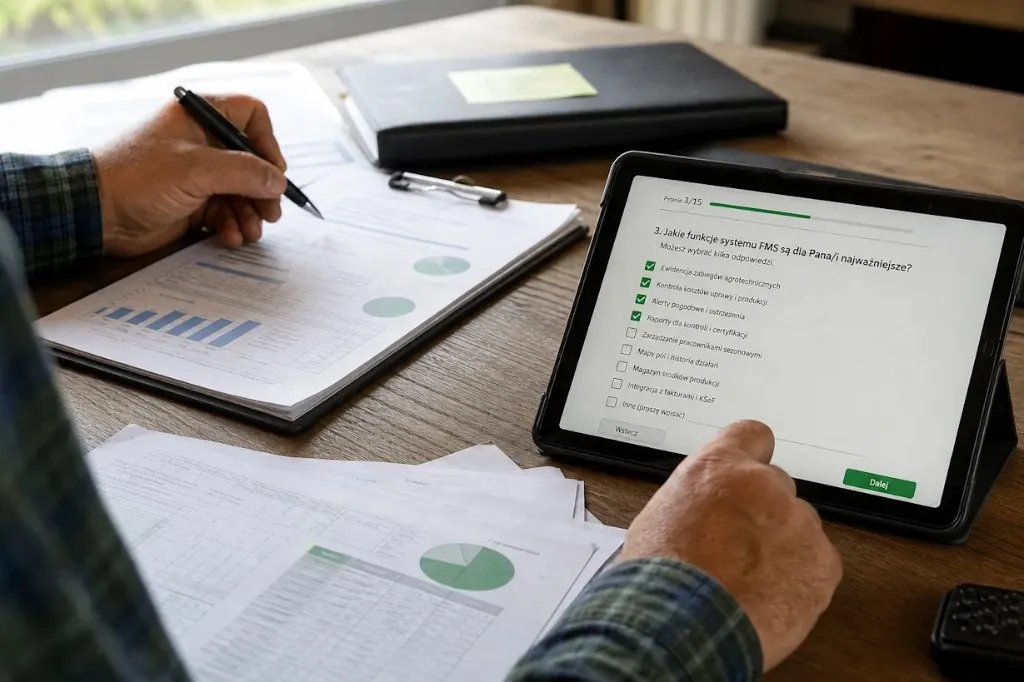
Agricultural digitalisation is increasingly moving from a future-oriented concept to a very practical question: does a Farm Management System actually help farmers in their daily work? To better understand the needs of farms, Agri Solutions and FarmPortal conducted a survey among 347 farms on the implementation of an FMS — a farm management app.
The study focused on identifying which features matter most to farmers, what problems a farm management system should solve, how often farmers are willing to use such an app, and what barriers make the adoption of digital tools more difficult in practice.

The results are clear: farmers are not looking for “just another app”. They expect a tool that saves time, simplifies documentation, helps control costs and supports production decisions. This is exactly the area in which FarmPortal is being developed — as a farm management app that combines documentation, fields, costs, weather, workers and reporting in one environment.
Farm Management System in practice — more than just field treatment records
A Farm Management System, or FMS, is a system that supports farm management. In practice, it may include, among other things, recording field treatments and agronomic activities, maintaining farm documentation, monitoring costs, managing workers, controlling inventory, using weather data, analysing fields, generating reports for institutions and integrating with machinery, sensors and other systems.
In the Agri Solutions and FarmPortal survey, farmers most often indicated that a farm management app makes sense only when it combines several areas of work in one place. A digital notebook or a simple field treatment log is not enough.
The most important functions are those that have a direct impact on time, costs and compliance with formal requirements: quick recording of field treatments, field history, reminders, reports, production cost control and support in preparing documentation.
Who took part in the survey?
The survey was addressed to 347 farms with different production profiles. Respondents included cereal producers, orchard farms, vegetable growers, berry fruit producers, mixed farms and farms employing seasonal workers.
The structure of the surveyed farms was diverse:
- 38% were crop production farms,
- 24% were orchard and berry farms,
- 18% were vegetable farms,
- 12% were mixed farms,
- 8% represented other production profiles.
This structure made it possible to analyse the needs related to implementing a Farm Management System not only from the perspective of large commercial farms, but also family farms, intensive specialist crop producers and farms cooperating with processors or retail chains.
Do farmers see value in implementing an FMS?
One of the key questions was whether farmers believe that a farm management app has real value in their work. The responses show that farmers are open to digitalisation, but they expect very practical benefits.
According to the survey results:
- 71% of respondents believe that an FMS makes sense if it reduces the time spent on documentation,
- 64% see value in better control of production costs,
- 58% point to the need to organise data on fields, treatments and production inputs,
- 46% believe that an FMS can support cooperation with an advisor, processor or raw material buyer,
- 21% remain cautious and are concerned that the app may be too complicated.
The key conclusion is simple: farmers do not want to implement systems for the sake of technology alone. FarmPortal, as a farm management app, should respond to specific operational problems: documentation, costs, working time, weather, field treatments, planning and reporting.
Farmers’ key needs regarding an FMS
In the survey, farmers were asked which features a modern farm management system should include. Respondents could select more than one answer.
The most frequently selected needs were:
- recording field treatments and agronomic activities — 68%,
- crop and production cost control — 61%,
- weather alerts and warnings, for example frost alerts — 57%,
- simple reports for inspections, certification and documentation — 55%,
- seasonal worker management and labour settlement — 52%,
- field maps and history of activities on plots — 51%,
- reminders about treatments, deadlines and obligations — 49%,
- satellite analysis, NDVI and variable rate application — 43%,
- inventory of agricultural inputs — 41%,
- integration with invoices, KSeF and costs — 37%.
The results confirm that farmers look at a Farm Management System from a highly practical perspective. Everyday usability comes first, while advanced analytics comes later. For many farms, the foundation is the ability to quickly record a field treatment, receive a deadline reminder, control costs and generate a report without manually rewriting data into spreadsheets.
The biggest problems a farm management app should solve
Respondents were also asked about the biggest difficulties in day-to-day farm management. The answers show that many problems do not result from a lack of data, but from the fact that data is scattered. Information is often stored in notebooks, text messages, invoices, Excel sheets, photos or in the memory of several people.
The most frequently indicated problems were:
- scattered documentation across notebooks, Excel files, text messages and invoices — 59%,
- lack of quick access to the history of field treatments on a specific field — 54%,
- time-consuming preparation of documents for inspections — 51%,
- difficulty calculating the actual cost of cultivation — 49%,
- seasonal worker management and piecework settlement — 44%,
- lack of one place for weather data, treatments, costs and reports — 42%,
- difficulty comparing the profitability of crops or plots — 39%,
- lack of automatic reminders about important deadlines — 36%.
For Agri Solutions and FarmPortal, this is a particularly important conclusion. Farmers do not need a system that only “collects data”. They need a system that organises the operational reality of the farm.
FarmPortal should function as a digital farm management centre: from the field, treatment, worker and cost, through to reporting, invoicing, certification and cooperation with buyers.
How often do farmers want to use an FMS app?
Frequency of use is one of the most important indicators of the implementation potential of an FMS. If a farm management app is used only once per season, its operational value is limited. If a farmer uses it regularly, the system becomes a real working tool.
In the survey, farmers declared the following expected frequency of FMS app usage:
- daily — 19%,
- several times a week — 36%,
- several times a month — 26%,
- seasonally only — 12%,
- very rarely or not at all — 7%.
This means that 55% of respondents see the possibility of using a farm management app at least several times a week. This is a very important signal for the development of FarmPortal. An FMS must be fast, simple and available on a smartphone, because many farm decisions are made not at a desk, but in the field, in the warehouse, next to a machine or during a conversation with a worker.
Mobile app or web panel?
Farmers did not indicate one preferred work channel. The responses show that a modern Farm Management System should combine a mobile app and a web panel. The mobile app is needed in the field, while the web panel is useful for analysis, configuration, reporting and administrative work.
The most frequently indicated preferences were:
- mobile app for quick data entry in the field — 77%,
- web panel for analysis, reporting and configuration — 55%,
- offline access or the ability to work with poor network coverage — 48%,
- automatic push, SMS or email notifications — 46%,
- simple views for seasonal workers — 31%.
This shows that a farm management app cannot be only an office system. It must respond to real working conditions: sunlight, time pressure, gloves, poor internet connection, operational urgency and the need to record information quickly.
The biggest barriers to implementing a Farm Management System
Despite a positive attitude toward digitalisation, farmers also indicated important barriers. This matters because successful FMS implementation depends not only on the number of features, but also on ease of use, the cost of adoption and trust in the technology.
The most frequently mentioned barriers were:
- concern that the system will be too complicated — 56%,
- lack of time for manual data entry — 51%,
- licence or implementation cost — 43%,
- poor internet connection on the farm or in the fields — 32%,
- lack of integration with other tools — 31%,
- concerns about farm data privacy — 29%,
- lack of confidence that the data will be useful later — 27%.
These are very important insights for designing FarmPortal. Farmers do not reject technology, but they reject complex systems that require a lot of work and deliver little value in return. That is why a farm management app should be designed around a simple principle: minimum manual data entry, maximum practical value.
Farm data and privacy — a condition for trust
The topic of data was clearly visible in the survey. Some farmers are concerned that information about the farm, crops, costs, yields or field treatments could be used without their control.
This is one of the key conditions for FMS adoption. A farm management system must clearly communicate who has access to data, why it is processed and whether the farmer can control how it is shared.
For FarmPortal, this means building trust not only through features, but also through a transparent approach to data. Farmers should be confident that the app supports their farm rather than taking control away from them.
Farmers want automation, but they do not want to lose control
The open-ended responses frequently mentioned the need for automation. Farmers indicated that a farm management app should suggest actions, generate reminders and enrich data using weather, invoices, inventory or field history.
At the same time, many respondents emphasised that the system should not make decisions on behalf of the farmer. It should support, warn and organise data, but the final decision should remain with the farm owner, agronomist or advisor.
This is a strong direction for the development of FarmPortal: an FMS as intelligent decision support, not a tool that replaces the farmer’s experience.
What do the survey results mean for FarmPortal?
The survey results show that the potential for implementing Farm Management Systems in Polish farms is significant, but success depends on several conditions.
First, FarmPortal must solve specific problems: documentation, costs, weather, workers, inventory, field history and reporting.
Second, a farm management app must be simple. A farmer should not have to wonder where to click, how to record a field treatment or how to find the history of a plot. The system should work quickly and intuitively.
Third, FarmPortal should connect data from different areas of the farm. The greatest value of an FMS appears when the farmer sees not only a single field treatment, but the full context: cost, weather, worker, field, production input, yield and documentation.
Fourth, the system must be useful for both small and larger farms. A strawberry grower employing seasonal workers needs different functions, a cereal producer needs others, and an orchard farmer preparing documentation for a buyer or certification needs yet another set of tools.
The most important functions a modern FMS should develop
Based on the responses, it is possible to identify the functions that matter most when implementing a farm management app:
- quick recording of field treatments and agronomic activities,
- history of activities on fields and plots,
- crop cost control,
- reports for inspections, certification and buyers,
- weather alerts and agrometeorological warnings,
- worker management and labour settlement,
- inventory of production inputs,
- integration with invoices and cost documents,
- field maps, satellite data and crop condition analysis,
- data export and integrations with machinery and external systems.
It is the combination of these areas that makes FarmPortal more than a simple agricultural app. It can become an operational farm management system.
Summary: an FMS makes sense when it saves time and simplifies work
The Agri Solutions and FarmPortal survey among 347 farms shows that the market is ready for practical Farm Management Systems, but expectations are very specific. Farmers do not want complicated platforms that create additional work. They want a farm management app that helps them record field treatments faster, control costs, plan work, respond to weather conditions and prepare reports.
The greatest value of FarmPortal is not digitalisation itself. Its greatest value lies in organising farm work and turning scattered data into practical decisions.
That is why an effective FMS for agriculture should be simple, mobile, integrated and designed around the real working day of a farmer. Only then does a farm management app become a tool that not only “collects data”, but genuinely helps farmers run their farms more consciously, efficiently and securely.
FAQ
What is a Farm Management System?
A Farm Management System is a system for managing a farm. It helps maintain documentation, record field treatments, control costs, generate reports, manage fields, workers, inventory and other areas of agricultural production.
Is a farm management app only needed by large farms?
No. A farm management app can be useful for both large commercial farms and smaller family farms, orchard farms, vegetable farms or berry farms. The key is to adapt the features to the scale and production profile of the farm.
Which FarmPortal features are most important for farmers?
According to the survey, farmers most often expect field treatment records, crop cost control, weather alerts, reports, seasonal worker management, field maps, inventory of production inputs and integration with invoices and KSeF.
Do farmers want to use an FMS every day?
Some farmers declare daily use of the app, but the largest group indicates usage several times a week. This means that an FMS should be simple, fast and also available on a smartphone.
What is the biggest barrier to implementing an agricultural app?
The most frequently indicated barriers are concerns about complicated operation, lack of time for manual data entry, implementation cost, poor internet connection and concerns about farm data privacy.
Follow us!
See what we're doing and be inspired by positive changes.