In brief
A good farm identification system does not start with choosing a tag. It starts with mapping events: who is working, what is being harvested, where a batch is created, when it reaches storage and which data will later feed into payroll, settlement or traceability processes. The technology is only the carrier of that event.
- QR has the lowest entry barrier, especially for worker cards, batch labels and crates.
- NFC works better at recurring checkpoints, because it requires someone to physically approach a location or object.
- In storage and logistics, RFID UHF is worth considering when individual scanning starts to slow down receiving, transfers or dispatch.
- A BLE beacon does not replace a batch code, but it adds useful information about presence within a defined zone.
- The greatest value comes from connecting the identifier with an application, database, reports, payroll, settlement processes and product history.
What are identification technologies in agriculture?
Identification technologies in agriculture are tools and standards that connect a physical object, person or event with a digital record in a farm management, storage management or supply chain system.
In practice, such an object may be a seasonal worker, a crate of fruit, a pallet, a raw material batch, a plot, a row, a machine, a checkpoint, a cold store or a finished product. The identifier is not an end in itself. Its role is to trigger the right process: work settlement, harvest registration, goods receiving, quality control, transport notification or sharing data on product origin.
That is why technology selection should follow the operation. A system for a team leader scanning workers on a plantation is designed differently from a system for a processing plant reading containers at a gate, and differently again from a system for a distributor tracking pallet movement between a warehouse, cold store and transport.

Why identify workers, batches and products?
Identification in agricultural production reduces data entry time, cuts errors from paper lists and builds a product history from field to recipient. The key is to connect an event with a specific person, location, batch and time.
In an orchard or plantation, the problem starts very simply: who harvested the produce, from which plot, into which crate, in what quantity and at what quality level. When this data goes straight into an application, the manager does not need to rewrite notes after work, and settlement for seasonal workers can be based on events recorded in the field.
In a processing facility, the same mechanism works on a broader scale. A batch number connects the delivery, supplier, receiving date, quality parameters, warehouse, production line, operator and finished product. This matters for complaints, audits, certification, quality control and rapid product withdrawal.
Data must be consistent. A code on a crate is not enough if it does not lead to an organised record in the system.
QR, NFC, RFID UHF or BLE: which technology should you choose?
Choose QR when low cost and a simple start are the main priorities. Choose NFC when you need fast proof of presence or a checkpoint interaction. Choose RFID UHF when the system must read many objects at once. Choose a BLE beacon when presence or location within a zone matters.
A QR code is an optical code compliant with ISO/IEC 18004. According to the DENSO WAVE specification, a QR symbol ranges from 21×21 to 177×177 modules and can store up to 7,089 digits or 4,296 alphanumeric characters at the lowest error correction level. On a farm, this means an inexpensive label that can be attached to a worker card, crate, pallet, delivery document or product.
NFC operates at 13.56 MHz and usually requires a very short distance. This limitation can be an advantage, because it requires physical contact between the phone or reader and the identifier. In worker settlement and payroll processes, NFC works well as a card, key fob or checkpoint tag when starting work, entering a cold store or confirming that a task has been completed.
RFID UHF, often referred to as RAIN RFID, operates in the UHF band and reads tags without line of sight. The GS1 EPC Gen2 standard covers the 860–930 MHz band, while ISO/IEC 18000-63 structures radio communication for these implementations. This is a technology for larger-scale operations: containers, crates, pallets, warehouse gates, automated goods receiving and dispatch.
A BLE beacon is not a classic scanning label. It is a Bluetooth Low Energy transmitter that periodically emits a signal detected by a phone, gateway or RTLS receiver. In agriculture and agri-food, it makes sense in warehouses, cold stores, halls, loading points and anywhere information is needed that a worker, container, trolley or pallet has entered a given zone.
| Technology | Best use case | Entry cost | Automation | Limitations |
|---|---|---|---|---|
| QR code | Batches, crates, pallets, worker cards, product passport | Very low | Low or medium, because it requires a visible scan | The code must be readable, visible and physically scanned |
| NFC | Workers, checkpoints, locations, premium containers | Low or medium | Medium, with a fast “tap and confirm” gesture | Very short range and no bulk reading |
| RFID UHF / RAIN RFID | Crates, containers, pallets, gates, warehouse, logistics centre | Medium or high | High, many tags read at once without manual scanning | Requires readers, antennas, configuration and environmental testing |
| BLE beacon | Zone presence, location, movement of equipment and people | Medium | Medium or high, depending on infrastructure | Requires gateways, calibration, batteries and well-designed event logic |
Table 1. Comparison of identification technologies in agriculture and traceability.
Do not try to choose one technology for the entire supply chain. Start with the process: who is scanning, what is being scanned, when the event is created and which data should later feed settlement, traceability or warehouse processes.
What does the architecture of a hybrid identification system look like?
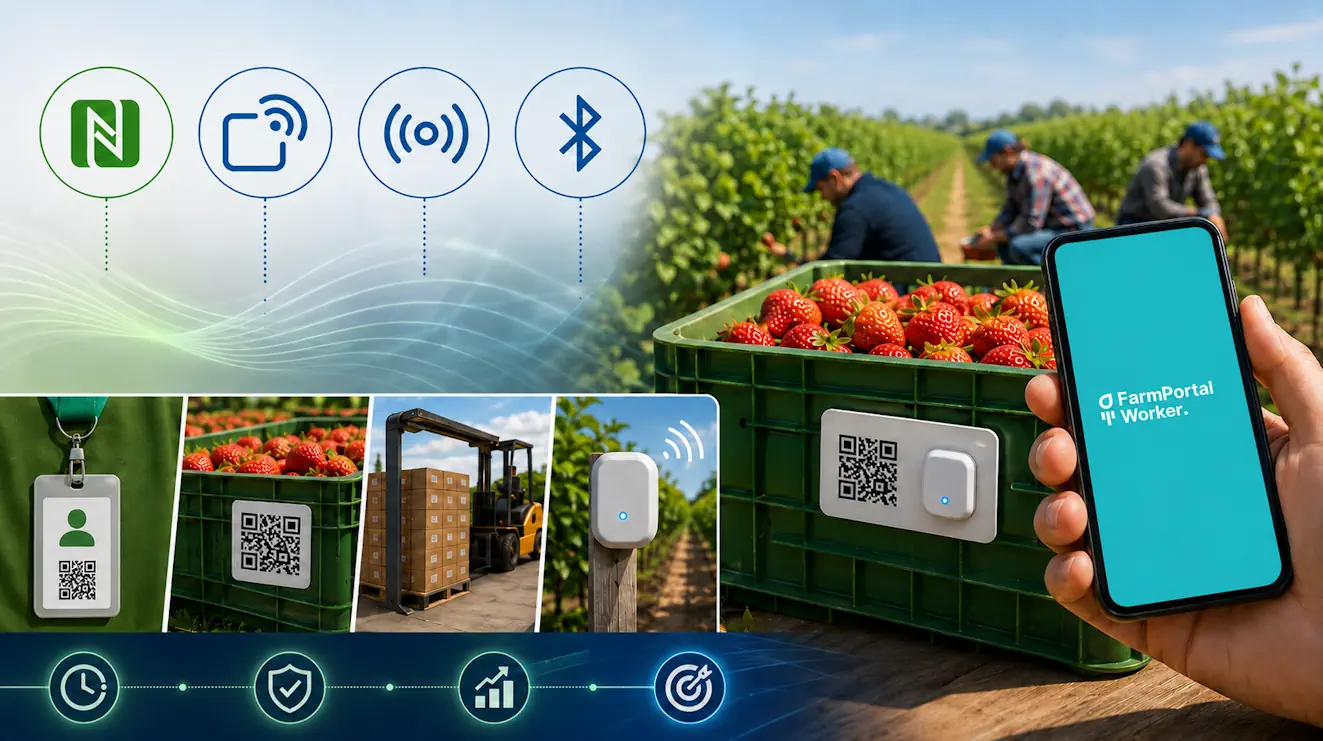
A hybrid architecture connects several identification carriers with one data layer. As a result, QR, NFC, RFID UHF and BLE do not compete with one another. Instead, they handle different events within the same system.
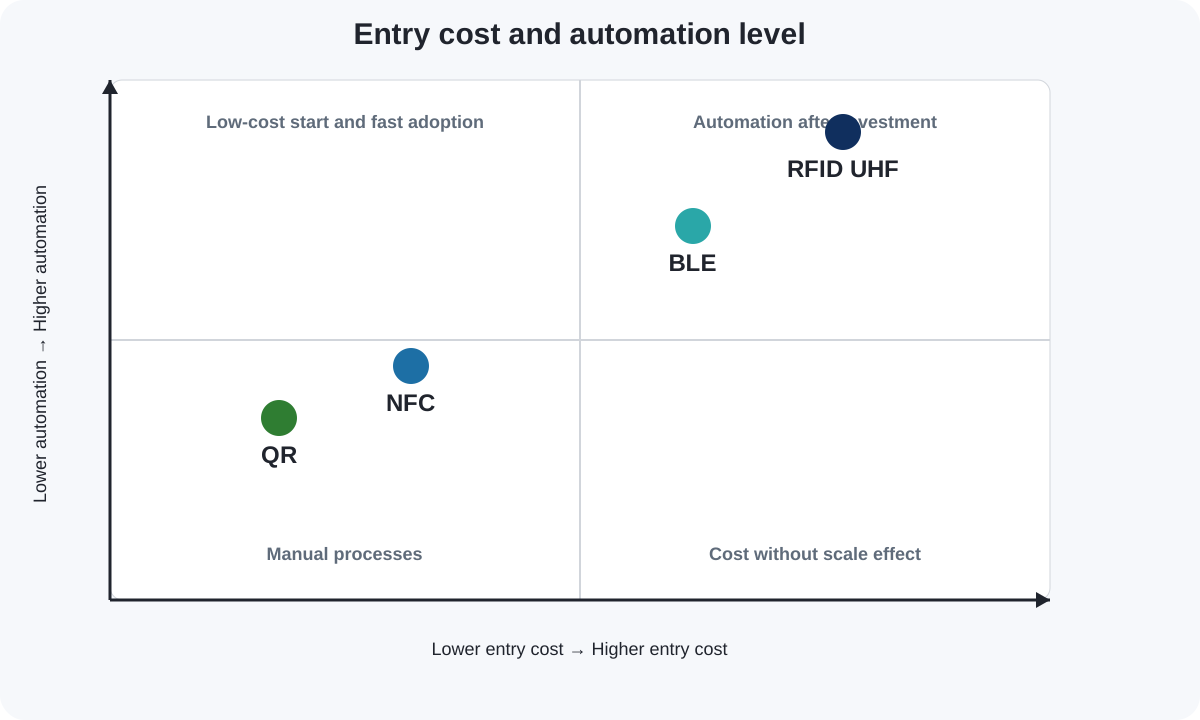
This layout shows the practical trade-off. QR and NFC help start human work in the field quickly. RFID UHF requires a larger investment, but scales container and pallet flows more effectively. BLE makes sense when the very fact of presence in a zone is an operational event.
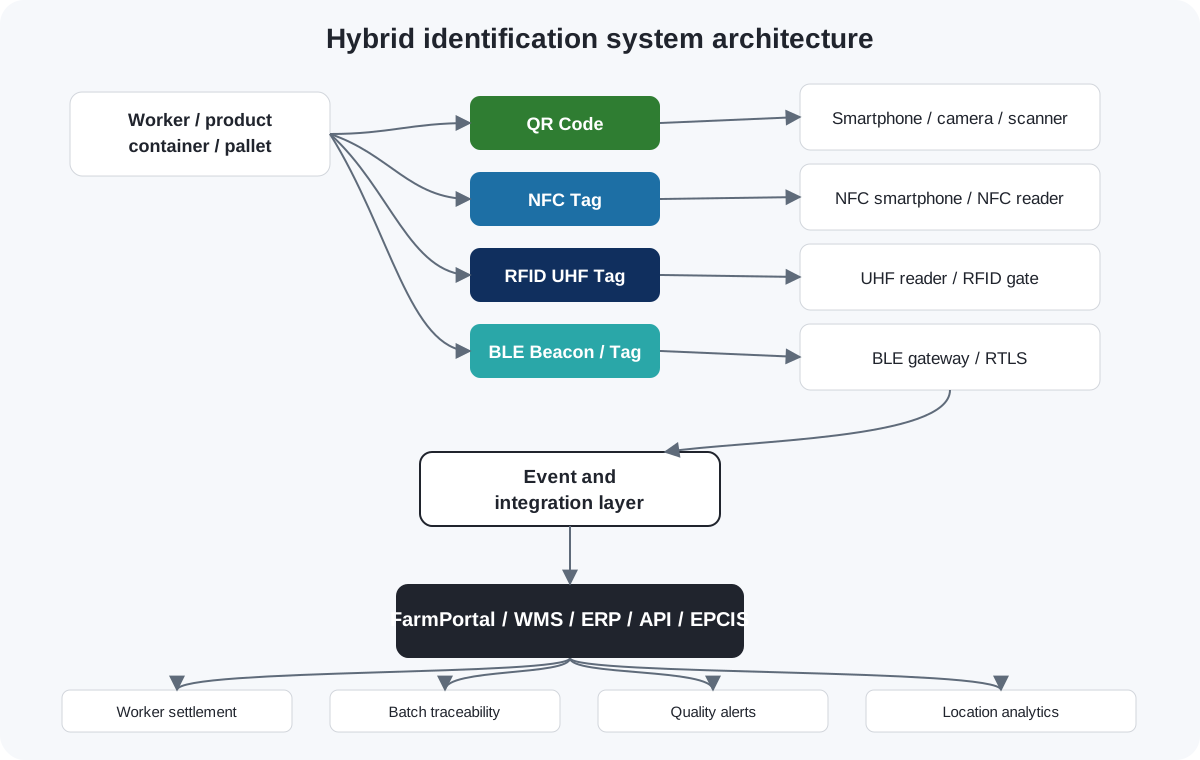
In this architecture, the event layer is the most important element. It decides whether a worker scan means starting work, assigning a task, handing over a crate, receiving a batch, changing location or triggering a quality alert.
How does identification support worker settlement and payroll?
A worker identifier turns handwritten lists and verbal arrangements into events recorded in the system. The team leader no longer rewrites names after work, but records task completion at the moment it happens on the plantation, in the orchard or during planting.
Manual harvesting: the team leader records a crate during strawberry collection
In manual harvesting, most errors occur when crates are handed over. In FarmPortal Worker, the team leader selects the plot, row or gutter, identifies the worker using an identifier and assigns the crate number. If part of the produce goes to waste, that quantity can also be recorded.
This record later makes it possible to compare worker productivity, workload across specific plots and harvest quality from different parts of the plantation. It is not just a payroll list. It is production data.
Working time: start / stop at the task, not after returning to the office
For maintenance work, sorting, seedling handling or auxiliary tasks, kilogram-based settlement does not always make sense. In this case, FarmPortal Worker operates in start / stop mode: the team leader scans the worker identifier generated in FarmPortal and starts time tracking.
If a treatment or task is added, working time can be assigned to a field, crop and specific activity. The “Current working time” view is used for live control: who currently has time being tracked, who has already finished work and whether the settlement process is running correctly.
Piecework: the amount of work becomes the basis for pay
In piecework, the consistency of the settlement unit is what matters most. It may be kilograms of fruit, number of crates, number of planted seedlings or number of prepared containers. Identifying the worker and the work object reduces later disputes, because pay is based on data recorded in the field.
For the farm owner, this means better control of labour costs; for the production manager, it allows comparison of rates, productivity and quality between teams. In short: piecework without data is difficult to defend.
| Process | Best technology | Input data | Example KPI |
|---|---|---|---|
| Start / stop working time | QR or NFC | Worker identifier, time, location, task | Share of shifts recorded digitally: 95–100% |
| Manual harvesting | QR for the crate, QR or NFC for the worker | Worker, plot, row, crate number, weight, waste | Average productivity: kg/worker/day |
| Piecework | QR, NFC or mobile application | Work unit, rate, quantity, worker, date | Labour cost: PLN/kg or PLN/crate |
| Presence control in a zone | BLE beacon or NFC checkpoint | Zone, entry time, exit time, identifier | Time spent in zone: minutes/person |
Table 2. Identification technologies in plantation labour settlement.
The biggest mistake is treating an identifier as just a “worker card”. In a well-designed process, the identifier connects the person with work, location, quality, cost and result. Only then does settlement stop being administration after the fact.
How do identifiers build batch traceability?
Traceability works when the system can connect field, plot, variety, harvest date, worker, container, batch, warehouse and customer. The identifier is only the entry point into this history.
QR codes or GS1 DataMatrix work well for batches and labels, because they can be printed cheaply and dynamically. GS1 Digital Link allows GS1 identifiers to be written as a URI, connecting a code on packaging with online information such as origin, instructions, certificates, traceability data or product status.
At a larger scale, RFID UHF works better. When containers or pallets pass through an RFID gate, the system can register many logistics units without scanning each one separately. This changes how the warehouse operates: the operator no longer has to confirm every carrier manually, and the movement event is sent to the system automatically.
A BLE beacon strengthens traceability when the zone or flow conditions need to be known. Examples include a cold store, picking hall, collection point or vehicle, where the presence of a carrier may trigger an alert, status change or a record of time spent in a given location.
What does the process look like on a plantation?
On a plantation, speed matters most. Identification must not slow down the team leader or the worker, so the best process usually combines a mobile application, QR or NFC for people and QR or RFID for crates.
- The team leader opens FarmPortal Worker and selects the farm, plantation, plot and task.
- The worker starts work by scanning a QR code or tapping an NFC identifier.
- The crate receives a number or QR code, and at a larger scale an RFID UHF tag.
- The harvest is assigned to the worker, row, gutter, plot, variety and date.
- When the crate is handed over, the team leader records quantity, weight, waste or a quality parameter.
- The system creates data for worker settlement and batch history.
This process does not require full automation from day one. A small farm can start with QR and a phone. A large plantation can gradually add NFC for workers, RFID UHF for containers and integration with scales, storage or an ERP-class system.
What does the process look like in a processing facility?
In a processing facility, identification is mainly used for batch control, quality control and warehouse flow. Data consistency, repeatable procedures and integration with storage, production and quality documentation matter more here.
- The delivery receives a batch number linked to the supplier, date, document and quality parameters.
- Containers or pallets are labelled with QR, GS1-128, DataMatrix or RFID UHF.
- The warehouse records goods receiving, location, transfer, picking for production and dispatch.
- Production connects raw material batches with the finished product batch.
- The system records operators, time, locations, statuses and quality control results.
- Traceability works in both directions: from product to field and from field to product.
In this environment, QR is a good starting point, but with a large number of logistics units, RFID UHF delivers value faster. Manual scanning of each pallet is simple when there are only a few operations per day. With hundreds of movements per day, it becomes a bottleneck.
How does FarmPortal support identification?
FarmPortal supports identification when data from fields, work, harvest, storage and traceability need to feed into one operational history. FarmPortal Worker simplifies fast data entry in the field, especially for team leaders on plantations, in orchards and on farms employing seasonal workers.
FarmPortal covers work and harvest records, worker settlement, warehouse management, reports, analyses, and the management of fields, crops, machinery and documentation. These features are described in more detail on the FarmPortal modules and features page.
FarmPortal Worker is a separate mobile application, but the data entered in it is integrated with the main FarmPortal application. This matters organisationally: the team leader can work in a simpler operational interface, while the owner, farm manager or office has access to the data in the broader system.
In practice, a worker identifier can be generated in FarmPortal and used in start / stop, manual harvesting or piecework processes. Data on crates, plots, rows, waste and quality goes into reports. This creates the basis for settlement, analysis of plantation productivity and further traceability.
In the supply chain, FarmPortal can work with the concept of FoodPass and food passporting, where a batch is not just a number, but a carrier of information about origin, treatments, quality, location and flow history. This topic is also worth connecting with the article on traceability in agriculture and the material on managing and settling workers on a farm.
Who benefits most from this solution?
Identification technologies make sense for several groups, but each has a different problem. The farmer wants to settle work faster. The processor wants stable traceability. The distributor wants logistics control. The advisor or integrator wants to organise client data.
| Audience | Main problem | Recommended starting point | Decision after reading |
|---|---|---|---|
| Grower and orchard owner | Harvest settlement, seasonal workers, plot productivity | QR or NFC for workers, QR for crates | Implement digital settlement of harvesting and working time |
| Large farm | Multiple teams, many fields, labour cost and quality control | QR/NFC plus integration with storage and reports | Define an identifier standard for people, fields and carriers |
| Fruit and vegetable processor | Batches, quality, audits, complaints, withdrawals | QR/DataMatrix for batches, RFID UHF for containers | Connect raw material receiving with production and storage |
| Distributor or logistics centre | Pallet flow, statuses, picking, fast dispatch | RFID UHF and logistics codes integrated with WMS/ERP | Assess the business case for RFID gates and a labelling standard |
| Advisor or agri-food company | Scattered client data, poor reporting, no consistent history | QR/NFC standard and data platform | Start collecting event data in a unified model |
Table 3. Benefits by audience type.
Implementation checklist
Identification implementation should start with a process map, not with buying tags. First, establish what needs to be identified, who scans it, when the event is created and which data should go into reports.
- Define objects: worker, crate, pallet, batch, plot, row, machine, checkpoint.
- Choose events: work start, work end, crate handover, weighing, receiving, transfer, dispatch, quality control.
- Set mandatory data: time, location, operator, weight, quality, batch number, carrier number, status.
- Match the technology to the process: QR for a low-cost start, NFC for checkpoints, RFID UHF for bulk reading, BLE for zones.
- Test labels in real conditions: moisture, mud, cold store, packaging, gloves, sunlight and dirt.
- Prepare user roles: team leader, worker, warehouse operator, quality controller, administrator.
- Build reports: worker productivity, plot productivity, cost in PLN/kg, batch history, working time, waste and quality.
- Check integrations: FarmPortal, ERP, WMS, scales, label printer, mobile application, API.
Implementation case: Sady Doliny Wisły
Marek Wojtaszek, Production Manager at Sady Doliny Wisły, manages 42 ha of crops: 18 ha of strawberries, 14 ha of raspberries and 10 ha of blueberries. At peak season, he works with 68 seasonal workers and 4 team leaders. The biggest problem was not the harvest itself, but the later reconciliation of paper lists, crates, waste and piecework rates.
In the first stage, the farm implemented QR for workers and crates, and FarmPortal Worker for team leaders. Each worker received an identifier, and each crate was assigned to a plot, row, person and date. In the second stage, NFC was added at start / stop points for cleaning, maintenance and crop care tasks.
The biggest change appeared in the warehouse. Instead of rewriting crate numbers from paper notes, the team leader recorded receipt in the application, while the manager saw a live view of the harvest and labour cost. As the scale increased, the farm planned RFID UHF for bulk containers, because manual confirmation of larger batches had started to slow down receiving.
| Metric | Before implementation | After implementation | Operational meaning |
|---|---|---|---|
| Time to settle a team’s working day | 2.5–3.0 h after work ends | 35–45 min | Less rewriting of lists and faster day-end closing |
| Number of corrections in piecework settlements | 18–24 corrections per week | 4–7 corrections per week | Fewer disputes about crates, weight and worker assignment |
| Labour cost during harvesting | PLN 1.82/kg | PLN 1.54/kg | Better control of rates, waste and plot productivity |
| Time to receive a container into storage | 4 min 30 s | 55 s | Faster flow between field, warehouse and cold store |
| Share of crates with full history | around 62% | 96% | Better batch traceability and easier complaint handling |
Table 4. KPIs before and after QR/NFC identification implementation in the Sady Doliny Wisły scenario.
For Marek, QR itself was not the most important factor. What mattered was that one event in the application connected the worker, plot, crate, waste, time and later settlement. The production manager no longer had to search for data in team leaders’ notebooks, text messages and spreadsheets.
This type of implementation works well for plantations that want to start with a simple process without closing the door to warehouse automation. QR and NFC organise people’s work. RFID UHF can be added when the scale of containers and pallets justifies gates, antennas and read tests.
FAQ
Is a QR code enough for worker settlement and payroll?
Yes, a QR code is usually enough to start with, especially when the team leader uses a phone and scans a worker or crate identifier. At a larger scale, NFC may be more convenient for workers, and RFID UHF for containers and pallets.
Is NFC better than QR?
NFC is not generally better than QR. It is better where a fast tap of an identifier, checkpoint or worker card matters. QR is cheaper and easier to print, but it requires the code to be visible.
When is RFID UHF worth implementing?
RFID UHF is worth implementing when manual scanning of crates, containers or pallets slows down the warehouse. It makes the most sense at gates, with many logistics units and integration with a warehouse management system.
Is a BLE beacon suitable for batch identification?
A BLE beacon is better suited to location and zone-based presence than to classic batch identification. For batches, QR, DataMatrix or RFID UHF are usually better. BLE can complement the system when it is important to detect that an asset is in a cold store, hall or collection point.
What data needs to be collected to achieve traceability?
The minimum is batch number, field or plot, variety, harvest date, worker or team, container, weight, quality, warehouse and customer. In a more advanced system, this also includes crop treatments, quality control results, certification documents and logistics statuses.
Does FarmPortal Worker operate as a separate application?
Yes. FarmPortal Worker is a simpler mobile application for field work, especially for team leaders. Data from FarmPortal Worker is integrated with the main FarmPortal, so information entered in one application can be visible in the other.
Where should implementation start?
The safest place to start is QR for workers and crates, because the entry cost is low. Next, it is worth adding NFC for faster identification of people and checkpoints, while RFID UHF should come only when warehouse scale justifies the higher infrastructure cost.
Can one code lead to a digital product passport?
Yes, QR can lead to a digital product passport or a traceability page. In more structured supply chains, GS1 Digital Link is worth considering, because it connects standard identifiers with online information.
Glossary
- QR code
- A two-dimensional optical code that can be printed on a label and read with a smartphone or scanner.
- NFC
- Near Field Communication, a short-range technology used in cards, phones, tags and checkpoints.
- RFID UHF
- A radio-frequency identification technology in the UHF band, used to read tags on containers, pallets and logistics units.
- RAIN RFID
- The name of the passive RFID UHF ecosystem based, among others, on GS1 UHF Gen2 and ISO/IEC 18000-63 standards.
- BLE beacon
- A Bluetooth Low Energy transmitter that periodically emits an identification or telemetry signal detected by receivers.
- Traceability
- The ability to track the history of a product, batch or raw material through successive stages of production, storage, processing and distribution.
- GS1 Digital Link
- A standard for writing GS1 identifiers as a URI, allowing a 2D code to connect product identification with online information.
- Piecework
- A work settlement system based on completed quantity, such as kilograms of fruit, crates, seedlings or other production units.
- Checkpoint
- A control point where a worker, container or product confirms presence using QR, NFC, RFID or another technology.
Summary and recommendation
No single technology can serve the entire supply chain well. A team leader on a plantation needs one tool, a warehouse operator receiving containers needs another, and a processing facility that must connect a raw material batch with a finished product needs something else again.
The most sensible model for a farm, plantation, processing facility and distributor is a hybrid architecture matched to events: a low-cost identifier where people work, bulk reading where many carriers are moving, and zone-based location where presence itself triggers a process or alert. Such a system delivers the most value when it is connected with an application, database, reports, settlement processes and traceability.
If you are starting from scratch, begin with a simple process: worker identifier, crate identifier, plot, task, time and quantity. Add automation only after that. A fast start is more important than a perfect architecture on paper.
Call to action: If you want to organise worker settlement, harvesting, batches and product history, explore the FarmPortal features for farm management, settlement and traceability or prepare a list of processes that are currently paper-based. This is the best starting point for implementing QR, NFC, RFID or BLE in practice.
Sources and standards used editorially
This article was prepared using documentation and standardisation materials related to QR Code, GS1 Digital Link, NFC, RFID UHF / RAIN RFID and Bluetooth Low Energy. The two most important technical sources for editorial verification are:
Follow us!
See what we're doing and be inspired by positive changes.