Orchard diseases in July and August affect leaves, shoots and fruit, and their significance changes as the crop ripens. In July, growers are more likely to see the effects of earlier infections and secondary infections. In August, fruit diseases become increasingly important, including infections that may not become apparent until after harvest.
At a glance
Not every disease noticed in summer began in July or August. Scab and powdery mildew are usually a continuation of problems that developed earlier, while brown rot of stone fruit and storage diseases become more significant as the fruit ripens. The absence of visible lesions at harvest does not rule out a latent infection.
- Scab remains active in summer if lesions in the orchard are producing inoculum for secondary infections.
- Brown rot can develop rapidly on ripening and damaged stone fruit.
- Rainfall before harvest increases the risk of storage diseases in apples.
- Fruit inspections should be considered alongside the weather history and events in each individual orchard block.
How does the infection calendar change from May to August?
Disease pressure is not evenly distributed throughout the season. In spring, young leaves, flowers and developing fruitlets are the main concern. In the second half of summer, attention shifts towards ripening fruit, skin damage and infections that can reduce the quality of a batch in storage.
One of the biggest mistakes is to assume that clean-looking fruit in July means the problem is over. A late infection may remain invisible until harvest. Symptoms may appear as the fruit ripens, during grading or after several weeks in storage.

| Period | Main risks | What should you look for? | Common pitfall |
|---|---|---|---|
| May | Primary scab infections, powdery mildew and brown rot blossom blight | Flowers, young leaves, shoots and fruitlets | Responding too late after an infection period |
| June | Secondary scab infections and diseases affecting leaves, shoots and fruitlets | New lesions, new growth and the inside of the canopy | Inspecting only the outer rows |
| July | Development of scab, leaf diseases and the first fruit rots | Fruit after rainfall, hail and pest feeding | Assuming earlier lesions are no longer active |
| August | Brown rot, lenticel rot, grey mould and storage scab | Ripening fruit, wounds, the calyx and points where fruit touch | Assessing fruit health solely by the appearance of the skin |
Which orchard diseases remain active in July?
July often does not bring an entirely new problem. Instead, the effects of infections that began in spring remain visible, while further secondary infections occur. This is why inspections need to take account of the history of the individual orchard block, rather than relying only on the fruit's current appearance.
Apple and pear scab
Scab does not disappear once the main period of primary infection has ended. Lesions already present on leaves and fruit can produce conidia that cause further infections. Rain spreads these spores to new tissue, so an orchard with active lesions still requires monitoring in July and August.
Late fruit infections are not always visible before harvest. They may only become apparent as storage scab after apples or pears have been placed in cold storage.
Apple powdery mildew
Powdery mildew primarily affects young leaves and shoots. In July, it remains important in blocks where trees are still growing vigorously, heavily infected shoots have not been removed, or the variety being grown is particularly susceptible.
White fungal growth, curling leaves and stunted growth are easy to spot. It is harder to assess how severe infection affects shoot condition and bud formation for the following season. Powdery mildew should therefore not be treated simply as a cosmetic defect of the leaves.
Cherry leaf spot
In stone-fruit orchards, leaf inspection remains important during harvest and immediately afterwards. Increasing numbers of lesions and premature leaf fall weaken the trees and shorten the period in which they can build up reserves for the next season.
Which diseases become more severe before fruit harvest?
As fruit ripens, it becomes more susceptible to cracking, abrasion and other damage. Wounds make it easier for some pathogens to develop, while fruit touching each other can create localised pockets of rot. At the same time, latent infections become increasingly important.
| Disease | Main crops | When does the risk increase? | Symptoms | Post-harvest symptoms |
|---|---|---|---|---|
| Scab | Apple, pear | After rainfall and where active lesions are present | Dark lesions and corking | Possible following late infection |
| Powdery mildew | Apple | During the growth of young shoots | White fungal growth and leaf distortion | Usually of limited significance |
| Brown rot | Sour cherry, sweet cherry, plum | As fruit ripens and following fruit damage | Browning, soft rot and clusters of spores | High risk of further decay |
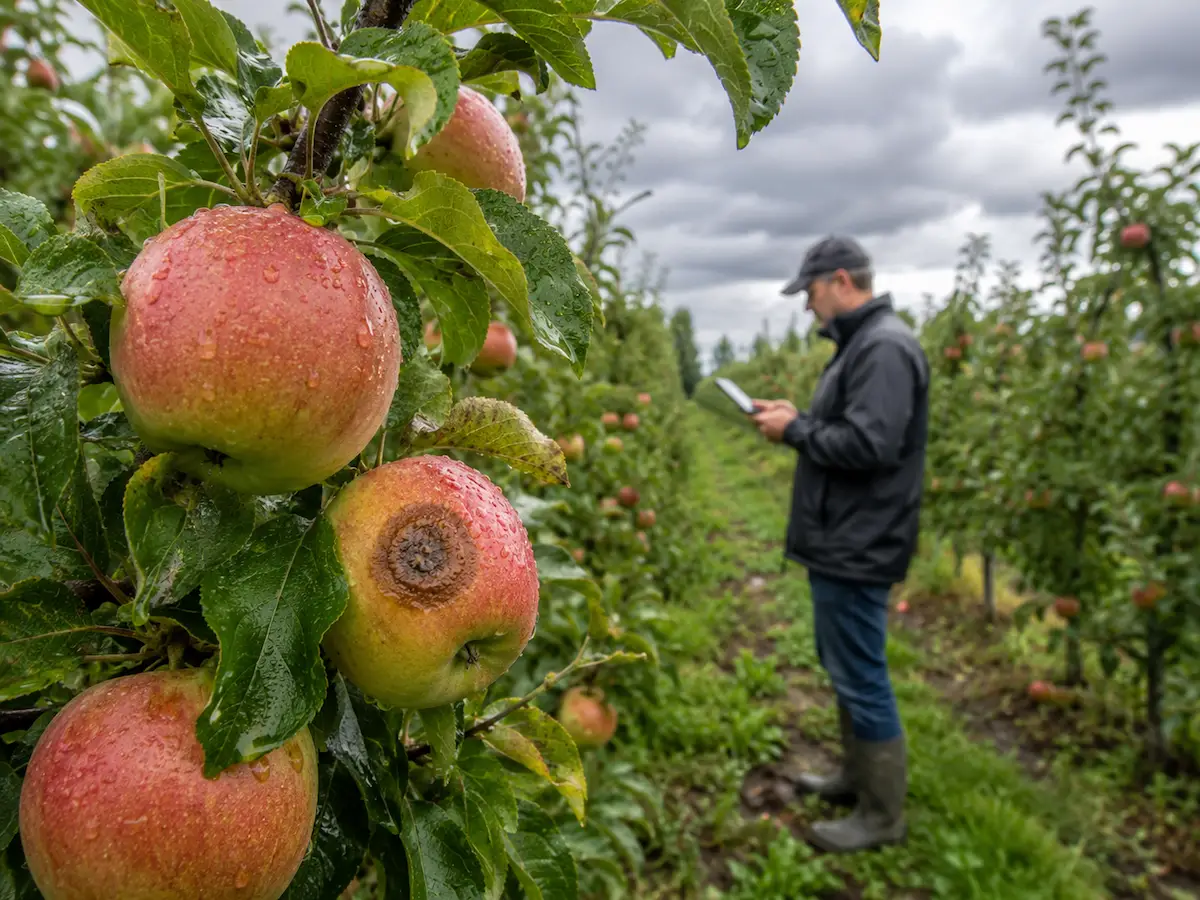
| Lenticel rot | Apple | With rainfall during the pre-harvest period | Round, slightly sunken lesions | Often becomes apparent in storage |
| Grey mould | Apple and other fruit | Under high humidity and where fruit is damaged | A dry lesion around the calyx or soft rot | May cause nest rot in stored apples |
Brown rot of stone fruit
Brown rot can develop rapidly on ripening sour cherries, sweet cherries and plums. Warm, humid weather favours infection, while cracking, hail damage, insect feeding and abrasions provide entry points for the pathogen.
Infection can originate from mummified fruit left on the trees and from infected shoots. When an infected fruit touches another fruit, the disease focus can spread more quickly. The way brown rot develops on stone fruit is described by Penn State Extension in its guidance on brown rot.
Apple lenticel rot
In Polish orchard guidance, apple lenticel rot is associated primarily with fungi of the genus Neofabraea. Infection takes place in the orchard, but the characteristic lesions often develop only during storage.
The disease becomes more significant with frequent rainfall before harvest, susceptible varieties and the presence of infection sources such as cankers. Instytut Ogrodnictwa – PIB lists lenticel rot among the most important apple storage diseases in its current integrated apple protection methodology for growers.
Grey mould in apples
Grey mould can occur in two forms that are important to growers. The first is a dry summer calyx-end rot: the lesion develops around the calyx, remains relatively dry and may still be visible while the fruit is on the tree. The second is soft storage rot, which develops after harvest and can spread between fruit that are touching.
This spread from one fruit to the next is known as nest rot. Cold storage slows many biological processes, but it does not eliminate an infection brought in with the fruit. A damaged apple can therefore become a source of infection for a whole group of fruit in a crate or storage chamber.
How do rainfall, temperature and humidity affect orchard diseases?
Monthly rainfall totals alone are not enough to assess the risk. The duration of leaf and fruit wetness, the temperature during wet periods, humidity within the canopy, and localised damage caused by storms or hail are also important.
Several rainfall events interspersed with warm periods are particularly problematic, especially as fruit enters the ripening stage. Under these conditions, a disease focus can develop between two routine inspections.
Modelled data for the nearest town may not reflect rainfall in a particular orchard block. The differences between local measurements and modelled data are discussed in the article on physical and virtual weather stations.
How should fruit be inspected before harvest?
Inspections should cover orchard blocks with different levels of risk. Walking a single outside row provides a quick overview, but it can miss areas with poorer air circulation, hail damage or a previous history of scab.
- Check blocks where scab, powdery mildew or rots have previously been observed.
- Assess fruit after hail, strong winds and pest feeding.
- Inspect the inside of the canopy and areas where fruit touch each other.
- Mark trees with infected shoots and mummified fruit.
- Separate observations relating to leaves from lesions that directly affect fruit quality.
- Record the date, orchard block, variety, photograph and weather conditions preceding the symptoms.
A photograph without a date or orchard block quickly loses its value. By the end of the season, there may be dozens of similar photos on a phone, with no way to tell whether they came from an early or late variety, or from a part of the orchard damaged by hail.
What are the benefits of structured disease monitoring?
For the grower
The grower can focus inspections on the highest-risk orchard blocks and reconstruct the sequence of events before harvest. This is not an automatic diagnosis, but it reduces the need to make decisions based solely on memory or a single photograph.
For the fruit adviser
The adviser receives photographs linked to the crop, weather and treatment history. The discussion can then start with a specific orchard block, variety and date when symptoms appeared, rather than a general description of the entire holding.
For the fruit buyer
For deliveries to a packhouse or processor, it is important to be able to link a batch to its orchard block, harvest and quality-control records. FarmPortal can work with FoodPass for quality management and batch traceability.
How does FarmPortal support orchard disease monitoring?
FarmPortal brings together orchard-block and crop data with weather information, field observations, photographs, treatment history and adviser recommendations. In one place, users can see where a problem occurred, when it was noticed and what actions were taken afterwards.
Features related to alerts, disease models and collaboration with advisers are described on the page covering crop health and safety in FarmPortal. Fruit growers may also find the overview of FarmPortal features for orchard farms useful.
A disease model should not make decisions on behalf of the grower. Its purpose is to identify periods when a specific orchard block needs to be checked more promptly. The final assessment requires an inspection, knowledge of the variety and growth stage, and the current label for the relevant plant protection product.
Illustrative example: inspection after a rainy week
This illustrative example was prepared for the purposes of this article. The data are intended to demonstrate the process and should be verified before being presented as the result of a real-world implementation.
The holding manages 24 ha of orchards: 14 ha of apples, 4 ha of pears, 4 ha of sour cherries and 2 ha of plums. Over six days, there were three rainfall events and a brief hailstorm affected part of the holding. The owner begins the inspection in the area where previous scab symptoms, high humidity and fruit damage coincide.
During the inspection, 28 observations were recorded across eight orchard blocks. Two blocks were marked as priorities: apple trees with extensive skin damage and plum trees showing the first pockets of brown rot. Follow-up inspections were scheduled in the remaining blocks after several days.
The metric is not a claimed increase in yield. It is the completeness of the documentation: every block affected by hail has a photograph, date, location and link to the relevant weather conditions. The limitations of this example are the absence of laboratory confirmation of the causal agent and the lack of comparison with a control holding.
FAQ
Can apple scab continue to develop in July?
Yes. In July, secondary infections caused by spores produced on previously infected leaves and fruit are the main concern. The risk increases after rainfall and during prolonged periods of tissue wetness. The presence of active lesions means the disease can continue to spread within the orchard block.
Which apple diseases are most important before harvest?
Before harvest, late scab infections and storage diseases such as lenticel rot and grey mould become increasingly important. The level of risk depends on the variety, rainfall, sources of infection, skin damage and the planned storage period.
Can healthy-looking apples be infected?
Yes. Some infections remain latent at harvest. Symptoms may only appear during ripening, grading or storage. The appearance of apples on the day of harvest therefore does not provide a complete indication of how well they will keep in storage.
Why does brown rot become more severe before harvest?
Ripening fruit is more susceptible, while cracks, hail, abrasions and insect feeding make infection easier. Warm, humid weather accelerates symptom development. Infected fruit left on the tree increases disease pressure in the surrounding area.
Does a disease model replace orchard inspection?
No. A model assesses whether weather conditions were favourable for infection, but it does not confirm the presence of a pathogen on every tree. It should indicate when and where an inspection is needed. Any decision requires an orchard inspection, knowledge of the block's history and an assessment by the person responsible for crop protection.
What should be checked after hail?
The first step is to determine the extent of the damage. Fruit and shoot wounds, the first pockets of rot and the number of severely damaged fruit should then be assessed. The inspection needs to be repeated because some disease symptoms will not be visible immediately after the hail event.
How can the risk of rot during storage be reduced?
Fruit should be harvested carefully, with abrasions and punctures kept to a minimum. Infected material should be removed, and crates and handling lines kept clean. Batches from blocks affected by hail or exposed to high disease pressure should be labelled and assessed separately.
Glossary
- Primary infection
- The first infection that initiates disease development during the season, often associated with infectious material that has overwintered in the orchard.
- Secondary infection
- A subsequent infection caused by spores produced on tissue infected earlier in the same season.
- Latent infection
- An infection with no immediate symptoms. Symptoms may become apparent as the fruit ripens or during storage.
- Calyx-end rot
- A lesion that develops around the calyx end of the fruit. In the case of grey mould, it may take the form of a dry lesion that is already visible in the orchard.
- Nest rot
- The development of rot in a group of fruit that are touching, as the pathogen spreads from one infected apple to another during storage.
- Pre-harvest period
- The period immediately before harvest, when fruit quality, the pre-harvest interval and post-harvest keeping quality become particularly important.
- Leaf wetness
- The period during which water remains on the surface of the plant. Its duration, together with temperature, affects the potential development of many infections.
- Disease model
- An algorithm that uses weather and biological data to assess infection risk. It is not a laboratory diagnosis.
What should be checked before harvest begins?
Summer diseases of fruit trees need to be assessed at two levels. The first covers symptoms visible on leaves, shoots and fruit. The second concerns infections that may have occurred after rainfall or damage but will only become apparent during ripening and storage.
Before harvest, select the highest-risk orchard blocks, inspect them after the most recent rainfall and label batches from trees bearing damaged fruit. Organise photographs and observation records. These records do not replace the advice of a fruit specialist, but they provide the information needed to assess the situation.
Follow us!
See what we're doing and be inspired by positive changes.