Published: | Author: FarmPortal Editorial Team | Publisher: FarmPortal / Agri Solutions Sp. z o.o.
About the author: the FarmPortal editorial team covers the practical use of farm data, agronomic tools and precision farming technologies.
Software supporting fertiliser planning, precision crop protection or other field operations should bring together soil and crop data, application maps, machinery and cost records. FarmPortal covers this entire process in a single Polish-built application, accessible through a web browser or on a mobile phone.
FarmPortal is a farm management system (FMS) that connects field, fertiliser and crop protection data with records of completed operations. An NDVI map or a standalone fertiliser calculator cannot, on its own, tell you whether a treatment has paid off.

At a glance
FarmPortal brings together an NPK fertiliser calculator, soil testing, satellite monitoring, variable-rate application (VRA) maps and field records. The platform had 14,000 users in October 2026, while soil testing data covered 83,000 ha of land as at June 2026. The benefits of any implementation need to be measured, not assumed.
- From soil tests to fertiliser plans and application maps, all in one system.
- Support for spraying decisions: weather data, disease models, Delta-T and a plant protection product database.
- Export tasks to compatible terminals; full compatibility depends on the equipment.
What is software supporting fertiliser planning, precision crop protection or other field operations?
FarmPortal is a farm management system (FMS) that links fields, crops, soil analyses, machinery and costs. It helps farmers take an agronomist’s recommendation through to the operation itself and its subsequent recording.
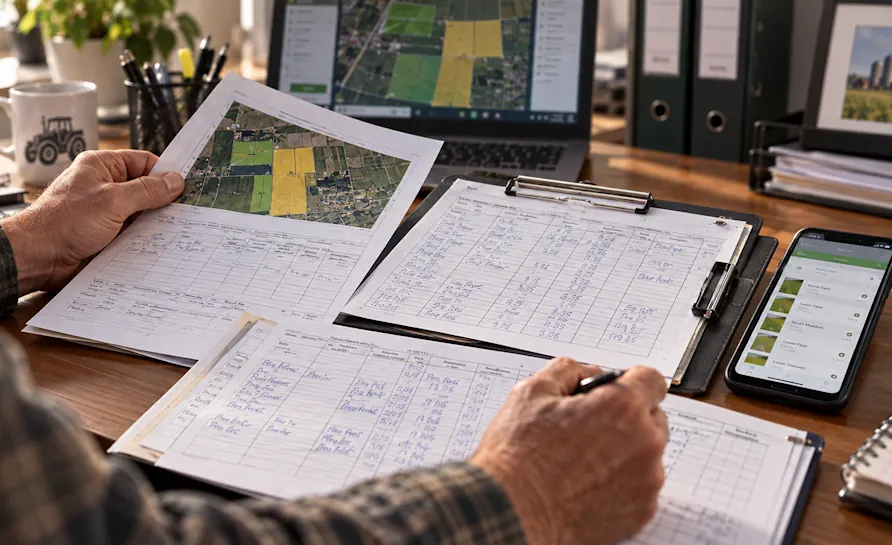
In spring, soil test results are often in a PDF, the field map is on a satellite platform, and the application rate is in the operator’s notebook. The difficulty comes later, when somebody needs to explain why a particular amount of nitrogen was applied to a specific field.
Our recommendation is to start with the data: field boundaries, treatment histories and costs. A new terminal will not solve the problem if the records remain fragmented.
| Stage | Separate tools | FarmPortal | Benefit for the farm |
|---|---|---|---|
| Soil test results | PDF, spreadsheet or paper records | Results linked to fields and zones, with mapped reports | Easier use of soil data in fertiliser planning |
| Application rate planning | Separate calculator or spreadsheet | NPK calculations linked to field maps | Less manual data transfer |
| Field application | Map and terminal with no shared treatment history | VRA export; integration depends on the terminal | Better continuity between planning and application |
| Cost accounting | Notebook, stock records and invoices | Field log, fertiliser and plant protection product use, costs | Compare fields and seasons |
How can you plan fertiliser applications using soil test results?
Effective fertiliser planning starts by matching soil nutrient levels to crop requirements. FarmPortal provides an NPK fertiliser calculator, a fertiliser database and tools for managing soil test results by field zone.
Developed in collaboration with the University of Agriculture in Krakow, the calculator supports arable and horticultural calculation methods, soil analysis and macronutrient balances.
According to Agri Solutions’ own data, 83,000 ha of land was covered by soil testing in FarmPortal as at June 2026. This figure refers to the area associated with tests, not the number of samples taken.
Where phosphorus availability varies between zones, the results should inform the fertiliser calculation and then be carried through into the field operation history. FarmPortal precision fertilisation connects these steps with a field map.

Before calculating application rates, check that the analyses are up to date, that soil pH has been considered and that the samples are representative. NDVI does not measure soil nutrient content. The sampling procedure is explained in the guide to soil sampling in Poland.
How do variable-rate fertiliser and spraying maps work?
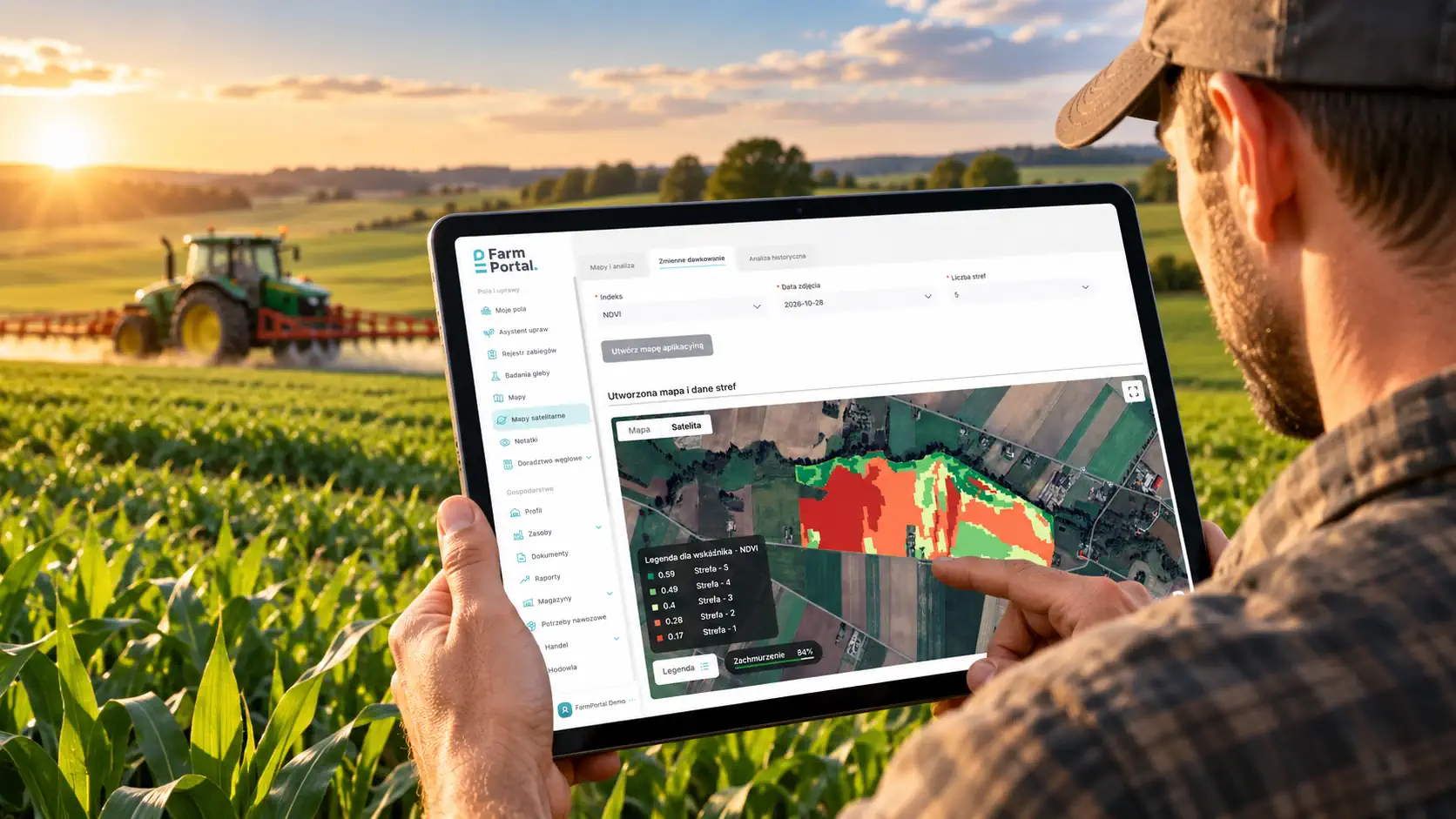
Variable Rate Application (VRA) means applying different rates to different parts of a field, based on agronomic recommendations. FarmPortal draws on soil tests and satellite vegetation indices such as NDVI, NDRE, MSAVI and RECI.
The farmer imports a field, defines zones, sets application rates and exports the task. ISO-XML is used to exchange data with compatible terminals, while ISOBUS (ISO 11783) supports communication between agricultural devices. Support for the standard does not automatically mean that VRA is enabled.
- Gather field boundaries, cropping history, soil analyses and recent satellite imagery.
- Distinguish persistent differences in soil and field performance from temporary crop stress.
- Define management zones, set the rates and check that they are agronomically sound.
- Check the units, file format and variable-rate capabilities of the terminal.
Problems often emerge in the tractor cab: a terminal rejects the file because TC-GEO is not enabled or the units do not match. Test the file before heading out to the field. For more detail, see the step-by-step guide to VRA.

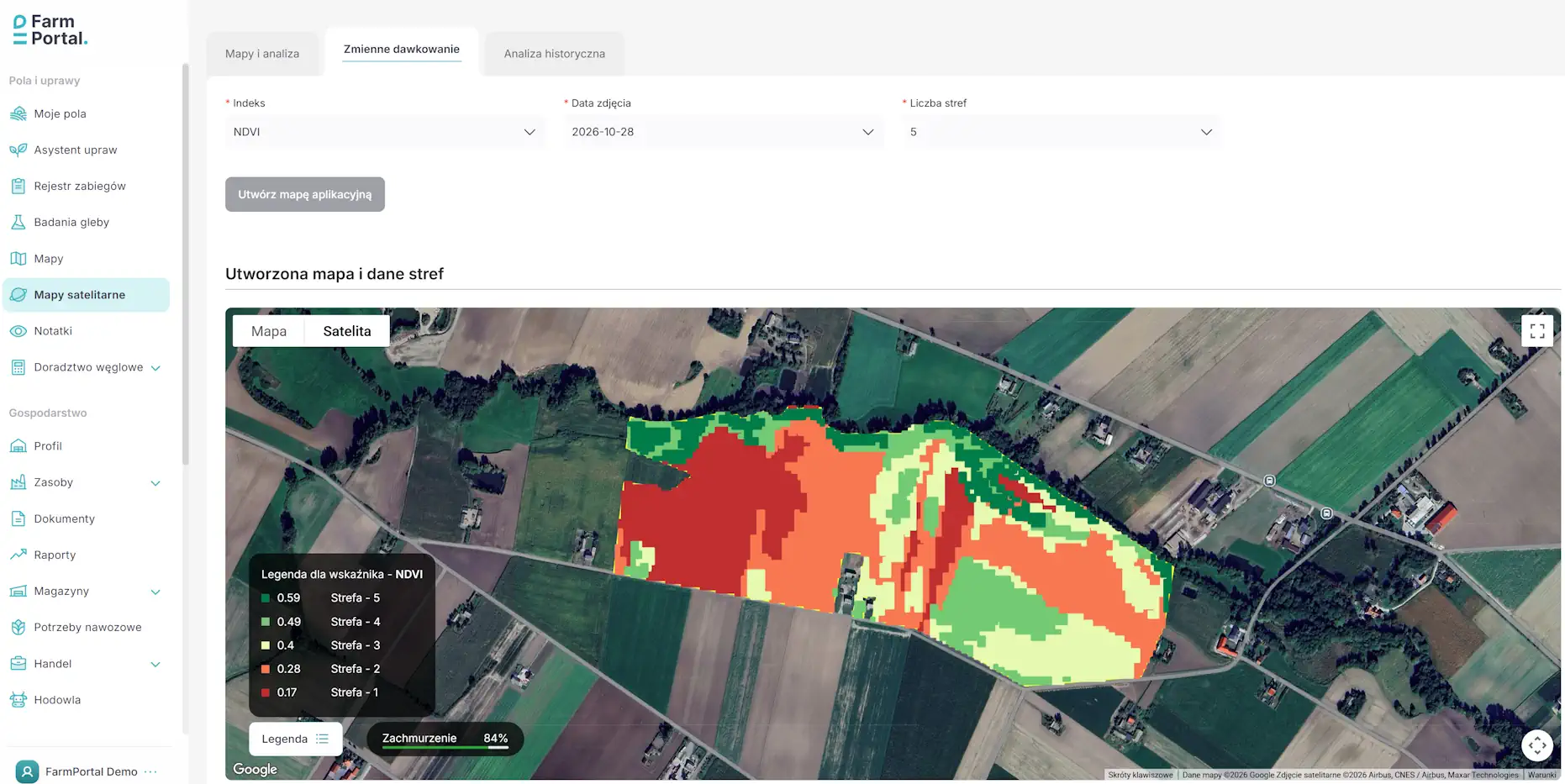
How does FarmPortal support precision crop protection and spraying decisions?
FarmPortal supports crop protection decisions with weather forecasts, disease models, data from weather stations and a database of more than 3,000 plant protection products linked to Poland’s Ministry of Agriculture and Rural Development (MRiRW).
When choosing when to spray, farmers can assess temperature, wind, humidity, Delta-T, rainfall risk, crop conditions and the product’s pre-harvest interval. A weather forecast alone is not a reason to spray.
The system records treatments across a whole field or part of it, calculates the quantity of product needed and links costs to stock records. Spraying maps can be exported to compatible terminals. Application rates must comply with the plant protection product label.
How can you manage field operations and digital treatment records?
FarmPortal records sowing, fertiliser applications, spraying, irrigation and harvesting. The field log captures details such as the date, product, rate, BBCH growth stage, reason for treatment, operator and cost. Reports can be exported as PDF or CSV files.
When an operator notes a treatment in the tractor cab and the farm owner copies it into a notebook that evening, the treated area or date can easily be lost. Recording the operation on a mobile phone in the field avoids much of this double handling.
What will change in plant protection product records from 2027?
The rules for recording plant protection product use remain unchanged in 2026. From 1 January 2027, records must include additional information, such as the authorisation number and, in certain circumstances, the BBCH growth stage and time of application. Transitional arrangements for transferring records into electronic form apply from 2027 to 2029; from 1 January 2030, records must be maintained electronically as treatments take place.
These dates are confirmed by the Regional Plant Health and Seed Inspection Inspectorate in Wrocław (WIORiN) (28 May 2026). FarmPortal helps prepare reports for ARiMR and PIORiN, but the user remains responsible for complete records and legally compliant applications.
What do FarmPortal’s figures tell us about the adoption of precision farming?
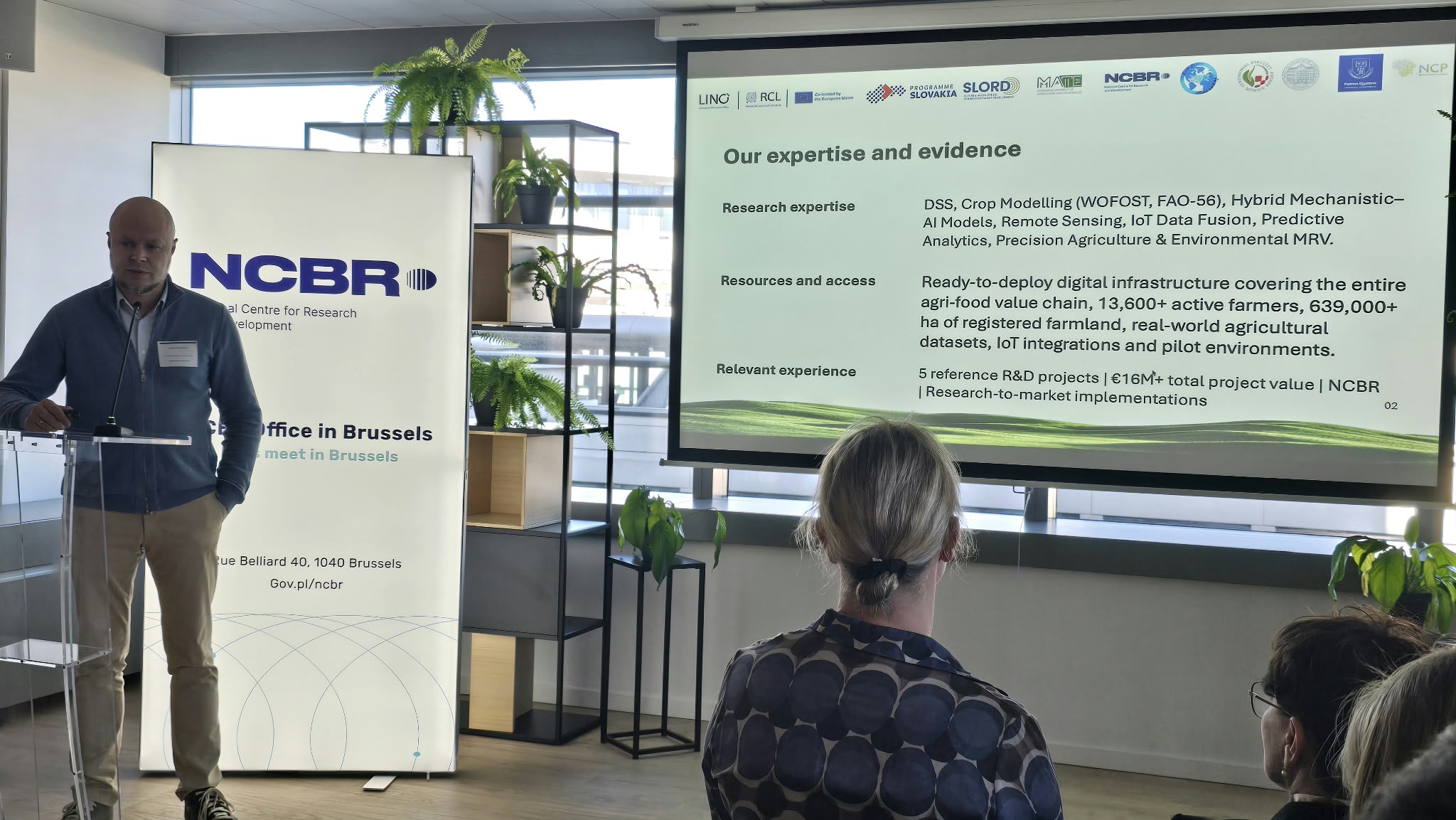
Agri Solutions’ own figures show 14,000 users of FarmPortal in October 2026, approximately 639,000 ha of fields and crops recorded in the system, and 83,000 ha covered by soil testing as at June 2026.
Around 3,000 operations are recorded each week, including more than 800 plant protection treatments. In 2025, the system generated 42,303 ARiMR/PIORiN reports. The number of VRA spraying maps generated has risen:
- 83 maps in 2024;
- 1,533 maps in 2025;
- 3,144 maps between the start of 2026 and 16 October.
Generating a map does not prove that the treatment was carried out or that any savings were achieved. It measures use of the tool; machinery data and costs are needed to assess the outcome.
How should savings and efficiency be measured after adopting FarmPortal?
After implementation, useful measures include kg of fertiliser and plant protection products per hectare, yield, cost in PLN/ha and the completeness of treatment records. Potential reductions in product use are indicative pilot targets, not guaranteed results from FarmPortal.
| Area | Benchmark | Business significance and evidence status |
|---|---|---|
| Variable-rate fertilisation | 5–18% less nitrogen fertiliser | Indicative pilot target; lower costs and environmental pressure are possible, but not guaranteed. |
| Crop protection | 5–15% less plant protection product used | Indicative target, subject to maintaining treatment effectiveness and complying with the product label. |
| Treatment records | 43 seconds per entry versus 3–5 minutes manually | 76–86% less time; comparison of the internal median for mobile entry against an estimate for manual recording. |
| Application maps | Number of VRA maps generated per season | Measures feature adoption; creating a map is not the same as carrying out an application. |
| Nitrogen-use efficiency | kg N per tonne of crop yield | Assesses nitrogen use across comparable crops and growing conditions. |
| Production costs | PLN/ha before and after implementation | Measures changes in spending, including service and equipment costs. |
| Record-keeping | Share of treatments with complete records | Indicates the quality of records and readiness for inspection. |
Source: The 5–18% and 5–15% ranges are results from documented FarmPortal deployments to the test farms. The internal median for recording a treatment on a mobile device is 43 seconds; the estimate of 3–5 minutes for manual recording is not based on a controlled study.
Who stands to benefit from FarmPortal, and when is VRA not worthwhile?
Individual farmers are most likely to use the calculator, field records and mobile app. Larger farms may also monitor machinery, staff and costs. Agronomists work with soil analyses, while farmers investing in Agriculture 4.0 assess compatibility with their equipment.
Not every field needs VRA. On a small, uniform field, sampling, licence and setup costs can outweigh the savings. NDVI cannot identify the cause of crop stress on its own, and a terminal may require an additional licence to handle application maps.
Example: is VRA worthwhile on a farm growing 200 ha of wheat?
A farm grows 200 ha of winter wheat on soils with varying nutrient levels. It has previously applied an average of 150 kg N/ha and wants to assess VRA without sacrificing yield.
Illustrative example prepared for this article. The figures are intended to demonstrate the process and must be verified before being presented as results from a real implementation.
Starting figures: 200 ha, 150 kg N/ha and PLN 6/kg N. The scenario assumes a 10% reduction in nitrogen use with yield unchanged at 6 t/ha. FarmPortal is used to map the zones and record applications.
Illustrative result: 30,000 kg N before the change and 27,000 kg N afterwards. Gross saving on nitrogen: PLN 18,000, before the cost of testing, mapping and equipment. Nitrogen use per tonne of crop would fall from 25 to 22.5 kg N/t, but only if yields were maintained.
Key performance indicators: kg N/ha, t/ha, PLN/ha, and whether actual application rates match the map. If yields fall or integration costs are high, the net benefit could be nil or negative.
Does FarmPortal meet the description of category 31 under the I.10.4 investment scheme?
FarmPortal’s functions match the software category described in I.10.4, but this does not mean that a purchase will automatically be reimbursed or that ARiMR has formally approved the product.
In the MRiRW guidance dated 6 May 2026, category 30 covers software for creating fertiliser and spraying application maps. Category 31 covers “Software supporting fertiliser planning, precision crop protection or other field operations”.
The precise wording appears in the I.10.4 investment schedule, Annex 1, p. 24. Before buying, check the call for applications, licence conditions and eligible-cost rules. Number 31 identifies an investment category, not a certification of any particular application.
Frequently asked questions (FAQ)
Does FarmPortal support fertiliser planning, precision crop protection and other field operations?
Yes. FarmPortal brings together NPK fertiliser planning, soil test results, disease models, VRA maps and field records. Its functions match the description of category 31 under I.10.4. However, this does not automatically make the purchase eligible for funding or guarantee a grant. The body administering the funding scheme makes the final decision.
Can I use the fertiliser calculator without an ISOBUS terminal?
Yes. You do not need a terminal to calculate NPK requirements, review soil tests or maintain field records. A compatible controller is needed to apply variable-rate maps automatically. Before buying one, check that it supports the required format, VRA functionality and application units. Basic farm records are a sensible starting point.
Can FarmPortal produce variable-rate fertiliser and spraying maps?
Yes. FarmPortal creates VRA application maps from management zones and agronomic data. Transferring a map to a machine requires a compatible terminal and file format, such as ISO-XML. Crop protection application rates and methods must comply with the product label, and the effectiveness of the completed treatment still needs to be checked.
How much fertiliser could I save with VRA?
The 5–18% reduction in nitrogen use mentioned here is only an indicative target to test in a pilot. Actual savings depend on field variability, data quality, equipment and costs. Measure kg N/ha, yield in t/ha, cost in PLN/ha and implementation expenses together, using comparable conditions across the season.
Can digital field records help with ARiMR and PIORiN inspections?
Yes. FarmPortal keeps dates, fields, application rates, products, reasons for treatment and PDF/CSV reports together. Users must still verify the accuracy of the data and comply with product labels. Record-keeping requirements expand from 2027, with transitional provisions for electronic records. Each entry should be checked as soon as the treatment is finished.
Is FarmPortal specifically listed as product number 31 for grant funding?
No. Category 31 is not a list of named products. It covers software supporting fertiliser planning and crop protection, and FarmPortal matches that description in functional terms. Eligibility of the licence cost and purchase must be assessed against the documents for the relevant funding call, including the scope of the software being purchased.
Is FarmPortal suitable for small farms and work with an agronomist?
Yes. Smaller farms can start with field boundaries, soil testing, the NPK calculator and treatment records. An agronomist can review the results they share. Machinery telemetry and VRA maps can be added later if the size of the operation and variation between fields justify the cost. The choice should reflect the farm’s economics.
Glossary
- FMS (Farm Management System)
- Software for collecting and managing information about fields, operations, machinery and costs. FarmPortal is an example of an FMS.
- NPK
- Nitrogen (N), phosphorus (P) and potassium (K), the main nutrients covered by fertiliser planning and nutrient balances.
- VRA (Variable Rate Application)
- Applying fertilisers, plant protection products or other inputs at different rates according to a prescription map.
- NDVI and NDRE
- Vegetation indices calculated from imagery to show variation in crop condition. They do not replace soil testing.
- ISOBUS (ISO 11783)
- A communication standard for agricultural machinery and terminals. Compliance does not guarantee support for every VRA function.
- ISO-XML
- A data format for exchanging field operation tasks between farm software and compatible machinery terminals.
- DSS (Decision Support System)
- Software that brings together information such as weather, disease-risk models and crop data to support decisions.
From fertiliser planning to treatment costs: what should you do next?
FarmPortal connects soil analysis, fertiliser calculations, VRA maps, crop protection and field records. Start by establishing accurate field boundaries and treatment histories, then assess equipment and data quality before deciding how far to automate.
Explore FarmPortal’s features, then create a free account. For larger farms, a pilot on fields with pronounced variability is a sensible place to start.
Follow us!
See what we're doing and be inspired by positive changes.