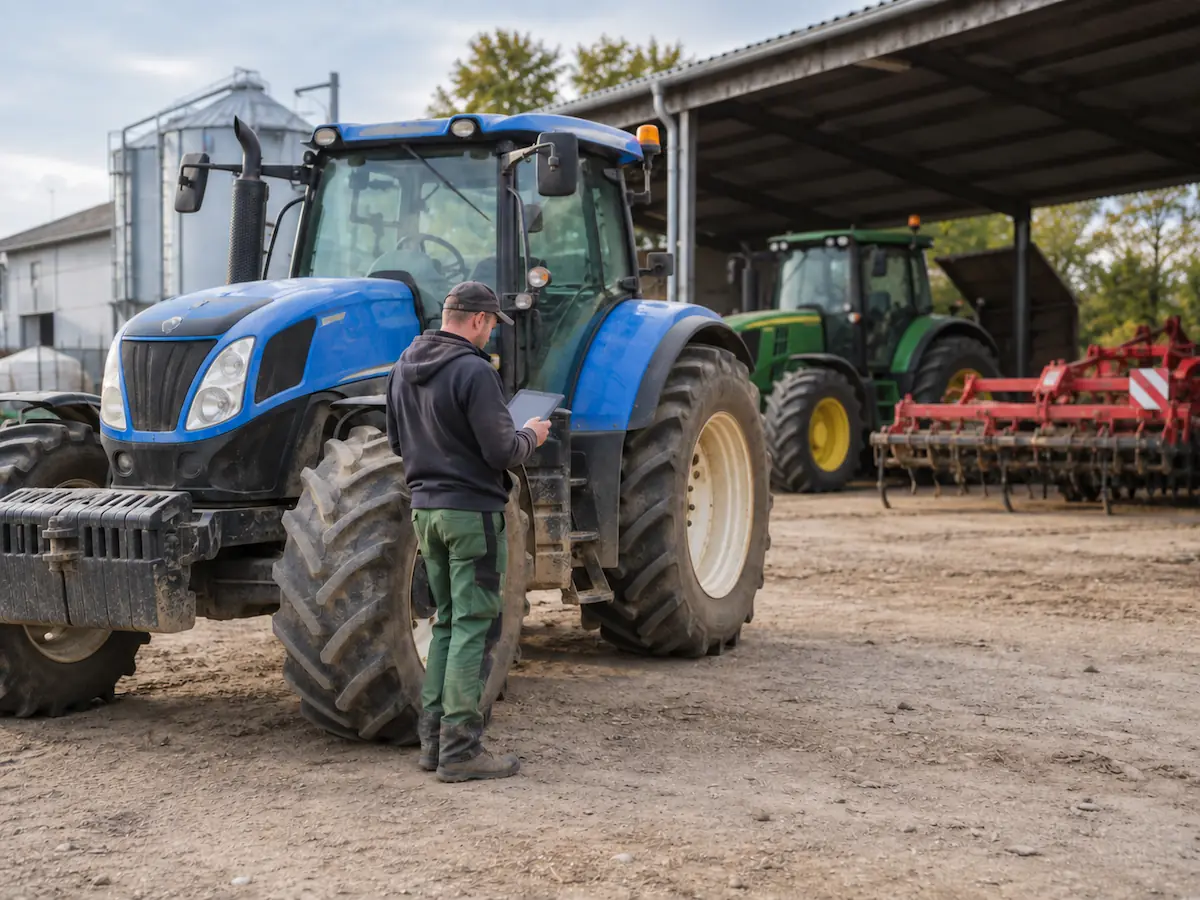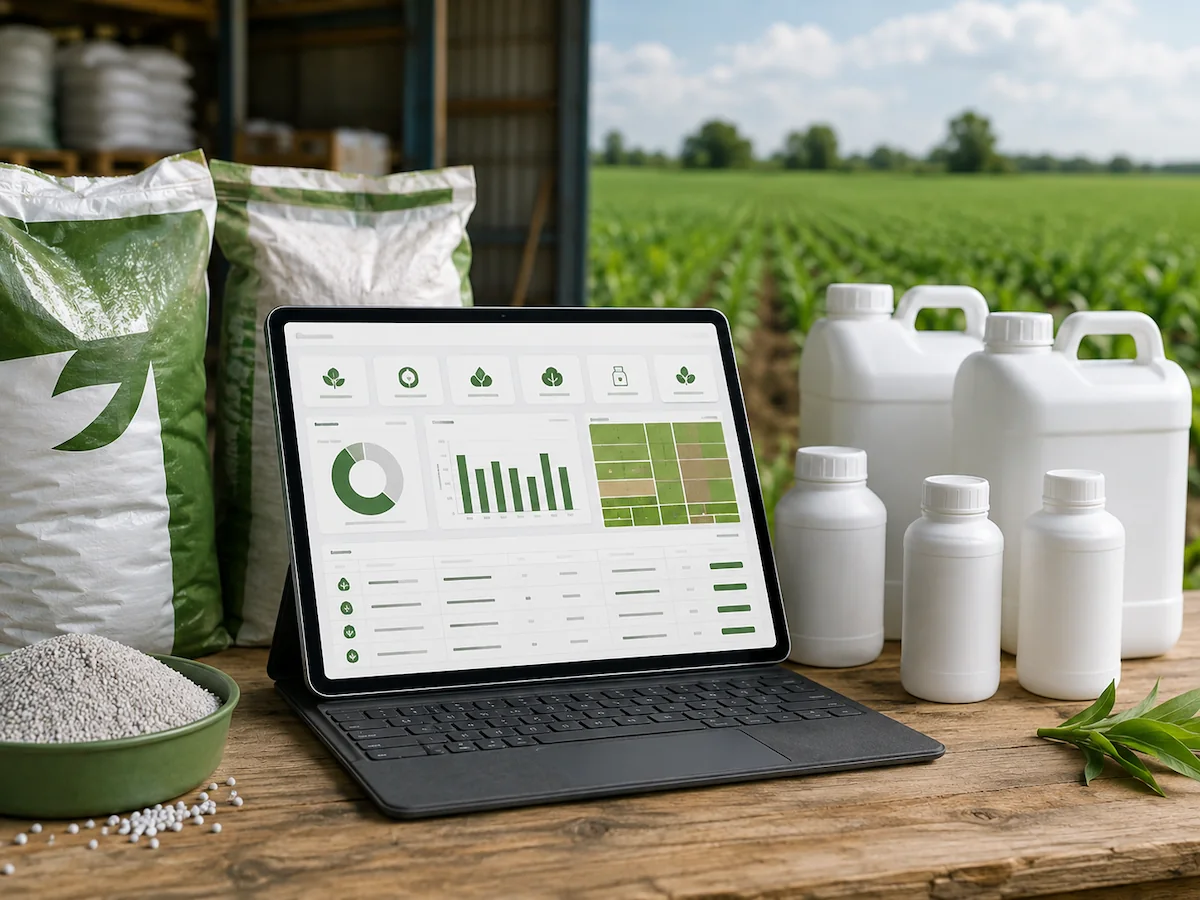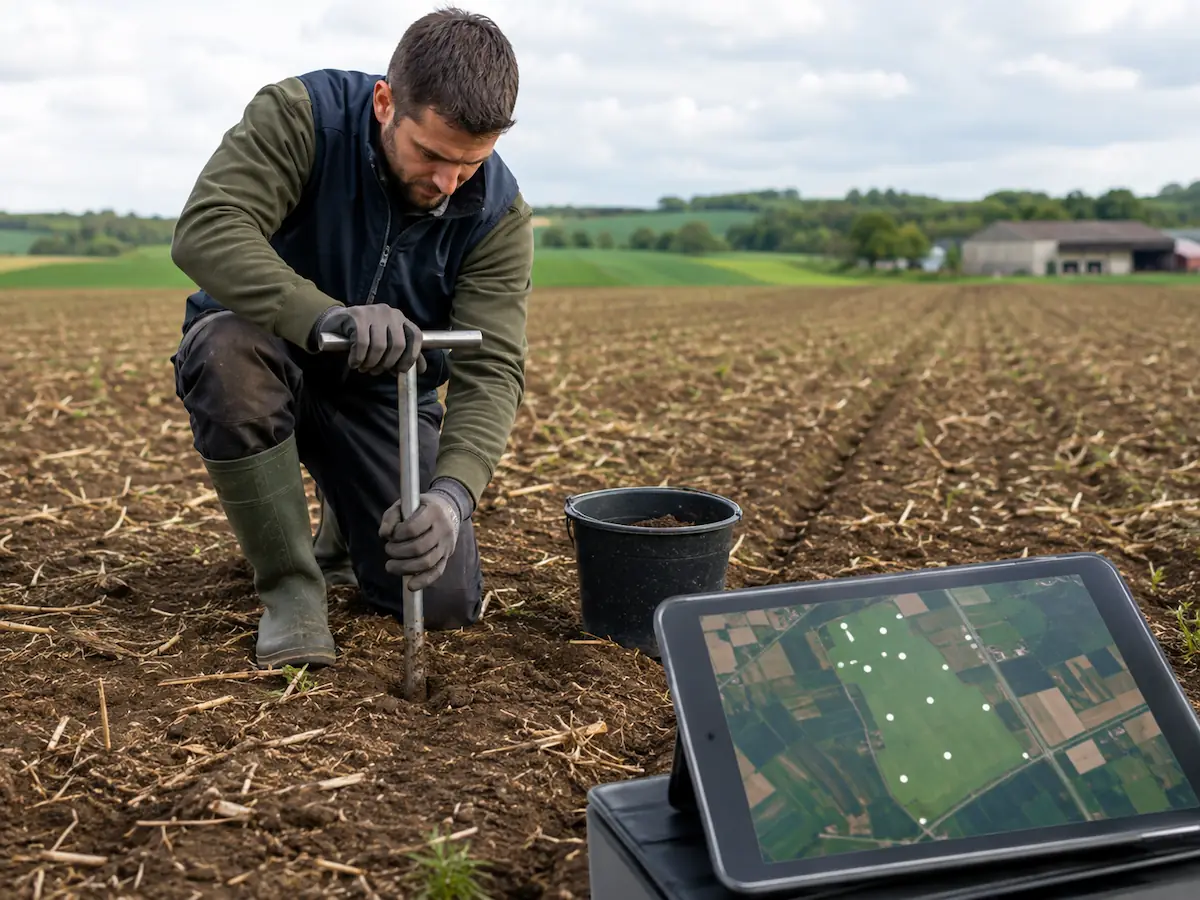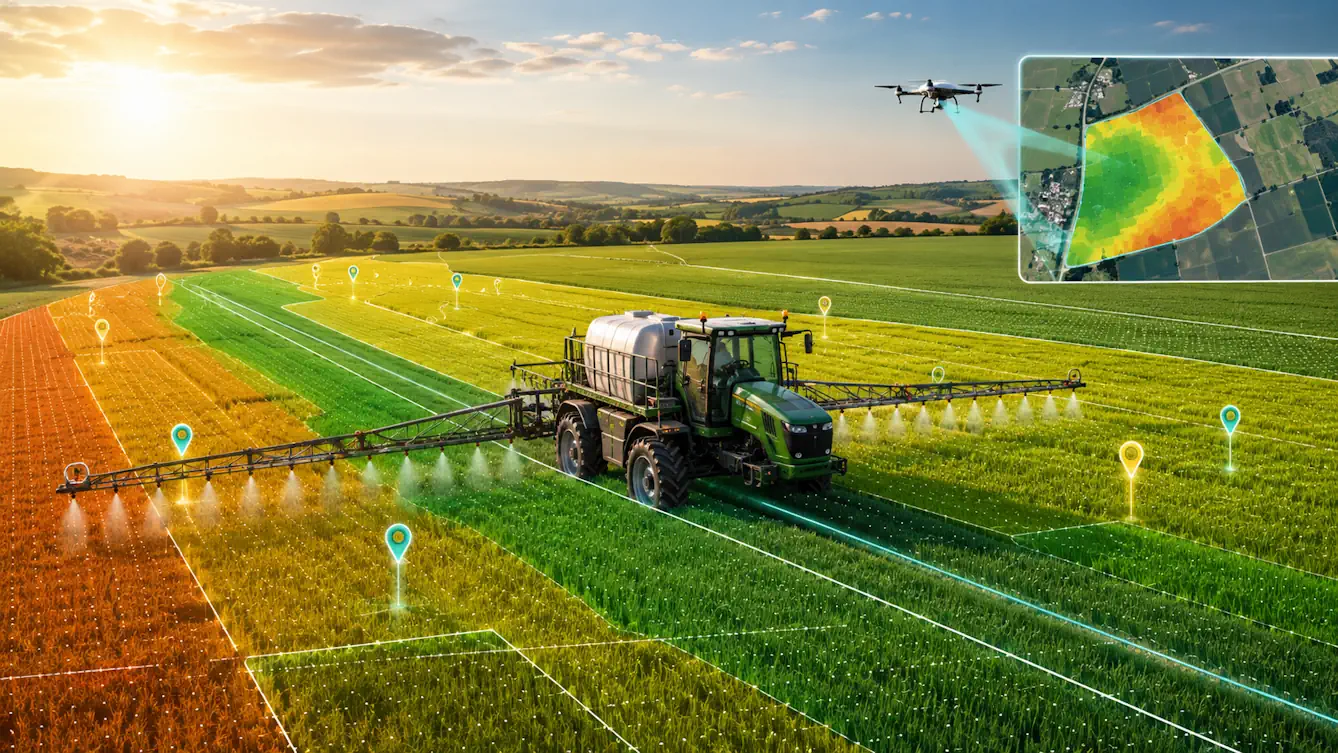
VRA, or variable-rate application, makes it possible to apply fertiliser, crop protection products, seeds or water not according to one average rate per hectare, but according to the real variability of the field. In practice, it follows one principle: the right rate, in the right place, at the right time.
In brief
Variable-rate application, or VRA, is one of the key tools of precision farming. Instead of treating the entire field in the same way, the system divides it into zones and assigns different rates to them according to yield potential, soil fertility, crop condition, field history and the agronomist’s decision.
Properly implemented VRA can reduce excessive use of fertilisers and crop protection products, improve crop uniformity, simplify treatment documentation and provide data for environmental reporting. However, it is not a “magic satellite map”. Its effectiveness depends on input data, machine calibration, terminal compatibility, correct file format and execution control.

- The greatest VRA potential occurs in fields with high variability in soil, pH, nutrient availability, moisture or yield history.
- NDVI shows the crop response, but it does not replace soil testing because it does not clearly explain the cause of crop stress.
- ISO-XML and ISOBUS organise data exchange between the farm management system, terminal and machine.
- Section Control is not the same as VRA. Section Control switches sections on and off, while VRA changes the rate spatially.
- ROI should be calculated after the season by comparing the prescription map, as-applied map, costs, yield and commercial quality.
What is VRA?
VRA stands for Variable Rate Application, meaning the application of a variable rate. In agricultural practice, it is most often associated with variable-rate fertilisation, but the technology also covers spraying, liming, seeding, irrigation and other operations performed at variable intensity.
Under uniform-rate application, the entire field receives the same rate, for example 180 kg of fertiliser per hectare. In VRA, the field is divided into zones, and each zone receives a different rate, for example 130, 160, 190 or 210 kg/ha. The difference comes from data: soil fertility maps, yield maps, NDVI, soil scanning, field observations, moisture, terrain and the agronomic objective.
Short definition for citation
VRA is a precision farming method in which the rate of an input is automatically changed during machine operation based on a prescription map, sensor data or a combination of both methods.
In the context of the CAP 2023–2027 and eco-schemes, VRA has significance beyond production. It helps document rational nutrient management, reduce nitrogen surpluses and prepare data needed in the supply chain, including for MRV, carbon footprint calculations and environmental reporting.
Who is this article for?
VRA is not relevant only to the farmer who performs the field operation. In practice, it is a process that connects the farm, advisor, machinery manufacturer, input supplier, processor and the company managing raw material quality. Each group sees different benefits and different risks.
The table below shows what problems variable-rate application solves from the perspective of the key market participants.
| Audience group | Problem to solve | Benefit from VRA | Key requirement |
|---|---|---|---|
| Farmers | Rising costs of fertilisers, crop protection products, fuel and labour | Better rate adjustment, fewer losses, better commercial yield | Good field data and a calibrated machine |
| Agronomists and agricultural advisors | Difficulty translating recommendations into machine execution | Prescription maps, management zones and measurable effect control | Combining satellite, soil and field scouting data |
| Machinery manufacturers | Customer expectations around ISOBUS, automation and documentation | Higher machine value, fewer overlaps, better after-sales support | Support for TC-GEO, TC-SC and as-applied data |
| Fruit and vegetable processors | Non-uniform raw material, lack of production data, more difficult audits | Better fertilisation and crop protection documentation, more predictable quality | A common data standard across suppliers |
| Management teams and producer group owners | Lack of comparable KPIs between fields, farms and seasons | Dashboards for costs, efficiency, emissions and treatment execution | A continuous data collection process, not a one-off experiment |
Table 1. Benefits and problems solved by VRA for different audience groups.
How does VRA work from a technical perspective?
VRA works as a data chain: from measuring field variability, through preparing a prescription map, to executing the operation in the machine terminal and saving the as-applied map. If any element of this chain is weak, the whole process loses credibility.
Technically, VRA can be described as a combination of four layers: input data, an algorithm or agronomic decision, execution equipment and documentation of the operation.
Input data sources
In most cases, data from several sources are used at the same time. The goal is not to choose “one best map”, but to combine information that shows different aspects of the field.
- NDVI, NDRE and other vegetation indices – from satellite or drone data, showing crop condition and biomass variability.
- Yield maps – from combines or harvest systems, showing the historical production potential of field zones.
- EC maps and soil scanning – helping determine variability in soil properties, texture and moisture.
- Soil samples – grid-based or zone-based, providing data on pH, P, K, Mg, micronutrients and organic matter.
- Historical maps – helping distinguish persistent field variability from temporary seasonal stress.
- Weather and moisture data – helping assess whether a problem comes from nutrient deficiency, drought, waterlogging or disease risk.
Management zones
A management zone is a part of a field with similar potential, similar constraints or a similar crop response. Zones can be created based on yield maps, vegetation indices, EC, topography, soil test results and the farmer’s knowledge.
Most often, 3 to 5 zones are used. Too few zones oversimplify the issue, while too many zones may make the operation harder to execute, increase errors and fail to deliver a real economic advantage.
Prescription map
A prescription map tells the machine what rate to apply in a specific part of the field. It may contain polygon zones or a point grid with assigned rates.
The most common formats are ISO-XML and shapefile. ISO-XML is particularly important in the ISOBUS environment because it allows data exchange between the farm management system, terminal and task controller. Shapefile is often used as an intermediate format, but it frequently requires conversion or adjustment to terminal requirements.
Terminal, ISOBUS and Section Control
The terminal in the tractor cab reads the prescription map, GPS position and machine parameters. It then sends information about the rate to be applied in a given place to the spreader, sprayer, seeder or irrigation system.
In practice, it is worth checking three ISOBUS functionalities:
- TC-BAS – documents total values, such as the amount of product used.
- TC-GEO – supports location-based data, prescription maps and as-applied maps.
- TC-SC – supports automatic switching of sections on and off, i.e. Section Control.
Section Control reduces overlaps on headlands, wedges and field boundaries. VRA changes the rate. The best result comes from combining both functions because the machine not only applies the right rate, but also avoids applying product where it should not.
NDVI vs soil testing – what should you choose?
One of the most common mistakes is treating NDVI as a replacement for soil testing. NDVI is very useful, but it answers a different question than laboratory analysis. It shows how crops look at a given moment, not how much phosphorus, potassium, magnesium or calcium is present in the soil.
In VRA decisions, the best results come from combining data. NDVI can indicate zones that respond more weakly or strongly, but only soil testing, yield history and field scouting help explain the cause.
| Criterion | NDVI / satellite data | Soil testing | Best use in VRA |
|---|---|---|---|
| What does it measure? | Crop condition and biomass | Nutrient availability, pH, minerals and soil properties | Combining crop response with the soil-related cause |
| Frequency | High, dependent on cloud cover and imagery availability | Low, usually every few years or as needed | NDVI for seasonal monitoring, soil testing for the baseline decision |
| Error risk | Stress may result from drought, disease, weeds or damage | Error may result from incorrect sample collection | Map validation through field observation |
| Best for | Nitrogen, biomass assessment, detection of stress zones | P, K, Mg, pH, liming, micronutrients | Creating stable management zones |
| Limitation | May saturate at high biomass levels | Does not show the current crop response | Use together, not interchangeably |
Table 2. Comparison of NDVI and soil testing in the process of preparing VRA prescription maps.
More information on the practical use of vegetation indices is available in the article Vegetation indices and variable-rate fertilisation in FarmPortal.
VRA step by step
VRA implementation should be a process, not a one-off file export to a terminal. The following workflow can be applied on arable, vegetable or fruit farms, as well as in producer groups working with advisors.
Step 1: Collect field data
The first step is to collect data on field history, crops, yields, fertilisation, pH, nutrient availability, agronomic problems and observations from recent seasons. Satellite and drone data are very useful, but they should not be the sole basis for decisions.
- field and production plot boundaries,
- crop and treatment history,
- soil sample results,
- NDVI, NDRE or other index maps,
- yield maps, if available,
- field notes, photos, issues with water, disease and weed pressure.
Step 2: Analyse variability and define zones
The goal is to separate persistent variability from random variability. If a given zone performs poorly across many seasons, it probably results from soil, terrain, water retention or pH. If a zone appears only once, it may be caused by temporary stress, an agronomic error or weather conditions.
A good practice is to start with 3 zones: low, medium and high potential. More advanced implementations use 4–5 zones, especially on large areas and fields with clearly mosaic conditions.
Step 3: Set the agronomic objective
This decision is crucial. VRA can be used to even out the field or to maximise the potential of the best zones. These are not always the same objective.
- Balancing strategy – a higher rate goes to weaker zones if the limitation can be corrected through fertilisation or liming.
- Potential strategy – a higher rate goes to the best zones because crops can use it more efficiently there.
- Loss reduction strategy – the rate is reduced where the nutrient will not be used, for example due to drought, low pH or low soil potential.
Step 4: Generate the prescription map
A prescription map should be the result of both an algorithm and an agronomist’s decision. The algorithm may calculate rates based on zones, analysis results and the target yield, but the agronomist should check whether the map makes practical sense.
It is worth checking the minimum and maximum rate, units, product, machine working width, field boundaries, headlands and zones excluded from the operation.
Step 5: Export to the machine terminal
The map can be transferred to the terminal via ISO-XML, shapefile, USB drive, memory card or the machine manufacturer’s cloud. The most important point is to check whether the terminal can read the format and whether it has an active variable-rate function.
At this stage, compatibility between the terminal, machine and file must be confirmed. A typical implementation problem is a correct map that the terminal cannot read because a TC-GEO licence is missing, the format has a different structure or the rate is saved in an unsupported unit.
Step 6: Execute the field operation
Before the operation, the operator should check field boundaries, product, base rate, working width, machine calibration and GPS status. In fertilisation, spreader calibration, granule quality and disc settings are important. In spraying, nozzles, pressure, speed, product label and weather conditions matter.
VRA does not exempt anyone from following the crop protection product label. Variable rates in crop protection must remain within legal, agronomic and technical limits.
Step 7: Verify the as-applied map
After the operation, it is necessary to check what was actually performed. The as-applied map shows the real rate, driving path, interruptions, overlaps and possible deviations from the plan.
Only comparing the prescription map, as-applied map, costs and yield map makes it possible to assess whether VRA worked. Without this verification, the technology remains a cost rather than a management system.
Types of VRA: offline, online and hybrid
VRA can be implemented in three ways. The choice depends on the type of operation, available data, equipment, crop and economic objective. Most farms start with the offline method because it is simpler to organise and easier to control.
| Type of VRA | How does it work? | Example | Advantages | Limitations |
|---|---|---|---|---|
| Offline, map-based | The prescription map is prepared before the operation and uploaded to the terminal | Liming, P/K, nitrogen, seeding | Easy control, option to consult an agronomist, good documentation | The map may not reflect sudden changes in conditions on the day of the operation |
| Online, sensor-based | A sensor measures the crop or soil in real time and changes the rate during operation | N-Sensor, GreenSeeker, weed sensors | Fast response to the current crop condition | Requires a good sensor, calibration and a clear decision algorithm |
| Hybrid | The base map is corrected by a sensor or current seasonal data | Nitrogen in wheat, growth regulation, spot spraying | Combines stable field knowledge with current measurement | The highest technical and organisational complexity |
Table 3. Comparison of offline, online and hybrid VRA.
Key applications of VRA
VRA started mainly with fertilisation, but today it covers many field operations. In each case, the logic is similar: determine field variability, assign a rate and execute the operation according to a map or sensor measurement.
1. Nitrogen fertilisation
Nitrogen is the most dynamic nutrient, so VRA in nitrogen requires seasonal data. NDVI and NDRE maps, biomass, yield potential and field observations help assess where the rate should be increased and where it should be reduced.
2. P/K and micronutrient fertilisation
Phosphorus, potassium, magnesium and micronutrients are best planned based on soil testing and nutrient removal with yield. VRA prevents overapplication in nutrient-rich zones and helps supplement nutrients where deficiencies limit potential.
3. Variable-rate liming
Liming is one of the most logical applications of VRA because pH often differs strongly within one field. A uniform rate can under-lime one part of the field and over-lime another at the same time.
4. Zoned spraying and spot spraying
In crop protection, VRA may mean different rates, different sections or applying a treatment only where the problem occurs. One example is “green-on-brown” weed detection after harvest, or more advanced “green-on-green” weed recognition within the crop canopy.
5. Variable-rate seeding
In maize, oilseed rape and other row crops, variable plant population can match the number of plants to the site potential. In better parts of the field, plant density may be higher, while in weaker zones it may be lower to reduce competition for water.
6. Precision irrigation
Variable-rate water application is particularly important in vegetables, orchards and protected crops. Data from soil moisture sensors, weather, evapotranspiration and soil zones help reduce water stress and nutrient losses.
Benefits, ROI and KPIs
VRA should be evaluated with numbers, not by the mere fact of having a map. The most important KPIs are input use, cost per hectare, yield, commercial quality, uniformity, number of overlaps, nitrogen use efficiency and the difference between the planned and executed map.
Literature and implementations report different results because the effect depends on field variability, fertiliser price, data quality, weather and crop. On uniform fields, the benefit may be limited. On mosaic fields, with large differences in pH, nutrient availability or yield potential, the effect can be significant.
| KPI | Typical direction of change | Indicative range | How to measure? | Notes |
|---|---|---|---|---|
| Fertiliser use | Decrease | 5–25% on fields with clear variability | Planned rate vs executed rate, kg/ha and PLN/ha | The greatest effect comes from reducing surpluses in weaker or nutrient-rich zones |
| Yield | Stabilisation or increase | 0–8% in many scenarios, higher in selected cases | Yield map, weighing, commercial yield | The goal is often the same yield at a lower cost, not always maximum yield |
| Nitrogen use efficiency | Increase | Depends on crop and site | kg of yield / kg N or margin / kg N | Important for cereals, maize and intensive crops |
| Overlaps on headlands and wedges | Decrease | Depends on field shape and machine working width | As-applied map and covered area | Section Control is particularly helpful here |
| N₂O emissions | Potential decrease | In studies on precision nitrogen application: approx. 1–10% additional reduction depending on field variability | Emission model, nitrogen balance, rate and yield data | Requires a consistent MRV methodology |
| Commercial quality | Improved uniformity | Crop-dependent | Size, Brix, dry matter, protein, commercial fraction | Especially important for vegetables, fruit, potatoes and quality cereals |
Table 4. Example KPIs for assessing VRA effectiveness after the season. Ranges are indicative, prepared by Agri Solutions and require validation on a given farm.
How to calculate ROI?
The simplest ROI formula should include not only fertiliser savings, but also yield change, quality, service cost and equipment depreciation. Comparing only kilograms of fertiliser may understate or overstate the effect.
VRA ROI = (input savings + additional margin from yield and quality – cost of data, maps, service and equipment) / implementation cost.
For a farm, repeatability of the result is more important than the percentage ROI itself. If the technology works in only one season but there is no data collection procedure, it is difficult to scale it to a larger area or to suppliers in a producer group.
Barriers and implementation requirements
VRA requires equipment, data and skills. The most expensive mistake is buying technology without a process: without soil testing, without zones, without machine calibration and without verifying execution.
Equipment cost and compatibility
Variable-rate application requires a machine that can automatically control the rate. In practice, the terminal, GPS receiver, machine controller, ISOBUS licences and the ability to export and import data must be checked.
Input data quality
A prescription map is only as good as the data from which it was created. One satellite image taken during a cloudy period is not enough. One soil sample collected from a non-uniform part of the field may also lead to a wrong decision.
Operator and advisor competences
The operator must know how to upload the map, select the task, check units and start documentation. The advisor must understand whether a given zone requires a higher rate, a lower rate, liming, drainage, a variety change or a completely different strategy.
Machine calibration
Even the best map will not help if the spreader is incorrectly set, the sprayer has worn nozzles or the seeder does not maintain the target seeding rate. VRA requires regular calibration, working speed control and material quality checks.
Regulatory and financial context
VRA is not only a production technology. It is increasingly becoming part of documentation for environmental practices, carbon footprint and supply chain cooperation. In Poland, this matters in the context of the CAP 2023–2027, eco-schemes, investments in precision farming and the requirements of raw material buyers.
The “Carbon farming and nutrient management” eco-scheme includes, among other things, a fertilisation plan and a liming variant. VRA can support the preparation and execution of rational fertilisation, but the technology itself does not automatically mean eligibility for payment. Current ARiMR conditions and the requirements of the specific intervention should always be checked.
From the perspective of processors, distributors and large food buyers, data are critical. A prescription map, as-applied map, treatment record and field identification can feed MRV systems, ESG reporting, carbon footprint calculations and quality audits. VRA does not replace traceability or EUDR requirements, but it can be one of the proofs showing how production was managed.
How does FarmPortal support VRA?
FarmPortal supports VRA as part of a broader farm management process: from field records, through treatment planning, crop condition analysis and cost recording, to documentation of execution. In practice, the user needs not only a map, but a complete workflow that connects agronomic, operational and financial data.
Functions related to work planning, treatment records, costs, fields, GPS and documentation can be developed within FarmPortal functions for treatment planning and field records. In the context of VRA, this means one system in which the farmer, advisor and manager can see field, plan, execution and cost data.
Example FarmPortal workflow
The following process shows what practical VRA work may look like on a farm or for an advisor serving multiple farmers. The most important element is maintaining data continuity: from planning to execution and verification.
- Creating fields and crops – the user organises field boundaries, crops, varieties and production history.
- Collecting data – vegetation indices, soil test results, field observations, weather data and treatment history are included in the analysis.
- Defining zones – the farm or advisor creates management zones based on persistent field variability.
- Fertilisation or treatment plan – the agronomist sets the goal: field balancing, potential utilisation or loss reduction.
- Prescription map – a rate map is prepared with control of minimum and maximum values.
- Export to terminal – the file goes to the terminal in a machine-compatible format, for example ISO-XML or shapefile, depending on the configuration.
- Executing the operation – the operator works with the map, GPS, Section Control and rate control.
- As-applied documentation – after the operation, execution data return to analysis, cost records and production documentation.
- Post-season analysis – the execution map is compared with yield, quality, costs and agronomic assumptions.
- Reporting – data can support audits, carbon footprint calculations, MRV, cooperation with processors and documentation of environmental practices.
In a broader context, it is worth combining VRA with other elements of precision farming. More about this approach is described in the article Precision farming – what it is, how it works and why it is difficult to scale without an FMS.
Case study: 220 ha farm, winter wheat and nitrogen VRA
Farm context
The farm has 220 ha, of which 150 ha are winter wheat. The fields are mosaic: some plots have lighter soils and periodic water deficits, while others have higher yield potential. Before implementation, a uniform nitrogen rate was used across the whole field.
Implementation assumptions
- Crop: winter wheat, 150 ha.
- Technology: offline VRA, prescription map prepared before the operation.
- Data: NDVI from several dates, yield history, soil test results, field scouting.
- Zones: 3 potential zones – low, medium, high.
- Equipment: spreader with rate control, terminal supporting prescription maps, GPS.
- Objective: reducing nitrogen surpluses in weaker zones and increasing efficiency in high-potential zones.
| Indicator | Before VRA | After VRA implementation | Change | Interpretation |
|---|---|---|---|---|
| Average N rate | 170 kg N/ha | 160 kg N/ha | -5.9% | Less nitrogen in zones with low response to fertilisation |
| Wheat yield | 7.40 t/ha | 7.75 t/ha | +4.7% | Better use of productive zone potential |
| Protein | 12.1% | 12.7% | +0.6 p.p. | Quality improvement in high-potential zones |
| N efficiency | 43.5 kg grain / kg N | 48.4 kg grain / kg N | +11.3% | More yield from each unit of nitrogen |
| Nitrogen cost | 1,054 PLN/ha | 992 PLN/ha | -62 PLN/ha | Example at a price of 6.20 PLN/kg N |
| Operating margin | Baseline level | +285 PLN/ha | +42,750 PLN on 150 ha | Including N savings and additional yield |
| Data and map cost | None | 75 PLN/ha | 11,250 PLN | For a service including analysis and maps |
| Estimated net result | None | +31,500 PLN | ROI approx. 2.8x | Result after deducting map preparation cost |
Table 5. Illustrative calculation of nitrogen VRA effects on a 220 ha farm. The data demonstrate the ROI calculation method.
What mattered most?
The greatest impact on the result did not come from reducing the average rate itself, but from shifting nitrogen between zones. Weaker parts of the field did not receive a rate they could not use efficiently, while better parts received a rate aligned with their yield potential.
After the season, the farm compared the prescription map, as-applied map and yield. This made it possible to distinguish the effect of technology from the influence of weather and execution errors.
What FarmPortal users say about the VRA function and variable-rate fertilisation in the app
“On a 640 ha farm, the biggest change was not the map itself, but the discipline of working with data. After the first season, we reduced nitrogen rates in weaker zones by around 8–12%, without a yield decrease. The hardest part was checking terminal compatibility and training operators to download the as-applied map after the operation.”
“For a vegetable processor, fertiliser savings are not the only priority. Raw material quality repeatability is just as important. With onion and carrot suppliers, we want to see where a treatment was performed, at what rate and when. VRA and treatment records help us prepare data faster for audits and discussions with buyers.”
Implementation checklists
VRA is easier to implement when the farm follows a fixed checklist. The following practical lists help reduce technical and agronomic errors.
Pre-season checklist
- Check current field boundaries and crops.
- Collect soil test results and assess whether samples are representative.
- Compare NDVI from several dates, not from a single image.
- Check whether yield maps or historical data are available.
- Define management zones and confirm them through field scouting.
- Set the objective: field balancing, potential utilisation or loss reduction.
- Check terminal, machine and file format compatibility.
Checklist before uploading the map to the terminal
- Check the format: ISO-XML, shapefile or manufacturer-specific format.
- Check rate units: kg/ha, l/ha, seeds/ha, t/ha.
- Check the product and task name.
- Check the minimum and maximum rate.
- Check field boundaries and headlands.
- Check whether the TC-GEO licence is active for variable-rate application.
- Check TC-SC if you want to use Section Control.
ROI assessment checklist after the season
- Compare the planned rate with the executed rate.
- Compare fertiliser or crop protection costs before and after implementation.
- Compare yield and commercial quality by zone.
- Calculate the cost of data, maps, advisory and equipment depreciation.
- Check whether the as-applied map shows execution errors.
- Separate the technology effect from the weather effect.
- Save conclusions for the next season’s fertilisation plan.
7 most common mistakes when implementing VRA
Most problems with VRA do not result from the technology itself, but from data organisation and execution. The list below helps quickly identify where risk usually appears.
- A map based on only one NDVI date. A single image may show temporary stress rather than persistent field variability.
- No soil tests or poorly collected samples. Variable-rate P, K, Mg and lime application without reliable soil samples may lead to incorrect recommendations.
- Too many zones. Excessive map detail may exceed the real capabilities of the machine and operator.
- Incompatible terminal or missing licence. A terminal may support parallel guidance, but not necessarily TC-GEO and prescription maps.
- No calibration of the spreader, sprayer or seeder. Incorrect calibration destroys the effect of even a well-prepared map.
- Mistakes in units and products. kg/ha, l/ha, commercial fertiliser rate and pure nutrient rate are different things.
- No post-treatment analysis. Without the as-applied map, costs and yield comparison, it is impossible to assess whether VRA made economic sense.
Benefits for farmers, advisors, agronomists, machinery manufacturers and management teams
VRA solves different problems for each audience group addressed in this article. The following overview shows what value variable-rate application brings to daily work.
| Audience group | Main problem | Benefit from VRA |
|---|---|---|
| Commercial farmer | Rising nitrogen and crop protection costs with shrinking margins | 5–15% reduction in nitrogen fertilisation expenditure and variable yield balancing |
| Agricultural advisor / agronomist | No tool to justify the rate in a conversation with the client | Prescription map as an objective basis for recommendations |
| Agricultural machinery manufacturer | Competitive pressure around ISOBUS functionality and compatibility | VRA as a sales argument for spreaders, sprayers and seeders |
| Management team on a large-scale farm | No input/output controlling data per zone | Auditable as-applied data and a complete decision trail |
| Processor and raw material buyer | Carbon footprint reporting requirements (CSRD, EUDR) | VRA data as a source for MRV in the supply chain |
Table 1. Benefits of VRA implementation by audience group. Own elaboration based on FarmPortal implementation observations in the 2023–2025 seasons.
The VRA implementation process in 7 steps
The following workflow assumes that the farm already has equipment with TC-GEO functionality. The full cycle from data collection to the as-applied map usually takes 5–10 days for the first operation of the season and a few hours for subsequent operations.
- Collect field data. Download NDVI images from Sentinel-2 or a drone, import yield maps from previous years, perform or update soil testing, and pull treatment history from FarmPortal.
- Analyse variability and define zones. Clean the data, run clustering, and validate zone boundaries with an advisor or the farm agronomist.
- Set the agronomic objective. Decide whether lower-potential zones receive less nitrogen (cost-balancing strategy) or more nitrogen (potential-maximisation strategy). The choice depends on grain price and weather risk.
- Generate the prescription map. The algorithm proposes rates for each zone, and the agronomist accepts or adjusts the values. The map is saved in ISO-XML.
- Export to the machine terminal. Transfer the TASKDATA package via USB drive, farm Wi-Fi or directly from the FarmPortal cloud to a terminal that supports the cloud exchange protocol.
- Execute the field operation. The operator selects the task on the terminal, and the system automatically changes the rate and controls sections. Calibration of the spreader or sprayer before entering the first field is mandatory.
- Verify the operation. Download the as-applied map from the terminal, compare it with the commissioned prescription map and archive it in FarmPortal. After harvest, compare it with the yield map and draw conclusions for the next season.
Summary
VRA is a practical precision farming tool, but it requires an organised process. The best results are achieved when it combines NDVI, soil testing, yield maps, management zones, the agronomist’s decision, a compatible terminal and verification of the as-applied map.
In fertilisation, VRA helps reduce surpluses and improve nutrient use. In crop protection, it supports zoned spraying and overlap reduction. In seeding and irrigation, it allows the intensity of the operation to be matched to the site potential. In supply chain management, it provides data for audits, MRV and environmental reporting.
FarmPortal can act as the organisational layer of this process: connecting fields, treatments, costs, observations, maps, advisory work and execution documentation. For farms, advisors and processors, this means moving from individual files to a consistent system of decisions and production evidence.
FAQ – frequently asked questions about VRA
Is VRA profitable when field variability is low?
When field variability is low, VRA may generate a lower return on investment than on mosaic fields. It can still be profitable if it reduces overlaps on wedges, headlands, weaker soil zones or areas with different soil test results. A good starting point is to analyse yield maps, NDVI and soil samples.
What is the minimum equipment needed for variable-rate application?
The minimum setup includes a prescription map, a GPS/GNSS receiver, a terminal that supports field tasks and a spreader, sprayer, seeder or another machine with rate-control capability. For full automation, an ISOBUS terminal with TC-GEO support is required, and TC-SC is also needed for automatic section control.
Can I start using VRA without RTK?
Yes, for fertiliser spreading or simple prescription maps, you can start without RTK, although accuracy will be lower. RTK is particularly important for variable-rate seeding, work with narrow sections, spot spraying and operations where repeatable passes matter.
Is NDVI enough to prepare a fertilisation map?
NDVI alone is usually not enough for a safe fertilisation decision because it shows crop condition but does not clearly indicate the cause of the problem. Low NDVI may result from nitrogen deficiency, drought, disease, damage, waterlogging or weaker soil. The best results come from combining NDVI with soil testing, yield history, field scouting and an agronomist’s decision.
Do soil tests replace satellite maps?
No. Soil tests show nutrient availability, pH and mineral components in the soil, while satellite maps show the current or historical crop response. In practice, VRA should combine both types of data.
Can FarmPortal help prepare prescription maps?
FarmPortal supports the organisation of field data, treatment planning, crop condition analysis, cost recording, map-based work and treatment documentation. Exporting maps to a specific terminal should always be preceded by checking the file format, terminal licence and machine compatibility.
How can a machinery manufacturer prepare equipment for VRA?
A machinery manufacturer should ensure ISOBUS compatibility, TC-GEO support for variable rates, TC-SC support for section control, as-applied documentation and a simple data flow between the terminal and the farm management system.
What does a fruit and vegetable processor gain from VRA used by suppliers?
A processor gains better predictability of raw material quality, more structured treatment documentation, audit data and the ability to build environmental reporting. VRA does not replace quality control, but it helps prove how fertilisation, crop protection and production were managed in the field.
Does VRA support MRV, CSRD and environmental reporting?
Yes, because it creates data on planned and executed rates, area, treatment date and location. These data can feed MRV systems, carbon footprint calculations and supply chain reporting, but they require proper archiving and a consistent emissions calculation methodology.
How should ROI be checked after the season?
ROI should be calculated by comparing the planned and executed rate, the cost of fertilisers or crop protection products, yield, commercial quality, service cost, map cost and equipment depreciation. The strongest evidence comes from comparing field zones and the as-applied map against the yield map.
Glossary
The glossary below organises the key terms used in VRA. It is worth using them consistently in farm documentation, discussions with advisors and terminal configuration.
- VRA
- Variable Rate Application, meaning the application of an input at a variable rate depending on the location in the field.
- NDVI
- A vegetation index based on red and near-infrared light. It shows crop condition and biomass, but does not independently explain the cause of crop stress.
- NDRE
- A vegetation index using the red edge band. It is often more suitable than NDVI for assessing dense crop canopies and later growth stages.
- ISOBUS
- A communication standard between tractor, terminal and agricultural machine, based on the ISO 11783 family of standards.
- ISO-XML
- A format for exchanging field task data between a farm management system and an ISOBUS terminal.
- TC-GEO
- A Task Controller function that supports location-based data, prescription maps and as-applied maps.
- TC-SC
- Task Controller Section Control, a function for automatically switching machine sections on and off based on GPS position.
- RTK
- A GNSS correction technology that enables centimetre-level accuracy, important for precise passes and repeatable tracks.
- Soil EC
- Apparent electrical conductivity of soil. It helps assess variability in soil, texture and moisture.
- Prescription map
- A map that defines the input rate in different parts of the field.
- As-applied map
- A map showing the actual execution of a field operation: path, rate, coverage, overlaps and gaps.
- Management zone
- A part of a field with similar potential, constraints or fertilisation needs.
- MRV
- Monitoring, Reporting, Verification – a system for measuring, reporting and verifying environmental or production effects.
Sources
The following sources were used to prepare the statistical, technical and environmental parts of this article. The links lead to professional and scientific materials available online.
- USDA Economic Research Service, Precision Agriculture in the Digital Era: Recent Adoption on U.S. Farms, 2023 – data on the adoption of precision farming technologies, including yield maps, soil maps and VRT.
- Mistra Food Futures, Precision nitrogen application – potential to lower the climate impact of crop production, 2022 – analysis of the impact of precision and variable-rate nitrogen application on yield and N₂O emissions.
Public AEF documentation on ISOBUS functionalities, including TC-BAS, TC-GEO, TC-SC and ISO-XML, as well as documents related to the CAP Strategic Plan 2023–2027, were also used.
Follow us!
See what we're doing and be inspired by positive changes.