Precision agriculture - what it is, how it works, and why there is no precision without an FMS
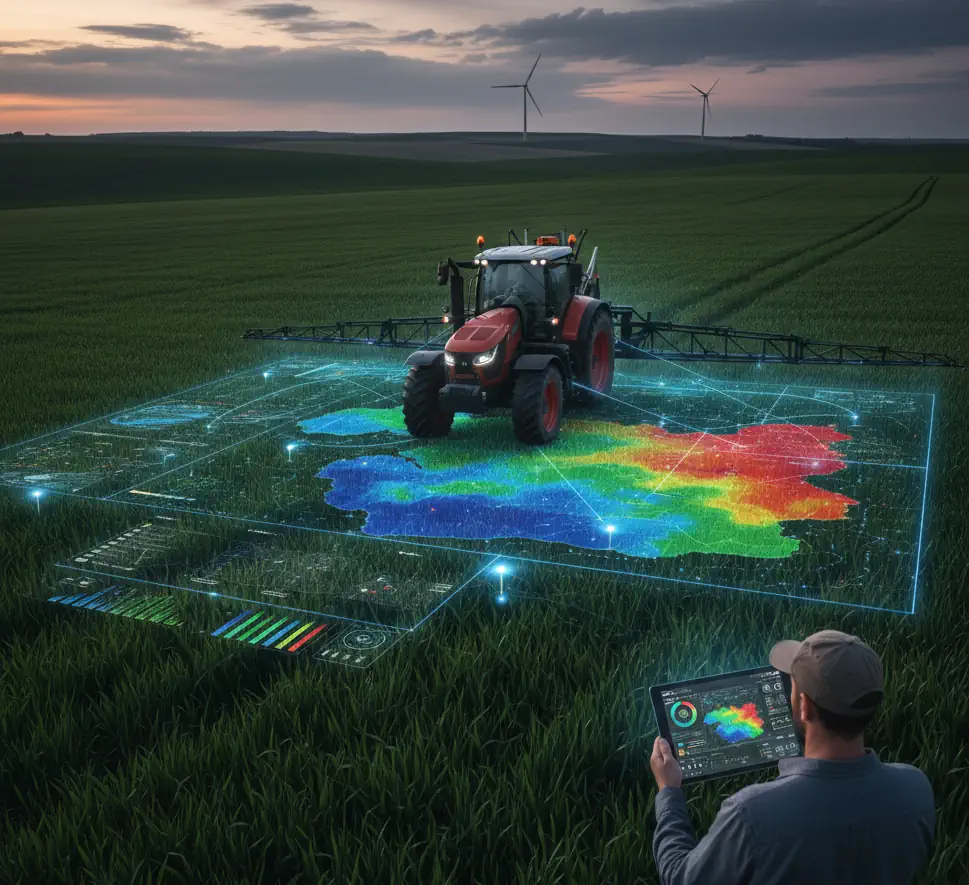
Precision agriculture is an approach to crop production in which agronomic decisions are made based on data rather than averages or assumptions. Its goal is to match field operations to the actual needs of crops and soil at a specific location and time. In practice, this means lower losses, better use of inputs, and greater yield predictability - particularly important for medium and larger farms in Poland that want to move toward Agriculture 4.0 without a hardware revolution.
Key benefits of precision agriculture - facts and figures
Lower fertilization costs (10-30%)
According to research reviews and implementation experience, variable rate application (VRA) based on soil testing and prescription maps reduces fertilizer use by an average of 10-30%, without yield loss - with the strongest effects on fields with high spatial variability.Proven profitability (68% of cases)
In a European Parliament report covering 234 studies, precision agriculture was profitable in an average of 68% of the analyzed cases.More stable yields and lower risk
Agronomy experts indicate that balancing nutrient deficiencies between field zones reduces crop stress and year-to-year yield variability.Fewer execution errors
Automatic transfer of prescription maps to machine terminals reduces the risk of errors caused by manual re-entry of rates and file formats.The simplest step toward Agriculture 4.0 and 5.0
Precision agriculture structures data and processes - without this foundation, telemetry, IoT, and automation cannot be scaled.
Answers to key questions
What is precision agriculture?
It is the management of field variability based on data (soil, yield, weather) to apply "the right rate in the right place at the right time".Is it only about fertilization maps?
No. Maps are just a tool. What matters most are data interpretation, correct execution of operations, and proper recording of what was done.Is an IT system (FMS) required?
Yes. Without an FMS, precision agriculture ends with SHP files and PDFs rather than a repeatable decision-making process.
1. Definitions - short and practical
1.1 Precision agriculture
Differentiation of field operations (fertilization, seeding, irrigation, crop protection) within a field based on measurement data and variability analysis.
1.2 Field variability
Natural soil and environmental differences (pH, nutrient availability, moisture, topography) that make a single uniform rate across the entire field inefficient.
1.3 VRA (Variable Rate Application)
Variable application - automatic adjustment of rates during machine operation according to a prescription map. For how to build rates from soil tests and NDVI, export prescription maps, and run them through ISOBUS, see our variable rate application (VRA) implementation guide.
1.4 FMS - Farm Management System
FMS (Farm Management System) is software such as FarmPortal that collects data from fields, machines, and sensors, integrates them into a single model, and supports the planning, execution, and documentation of field operations.
2. The specificity of Polish farms - why it works
In Poland, farms >=50 ha account for approx. 2.5% of all farms but manage around 31% of agricultural land. This means that:
- precision agriculture is an ideal solution for medium-sized farms,
- economic effects (fertilizers, fuel, time) become visible more quickly,
- implementation can be carried out in stages - without replacing the entire machinery fleet.
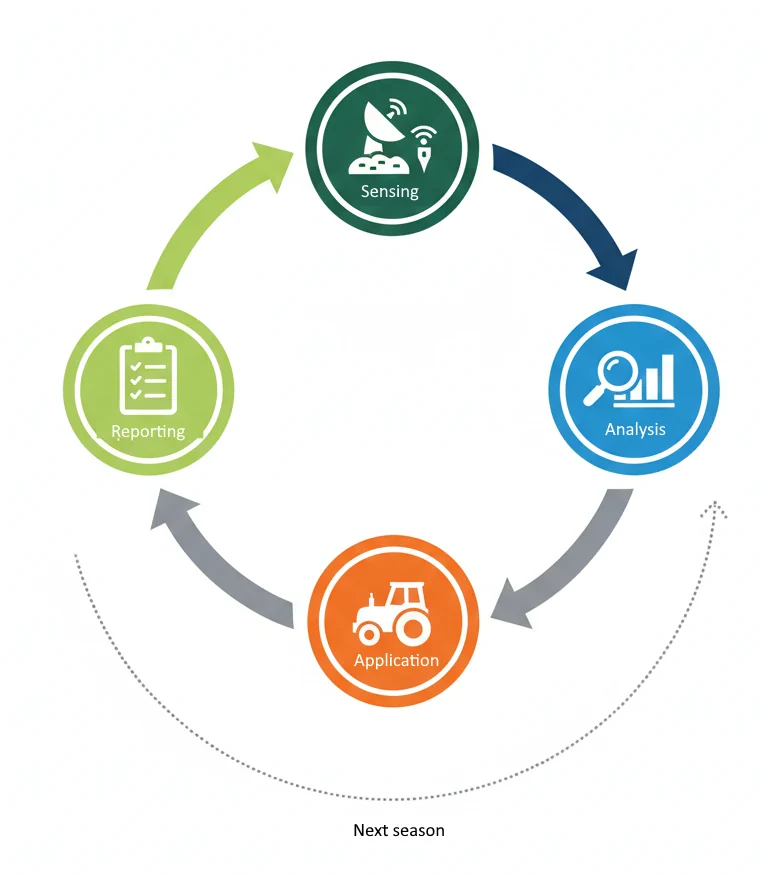
3. How precision agriculture works - the decision-making process
Data collection
Soil testing, yield and operation history, weather data.Analysis and interpretation
Defining production zones and yield targets.Prescription maps
Variable-rate maps for fertilization, seeding, or irrigation.Execution and recording
Transfer of maps to machines, rate control, and recording of actual execution.
4. Precision agriculture in practice - FarmPortal capabilities
4.1 Variable-rate fertilization maps
Creation, editing, and versioning of VRA maps based on soil tests and field zones (see also vegetation indices and variable-rate fertilization).
4.2 Direct transfer of maps to terminals
Exporting and transferring maps in standard formats without manual conversion.
4.3 Soil testing + fertilizer calculator
Combining soil analysis results with crop nutrient requirements - rates are derived from data, not averaged tables.
4.4 Fertilization and irrigation recommendations
Planning operations over time based on soil conditions, weather, and crop growth stages.
4.5 IoT sensors integrated in FarmPortal
Integration of sensor data (soil moisture, temperature, weather stations) into a single decision-support system.
4.6 Machine telemetry - standards and compatibility
Telemetry in FarmPortal is designed around open standards, which is critical for farmers looking for a solution compatible with different machinery brands.
FarmPortal and integrated devices support, among others:
- ISOBUS (ISO 11783) - integration with machines and terminals from different manufacturers,
- ISO-XML - import and export of completed operation data (tasks, rates, areas) directly from the application wirelessly to a tablet,
- Shapefile (SHP) - working with prescription maps, execution maps, and GIS data (see importing fields from KML, SHP and GML).
As a result:
- machine data is imported without manual conversion,
- plan vs. actual execution can be compared,
- the farm is not locked into a single hardware ecosystem.
According to implementation experts, support for ISOBUS FMS, ISO-XML in agriculture, and Shapefile in precision agriculture is one of the most important criteria when selecting an FMS.
5. Precision agriculture vs. traditional farming - comparison
| Area | Traditional farming | Precision agriculture |
|---|---|---|
| Fertilizer rates | One uniform rate per field | Variable rate (VRA) |
| Decisions | Experience-based | Data-driven and analytical |
| Documentation | Manual | Automatic (FMS) |
| Scalability | Limited | High |
6. Why FarmPortal is an essential tool
- It integrates maps, soil tests, IoT, and telemetry in a single system.
- It operates on open standards (ISOBUS, ISO-XML, SHP).
- It enables a real transition from data to execution.
- It is free in most cases, lowering the entry barrier for farms of any size.
- It forms the foundation for Agriculture 4.0 and 5.0.
Frequently asked questions
Is precision agriculture profitable?
Yes - this is confirmed by both scientific research and practical implementations.
Do I need new machinery?
No. Data and an FMS are key; hardware can be upgraded gradually.
Does FarmPortal support ISOBUS and ISO-XML?
Yes - FarmPortal operates on ISOBUS, ISO-XML, and Shapefile standards.
Is FarmPortal paid?
In most cases, FarmPortal is available free of charge, regardless of farm size, land area, or number of employees. Only precision fertilization maps above 50 ha are paid.
Sources
- European Parliament (2014). Precision agriculture: an opportunity for EU farmers - review of 234 studies, 68% profitability.
- Global AgTech Initiative (2019). Precision Agriculture Adoption in Poland - farm structure and technology adoption.
Follow us!
See what we're doing and be inspired by positive changes.