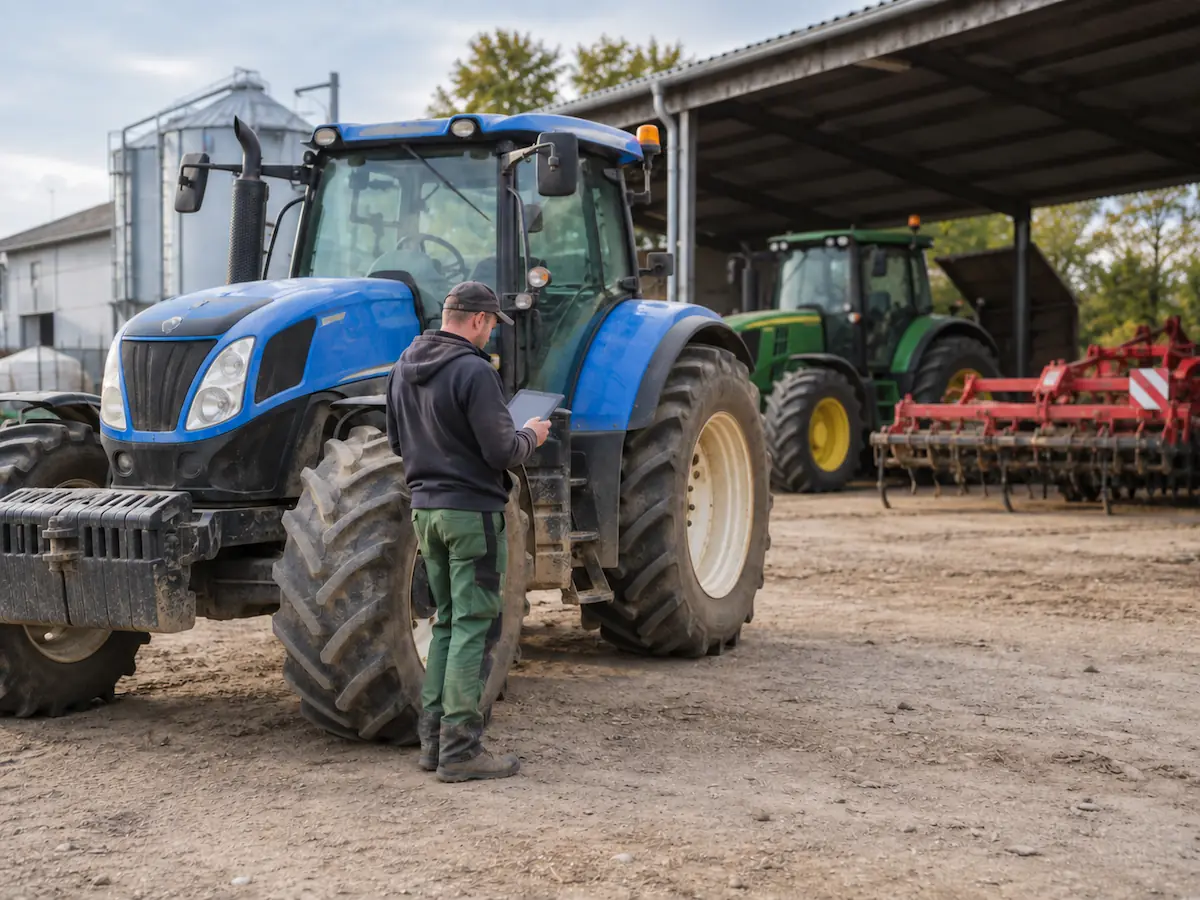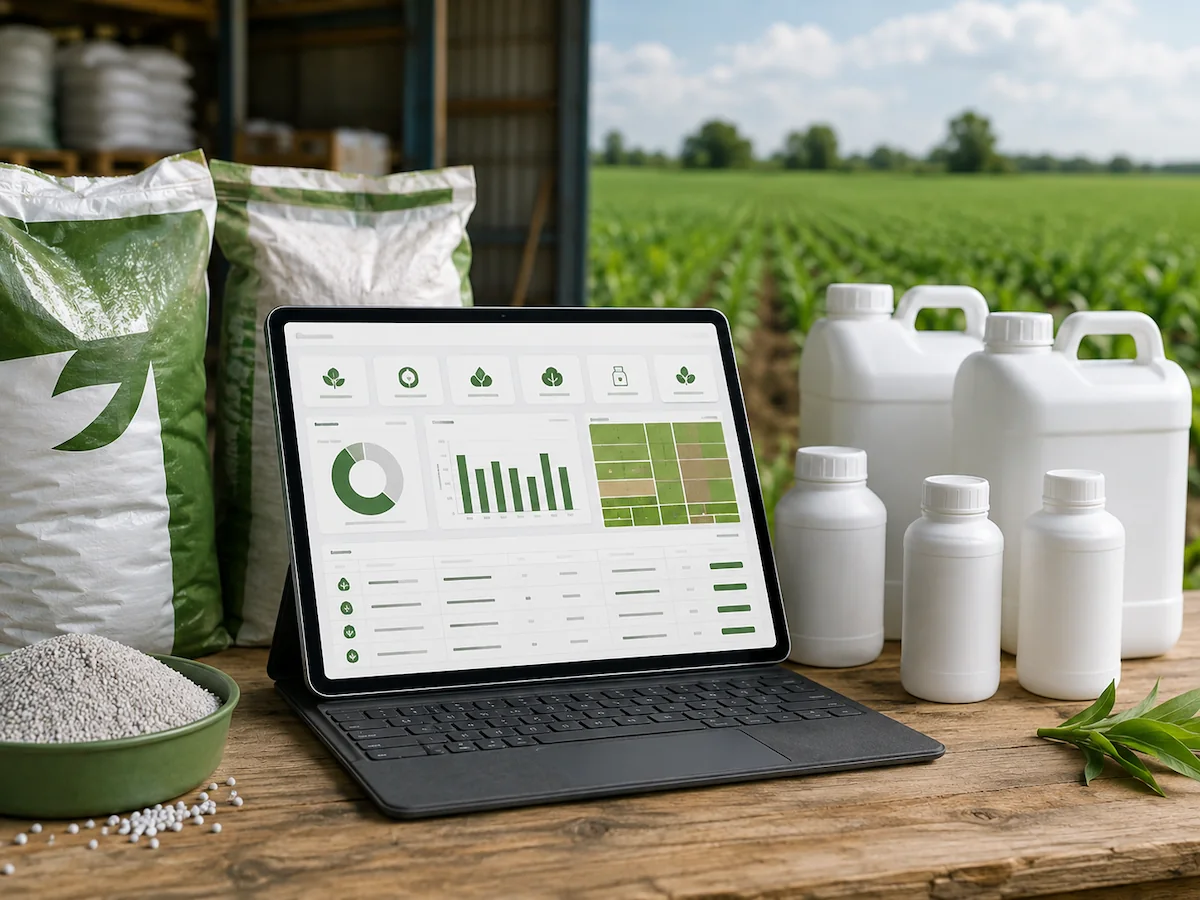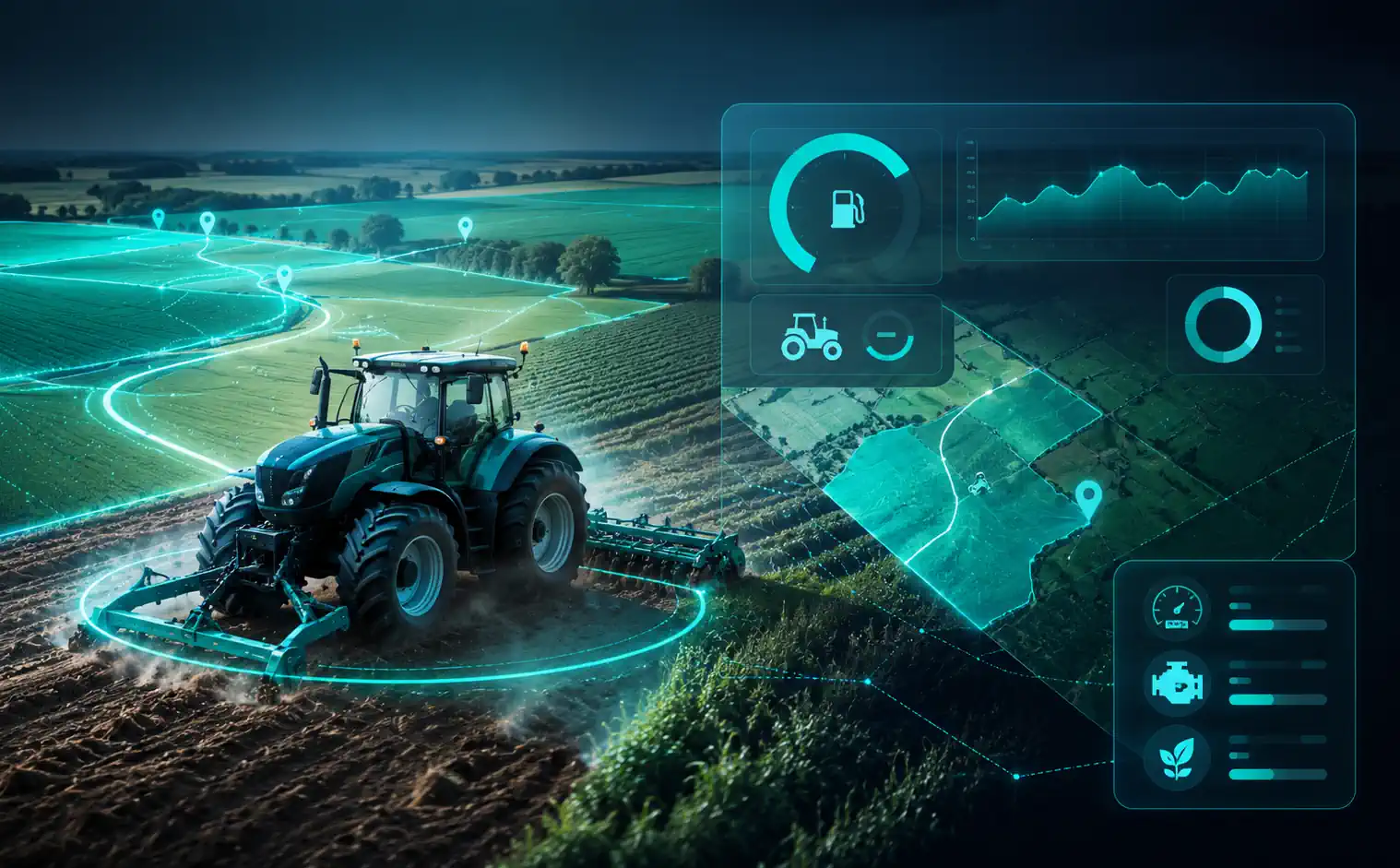
Agricultural machinery telematics is a system for collecting, transmitting and analysing data on the location, condition and utilisation of tractors and other machinery. It goes far beyond a dot moving across a map: it connects the route, working time, fuel, operator, field and completed task.
In brief
Telematics is worthwhile when it leads to a decision: reducing idling, improving the work plan or calculating the true cost of a field operation. GPS shows movement, CAN-Bus and SAE J1939 provide operating parameters, ISOBUS structures communication with the implement, and FarmPortal gives the data the context of a field, operator and cost.
- Do not equate engine time with productive fieldwork.
- Always calibrate fuel reports against the data source.
- Choose the KPI first, then the device.
- Start with the most heavily used machines.
What is agricultural machinery telematics?
Agricultural machinery telematics combines onboard electronics, GNSS positioning, data transmission and software. It answers more than the question, “Where is the tractor?” It also shows what the tractor is doing, when it started, which field it is on and what the work is costing.
At the most basic level, it provides location data and route history. The next level adds engine speed, engine hours, travel speed and fuel data. The most advanced level links completed work to a task in a farm management system (FMS). A machine spending two hours in a field does not necessarily mean that it completed two hours of productive work; some of that time may have been spent setting up equipment, refilling a tank or standing idle.

Why does operating without telematics cost time and money?
On a farm that runs several tractors intensively, the absence of telematics is not neutral. It conceals unnecessary journeys, idling, overdue servicing and uneven machinery utilisation. The cost becomes visible later, when work has to be reconstructed from phone calls, handwritten notes and operators’ memories.
In May, the situation often looks like this: at 9.30 pm, the farm manager still does not know whether the tractor has finished a field 18 km away or whether the sprayer can be sent elsewhere the next morning. The work record is completed two days later. The number of hours remains, but the idle time, route and exact completion time are lost.
Agri Solutions is also seeing growing interest among individual farms, supported by investment in Agriculture 4.0 and digitalisation grants. For that reason, FarmPortal is integrating an increasing number of telematics solutions rather than locking users into a single manufacturer’s ecosystem.
What data can be collected from agricultural machinery?
The scope depends on the model year, available connectors and integration method. Before buying any equipment, separate location data, engine data, fuel measurement, implement activity and the operational context supplied by the FMS.
| Layer | Data | Use | Limitation |
|---|---|---|---|
| GPS / GNSS | position, route, speed, stationary periods | location, road travel, geofencing | does not reliably identify the type of work |
| CAN-Bus / J1939 | engine speed, engine hours, load, faults | utilisation, servicing, fuel | some data may be proprietary |
| Fuel sensor | level, flow, refuelling, losses | fuel reconciliation and control | requires installation and calibration |
| ISOBUS / ISOXML | task, application rate, sections, status | variable-rate application and operation records | functional compatibility across the machine combination matters |
| FMS | field, operator, cost, schedule | management information and reporting | requires well-organised master data |
CAN-Bus connects a machine’s control units, while SAE J1939 standardises many messages used in heavy-duty vehicles and off-road machinery. The structure of this family of documents is set out in the SAE J1939 Top Level Document.
How can tractor fuel, working time and routes be monitored?
Three reports are particularly useful: working time divided into operating states, fuel allocated to a task, and a route linked to the field boundary. A farm manager should be able to distinguish engine-on time, movement, idling and work carried out within the planned area.
An engine hour is not always productive
A tractor may record 11.2 engine hours but only 7.8 hours of fieldwork. The rest may be road travel, refuelling, equipment set-up or waiting. Only this breakdown reveals where time is being lost.
Fuel data must be calibrated
The engine control unit (ECU) usually provides calculated consumption, a probe measures a fuel level affected by the machine’s angle, and a flow meter measures flow directly. The report should be checked against refuelling records over several complete operating cycles.
A route needs field context
Geofencing identifies entry, exit and time spent within a field boundary. Route sequencing should also account for the width of the machine combination, road restrictions, access to inputs and the distance between locations.
How do CAN-Bus, ISOBUS and agricultural guidance systems work together?
CAN-Bus carries messages between control units, telematics collects data, guidance steers the machine combination, and ISOBUS structures communication between the tractor, terminal and implement. These are separate layers. Bought without a data-exchange plan, they create yet more closed dashboards.
ISOBUS, or ISO 11783, covers machinery communication and data transfer to farm software. The Agricultural Industry Electronics Foundation (AEF) points out that compatibility depends on the functions supported by the complete combination, not simply on an ISOBUS label. This is explained in the AEF’s official overview of ISOBUS.
ISOXML transfers structured task data, including fields, operations, products, application rates and spatial data. GPS is sufficient for route monitoring; fuel analysis requires CAN/J1939 data or a sensor; ISOBUS is useful for Section Control and task exchange. The differences are discussed in more detail in this comparison of CAN-Bus and ISOBUS in agricultural machinery.
How can tractor utilisation and machinery costs be measured?
A metric should lead to a decision. A location chart alone is not enough. The most useful indicators are idling percentage, hectares per hour, litres per hectare, travel time and task cost.
| Indicator | Calculation | Decision |
|---|---|---|
| Idling | engine-on stationary time / engine time | organisation of loading and waiting |
| Work rate | completed ha / hours in the field | choice of machine combination and field sequence |
| Specific consumption | litres / ha or tonne | settings, operator, technical condition |
| Weather-window utilisation | productive time / available time | reallocation of an operator or machine |
| Operation cost | machinery + fuel + operator / ha | comparison of technologies and contracting |
Do not compare operators without accounting for the type of work. Higher fuel consumption on heavy soil does not prove that someone is driving badly. The report must include the field, implement and task.
How should agricultural machinery telematics be implemented step by step?
Start with an operational problem, not a device catalogue. Fuel control requires different data from automated fieldwork records. A pilot involving two or three machines is safer than installing equipment across the entire fleet at once.
- List the machines: model, model year, connectors, CAN/J1939, ISOBUS, terminal and engine hours.
- Choose one cost: idling, road travel, servicing, fuel or manual work records.
- Define the data sources: GPS, ECU, probe, flow meter, power take-off (PTO) or task status.
- Organise fields and operators: automated events have no context without accurate records.
- Run a pilot for 3–6 weeks: compare refuelling, time, hectares and work records.
- Define the response: decide who handles an alert and when a report should change the schedule.
- Scale after calibration: only then add more machines and ISOBUS data.
Before buying, check data ownership, offline buffering, export options, the API and transmission costs. A cheap tracker is a poor investment when its history cannot be transferred to the FMS.
How does FarmPortal use machinery data?
FarmPortal connects GPS monitoring with records of fields, crops, operators, tasks, costs and servicing. Data from a tractor can be assigned to a specific operation instead of remaining in a separate manufacturer dashboard.
The system organises the machinery fleet, scheduled servicing, repairs, costs and task history. The scope is described on the page covering FarmPortal features for farm and machinery management.
A work plan can be sent to an operator or a compatible terminal, while completion data can return to the field history. With application maps, this reduces the number of copied files and the risk of using an outdated task. An example is provided by the integration of an agricultural guidance system with FarmPortal.
Benefits for the farmer
The farmer can check completed work, machinery location, fuel consumption and the next service date more quickly. Where several operators use the same equipment, this reduces phone calls, manual records and disputes over engine hours.
Benefits for the farm manager
The manager can see fleet workload, the task queue and bottlenecks within a weather window. They can decide whether to move a machine combination, change the route, hire a contractor or make better use of an existing machine.
An example of a telematics implementation
A farm growing cereals, oilseed rape and maize operates across three locations. It has five tractors, one combine harvester and eight operators. The pilot covered the three most heavily used tractors. GNSS position was recorded every 30 seconds, together with ignition status, movement, engine speed, ECU fuel data, field boundaries and FarmPortal tasks.
| KPI | Before | After | Interpretation |
|---|---|---|---|
| Engine time | 642 hours | 601 hours | less engine time for a similar volume of work |
| Engine-on stationary time | 141 hours (22.0%) | 94 hours (15.6%) | changes to loading and waiting |
| Fuel | 12,420 litres | 11,610 litres | a difference of 810 litres |
| Missing work records | 29 tasks | 5 tasks | more records created from field data |
| Monthly reporting | 17 hours | 6 hours | less manual reconciliation |
At PLN 6.50 per litre, the difference is equivalent to PLN 5,265. This is an indicative figure, not a guaranteed saving. Weather, soil, the type of work and individual operators all affect the result. The most important outcome of the pilot is the identification of idling sources and improved data completeness.
When will telematics fail, and what mistakes do farms make?
In our experience, telematics will not repair a poor schedule or a lack of responsibility for acting on reports. It will reveal the problem, but someone still has to respond.
- Buying without a defined purpose: no KPI and no responsible person.
- Assuming full compatibility: CAN-Bus or ISOBUS does not guarantee access to every data point.
- No fuel calibration: the ECU reading is compared directly with the fuel invoice.
- Poor time classification: time spent in a field is automatically treated as productive work.
- Separation from the FMS: the operator still copies data into a notebook.
- Starting too broadly: the entire fleet is covered before three machines have been tested.
Full CAN data may not be economical for a single older tractor used only occasionally. In that case, GPS, a service schedule and a digital work record are a better option. The device should also buffer data when there is no signal, so a transmission gap does not create false stationary periods.
Questions we are most frequently asked by customers
What is agricultural machinery telematics?
Agricultural machinery telematics connects a device installed in a tractor or machine, its GNSS position, operating data and transmission to a management system. A basic setup records location, routes and working time. An advanced setup reads engine speed, fuel use, travel speed and diagnostic messages from CAN-Bus or SAE J1939.
What data can be read from a tractor?
The scope depends on the model year, brand, control units and integration. The most commonly available data includes position, speed, ignition status, engine hours, engine speed, stationary time and fuel consumption. Some machines also provide PTO status, load, temperatures and fault codes. The availability of each parameter must be confirmed before installation.
Is a tractor GPS unit enough to monitor fuel?
No. GPS shows position, movement and route history, but it does not measure fuel. A fuel report requires data from the engine control unit, a level probe or a flow meter. The Tracky CAN specification is a useful reference because the device supports the CAN-Bus network. CAN data may be sufficient for operational analysis, while detecting sudden fuel losses usually requires an independent sensor and correct tank calibration.
How does telematics differ from agricultural guidance?
Telematics records and transmits data on machinery operation, whereas a guidance system directs the operator along a defined path. RTK can reduce overlaps, but it does not replace fuel, idling and fleet-utilisation reports. The greatest value comes from connecting both layers with tasks and field history in an FMS.
Do CAN-Bus and J1939 work in every tractor?
No. An older machine may not have an accessible bus, while a newer one may expose only some parameters or use proprietary manufacturer messages. SAE J1939 structures data exchange, but it does not guarantee the same dataset across every brand. Before implementation, check the connector, supported parameter group numbers (PGNs) and a safe method of reading the data.
Is ISOBUS required for machinery monitoring?
No. GPS monitoring and tractor-parameter readings can operate without ISOBUS. ISO 11783 becomes important when connecting the tractor, implement, terminal and task, for example for Section Control, variable-rate application or operation records. An “ISOBUS” label alone does not confirm compatibility across every function of the machine combination.
How can machinery cost per hectare be calculated?
Allocate depreciation or leasing, servicing, parts, insurance, fuel, the operator and actual working time to the machine. Divide the cost of a specific operation by the completed area. Telematics makes the calculation more reliable because it separates engine time, road travel, idling and fieldwork instead of relying solely on the operator’s declaration.
Is telematics worthwhile on a smaller farm?
Yes, when a machine works intensively, carries out contracting work, serves several locations or is used by several operators. Full CAN data may not be justified for a single older tractor; a GPS tracker such as Tracky NoCAN may be sufficient, showing speed and position while automating field-operation records. A sensible starting point is GPS tracking, route history, task allocation and a service schedule, expanded once the need has been confirmed.
How can monitoring be introduced without replacing the machinery fleet?
We recommend dividing machinery into three groups: ready for CAN or J1939, suitable for GPS monitoring, and requiring additional sensors. Select two or three vehicles with the highest engine hours, define the KPI and run a pilot during one intensive period of work. Once the reports have been calibrated, extend the system to the rest of the fleet.
Glossary
- Agricultural machinery telematics
- Devices, data transmission and software that collect information on the location, condition and utilisation of machinery.
- GPS / GNSS
- Satellite positioning systems used for route recording, geofencing and machinery guidance.
- Geofencing
- A digital boundary around a field or farm base that identifies entry, exit and time spent within the area.
- CAN-Bus
- A network connecting control units and sensors; it may provide engine and diagnostic data.
- SAE J1939
- A family of CAN-based communication standards used in heavy-duty vehicles and off-road machinery.
- ISOBUS
- The ISO 11783 standard for communication between a tractor, terminal and agricultural implement.
- ISOXML
- A format for exchanging task, field, product, application-rate and spatial data between an FMS and a terminal.
- FMS
- A farm management system connecting fields, operations, machinery, employees, documentation and costs.
- PGN and SPN
- Identifiers for message groups and parameters in J1939, used to determine which data is available.
Telematics should manage work, not merely track a tractor
Location answers “where?”, CAN-Bus and J1939 answer “how is it operating?”, ISOBUS answers “what is the machine combination doing?”, and FarmPortal links the data to a field, task, operator and cost.
Our recommendation is clear: a farm with several intensively used machines should not manage them through phone calls and paper notes alone. It should begin with two or three machines, one problem and one report that leads to a decision. This should be supported by structured machinery maintenance and digital service records.
A practical next step
Select the three machines with the highest engine hours. For one week, record engine time, movement, fieldwork, refuelling, hectares and the operator. The differences will show whether the first stage should focus on GPS, fuel, CAN/J1939, servicing or integration with FarmPortal tasks.
Follow us!
See what we're doing and be inspired by positive changes.