Brief summary
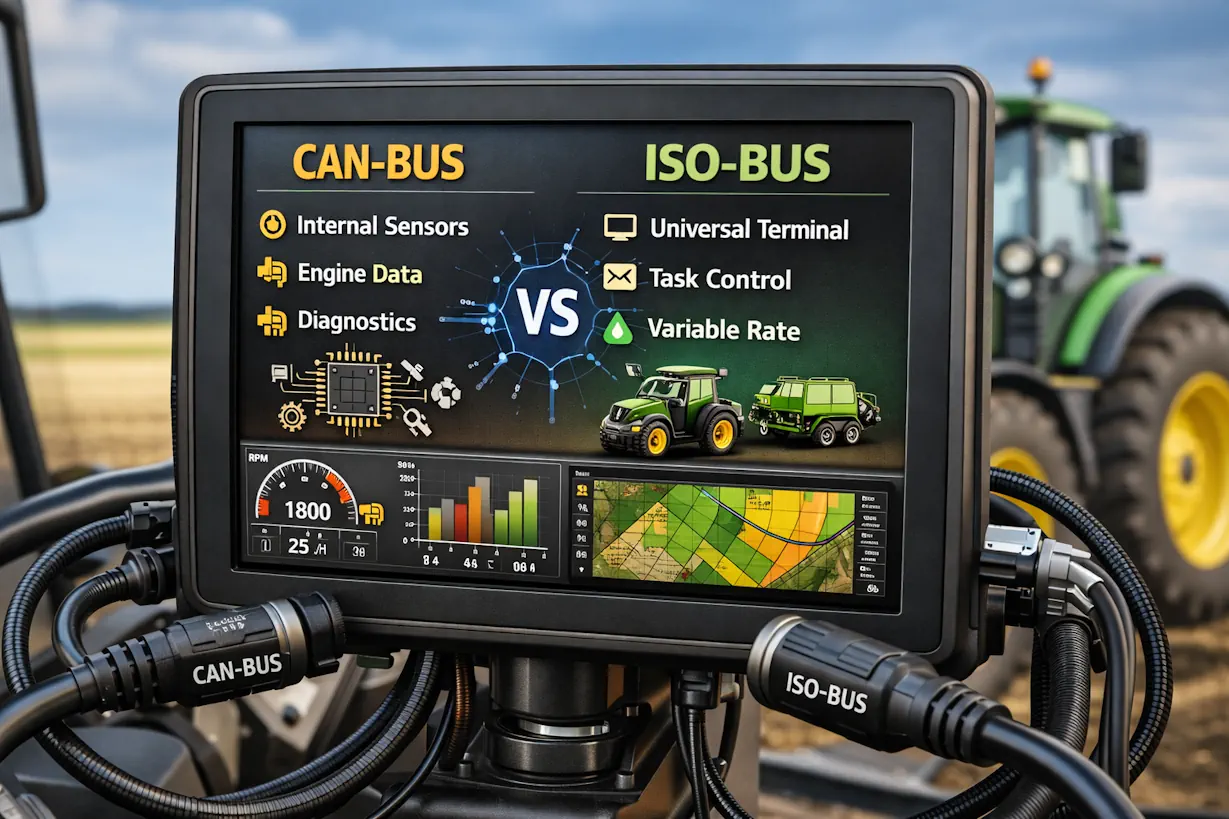
CAN-BUS and ISO-BUS are not equivalent terms. CAN-BUS is a general communication bus used in vehicle and machine electronics, whereas ISO-BUS is an agricultural communication standard based on CAN, designed so that tractors and implements from different manufacturers can exchange data in a predictable and standardized way.
Put simply: ISO-BUS uses CAN-BUS, but not every CAN-BUS is ISO-BUS. For farmers, this means the difference between merely reading data from machine electronics and achieving real interoperability between the tractor, terminal, implement, and farm management system.

What is the difference between ISO-BUS and CAN-BUS
This question comes up very often when purchasing a sprayer, fertilizer spreader, seeder, terminal, or telemetry system. Many users hear from a dealer that a machine “has CAN,” and then assume it will work seamlessly with any tractor, terminal, and reporting system. In practice, that assumption is often wrong.
CAN-BUS is primarily a method of electronic communication between controllers and sensors. ISO-BUS, the market name for the ISO 11783 standard, extends this concept for agriculture and defines not only the communication itself but also a common data language, terminal functions, task management, diagnostics, and tractor-implement interoperability. This enables capabilities such as one terminal for multiple implements, operation documentation, Section Control, variable rate application, and more advanced automation scenarios.
In scientific and industry literature, ISO 11783 is described as a foundation of modern precision agriculture applications, including VRA, Task Controller, and automation of mixed-brand machinery sets. CAN-BUS data, in turn, is increasingly used to estimate operation costs, working time, fuel consumption, and operational efficiency. This makes the topic relevant not only to electronics, but directly to costs, work organization, and data quality on the farm.
The key differences at a glance
From the perspective of a farm user, the three most important aspects are compatibility between brands, scope of data, and the ability to use this data beyond the machine itself. This is exactly where the real difference between the two buses begins.
- CAN-BUS is responsible for electronic communication at the level of controllers, sensors, and components.
- ISO-BUS is an agricultural standard based on CAN-BUS, but it adds a shared communication model between tractor, implement, terminal, and software.
- CAN-BUS may work correctly inside a single machine, but without guaranteeing full interoperability between manufacturers.
- ISO-BUS was created specifically to reduce the problem of closed proprietary manufacturer ecosystems.
- CAN-BUS data is excellent for telemetry, servicing, reading operational parameters, and building cost reports.
- ISO-BUS data is better suited for task control, operation documentation, Section Control, and variable rate application.
- The greatest value appears when data from both layers is fed into a system such as FarmPortal - FMS and linked to the field, crop, operator activity, fuel use, and costs.
Definitions and technical fundamentals
What is CAN-BUS
CAN-BUS, or Controller Area Network, is a communication bus standard used in vehicles and machines to exchange information between electronic modules. Thanks to it, controllers do not need to be connected by separate point-to-point wires. Instead, they communicate through a shared data network.
In agricultural practice, CAN-BUS can carry information about engine speed, load, fuel consumption, PTO status, travel speed, position of working elements, or signals from sensors. This is a highly valuable data layer for telemetry, diagnostics, and machine performance analysis.
What is ISO-BUS
ISO-BUS is the market name for the ISO 11783 standard for agricultural and forestry machinery. This standard defines communication between the tractor, implement, terminal, controllers, and task management systems. It is based on the CAN protocol and partly harmonized with SAE J1939, but includes its own functions specific to agriculture.
It is ISO-BUS that enables many of the functions users associate with modern precision farming: one terminal for multiple machines, operation documentation, jobs based on prescription maps, Section Control, and in more advanced cases also automation elements such as TIM.
Why these terms are confused
The confusion comes from the fact that ISO-BUS technically uses CAN-BUS. A dealer or integrator may therefore say that “the machine has CAN,” which is true, but it does not answer the user’s key question: whether this machine will work under the agricultural standard with another terminal, another tractor, and an external data system.
In practice, you can have a machine that uses CAN-BUS internally but does not offer full ISO-BUS functionality. You can also have a machine with an ISO-BUS socket but without the functions the user considers most important, such as Task Controller support or compatibility required for a given working scenario.
What this means for farmers, advisors, processors, and distributors
The topic of ISO-BUS and CAN-BUS is not relevant only for electronics specialists or service technicians. It translates into day-to-day work organization, operation cost, reporting quality, and the ability to prove what was done, where, when, and at what rate. That is why the significance of these standards differs across stakeholder groups.
| Stakeholder group | Most common problem | How understanding the difference helps |
|---|---|---|
| Farmers | Uncertainty whether the tractor, terminal, and machine will work together and whether the data can actually be used in practice | It becomes easier to assess whether you are buying only parameter readout or full interoperability of the machine set and operation data |
| Agronomic advisors | Lack of reliable data on rate, timing, and the actual execution of operations | It becomes easier to assess which data sources can be used for recommendations, documentation, and fertilizer calculations |
| Fruit and vegetable processors | Growing requirements related to traceability, process compliance, and operation records at supplier level | It becomes easier to understand which machine data can be used in quality and compliance reporting |
| Fruit and vegetable distributors | The need to confirm production standards, operations, and activities across the supply chain | It becomes easier to build a cooperation model based on data rather than producer declarations alone |
| Equipment manufacturers and integrators | Compatibility issues, complaints, and user expectations around “plug and play” | It becomes easier to describe functionality, limitations, and integration conditions precisely |
Why this matters to the farmer
For a farmer, the basic question is not “which protocol is used here,” but rather “will this work in my field and with my machinery setup.” If you have a fertilizer spreader, sprayer, or seeder and want to use prescription maps, Section Control, automatic work reports, or fuel analysis, the mere presence of CAN-BUS is not enough. You also need functional compatibility, correct configuration, and a destination system where the data will go.
The same applies to farms engaged in intensive vegetable, orchard, or arable production with high operation costs. In such cases, even small mismatches between plan and execution directly translate into money.
Why this matters to the agronomic advisor
An advisor who wants to carry out precise fertilizer calculations or analyze operation execution needs data that is reliable and anchored in time and location. CAN-BUS data helps evaluate machine work and operating parameters, while data in the ISO-BUS standard is better suited for tasks such as operation documentation, rate, section management, and information exchange between the terminal and the system.
As a result, the difference between these standards affects the quality of agronomic recommendations, not just the operator’s convenience.
Why this matters to processors and distributors
Processors and distributors increasingly expect greater production transparency from suppliers. This is not only about having documentation, but about being able to link operational data to a specific batch, plantation, or season. The better a farm integrates machine data, the easier it becomes to build a credible history of actions.
This does not mean a processor must analyze bus telegrams. It is enough to understand which data can be recovered from these standards and how it should reach a supplier collaboration system.
Comparison of ISO-BUS and CAN-BUS
The table below organizes the differences without marketing oversimplification. It is the shortest cheat sheet for people who want to make purchasing or integration decisions without the risk of false assumptions.
| Area | CAN-BUS | ISO-BUS |
|---|---|---|
| Nature of the solution | General communication bus | Agricultural communication standard based on CAN |
| Formal basis | CAN standard family / ISO 11898 and related solutions | ISO 11783 |
| Scope of use | Vehicles, machines, mobile electronics, control systems | Tractors, agricultural machines, terminals, controllers, and task data exchange |
| Inter-brand compatibility | Not guaranteed by the mere presence of CAN | One of the main goals of the standard |
| One terminal for multiple machines | Does not result from CAN-BUS alone | Yes, through standard functions such as Universal Terminal |
| Operation documentation and task handling | Possible indirectly, but without a shared agricultural data model | Yes, this is one of the key areas of application |
| Section Control and variable rate application | Possible only in specific manufacturer solutions | Typical application in precision agriculture |
| Telemetry and diagnostics | A very strong application area | Yes, but usually in the broader context of machine-task cooperation |
| Importance for FMS | Source of machine performance and operating data | Source of task, execution, and tractor-implement cooperation data |
Where you encounter CAN-BUS and ISO-BUS in practice
In practice, both standards often coexist within one organization, and sometimes even within one machine. So it is not worth asking which one is “better” in isolation from the objective. It is better to ask what you want to use the data for and what level of device interoperability you need.
Most common CAN-BUS applications in agriculture
- reading engine, load, and drivetrain parameters,
- telemetry of tractors and self-propelled machines,
- analysis of fuel consumption and working time,
- service and diagnostic monitoring,
- building operator and machine efficiency reports.
Most common ISO-BUS applications in agriculture
- machine operation through a single terminal,
- interoperability of tractors and implements from different brands,
- Task Controller and task data exchange,
- Section Control, operation documentation, and variable rate application,
- more advanced automation of machine-set work.
In a modern farm, the highest value comes from combining both layers. Operating data from CAN-BUS helps calculate cost, fuel, and time. Task and execution data from ISO-BUS helps assess operation quality, compliance with the plan, and field documentation.
How to check what your machine has
Before purchase or integration, it is not worth relying solely on generic claims such as “the machine has ISO” or “it has CAN.” From the farm’s perspective, what matters is which functions will actually work in a specific machinery set and whether the data can be used in day-to-day farm management.
Step-by-step guide
- Check the manufacturer’s documentation – look not only for CAN-BUS information, but also for ISO 11783 compliance and specific supported functions.
- Determine which terminal will be used – factory terminal, external one, or the terminal built into the tractor.
- Verify the functions – ask about Universal Terminal, Task Controller, Section Control, variable rate application, and compatibility with prescription maps.
- Ask about output data – which parameters can be retrieved for telemetry, reporting, and the FMS system.
- Check whether the data can be exported or integrated – without that, even good electronics will remain locked inside the terminal screen.
- Test a real work scenario – for example variable-rate seeding, sectional spraying, or a post-operation fuel report.
- Check whether the data will land in one place – field, machine, operator, inventory, operation history, and costs.
Top 7 questions to ask the dealer or integrator
- Does the machine have only CAN-BUS, or full ISO 11783 compliance?
- Which ISO-BUS functions are actually supported?
- Will it work with my tractor and current terminal?
- Does it support prescription maps and execution documentation?
- Which data can be retrieved for work and fuel reports?
- Can the data be integrated with a system such as FarmPortal - FMS?
- What limitations should I know about before purchase?
How FarmPortal supports work with machine data
A communication standard alone does not yet solve the farm management problem. The data must go into a system that can link it with the field, crop, operator activity, operation, storage, and costs. This is exactly where FarmPortal - farm management software comes in.
FarmPortal - FMS supports machine monitoring, fuel reporting, work and operation history, and integration of telemetry and Agriculture 4.0 data. As a result, the farmer no longer works across fragmented screens and files, but within one unified data environment.
Key benefits
- Machine monitoring – operating data is brought into one environment and displayed in the context of farm operations.
- Fuel reports – easier analysis of operating costs and operation efficiency.
- Work and operation history – better linking of execution to field, date, and operator.
- Fertilizer calculations and Fertilization Calculator – operation data can be compared with the fertilization plan and costs.
- Crop protection product database and Crop Protection Product Browser – easier organization of operation and compliance documentation.
More information about the functions is available at FarmPortal - farm management system functions. In the context of machine data, it is also worth reading about data security and telemetry integration in Agriculture 4.0 and the article on moving from standalone apps to a complete Agriculture 4.0 system.
If you want a practical telemetry setup, see GPS monitoring of agricultural machinery - Tracky with CAN-BUS support, which enables machine operation parameter readout, reporting, and fuel analysis in one FarmPortal environment.
Checklist before purchase or integration
The checklist below helps avoid the most common mistakes. It is especially useful when a new machine, a new terminal, or a new telemetry provider appears on the farm.
- Do I know which data I only want to view and which I want to use in reports and cost analysis?
- Do I need my machines to work together across brands?
- Do I care about prescription maps, Section Control, or operation documentation?
- Do the terminal and tractor support the same functions required by the implement?
- Can the data be transferred into FarmPortal - FMS?
- Do I know how the data will be assigned to the field, operation, and operator?
- Has the supplier clearly described compatibility limitations?
Case study
318 ha farm, cereals, maize, and onion
Context: a 318 ha farm with two main tractors, a sprayer, a fertilizer spreader, and a seeder. The owner had previously used telemetry data from tractors, but operation reporting and cost analysis were still carried out partly manually. The problem was not the lack of data, but the lack of a shared model for using it.
Scope of change: separating strictly operational CAN-BUS data from task and operation data from the ISO-BUS-compliant layer and bringing both into one management environment. In addition, the farm started using the data for work reports, fuel control, and more accurate cost allocation by field.
| Indicator | Before the change | After 4 months | Change |
|---|---|---|---|
| Average time needed to prepare the weekly machine work report | 2 hours 10 minutes | 35 minutes | -73% |
| Share of operations fully assigned to field and operator | 58% | 91% | +33 percentage points |
| Number of manual corrections when reconciling fuel and work data | 22 per month | 7 per month | -68% |
| Time needed to compare the fertilization plan with execution | 95 minutes | 28 minutes | -71% |
| Share of operations usable in field cost analysis | 64% | 88% | +24 percentage points |
Conclusion: the biggest benefit did not come from simply having a CAN-BUS bus or an ISO-BUS-compatible terminal. The breakthrough happened only when the data began flowing into one system and was linked with field, operation, fuel, and cost calculations. This is an important lesson for farms that invest in equipment but do not close the data loop.
Methodology of the example: model example prepared for the purposes of this article based on typical telemetry and operation-documentation implementation scenarios in medium and large farms. The indicators are illustrative and show what is worth measuring after implementation.
User opinions
In practice, the difference between CAN-BUS and ISO-BUS becomes truly clear only when a farm tries to connect several machine brands and start using the data in work and cost analysis.
“We run 210 hectares of cereals, rapeseed, and maize. Earlier, I was convinced that if the tractor provides data through CAN, the issue was solved. The problem appeared when I wanted to connect the spreader with the terminal, a prescription map, and the execution report. Only after structuring this under ISO-BUS and connecting the data to FarmPortal did I see what had really been done and how much the operation cost.”
Marcin Przybylski, 210 ha farm, Kuyavian-Pomeranian Voivodeship
“In vegetable production, precision and time matter. On 96 hectares of onion, carrot, and parsley, we had a mismatch between the plan and execution records. After implementing better order in machine data, we reduced the time needed to prepare reports by more than half and can now compare execution with costs more easily. The biggest challenge was not the equipment, but tying everything together into one process.”
Anna Sobczak, 96 ha vegetable farm, Łódź Voivodeship
Summary
CAN-BUS and ISO-BUS are not competing names for the same solution. CAN-BUS is a communication layer used broadly in vehicles and machines. ISO-BUS is an agricultural standard based on CAN-BUS that structures cooperation between the tractor, implement, terminal, and task data.
If your priority is reading operating parameters, telemetry, fuel analysis, and diagnostics, CAN-BUS data will be key. If your priority is cross-brand compatibility, operation documentation, prescription maps, variable rate application, and working through a single terminal, ISO-BUS will be key. In practice, the best results come from combining both layers and integrating them with a system such as FarmPortal - FMS.
For the farmer, this means less guesswork and less manual work. For the advisor, better input data. For the processor and distributor, greater transparency of the production process. For the equipment manufacturer, fewer misunderstandings around compatibility. That is why when buying a machine, do not just ask whether it “has CAN” or “has ISO.” Ask which functions you are actually getting and where that data will continue to work afterward.
Frequently asked questions
Are ISO-BUS and CAN-BUS the same thing?
No. CAN-BUS is a general communication bus, while ISO-BUS is an agricultural communication standard based on CAN-BUS. ISO-BUS adds shared functions and a common way of exchanging data between the tractor, implement, and terminal.
If a machine has CAN-BUS, will it work with every terminal?
No. The presence of CAN-BUS alone does not guarantee this. Interoperability between brands requires functional compliance with ISO 11783 and compatibility of specific functions on both sides.
Does ISO-BUS always mean full plug-and-play?
Not always. The standard was designed to make interoperability easier, but in practice you still need to verify specific functions, configuration, and compatibility of the tractor-terminal-machine set.
Which is better for fuel and working-time reports: CAN-BUS or ISO-BUS?
In many cases, CAN-BUS data is the foundation because it directly concerns machine operating parameters. However, it delivers the most value when it is fed into a management system and linked with work performed on a specific field.
What matters more for variable rate application and prescription maps?
Here, the functional layer associated with ISO-BUS is usually key, especially when you want to connect the terminal, implement, and task data in a standardized way.
Should an agronomic advisor understand the difference between ISO-BUS and CAN-BUS?
Yes, because it determines which data is available for evaluating operation execution, fertilizer calculations, and production technology documentation.
Why should a processor or distributor care about a machine communication bus?
Because the quality of production and operational data affects traceability, reporting, and process credibility at supplier level. This is becoming increasingly important in modern fruit and vegetable supply chains.
Can FarmPortal use telemetry and machine work data?
Yes. FarmPortal - farm management software supports machine monitoring, fuel reporting, work and operation history, and the integration of operational data with farm management.
Glossary
- CAN-BUS – a communication bus used for exchanging data between controllers and sensors in a vehicle or machine.
- ISO-BUS – the market name for the ISO 11783 standard for communication in agricultural and forestry machinery.
- ISO 11783 – an international standard describing communication between tractor, implement, terminal, and data systems in agriculture.
- Universal Terminal – a function that allows different machines to be operated through one standard-compliant terminal.
- Task Controller – a function related to work tasks, documentation, and exchange of operation execution data.
- Section Control – automatic control of working sections in order to reduce overlaps and skips.
- VRA – variable rate application, i.e. adjusting the application rate depending on a map or input data.
- Telemetry – remote collection and transmission of machine performance, location, and operating parameter data.
- FarmPortal - FMS – a farm management system that combines data from fields, machines, telemetry, costs, and documentation.
Sources
- D. S. Paraforos, G. M. Sharipov, H. W. Griepentrog, ISO 11783-compatible industrial sensor and control systems and related research: A review, Computers and Electronics in Agriculture, 2019.
- M. Mattetti et al., CANBUS-enabled activity-based costing for leveraging farm sustainability, Computers and Electronics in Agriculture, 2022 – scientific publication.
- V. Žuraulis et al., The Architecture of an Agricultural Data Aggregation and Analysis System Based on ISO 11783, Applied Sciences, 2023 – scientific publication.
Follow us!
See what we're doing and be inspired by positive changes.