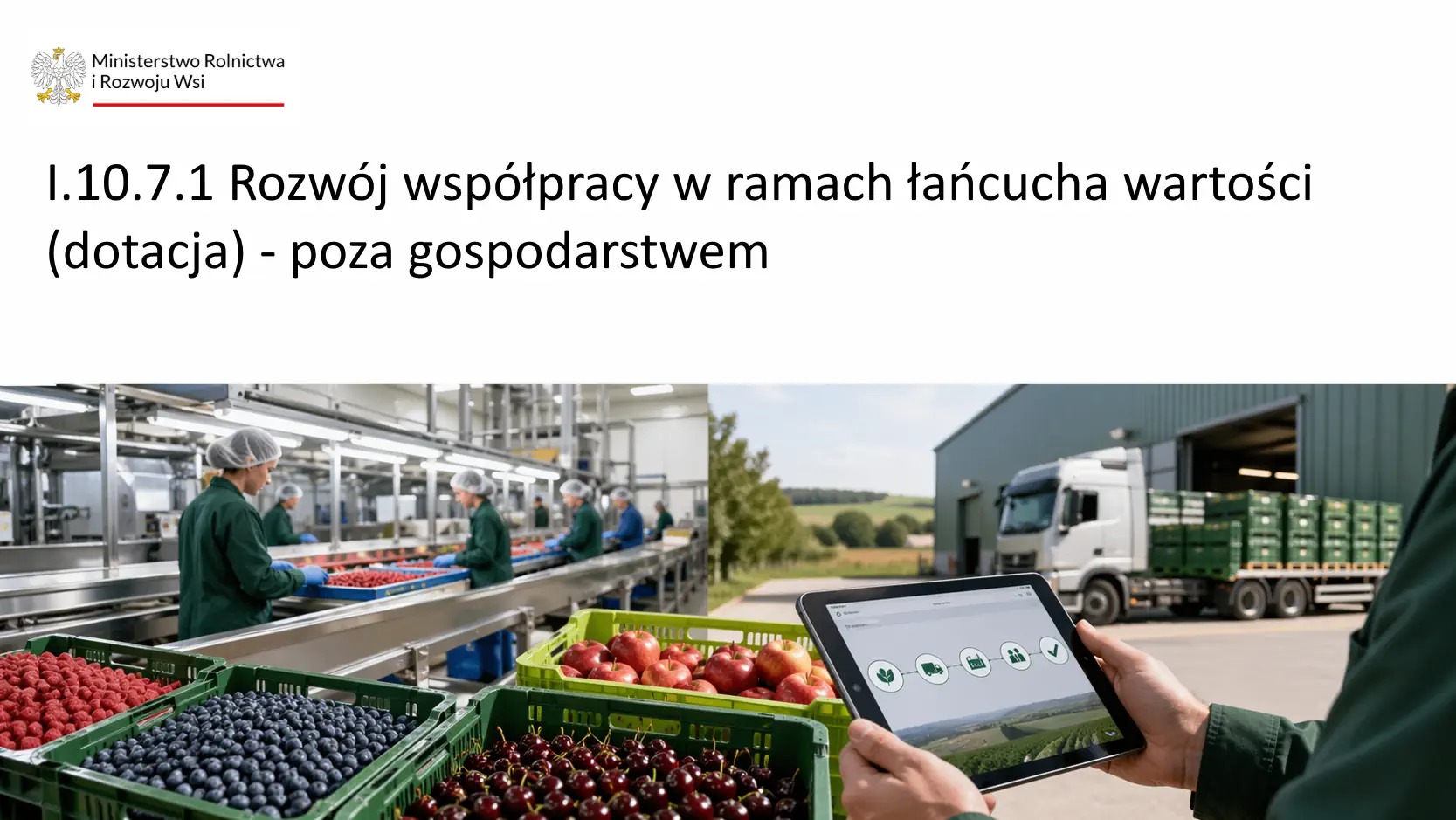
Intervention I.10.7.1 gives micro, small and medium-sized fruit and vegetable processors access to reimbursement from PLN 100,000 up to PLN 10 million and requires structured supplier cooperation, contracting, and evidence-based quality and origin documentation across the value chain.
Summary: Intervention I.10.7.1 “Development of cooperation within the value chain (grant) – outside the farm” gives micro, small and medium-sized fruit and vegetable processors the opportunity to apply for reimbursement from PLN 100,000 up to PLN 10 million — with aid intensity of up to 50–60% of eligible costs. Project preparation should start early because, in addition to the technical investment, the applicant needs to describe cooperation with suppliers, the raw material base, scoring criteria, contracting and the method for documenting the origin and quality of raw material.
What is intervention I.10.7.1 and why it is worth preparing now
Intervention I.10.7.1 “Development of cooperation within the value chain (grant) – outside the farm” is an investment support instrument under Poland’s CAP Strategic Plan for 2023–2027. Its objective is to strengthen the market position of the SME sector, shorten the food supply chain and promote cooperation between farmers, raw material suppliers and the processing industry.
For fruit and vegetable processors, this is one of the important funding instruments for investments outside the farm. The maximum amount of support may reach PLN 10,000,000 per beneficiary, while the minimum amount of support is PLN 100,000. However, the final possibility of applying for support depends on meeting applicant conditions, the investment scope, the type of activity, call documentation and the project’s compliance with the guidelines.

The fruit and vegetable processing sector operates under strong pressure from seasonality, raw material quality, energy costs, customer requirements and supply volatility. Therefore, a well-prepared project should not be limited to the purchase of machinery. It should show the full process: from raw material contracting, procurement and quality control, through storage and processing, to traceability and supplier settlement.
The application call should always be confirmed in the current ARiMR schedule and in the official call announcement. If the call is launched within the timeframe indicated in schedules, companies that organise documentation, supplier agreements, offers and the business plan in advance will have an organisational advantage.
Benefits for different audience groups
Fruit and vegetable processors
Intervention I.10.7.1 may support investments that allow processors to increase production capacity, implement new technologies and improve operational efficiency. Reimbursement may cover, among other things, plant modernisation, purchase of technological lines, development of storage infrastructure, implementation of environmental solutions and justified IT systems.
For processors, the main problem is often unstable raw material supply, insufficient delivery documentation, difficult settlements with farmers and growing customer requirements. A project prepared under I.10.7.1 may help combine a technical investment with a contracting system, fruit procurement software, quality control and raw material batch traceability.
Fruit and vegetable distributors
Distributors that also process or market agricultural products should verify their eligibility particularly carefully. Marketing under Area A is linked to conditions concerning organised forms of cooperation between farmers, so before preparing the project, the applicant should check the entity’s status, scope of activity and cooperation model with producers.
For distributors, the benefit may involve organising intake, storage, sorting, packing, labelling and documentation of batch origin. This is particularly important when customers include retail chains, processors, exporters or entities that require efficient traceability.
Agricultural advisors and agronomists
Agricultural advisors can support clients in preparing data on plantations, volumes, harvest dates, raw material quality and production risks. Their role is particularly important when the project requires connecting field-level information with the requirements of the processing plant or producer group.
In practice, an advisor can help describe how the raw material base will be managed after the investment is completed. They can also support the implementation of cooperation standards: delivery planning, quality assessment, documentation of treatments and communication between the farmer and the processing plant.
Management teams in companies using grant funding
For management teams and people responsible for investments, the key issue is connecting funding with a measurable business effect. The project should answer the following questions: which costs will be reduced, which processes will be improved, how losses will decrease, how supplier service will improve and how the investment will affect the company’s competitive position.
The best-rated projects are usually consistent: budget, technology description, raw material base, agreements, indicators and implementation schedule form one logical whole. This is why IT systems, contracting, procurement and traceability should be designed together with the technological investment, not added at the end.
Grant consulting companies
Grant consulting companies need not only invoices, offers and cost estimates from the client, but also operational data: suppliers, volumes, agreements, delivery routes, quality parameters, risks and expected effects. Without this data, it is difficult to justify the project well and show that it strengthens cooperation within the value chain.
This article helps organise the argumentation: the investment is not only a machinery purchase, but a way to improve quality, traceability, efficiency and long-term cooperation between the farmer, processor and final customer.
Who can apply — applicant conditions
Micro, small and medium-sized enterprises that meet the conditions set out in the detailed guidelines and call documentation may apply for support under intervention I.10.7.1. SME status should be verified taking into account capital and personal links, turnover, balance sheet total and employment.
The applicant should carry out activities in the processing of agricultural products or their marketing, in accordance with the scope indicated in the programme documentation. For entities involved only in marketing, it is particularly important to verify whether the entity operates as an organised form of cooperation between farmers, such as a producer group, cooperative, producer organisation or another eligible structure.
The investment location should also be checked in the call documentation. The intervention is aimed at strengthening SMEs in rural areas, so before starting preparations it is worth confirming whether the registered office, place of investment implementation and nature of the operation meet the conditions relevant to the specific call.
| Parameter | What should be verified |
|---|---|
| Enterprise status | Whether the company meets the definition of a micro, small or medium-sized enterprise, including links with other entities. |
| Type of activity | Whether the activity corresponds to the processing of agricultural products or their marketing as indicated in the guidelines. |
| Investment location | Whether the place of operation implementation meets the conditions relevant to the call and the objective of the intervention. |
| Business register entry | Whether CEIDG or KRS data is up to date and consistent with the scope of activity covered by the project. |
| Cooperation with suppliers | Whether the project shows real cooperation within the value chain, including raw material deliveries, agreements, volumes and the price-setting mechanism. |
| Marketing without processing | Whether the entity meets the conditions applicable to organised forms of cooperation between farmers. |
Table 1. Key applicant conditions to be checked before preparing an application under intervention I.10.7.1. Source: own study based on the detailed guidelines of the Ministry of Agriculture and Rural Development.
Area A vs. Area B — comparison of support parameters
Intervention I.10.7.1 divides support into two main areas. Area A concerns the processing and marketing of agricultural products by SMEs in the conventional model. Area B concerns organic products and requires verification of documents confirming activities covered by organic certification.
The choice of area affects the aid intensity, project conditions and how the investment should be justified. Before choosing the pathway, it is worth analysing the raw material structure, the share of organic products, supplier status and whether the company will be able to maintain the declared conditions during the durability period.
| Parameter | Area A | Area B |
|---|---|---|
| Scope | Processing and marketing of agricultural products. | Processing and marketing of organic agricultural products. |
| Maximum amount of support | PLN 10,000,000. | PLN 10,000,000. |
| Minimum amount of support | PLN 100,000. | PLN 100,000. |
| Aid intensity — standard | Up to 50% of eligible costs. | Up to 60% of eligible costs. |
| Aid intensity — organised cooperation | Up to 60% of eligible costs for eligible organised forms of cooperation between farmers. | Up to 60% of eligible costs. |
| Organic certificate | Generally not required, unless the project refers to organic products in another scope. | Requires verification in accordance with documentation for organic products. |
| Preference for the share of organic products | Not applicable as the main condition of the area. | May be relevant for scoring if the thresholds indicated in the call documentation are met. |
| Preference for environmental protection | Possible if the project meets the conditions for the environmental component. | Possible if the project meets the conditions for the environmental component. |
| Preference for innovation | Possible if investment costs meet innovation conditions. | Possible if investment costs meet innovation conditions. |
Table 2. Comparison of Area A and Area B under intervention I.10.7.1. Source: own study based on the detailed guidelines of the Ministry of Agriculture and Rural Development.
What the grant can finance — investment catalogue
The grant covers tangible and intangible investments related to the processing or marketing of agricultural products. In practice, the project may combine production, storage, environmental and IT infrastructure. Each cost should, however, be justified by the scope of the operation and have a direct link to the investment objective.
For fruit and vegetable processing plants, investments that improve raw material quality, reduce losses, increase plant throughput and enable better batch traceability are particularly important. The key cost categories worth analysing when building the project scope are described below.
1. Construction, extension and modernisation of processing buildings
The project may include the construction of new production halls, extension of existing plants, reconstruction, renovation combined with modernisation, or adaptation of infrastructure to new processes. For fruit and vegetable processors, this may mean, for example, a sorting hall, raw material warehouse, delivery intake zone, cold store or packing rooms.
2. Purchase of technology and production lines
The project may include lines for washing, calibrating, optical sorting, packing, freezing, pasteurisation, production of juices, purées, concentrates or other agricultural products. The technology scope should result from an analysis of plant needs, raw material volume, quality requirements and planned economic effects.
3. Environmental protection infrastructure
The environmental component may include, for example, technological wastewater treatment plants, heat recovery installations, water recirculation systems, emission reduction, lower energy consumption or waste management. If environmental costs reach the threshold indicated in the documentation, they may improve the project score.
4. Processing by-products and food waste
Fruit and vegetable processing plants generate pomace, peelings, sorting waste and other by-product fractions. The project may include solutions for their management, such as biogas production, biocomponents, feed, compost or secondary raw materials, provided this is compliant with the call documentation and eligibility scope.
5. Intangible investments and IT systems
Software for food processing, a fruit and vegetable procurement management system, a raw material contracting system, software for settling agricultural suppliers or a raw material batch traceability system may be a justified part of the project if they are directly linked to the operation. An example may be a raw material batch traceability system, which connects data about the supplier, field, harvest date, quality, warehouse and production batch.
Scoring criteria — 7 ways to increase the chances of funding
Applications are assessed according to selection criteria. The position in the ranking may determine whether support is granted, so it is worth designing the investment not only in terms of costs, but also scoring. Each criterion should, however, be confirmed in the current guidelines and call announcement, because details may depend on the support area and project scope.
1. Investments aligned with the Farm to Fork Strategy. Operations covering sustainable processing methods, product marking and labelling, circular economy and reduction of food loss and waste may be awarded points. For fruit and vegetable processors, traceability systems, monitoring of storage conditions and improved delivery planning are particularly important.
2. Processing by-products and producing biocomponents. If the operation includes the management of by-products generated in food production, it may gain additional scoring value. Examples include using pomace, peelings or sorting waste to produce biogas, compost or other by-products.
3. Environmental protection component. The project may receive a preference if an appropriate part of eligible costs concerns pro-environmental infrastructure. In the fruit and vegetable sector, this may include investments in water, energy, heat recovery, refrigeration, technological wastewater or reducing raw material losses.
4. Innovation. Innovation in the project should be described specifically: what process is new for the company, what data will be collected, and how the handling of deliveries, quality control or production will change. Innovation may include not only a new machine, but also a new way of managing raw material, contracting and traceability.
5. Organised form of cooperation between farmers. Producer groups, cooperatives, producer organisations and other eligible structures may benefit from preferences if they meet programme conditions. For many companies, this means analysing whether the project should be implemented individually or in a cooperation model.
6. Certification and quality standards. Participation in quality systems, production certification and meeting customer requirements may strengthen the project description. IFS, BRCGS and GLOBALG.A.P. are not public regulations, but commercial and certification standards that are often required by retail chains, exporters and large B2B customers.
7. Organic products. Under Area B, organic products and compliance with certification requirements are particularly important. If the company plans an organic project, it should carefully verify the share of organic products, certificates, supplier structure and the ability to maintain the declared conditions after the operation is completed.
Fruit and vegetable contracting — formal requirement and operational advantage
One of the distinguishing features of intervention I.10.7.1 is its focus on cooperation within the value chain. In practice, this means the need to describe the relationship between raw material suppliers and the processor well. In many projects, it will be important to document deliveries through agreements, volumes, the price-setting mechanism, raw material quality and delivery schedules.
A contracting agreement with a farmer should not be treated only as a formal attachment. It is a tool that stabilises supply, limits price risk, organises quality requirements and helps plan production capacity. For fruit and vegetable processors, this is particularly important because the harvest season is short and raw material quality may change from day to day.
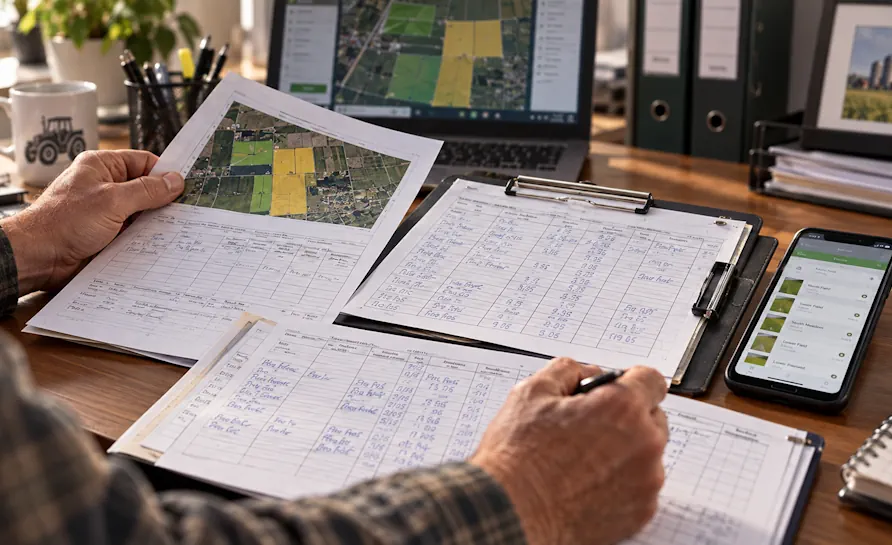
A manually managed raw material contracting system, for example in spreadsheets and binders, may work with a few suppliers. With dozens or hundreds of farmers, however, errors, delays, duplicate data and difficulties in preparing reports quickly begin to appear. A digital fruit and vegetable procurement management system can connect each delivery with the agreement, supplier, field, batch, quality and settlement.
More about shortening supply chains and building cooperation between farmers and buyers can be found in the guide to short supply chains in agriculture.
“Since we started managing contracting in the system, we know exactly how much raw material we have contracted for a given week, what the fulfilment percentage is and where deviations appear. Preparing data for discussions with a grant advisor is much easier because we no longer need to combine information from several spreadsheets and binders.”
How to submit an application for the I.10.7.1 grant — step-by-step guide
The application process should begin several months before the call opens. Project preparation includes not only a business plan and offers, but also data on the raw material base, suppliers, agreements, production process, quality and expected investment effects.
- Verify SME status. Check whether the company meets the definition of a micro, small or medium-sized enterprise. Include capital and personal links with other entities.
- Confirm the investment location. Check whether the registered office or place of operation implementation meets the conditions indicated in the guidelines and call documentation.
- Select Area A or Area B. If the project concerns organic products, verify certificates, the share of organic raw material and Area B conditions. In other cases, analyse the possibility of applying under Area A.
- Design the investment with scoring in mind. Analyse whether the project can include an environmental component, innovation, food loss reduction, processing of by-products or alignment with the Farm to Fork Strategy.
- Organise agreements and supplier data. Prepare the list of suppliers, volumes, crops, varieties, delivery dates, quality parameters and price-setting mechanism. Consider implementing FarmPortal software for food processing.
- Prepare the business plan. Describe the economic rationale of the investment, raw material sources, sales markets, financial forecasts, risks and impact on the value chain.
- Collect offers and technical documentation. Prepare offers, cost estimates, technology descriptions, construction, environmental and technical documentation, if required.
- Submit the application in accordance with the call rules. The method of submission, deadlines, forms and attachments should be confirmed in the current call announcement and ARiMR instructions.
Readiness checklist for the I.10.7.1 call
The list below helps quickly check whether the company is ready to speak with a grant advisor and begin preparing the application. Each point corresponds to an area that may be relevant formally, operationally or for scoring.
- ☐ SME status has been verified, including links with other entities.
- ☐ CEIDG or KRS data is up to date.
- ☐ The investment location has been checked against the call conditions.
- ☐ Business activity codes and the actual activity scope are consistent with the planned operation.
- ☐ Area A or Area B has been preliminarily selected.
- ☐ A list of raw material suppliers, crops, areas and volumes has been prepared.
- ☐ Supplier agreements or the plan to conclude them has been verified.
- ☐ The price-setting mechanism and raw material quality parameters have been described.
- ☐ A preliminary business plan and financial assumptions have been prepared.
- ☐ Initial offers or cost assumptions have been collected.
- ☐ The environmental component of the project has been analysed.
- ☐ The innovation component of the project has been analysed.
- ☐ Environmental, construction and technical documentation has been checked.
- ☐ Organic certificates have been verified if the project concerns Area B.
- ☐ Information on quality standards and customer requirements has been collected.
- ☐ A raw material batch traceability system or method for documenting traceability has been planned.
Implementation example: cherry and raspberry processing plant in Lubelskie Voivodeship
Context
“Owoc Lubelszczyzny” is a fictional but realistic soft fruit processing plant handling cherries, raspberries and currants, located in a rural commune in the Lublin district. The company employs 28 people in season and 12 permanently, generates revenue typical of a small regional processing plant and processes approximately 3,200 t of raw material from 85 suppliers. Status: small enterprise.
The previous model was based on partly formalised contracting, invoices, telephone arrangements and spreadsheets. The biggest problem was not production itself, but the lack of consistent data: who supplied the raw material, from which plantation, at what quality level, with what quality control result and to which production batch it was assigned.
Planned investment under Area A
The project includes modernisation of the IQF tunnel freezing line, i.e. individually quick frozen technology, construction of a cold store with controlled conditions, purchase of an optical sorter and implementation of food processing software with contracting and raw material batch traceability modules.
| Indicator | Before investment | After investment — forecast | Change |
|---|---|---|---|
| Freezing capacity | 1.2 t/h | 2.5 t/h | +108% |
| Raw material losses, including waste and quality defects | 14% | 7% | −50% |
| Storage capacity | 120 t | 520 t | +333% |
| Number of suppliers with an organised agreement or supplier profile | 12 | 85 | full organisation of the supplier base |
| Time needed to identify a raw material batch | 4–6 h, manual search | < 5 min, digital process | −98% |
| Net investment cost | PLN 4,200,000 | ||
| Potential requested reimbursement at 50% | PLN 2,100,000 | ||
Table 3. Key performance indicators for the planned “Owoc Lubelszczyzny” investment — model scenario. Source: own calculation for the purpose of the example, requiring adjustment to the data of a specific enterprise.
Scoring optimisation
The company planned the project to combine production, environmental and digital investment. The environmental component includes technological wastewater treatment and heat recovery from the cold store. The innovation component includes an optical sorter, a traceability system and digital handling of contracting. The entire investment supports the objectives of Farm to Fork, as it reduces food losses and improves batch traceability.
Opinions from processors and suppliers
“I run a raspberry and strawberry processing plant — 45 hectares of own crops and around 60 external suppliers, approx. 2,000 tonnes of raw material per year in total. The biggest challenge in preparing the project was documenting the supply chain: who delivered which batch, when and at what quality level. We implemented an application for processors with contracting and traceability modules. Now each delivery is linked to the supplier, agreement and quality control result. I estimate that this element alone saved us more than 120 working hours when compiling the data.”
“As an agricultural advisor, I work with apple producer groups in the Grójec region. Under I.10.7.1, the key is to show real cooperation, not just the purchase of a machine. If the group operates in an organised structure, has agreements, a delivery plan and quality history, it is much easier to prepare the business plan and justify the investment. With a project worth several million PLN, even the difference between 50% and 60% reimbursement is highly significant.”
How FarmPortal supports processors in contracting and raw material traceability
FarmPortal, developed by Agri Solutions Sp. z o.o., is a platform for farm management and cooperation in the food supply chain — from field to processing plant. In the context of I.10.7.1, the platform can support the areas that are particularly important for fruit and vegetable processors: contracting, procurement, quality documentation, traceability and supplier settlement.
Raw material contracting system. FarmPortal enables the creation, management and archiving of agreements with suppliers in digital form. Each agreement may include quality parameters, raw material delivery schedule, price terms and planned volumes. The processor sees contract fulfilment, deviations from plan and delivery status in one panel.
Raw material batch traceability. The platform links a delivery with a specific supplier, field, raw material batch and quality control result. Such a system can help meet the requirements of customers, commercial and certification standards such as IFS, BRCGS or GLOBALG.A.P., and make it easier to respond to complaints and audits.
System for settling agricultural suppliers. FarmPortal can automate the calculation of delivery value based on weight, quality and contractual terms. This helps the company reduce manual calculations, the risk of errors and disputes with suppliers.
Raw material delivery schedule. Delivery planning and monitoring helps the processor assess how much raw material has been contracted, how much has already been accepted, which batches are awaiting collection and where seasonal bottlenecks may arise.
Potential eligibility in the project. A traceability system, contracting system or fruit procurement software may be an eligible cost as an intangible investment if it is directly justified by the scope of the operation and linked to processing, storage, preparation for sale, quality control or supply chain management. Final eligibility should be confirmed in the call documentation and in the description of the specific project.
A full overview of the platform’s features is available at farmportal.eu/en/functions.
Frequently asked questions
Can a small fruit processing plant apply for the I.10.7.1 grant?
Yes, provided the company meets the conditions indicated in the guidelines and call documentation. SME status, activity scope, business activity codes, investment location, type of operation and obligations related to cooperation with raw material suppliers should be checked. The minimum amount of support is PLN 100,000 and the maximum is PLN 10,000,000.
What investments may qualify for reimbursement under I.10.7.1?
Tangible and intangible investments may qualify if they are related to the scope of the operation. Examples include construction or modernisation of processing buildings, purchase of technological lines, sorting, packing and storage systems, environmental protection infrastructure, solutions for processing by-products and justified software supporting process management.
How much funding is available and what is the reimbursement rate?
The maximum amount of support is PLN 10 million per beneficiary, and the minimum is PLN 100,000. Under Area A, reimbursement may reach up to 50% of eligible costs, or up to 60% for organised forms of cooperation between farmers. Under Area B, reimbursement may reach up to 60% of eligible costs.
When will the call for applications for the I.10.7.1 grant open?
The call date should be confirmed in the current ARiMR schedule and official call announcement. Preliminary schedules may indicate indicative dates, but only documents published by the relevant institution are binding.
Do I need contracting agreements with farmers to receive the grant?
In many projects, demonstrating real cooperation with raw material suppliers will be key. Contracting agreements or other supply agreements help document volumes, quality, schedules and the price-setting mechanism. The detailed scope of obligations should be verified in the call documentation.
What additional points can I obtain as a fruit and vegetable processor?
Additional points may result from alignment with the Farm to Fork Strategy, environmental component, innovation, processing by-products, operating as an organised form of cooperation between farmers or participating in quality systems. Criteria and scoring should be confirmed in the current documentation.
Can an agricultural advisor help a client prepare an I.10.7.1 application?
Yes. An advisor can help collect data on plantations, suppliers, volumes, quality, production risks and delivery schedules. They can also support the preparation of the raw material base description, cooperation standards and business justification for the project.
What is the difference between Area A and Area B under intervention I.10.7.1?
Area A concerns the processing and marketing of agricultural products. Area B concerns organic products and requires verification of certificates and the share of organic products. The areas differ in reimbursement level, requirements and the way the project should be justified.
Conclusion
Intervention I.10.7.1 is an important investment support instrument for fruit and vegetable processors under Poland’s CAP Strategic Plan 2023–2027. Reimbursement of up to PLN 10 million, aid intensity of up to 60% and a broad catalogue of investments may support plant modernisation, implementation of new technologies, improvement of raw material quality and development of formal supplier relationships.
Key conclusions for fruit and vegetable processors and distributors:
- Project preparation should start early, because data on suppliers, raw material, volumes, quality, technology and planned effects is required.
- Raw material contracting and organised supplier agreements may significantly strengthen the project description and facilitate later settlement.
- Optimising scoring criteria such as environmental protection, innovation, by-products and the Farm to Fork Strategy may affect the project’s ranking position.
- An organised form of cooperation between farmers may increase the aid intensity under Area A if programme conditions are met.
- A raw material batch traceability system, contracting system or fruit procurement software may be an eligible cost if justified by the scope of the operation and directly supporting processing, storage, quality or supply chain management.
Glossary
- Beneficiary
- An entity that has been granted support under intervention I.10.7.1.
- Traceability
- The ability to track the movement of raw material, product or batch through successive stages of production, processing, storage and distribution.
- Innovation in the project
- The introduction of a new or significantly improved product, process, technology or organisational method at the enterprise level, in accordance with the conditions indicated in the call documentation.
- Raw material contracting
- Formal or system-based management of agricultural product deliveries between farmers or other suppliers and the processor, covering quantity, quality, price, schedule and acceptance terms.
- Eligible costs
- Costs necessary to implement the operation, rational, justified and compliant with the cost catalogue and call conditions.
- SME
- A micro, small or medium-sized enterprise meeting criteria concerning employment, turnover, balance sheet total and links with other entities.
- Rural area
- An area whose eligibility should be checked in accordance with the guidelines and documentation of the specific call. Intervention I.10.7.1 is aimed at strengthening SMEs in rural areas.
- Durability period
- The period after final payment during which the beneficiary should maintain the project effects and comply with obligations resulting from the agreement and guidelines.
- Agricultural products
- Products covered by the scope indicated in the documents concerning the intervention, taking into account exclusions and definitions relevant to the programme.
- Processing of agricultural products
- Activities carried out on agricultural products resulting in products falling within the scope of the programme, in accordance with the definitions included in the guidelines.
- Farm to Fork Strategy
- An EU strategy for a more sustainable, safe and transparent food system. In I.10.7.1 projects, it may be important for justifying investments in quality, traceability, loss reduction and sustainable processing.
- Organised form of cooperation between farmers
- An economic structure created by farmers, such as a producer group, cooperative, farmers’ cooperative, producer organisation or another form indicated in the programme documentation.
Sources
- Ministry of Agriculture and Rural Development — Intervention I.10.7.1 “Development of cooperation within the value chain (grant) – outside the farm”, CAP Strategic Plan 2023–2027 and detailed guidelines for intervention I.10.7.1.
- PARP — Report on the state of the small and medium-sized enterprise sector in Poland 2024.
Follow us!
See what we're doing and be inspired by positive changes.