Short Summary
Short food supply chains in agriculture are a sales model in which a limited number of entities operate between the farmer and the end customer, usually no more than one intermediary. In practice, this means greater control over margin, better market contact, and the ability to build sales around quality, locality, and transparent product origin.
However, this is not automatically a better solution in every situation. Short food supply chains increase organisational requirements on the farm or company side: supply, documentation, logistics, settlements, customer communication, and batch traceability all need to be planned more effectively. They work best where sales are supported by a good system for managing data and processes.
Short Food Supply Chains in Agriculture - What They Are
Short food supply chains are a food trade model in which a farmer, processor, or producer group shortens the commercial, organisational, or relational distance between the place of production and the place of sale. In the EU perspective, this is not only about a small number of intermediaries, but also about closer cooperation, local economic development, and stronger social and geographical ties between the producer, processor, and consumer.
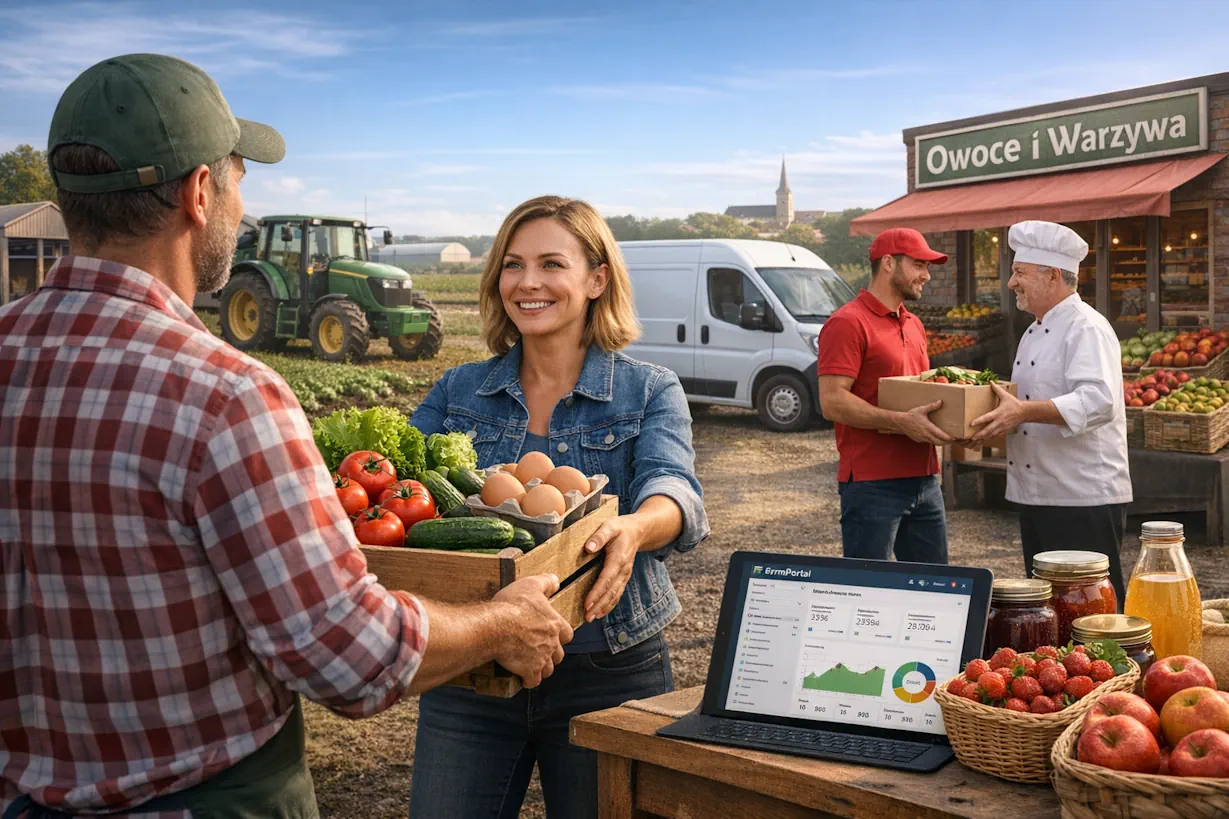
In agricultural practice, this may include direct sales from the farm, deliveries to local shops and restaurants, sales through one's own outlet, cooperatives, subscription boxes, local ordering platforms, trade with one intermediary, or a model in which the farmer works with a processor or distributor while retaining greater control over data quality, origin, and delivery settlement.

For fruit and vegetable producers, this topic is especially important because with fresh goods, timing, quality, batch, harvesting conditions, and speed of settlement all have a direct impact on financial performance. A short food supply chain is therefore not only about "selling closer to home." It is a way of organising a business that can improve margin, while also shifting more operational responsibility to the farm or company.
Key Benefits and Limitations
The biggest advantage of short food supply chains is recovering part of the value that, in a long supply chain, is distributed across successive links. However, this does not happen automatically. Profit appears when the producer is able to combine sales with supply planning, quality control, settlements, and good product information.
European research shows that short food supply chains have not only economic, but also social and environmental significance. At the same time, the literature highlights that their development requires more organisational effort, efficient logistics, and strong management of customer relationships and documentation.
| Area | Potential Benefit | Most Common Limitation |
|---|---|---|
| Margin | A larger share of the final price for the producer | Higher cost of own sales, packaging, and customer service |
| Relationship with the buyer | Direct contact and faster feedback | The need for ongoing communication and order handling |
| Quality and traceability | Easier demonstration of origin, variety, production method, and harvest date | Greater responsibility for data consistency and labelling |
| Business resilience | Diversification of sales channels and lower dependence on a single buyer | Greater operational complexity when working with many small buyers |
| Production planning | Better alignment of the offer with the local market | The need for more accurate forecasting of harvest volume and quality |
What This Means for Farmers, Advisors, Processors, and Distributors
Short food supply chains are not a solution only for farms selling at local markets. This is a model that can also work in cooperation with a local processor, restaurant, specialist shop, buying group, or distributor building a regional offer. That is why the benefits and challenges need to be assessed separately for each stakeholder group.
| Stakeholder Group | Most Common Problem | What the Short Food Supply Chain Solves |
|---|---|---|
| Farmers | Low bargaining power with large buyers and weak visibility of their own quality | Greater control over price, customer relationships, and how the product is presented |
| Agricultural advisors | Lack of connection between production technology and actual sales performance | Stronger link between advisory work, market quality, supply planning, and profitability |
| Processors | Unstable supply, weak batch transparency, and difficulty building relationships with growers | Closer cooperation with the supplier, greater batch control, and faster information flow |
| Fruit and vegetable distributors | Quality pressure and the need for quick confirmation of origin | Better traceability, more flexible contracting, and shorter response time |
| Agricultural equipment manufacturers | Difficulty in demonstrating the real value of digital solutions to the end customer | The ability to embed farm data into a specific sales and logistics model |
What the farmer gains
The farmer primarily gains greater influence over price, sales format, and contact with the buyer. In a short supply chain model, it is easier to show quality advantages, local origin, freshness, variety, or cultivation method. This is especially important in vegetables, berries, orchards, and specialist production.
At the same time, the farm takes on more responsibilities: orders need to be managed, availability confirmed, batch quality controlled, transport arranged, and settlements handled. Without a good system, these activities quickly begin to consume time that was previously hidden on the intermediary's side.
What the agricultural advisor gains
The advisor can better connect production technology with economic performance. When a farm sells closer to the end market, it becomes easier to assess how decisions related to fertilisation, crop protection, harvest date, and quality affect sales, complaints, and price. This creates better conditions for working with data rather than only with general recommendations.
In such a model, fertiliser calculations, treatment planning, quality control, and batch documentation become particularly important. Advisory work then becomes more business-oriented, not only technology-oriented.
What the processor and distributor gain
For processors and distributors, a short food supply chain may mean not only fewer intermediaries, but also better raw material data. With fresh fruit and vegetables, the speed of information about the batch, plantation location, harvest quality, delivery date, and any deviations is highly important.
If cooperation with the grower is well organised, the company gains not only raw material, but also more stable business relationships and easier traceability. This matters operationally, in quality terms, and from a marketing perspective.
The Most Common Short Food Supply Chain Models
A short food supply chain does not have a single pattern. It works differently across market segments. It is different in dessert strawberries, different in onions and carrots, and different again in the sale of processed products, fermented foods, or premium products.
Top 7 models seen in practice
- Direct sales from the farm.
- Deliveries to local shops and greengrocers.
- Cooperation with restaurants and food service.
- Subscription boxes and recurring orders.
- Online sales with own logistics or collection.
- Cooperation with a local processor while maintaining batch traceability.
- A model with one intermediary specialised in the local or regional market.
The choice of model depends on the type of product, the scale of the farm, product shelf life, labour availability, and commercial capabilities. Not every farm should move into full direct sales. Sometimes a mixed model is more profitable: part of the production goes to a stable buyer, and part goes to higher-margin channels.
Comparison: Short and Long Supply Chains
In discussions about local sales, there is often an oversimplification that a short food supply chain is always better. That is not true. In practice, both models make sense, but they serve different purposes. The table below helps structure the differences from the perspective of the farm and companies working with farmers.
| Area | Short Food Supply Chain | Long Food Supply Chain |
|---|---|---|
| Producer margin | Usually higher per unit of product | Usually lower, but at greater scale |
| Volume | Often smaller or more diversified | Usually larger and more repeatable |
| Customer contact | Direct or very close | Indirect |
| Organisational requirements on the farm side | High | Some tasks are taken over by intermediaries |
| Traceability and product storytelling | Easier to demonstrate | More difficult, unless the company has a developed traceability system |
| Resilience to fluctuations from a single buyer | Higher with channel diversification | Lower with strong sales concentration |
How to Implement a Short Food Supply Chain Step by Step
The biggest mistake is that a farm starts with promotion rather than process. A short food supply chain works best when production, quality, logistics, and data are organised first. Only then is it worth scaling sales.
Step-by-step guide
- Choose a product or product group - it is best to start with an assortment that has a clear quality or local advantage.
- Define the sales model - direct, with one intermediary, through a local shop, for food service, or in a box scheme model.
- Calculate the minimum profitable volume - include packaging, losses, transport, labour, and complaints.
- Set the batch standard - variety, size, quality, harvest date, packaging method, and labelling.
- Organise production data - field, treatment, quality, harvest date, worker, batch, buyer.
- Define the settlement process - payment, documentation, delivery confirmation, complaints.
- Start with a pilot - one channel, one product group, clearly defined indicators.
7 indicators worth measuring
- average sales price per unit of product,
- share of complaints in the number of batches,
- time from harvest to delivery,
- share of goods sold in the premium class,
- packaging and logistics cost per kilogram or crate,
- time needed for handling orders and settlements,
- share of sales made to regular buyers.
How FarmPortal Supports Short Food Supply Chains
Short food supply chains require good organisation of data and processes. The field, harvest, quality, worker, batch, buyer, and settlement all need to be connected. This is exactly where FarmPortal - farm management software brings real operational value.
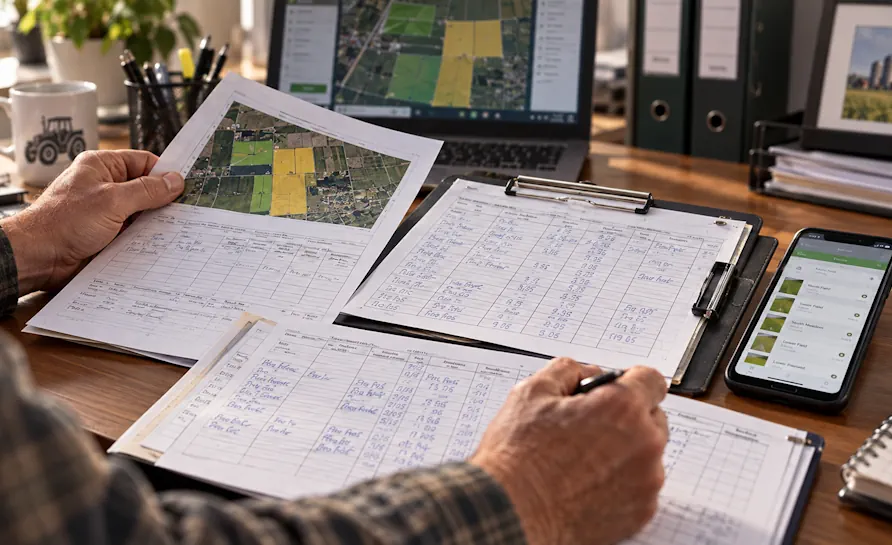
FarmPortal - FMS helps organise production, documentation, and settlements. In fruit and vegetables, the grower module and features related to harvest registration, quality control, worker productivity, and cost calculation are especially important. As a result, the short food supply chain stops being an improvised setup based on phone calls and spreadsheets and becomes a repeatable process.
Key features and benefits
- Harvest registration and worker settlements - especially important in fruit and vegetable production.
- Batch quality control - easier linking of quality with a specific plantation, day, and team.
- Cost calculations - better comparison of margins between sales channels.
- Data for cooperation with the buyer - better visibility of the batch, harvest date, and field history.
- Digital Product Passport in a QR code - presentation of marketing data, quality data, origin information, and carbon and water footprint in a format that is easy to share with the buyer.
- Automation of batch tracking and monitoring - faster assignment of batches to field, harvest, quality, warehouse, and buyer, along with a lower risk of documentation errors.
- Data from field to fork - better integration of production, harvest, quality, logistics, and sales information, increasing transparency across the entire supply chain.
A description of the features is available on the FarmPortal - farm management system features page. It is also worth visiting the page about farm management and fruit and vegetable harvest settlements as well as the article about organising data and moving to Agriculture 4.0.
Checklist Before Launching Sales
The checklist below helps quickly assess whether a farm or company is ready to enter a short food supply chain model. It is best to go through it before the first season or before expanding the sales channel.
- Do I know exactly who I want to sell to and what quality the buyer expects?
- Can I calculate the cost of the batch, packaging, and delivery?
- Do I have a quality standard and a method for batch marking?
- Do I know how I will manage orders, confirmations, and complaints?
- Is my harvest and worker data organised?
- Do I have a plan for surplus or shortage situations?
- Can I compare the profitability of short and long sales channels?
Case Study
74-hectare farm, strawberries, raspberries, and seasonal vegetables
Context: a 74-hectare farm, including 18 hectares of strawberries, 9 hectares of raspberries, and the remaining area dedicated to seasonal vegetables. Before implementation, most of the production was sold to two large wholesale buyers. The farm wanted to launch a local sales channel for part of its premium production and organise harvest settlements and batch quality.
Scope of change: launching sales to local shops and food service, implementing harvest and batch quality registration, comparing margins between the local and wholesale channels, and improving supply planning using one integrated data environment.
| Indicator | Before implementation | After 5 months | Change |
|---|---|---|---|
| Average gross margin per kilogram of premium product | PLN 1.85/kg | PLN 3.10/kg | +68% |
| Share of batches fully assigned to harvest day and crew | 46% | 92% | +46 percentage points |
| Average time needed to prepare harvest summaries and weekly settlements | 3 hours 40 minutes | 1 hour 10 minutes | -68% |
| Percentage of complained batches in the local channel | 4.8% | 2.1% | -56% |
| Share of local sales in seasonal revenue | 8% | 19% | +11 percentage points |
Conclusion: the biggest improvement did not result solely from a higher sales price. The key factor was better organisation of harvest, quality, and batch data. Thanks to this, the farm was able to deliberately direct selected batches to the local channel, respond more quickly to quality issues, and reduce losses in settlements and complaints.
Example methodology: this is a model example prepared for the purposes of the article, based on a typical implementation path of a local sales channel in a fruit and vegetable farm. The indicators are illustrative and show what data is worth measuring in practice.
User Reviews
The statements below are illustrative, but they reflect the real benefits and challenges that arise in short food supply chains. The biggest challenge is usually not the sale itself, but the day-to-day organisation of the process from field to buyer.
"We manage 58 hectares of vegetables, and previously almost everything went to one wholesaler. After launching a local channel for part of our carrots, onions, and beetroot, we clearly saw that the higher price only makes sense when we control batch quality and harvest settlement. Once the data was organised, it became easier for us to decide which goods should go to the local shop and which should stay in wholesale."
Rafal Mikolajczyk, 58-hectare vegetable farm, Kuyavian-Pomeranian Voivodeship
"On 112 hectares of strawberries and raspberries, the biggest problem was not the lack of customers, but the chaos in harvest, quality, and worker data. After implementing a more structured process, we reduced the time needed for weekly settlements by more than half, and the share of premium batches sold locally increased from 12% to 21%. The hardest part was building repeatability, not finding buyers."
Katarzyna Domanska, 112-hectare berry farm, Mazovian Voivodeship
Summary
Short food supply chains in agriculture are not a trend, but a concrete sales organisation model. They can improve margin, increase farm resilience, and bring the producer closer to the market, but at the same time they require better planning, better data, and stronger operational discipline. The greatest benefits go to those farms and companies that treat the short chain not as an add-on, but as a structured process.
For the farmer, this means greater control over price and the quality of the relationship with the buyer. For the advisor, it means a better connection between technology and economic performance. For the processor and distributor, it means a more transparent batch and closer cooperation with the supplier. For the entire agri-food chain, it means clearer origin, faster information flow, and a better ability to respond to market changes.
If a farm wants to develop local sales, cooperation with food service, regional sales channels, or a mixed model, it becomes crucial to connect production, quality, harvests, settlements, and batch history. That is exactly why FarmPortal - FMS can be a practical operational backbone for short food supply chains, especially in fruit and vegetables.
Frequently Asked Questions
Does a short food supply chain always mean direct sales to the consumer?
No. A short food supply chain may also include a model with one intermediary, a local shop, a restaurant, or another entity, as long as the relationship between the producer and the buyer remains close and the number of links is limited.
Are short food supply chains profitable only for small farms?
No. They can also work in medium-sized and larger farms, especially when part of the production is directed to premium or local channels and the rest to wholesale sales. In many cases, the best result comes from a mixed model.
What is the biggest challenge in local fruit and vegetable sales?
Most often, it is not the sale itself, but the organisation of the process: batch quality, harvest timing, packaging, availability confirmation, logistics, and settlements. The fresher and more demanding the product, the more important operational order becomes.
Does the agricultural advisor have a real role in a short food supply chain?
Yes. The advisor can help connect production technology with market quality, harvest planning, cost calculation, and complaint reduction. In this model, technology and sales are closely linked.
How can a processor benefit from closer cooperation with the grower?
Primarily through better batch traceability, faster flow of quality information, greater predictability of supply, and more efficient settlements. This is especially important in fresh fruit and vegetables or products processed shortly after harvest.
Does a short food supply chain mean a smaller sales scale?
Not necessarily. It may mean a smaller scale within a single channel, but greater diversification overall. In practice, many farms combine higher-margin local sales with larger-volume sales carried out through other channels.
Does FarmPortal help only in the field, or also with sales and settlements?
FarmPortal supports not only crop management, but also harvest registration, worker settlements, quality control, cost calculation, and organisation of the data needed for cooperation across the supply chain.
What data is most important when developing a short food supply chain?
Most often: field or plantation, harvest date and volume, batch quality, worker or crew, cost, buyer, packaging method, and delivery history. Without this data, it is difficult to compare profitability and scale sales.
Glossary
- Short food supply chain - a sales model with a limited number of links between the producer and the buyer, usually with no more than one intermediary.
- Batch traceability - the ability to connect a product batch with the place of production, harvest date, quality, and further movement through the chain.
- Direct sales - sales from the producer directly to the consumer without intermediaries.
- Mixed model - a combination of short and long sales channels within one farm.
- Fertiliser calculations - analysis of fertiliser needs and fertilisation costs in relation to a specific crop.
- Fertiliser calculator - a tool supporting fertiliser dose selection and profitability assessment of fertilisation.
- Crop protection products database - an organised set of data on products used in crop protection.
- Crop protection products browser - a feature that makes it easier to search for and verify products and their use.
- FarmPortal - FMS - a farm management system combining production, cost, and operational data.
Sources
- Agata Malak-Rawlikowska et al., Measuring the Economic, Environmental, and Social Sustainability of Short Food Supply Chains, Sustainability, 2019 - scientific publication.
- Michal Borychowski et al., Are farms in short food supply chains more resilient to external shocks? The assessment of Polish farmers' perception, Agricultural and Food Economics, 2026 - scientific publication.
- European Parliament / EU implementing acts concerning rural development - definition of a short food supply chain as a chain with no more than one intermediary between the farmer and the consumer.
Follow us!
See what we're doing and be inspired by positive changes.