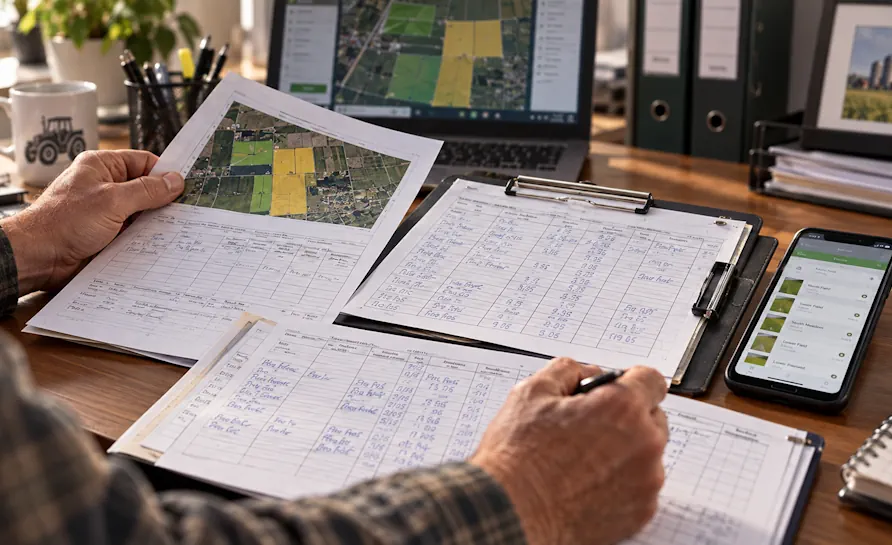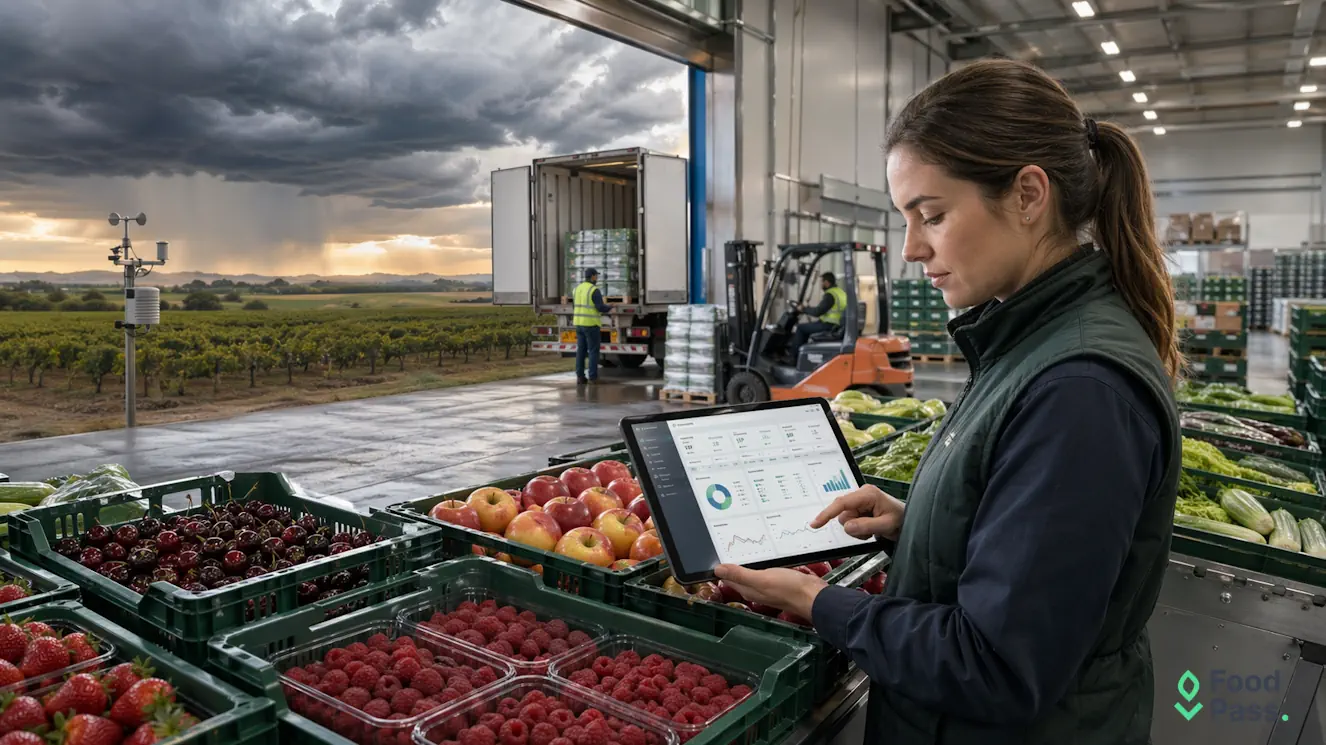
If a company has no visibility into crop status, batch quality parameters, treatment history, test results and current procurement obligations, it operates reactively. In practice, this means higher losses, weaker margins, greater risk of complaints, contractual penalties and more difficult cash flow management.

Brief summary
In fruit and vegetable processing and distribution, the greatest risk stems from the unpredictability of the raw material. Volume, quality, harvest timing, technological parameters, food safety and logistics change faster than in most manufacturing industries. This means planning must be updated daily based on actual data, not assumptions made at the start of the season.
The largest losses do not result solely from a single mistake. They are usually the cumulative effect of many small delays and information gaps: a yield decline reported too late, a missing sample confirming batch safety, a queue at the ramp, manual settlement corrections and the absence of a single data view for quality, production and finance.
The 8 most important risks for a processor and distributor
In this industry, risks must be described in operational language — not just the general language of quality or procurement. This allows faster mapping of a problem to a process and selection of the right tool to limit losses.
- Volume risk: weather, late frosts, drought or heat waves shorten the season and change delivery volumes.
- Quality risk: Brix, acidity, firmness, colour or calibre deviates from production or customer requirements.
- Food safety risk: MRL, physical, chemical or microbiological contamination blocks batch acceptance.
- Logistics risk: raw material waits too long at the ramp or in transport and rapidly loses value.
- Traceability risk: the absence of a full batch trail from field to product complicates complaints, audits and recalls.
- Contractual risk: raw material shortages or quality deviations translate into lower order fulfilment.
- Liquidity risk: procurement obligations accumulate faster than sales revenues and buyer settlements.
- Organisational risk: data is scattered across departments, slowing decisions precisely when hours matter.
Raw material and production risks
A fruit and vegetable processor operates on living, non-standardised and seasonal raw material. This is a fundamentally different situation from discrete manufacturing. The raw material arrives in narrow time windows, and its quality changes from day to day depending on weather, maturity and harvesting conditions.
A late frost in May can reduce the strawberry volume by several dozen percent, while a heat wave in July can compress the entire sour cherry season from a few weeks to a few days. A processor with no visibility into the crop status of its suppliers learns about the problem only at the ramp, when the options for response are already limited.
The most common sources of quality risk
Quality risk is not limited to appearance or commercial grade. It also covers technological parameters that directly affect the recipe, production yield, auxiliary material consumption and compliance with buyer requirements.
| Risk area | What happens in practice | Business impact | What process support is required |
|---|---|---|---|
| Batch parameter instability | Fluctuations in Brix, acidity, colour, calibre and firmness | Recipe change, cost increase, complaints | Quality measurement at intake and assignment of the batch to the right application |
| MRL and residues | Exceedances or non-compliance risk | Batch rejection, blocking, recall, supplier dispute | Treatment history, samples, laboratory, batch blocking |
| Contamination | Sand, stones, plastic, metals, nitrates, pathogens | Downtime, additional cleaning, food safety risk | Quality control, documentation, photos, corrective actions |
| Cold chain interruption | Excessive waiting time or incorrect temperature | Loss of firmness, fermentation, shortened shelf life | Monitoring of time, transport and storage conditions |
| Traceability errors | Inability to quickly identify origin and batch trail | Slower recall, higher complaint costs, weaker audit performance | Full backward and forward traceability |
Table 1. Key quality and operational risks in fruit and vegetable processing.
The second critical risk is logistics. Raw material that waits too long at the ramp loses quality, ferments or rots. Every hour of line downtime at the peak of the season generates real losses, because processing capacity is finite and the raw material will not wait. In practice, this means the need for fast action at the ramp, a minimum of manual operations and immediate assignment of each batch to a contract, quality grade and production plan.
Penalties, sanctions and business consequences
Penalties in this industry come from multiple directions simultaneously. Retail chains impose sanctions for non-delivery of contracted volume, quality deviations from specification and delays. A single failed delivery to a major retailer can mean not only a financial penalty but also the risk of product delisting.
IFS and BRC auditors may lower the score or question the readiness of the quality system if traceability is not functioning properly. For many companies, this means the risk of losing access to key sales channels. On top of this comes liability to supervisory authorities, the risk of market withdrawal, the cost of reverse logistics and disposal, and the hard-to-rebuild loss of buyer and consumer trust.
The most common categories of costs and sanctions
- Contractual penalties from retail chains: for late delivery, incomplete orders or goods that do not meet specification.
- Audit score: a lower IFS/BRC rating due to weak traceability and scattered documentation.
- Recall costs: returns, disposal, communication, batch blocking and lost sales.
- Warehouse blocking: quarantine of a batch suspected of non-compliance freezes working capital.
- Liability for damages: increases in the event of food safety incidents.
- Regulatory and reporting risk: the lack of supply chain data weakens readiness for ESG reporting and cooperation with demanding buyers.
Cash flow and its impact on production
The cash flow of a fruit and vegetable processor has an extremely seasonal profile. During several months of the procurement season, the company spends very large sums on raw material, energy, packaging, seasonal labour and logistics, while revenues from finished product sales arrive later. Some products are additionally sold over the following months, extending the financial cycle.
Imprecise delivery settlement directly hits liquidity. If the company does not know exactly how much raw material it received, at what quality and at what price, it cannot accurately forecast obligations to suppliers. Underestimation means a liquidity shock; overestimation freezes funds that could support ongoing production.
The same applies to supplier relationships. Delayed payments cause the best growers to switch to competitors, which in turn deteriorates the raw material base in the following season. Transparent and timely settlement is therefore not just a financial tool but also an instrument for supplier retention and raw material quality stabilisation.
How risk translates into plant operations
Production in fruit and vegetable processing is reactive to the raw material. It is the raw material that dictates the pace and direction of decisions. The production plan changes daily depending on what arrived at the ramp, in what quantity, quality and technological condition.
In practice, this means that one batch may be suitable for the premium line, while another is suitable only for freezing or industrial processing. When sour cherries arrive earlier than planned, the plant must reschedule shifts, prepare cold storage and organise additional workers. When strawberries have too low a Brix, the line plan must be changed or the recipe adjusted. These decisions are made within hours and require real-time data.
Without a system that integrates procurement, quality, production and settlement, the organisation runs on spreadsheets, phone calls and shift managers' experience. This works up to a certain scale, but with a larger number of suppliers, lines and buyers it generates losses from raw material waste, downtime and unfulfilled orders.
What system requirements arise from these risks
The risks described above translate into specific system requirements. A processor does not need yet another tool for entering data, but an environment that shortens response time, structures the process and provides a shared view of the situation for several departments at once.
Key system requirements
- Early warning: aggregation of weather data, yield forecasts and crop status from suppliers.
- Speed at the ramp: fast intake, weighing, quality classification and assignment of the batch to a contract.
- Scenario simulation: analysis of the impact of supply drops on the production plan, contract fulfilment and margin.
- Shared dashboard: procurement obligations, production costs, WIP, quality and receivables combined in a single view.
- Full traceability: rapid tracing of a batch from field to product and from product to buyer.
- Quality and laboratory workflow: sample collection, test results, batch blocking and corrective actions.
- Audit readiness: documentation for IFS, BRC, IJHARS, sanitary inspection and retail buyers.
- ESG and MRV data: collection of reliable data for carbon footprint and Scope 1 and Scope 3 reporting.
How FarmPortal and FoodPass support processors, distributors and advisors
This is precisely where linking FarmPortal with FoodPass delivers the greatest value. It is not just about delivery recording, but about connecting field data, contracting, quality, traceability, communication, documentation, audits and settlement in a single operational flow.
Supplier base management and contracting
With FoodPass, processors and distributors can contract deliveries, manage schedules, settle deliveries, assess quality, evaluate suppliers and store documents in one place. This is a direct response to the needs of companies looking for a raw material contracting system, a fruit procurement program and a supplier settlement system.
Real-time visibility into crop status
FoodPass linked with FarmPortal makes it possible to manage, support and monitor production across multiple farms simultaneously. The processor or distributor sees in real time what is happening in the crop, can identify risks, plan preventive actions and adjust delivery schedules before the problem appears at the plant.
Quality control, sampling and laboratory integration
The system supports sample collection at various stages of production and processing, recording of test results and laboratory integration. It makes it possible to document quality, block batches or suppliers, and maintain a complete evidence trail for food safety and audits.
Supplier settlement and cash flow impact
FoodPass supports supplier settlement based on weight, quality, contract and agreed commercial terms. This shortens settlement closure time, reduces the number of corrections and disputes and improves the predictability of procurement obligations, which has a direct impact on liquidity management.
Preparation for audits, inspections and compliance
The system helps prepare for audits by retail chains, IFS, BRC, IJHARS and sanitary inspection. It enables planning of visits, audits, sample collection and action schedules. It supports documentation of compliance with standards and certification of agricultural production.
ESG, emissions and MRV
FoodPass makes it possible to reduce costs related to production emissions and obtain actual data for ESG purposes through MRV — measurement, reporting and verification. This is especially important for companies that need to provide reliable Scope 1 and Scope 3 data to their trading partners.
Product passportisation, traceability and marketing
FoodPass enables building product image and marketing through passportisation and traceability. The system supports campaigns with product passports, origin history and regional promotion. This is particularly valuable for distributors and brands that want to build competitive advantage on transparency and quality of origin.
CRM for agricultural advisors and field support
FoodPass also offers a CRM for agricultural advisors, where they can maintain their own notes, farm lists, address and registration data, plan visits, audits, sample collection and travel routes. Thanks to crop geolocation, it is easy to navigate to the field, saving time and reducing confusion about field location.
Remote advisory and information exchange
An advisor can send crop recommendations, and the farmer receives notifications, including PUSH notifications in the FarmPortal mobile app. The system supports remote advisory based on data, analysis of soil test results, fertilisation calculations, adding custom recommendations and conducting advisory activities using data from sensors and measuring devices.
File exchange and integration with existing systems
FoodPass enables sending messages and any files, such as invoices, recommendations, analysis results, photos and other documents. It also integrates with existing ERP, CRM, production planning and warehouse management systems, such as SAP, Microsoft Dynamics, Comarch Optima and Salesforce.
More about platform capabilities can be found on the FarmPortal features page, as well as in articles about traceability and about data-driven advisor–farmer collaboration.
Benefits for individual audience groups
This topic is relevant to several groups simultaneously. Each sees the problem at a different point in the process, but in practice all benefit from structuring the data flow from field to product.
Fruit and vegetable processors
Problems: lack of delivery predictability, batch quality variability, difficulty with procurement settlement, line downtime, poor visibility of obligations and high risk of complaints and penalties.
Benefits: earlier knowledge of raw material status, faster operational response, better production planning, shorter settlement time and greater audit readiness.
Fruit and vegetable distributors
Problems: scattered origin documentation, difficulty quickly reconstructing a batch trail, greater sensitivity to complaints from buyers and retail chains.
Benefits: better traceability, faster response to quality incidents, stronger documentation and better tools for building product credibility.
Agronomists and agricultural advisors
Problems: scattered notes, no recommendation history, difficulty managing multiple farms and lack of alignment between a field visit and the processor's decision.
Benefits: CRM, visit planning, field geolocation, photo documentation, soil analysis, remote recommendations, farmer communication and work on actual data.
Senior management
Problems: different data in different departments, low predictability of obligations and no shared view of the operational situation.
Benefits: a single view of deliveries, quality, obligations, WIP and receivables, supporting faster financial and production decisions.
Comparison of approaches: Excel vs point system vs FarmPortal and FoodPass
Many organisations do not have a problem with the absence of tools, but with their excess and fragmentation. Each system handles a fragment of the process, and no one sees the complete batch trail, cost and risk.
| Area | Excel and messaging apps | Point system | FarmPortal + FoodPass |
|---|---|---|---|
| Contracting and delivery schedule | Manual files, high error susceptibility | Separate module without full link to quality | Connected with delivery, quality and settlement |
| Ramp intake | Slow, dependent on people and manual corrections | Partial automation | Fast assignment of batch to contract and quality parameters |
| Quality and samples | Scattered notes and PDF files | Separate workflow without full batch history | Consistent sample, laboratory and blocking workflow |
| Traceability | Slow history reconstruction | Partial, dependent on integration | Full backward and forward traceability |
| Settlement and cash flow | Delayed view of obligations | Data in multiple reports | Better visibility of obligations and supplier settlements |
| ESG and Scope 3 | Manual compilations and surveys | Limited application | Environmental and MRV data from the supply chain |
| Advisory support | Phone calls, messages and no history | No single farm view | CRM, visit planning, recommendations, notes and navigation |
Table 2. Comparison of approaches to procurement, quality and traceability management.
Pre-season checklist
The following list allows you to quickly check whether the organisation is ready not only for raw material intake but also for settlement, quality, production and audit.
- Does every supplier have assigned fields, locations, contract terms and documents?
- Do you know which crops are currently in a zone of elevated weather or quality risk?
- Do you have a sampling plan for high-risk batches and farms?
- Does quality measurement at intake cover the parameters critical for production, e.g. Brix?
- Can you reconstruct a batch history in minutes rather than days?
- Do procurement obligations accumulate in a single view together with quality adjustments?
- Do the quality, production and finance departments work with the same batch identifiers?
- Can you immediately block a batch or supplier following an analysis result?
- Is audit documentation built continuously rather than reconstructed after the season?
- Is environmental data from suppliers collected in a way that is useful for ESG and MRV?
Step-by-step implementation approach
A good implementation does not start with screen configuration but with structuring the critical operational decisions. In the fruit and vegetable industry, it is especially important to connect processes that previously operated in isolation.
- Identify the critical loss points. Check where you most commonly lose time, margin and control today: at the ramp, in quality, settlement, complaints or production planning.
- Standardise the batch identifier. All departments should work with the same identifier from the field through to shipment.
- Link contracting with quality. Quality parameters must influence the acceptance decision, pricing and assignment of the batch to a production line.
- Bring field data into plant decisions. Crop monitoring, photos, communication, treatment history and warnings should be visible before delivery.
- Automate the sample and blocking workflow. An analysis result should lead to an operational action, not just a saved document.
- Build a shared dashboard for multiple departments. Procurement, quality, production and finance should see the same numbers.
- Test recall and audit readiness. Periodically check how quickly you can reconstruct a complete batch history and prepare documents.
Case study
The following case study is an implementation scenario based on typical parameters of a medium-sized fruit and vegetable processing plant in Poland. Its purpose is to illustrate the business mechanism and the indicators worth measuring when implementing a procurement, quality and traceability management system.
Company profile
A medium-sized frozen food and concentrate processing plant: approximately 7,200 tonnes of raw material per season, 138 active suppliers, 2 intake ramps, 3 main production lines, handling strawberries, raspberries and sour cherries.
Situation before implementation
- Average vehicle processing time at the ramp: 18 minutes
- Settlement corrections after intake: 4.6% of deliveries
- Average time to close supplier settlement: 12 days
- Waste and raw material value loss: 5.4%
- Time to prepare documentation for audit or complaint: 6–9 working days
- No 21-day volume forecast based on crop data
Implementation scope
FoodPass was deployed for contracting, delivery scheduling, quality, traceability, sample collection and reporting. FarmPortal was deployed on the supplier side for crop monitoring, weather alerts, communication, documentation and agronomic support. In addition, laboratory data was linked with financial reports for procurement obligation tracking.
| Indicator | Before implementation | After 1 season | Change |
|---|---|---|---|
| Average vehicle processing time at ramp | 18 min | 8 min | -56% |
| Settlement corrections after intake | 4.6% | 1.3% | -72% |
| Supplier settlement closure time | 12 days | 48 hours | significant reduction |
| Waste and raw material value loss | 5.4% | 2.9% | -2.5 pp |
| Time to prepare audit or complaint documentation | 6–9 days | 1–2 days | several-fold reduction |
| Deliveries requiring emergency intervention | 100% | 74% | -26% |
Table 3. Proposed KPIs after combining contracting, quality, traceability and crop monitoring.
Conclusion: the greatest improvement did not come from a single module, but from connecting several stages into a single flow: farm, contract, intake, quality, sample, decision, settlement and reporting.
User testimonials
The following statements reflect typical challenges and outcomes observed when digitalising collaboration between supplier, advisor and raw material buyer.
"I farm 86 ha of field vegetables and 14 ha of strawberries for processing. The biggest problem was not production itself, but misunderstandings after delivery. Since the implementation, we have a single batch history, photos, sample results and clear settlement. The number of post-delivery corrections dropped from several per week to isolated cases per month."
"As a quality manager at a company serving 22 farms and 4 packing locations, I used to collect documents from emails, phone calls and network drives. Today I see samples, results, corrective actions and batch origin in one place. Our audit preparation time has been cut by more than half, and conversations with buyers after a complaint are based on data rather than guesswork."
Frequently asked questions
How can I reduce the risk of MRL exceedance before the raw material is even delivered?
The best approach is to link treatment history, crop monitoring, sample collection and laboratory results with operational decision-making. This way, the company can react before accepting the batch rather than only after starting production.
Is Excel alone enough for settling fruit and vegetable procurement?
At a small scale it sometimes is, but during the season it quickly turns out to be too slow and too error-prone. As the number of suppliers, quality parameters and price adjustments grows, you need a system linking contract, weight, quality and settlement.
How can I quickly reconstruct a batch trail during a complaint or recall?
You need backward and forward traceability — from the field and the supplier, through intake, testing, production and storage, all the way to the buyer. Without this, response time increases and incident costs rise.
Does a distributor that does not process also need traceability?
Yes, because it is responsible for batch origin transparency, documentation quality and speed of response to customers and retail chains.
How do I prepare for an IFS or BRC audit without manually collecting documents?
The best approach is to build documentation continuously: delivery, quality control, sample, result, decision and corrective action should enter a single data workflow from the start.
What does linking FoodPass with supplier-side FarmPortal give me?
It provides earlier knowledge of crop status, weather risk, quality and production costs. This allows the processor or distributor to act proactively — not only when the raw material reaches the ramp.
I am an agricultural equipment manufacturer. What data is worth integrating with the processor and advisor system?
The most valuable data includes location, task execution time, application rate, fuel consumption and task parameters — provided they can be linked to a specific field, batch and season.
Conclusion
Production risks for fruit and vegetable processors and distributors do not start in the production hall. They start earlier — in the field, in the contract, in data quality and in the organisation of raw material intake. A company that sees the problem only at the ramp is usually already too late to respond effectively.
That is why the best fruit and vegetable procurement management system should answer not only the question of what has arrived, but also what is happening at the suppliers, what the quality risk will be in a few days, which batch feeds which product, how quickly the supplier can be settled, and whether finance, quality and production see the same numbers. This is exactly where the combination of FarmPortal and FoodPass delivers a competitive advantage.
Glossary
- Traceability
- The ability to trace a batch history backward and forward: from source to buyer.
- MRL (Maximum Residue Level)
- The maximum permissible level of plant protection product residues in food.
- Recall
- Withdrawal of a product from the market due to a safety threat, non-compliance or quality risk.
- Brix
- An extract content indicator used as a practical measure of sugar levels in fruit and semi-finished products.
- WIP (Work in Progress)
- In-process inventory — the stock of semi-finished products or batches between successive process stages.
- MRV (Measurement, Reporting and Verification)
- A framework for monitoring, reporting and verifying data, most commonly environmental or emissions data.
- Scope 1
- Direct emissions arising from a company's own operations.
- Scope 3
- Indirect emissions occurring in the value chain, beyond the company's direct emissions.
- Supplier portal
- An environment where the supplier and the buyer work on shared data about the contract, quality, documents and communication.
Sources
Follow us!
See what we're doing and be inspired by positive changes.