How does artificial intelligence help decide when to fertilise, irrigate and spray? These questions will be addressed during the training course “Farm management using artificial intelligence”, organised by the Agricultural Advisory Centre (CDR) on 19 November 2026. During the event, we will demonstrate practical applications of AI in FarmPortal.
AI in agriculture means using artificial intelligence to analyse farm data, identify relationships and support agronomic decisions. Its value lies not in generating another chart, but in suggesting a specific action that the farmer can verify in the field.
At a glance
CDR in Brwinów, Poznań Branch, invites farmers and advisers to an online training course on artificial intelligence in farm management. During the FarmPortal presentation, we will demonstrate AI supporting fertilisation, irrigation, crop protection and soil sampling, as well as the use of satellite imagery, disease models and machinery data. These technologies help prepare decisions, but do not replace soil testing or field scouting.
- Date: 19 November 2026, 9:00–15:00, online via Microsoft Teams.
- Organiser: Agricultural Advisory Centre in Brwinów, Poznań Branch.
- Registration: until 18 November 2026, via e-CDR; admission is subject to qualification.

What will the CDR training cover?
The Agricultural Advisory Centre focuses on practical uses of artificial intelligence: data analysis, production optimisation and the implementation of digital tools. The official CDR programme lists FarmPortal for production monitoring and control, and FoodPass for managing information in the supply chain.
This is a good starting point for a discussion about AI: can a system help a farmer make a decision for a specific field, rather than simply store information?
How do you register for the CDR training?
The CDR training will take place on 19 November 2026, from 9:00 to 15:00, on Microsoft Teams. Registration is open until 18 November via e-CDR. The official CDR announcement about the AI training provides the programme and participation rules; applications can be submitted through the e-CDR platform.
Participation is free for advisers from public advisory organisations and agricultural chambers. For other participants, the fee is PLN 200 including VAT. CDR qualifies applications in the order they are received; confirmation of submitting the form does not yet mean admission.
How do we use artificial intelligence in FarmPortal?
During the training, we will show examples in which artificial intelligence and decision support systems (DSS) combine crop observations, soil analyses, weather and treatment history. The four main areas are fertilisation, irrigation, crop protection and the selection of sampling locations.
| Area | What do we analyse? | Which decision do we support? |
|---|---|---|
| Fertilisation and NPK | Soil tests, field history, satellite indices | Fertilisation zones, nutrient balance and rate verification |
| Irrigation | Weather forecasts, rainfall, moisture, crop condition | The need for and timing of irrigation |
| Crop protection | Disease models, weather conditions, spraying history | Field scouting, assessment of infection risk and the treatment window |
| Soil samples | Spatial variability within the field and satellite images | Identifying representative sampling locations |
We will also present an approach to estimating NPK using satellite imagery. This is a modelling result that requires calibration and checks, rather than a direct laboratory measurement of phosphorus, potassium or nitrogen. Ignoring this distinction leads to incorrect fertilisation recommendations.
How do satellite images and machinery support AI decisions?
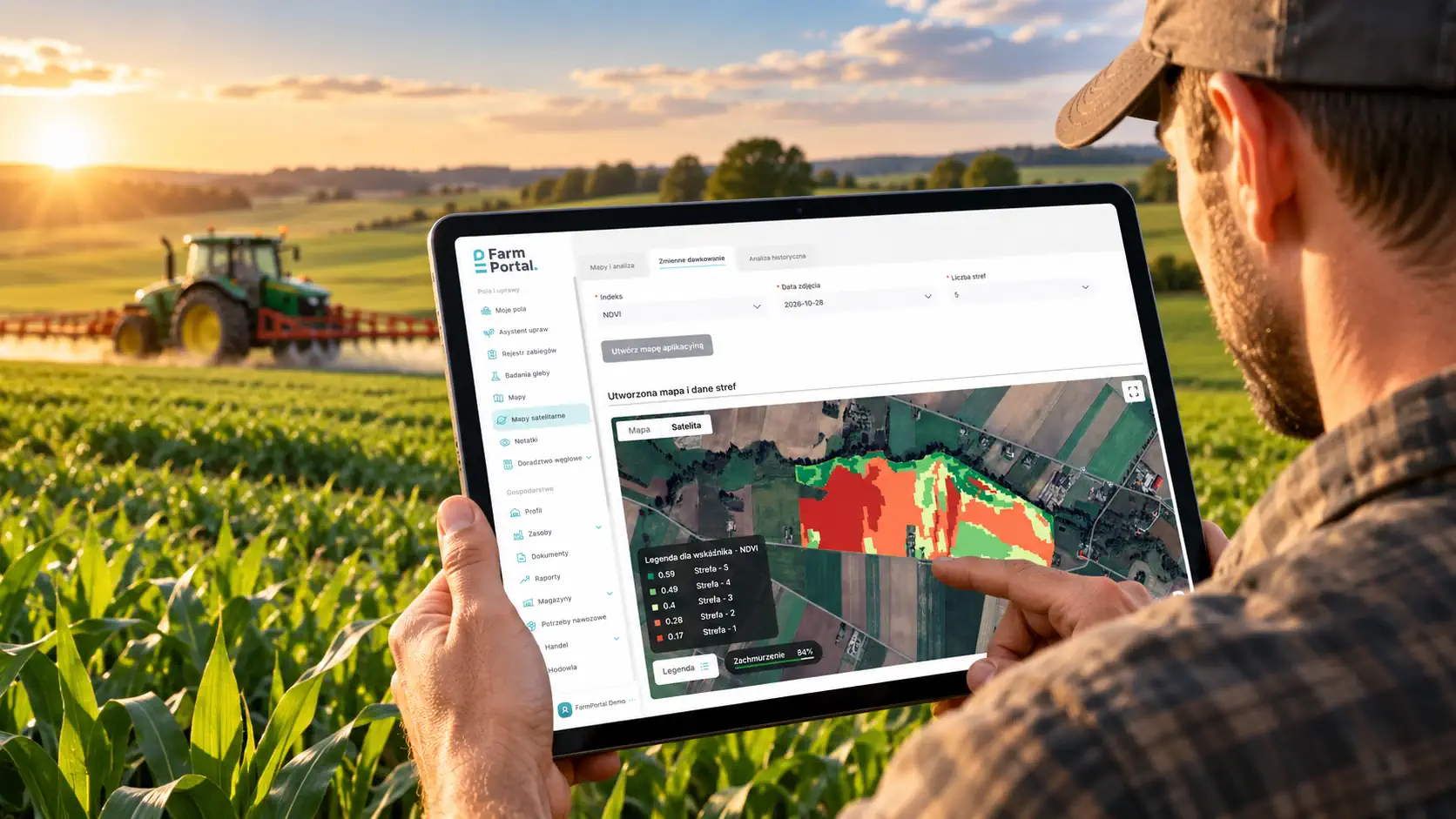
We will show NDVI, NDRE, MSAVI and RECI imagery, which can be used to identify zones with different plant conditions. The next step is variable-rate fertilisation maps, spraying and seeding maps (VRA), transferred to compatible equipment using formats such as ISO-XML. We also describe variable-rate application in practice on our blog.
The second part of the demonstration will cover machinery information: ISOBUS, the CAN bus, GPS and telemetry, as well as operating costs, fuel and reporting. Reading CAN data alone is not AI. Only linking these data to an operation and the field history creates a foundation for analyses, forecasts and recommendations.
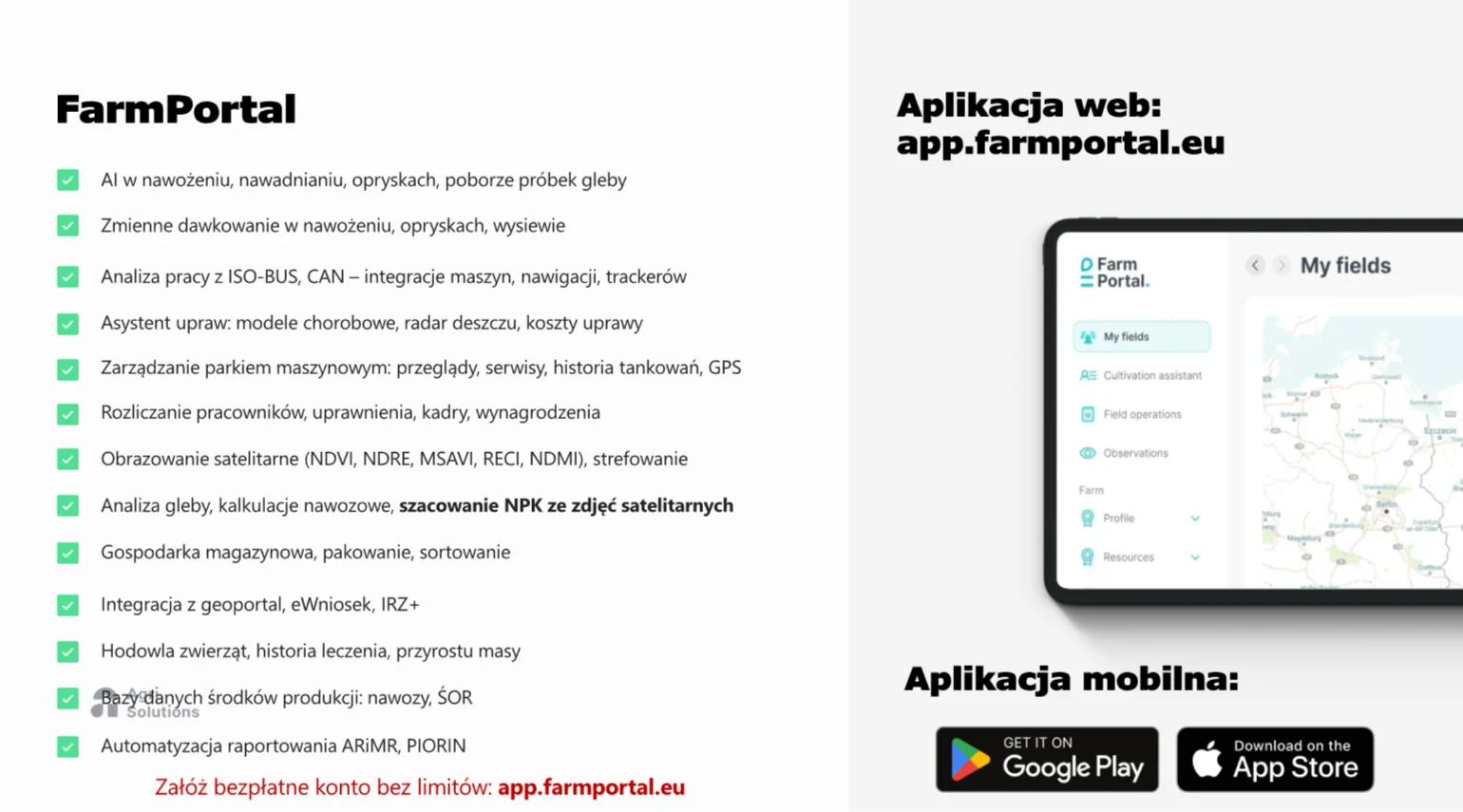
These are complemented by the crop assistant, rain radar, disease models, employee records, warehouse management and integrations with Geoportal, eWniosek and IRZ+. The range of FarmPortal features also covers livestock farming and preparing reports for ARiMR and PIORiN.
Frequently asked questions
When and where will the CDR training on artificial intelligence take place?
The training course “Farm management using artificial intelligence” will take place on 19 November 2026, from 9:00 to 15:00. It is organised by the Agricultural Advisory Centre in Brwinów, Poznań Branch. The meeting is held online via Microsoft Teams, and access details will be sent to admitted participants.
Which applications of AI in agriculture will FarmPortal demonstrate?
We will demonstrate the use of AI in crop condition analysis, support for fertilisation, irrigation and crop protection, and the identification of soil sampling zones. We will also show variable-rate application maps, satellite data and disease models. Some of these tools use agronomic models and automation, which are not the same as artificial intelligence.
Can artificial intelligence determine NPK content from a satellite image?
Satellite images show, among other things, variability in plant condition and can provide inputs to models estimating crop status and the need for further testing. They are not a direct laboratory measurement of nitrogen, phosphorus and potassium in soil. Conclusions about NPK should be verified through soil sample analyses and information about field history.
How much does participation cost and how do you register?
According to CDR, the training is free for advisers employed by public advisory organisations and agricultural chambers. Other participants pay PLN 200 including VAT. Applications via the e-CDR platform are accepted until 18 November 2026. Admission is determined by the order of applications; submitting the form alone does not guarantee a place.
What is worth preparing before the training?
Choose one field where it is difficult to determine the right fertiliser rate, irrigation timing or need for spraying. Check whether you have up-to-date soil tests, treatment history and observations. During the CDR training, compare your data with the examples of AI applications being demonstrated.
Follow us!
See what we're doing and be inspired by positive changes.