The importance of disease forecasting models in Agriculture 4.0
Plant diseases are among the most serious risk factors in agricultural production – in orchards, vegetables and field crops they can reduce yield, lower marketable quality or force costly, repeated protection treatments within days. Under growing regulatory pressure, shrinking active substance portfolios and climate variability, the traditional “calendar-based” approach is no longer sufficient. The answer is plant disease forecasting models (plant disease forecasting models) – tools that combine epidemiology, meteorology and agronomy to pinpoint when infection risk is high.
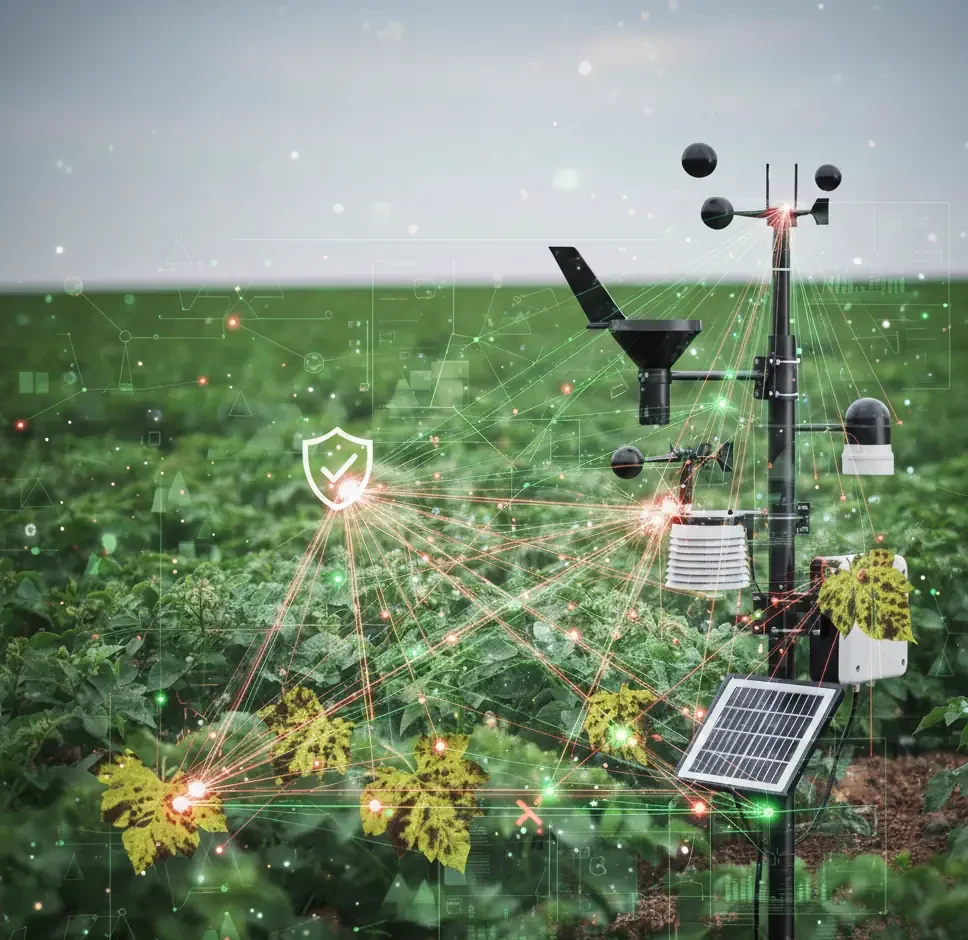
Disease models are based on scientifically described relationships between pathogen, plant and environment. Using data from weather stations – such as temperature, relative humidity, rainfall and leaf wetness duration – they identify infection periods and define the optimal treatment window. In practice they form the core of Decision Support Systems (DSS), which support the decision: whether a treatment is needed, when to apply it and at what intensity.
The development of disease models has a solid scientific basis and a long history – from classic infection tables for apple scab to modern systems using advanced algorithms, weather forecast integration and aerobiological data. Field studies show that well-calibrated models can cut the number of fungicide applications by tens of percent while maintaining effective control and without yield loss. That means not only cost savings but also a real contribution to Integrated Pest Management (IPM).
In business terms, disease models solve a simple problem: when you really need to spray (and with what), and when a treatment would only add cost and risk (residues, phytotoxicity, resistance selection pressure, environmental footprint).
This article provides a comprehensive view of disease models: definitions, how they work, required data and equipment, research-backed effectiveness and impact on modern agriculture. We also cover who uses them, when they bring the greatest benefits, and which scientific and international initiatives drive their development.
What are plant disease models
A disease model (plant disease forecasting / epidemiological model) is a formal description of the pathogen–plant–environment relationship (often including protection practices) that allows forecasting of:
- infection risk,
- infection periods,
- epidemic development rate (sometimes),
- and supports the decision of when and whether to apply a treatment (Decision Support System, DSS).
In scientific terms it is part of the evolution of plant disease modelling (from tables/heuristics to DSS and increasingly hybrid/AI models).
How they work step by step (epidemiological logic)
Most often a sequence of events is modelled:
- Inoculum source (e.g. spore maturation, availability)
- Conducive conditions (temp., humidity/wetness, rainfall, wind, radiation)
- Infection (primary and/or secondary)
- Incubation and symptoms (optional)
- Recommendation: spray window, interval, priority
In practice the key component is leaf wetness duration (LWD) and temperature (or RH as a proxy), because many pathogens require a certain wetness duration at a given temperature for infection to occur (classic example: apple scab – Mills/MacHardy).

Types of disease models (in literature and practice)
A) Threshold / empirical (rule-based) models
- Rules such as “if RH > X% for Y hours at temp. T → risk increases”.
- Often simple and implementable, but sensitive to “climate change” and transfer between regions.
B) Index models (e.g. DSV)
- Calculate a daily disease pressure index from weather.
- Example: TOMCAST for early blight (Alternaria) – DSV derived from temperature and humidity/wetness conditions. (PMC)
C) Mechanistic (process-based) models
- Simulate pathogen biology (spore production/dispersal, infection, development).
- Usually more “scientific”, data-heavy, often implemented as DSS.
D) Hybrids (mechanistics + spray rules + data)
- The most common format of commercial DSS: risk model + “what and when” decision module.
E) AI/ML (data-driven) and “next-gen” approaches
- Strong trend 2023–2025: growing body of work on ML and integration of more variables (host–pathogen–environment), plus debate on how far ML replaces classical modelling and how to ensure transferability/validation. (ScienceDirect)
What data and equipment are needed
Minimum for implementation (practical DSS in orchards and vegetables)
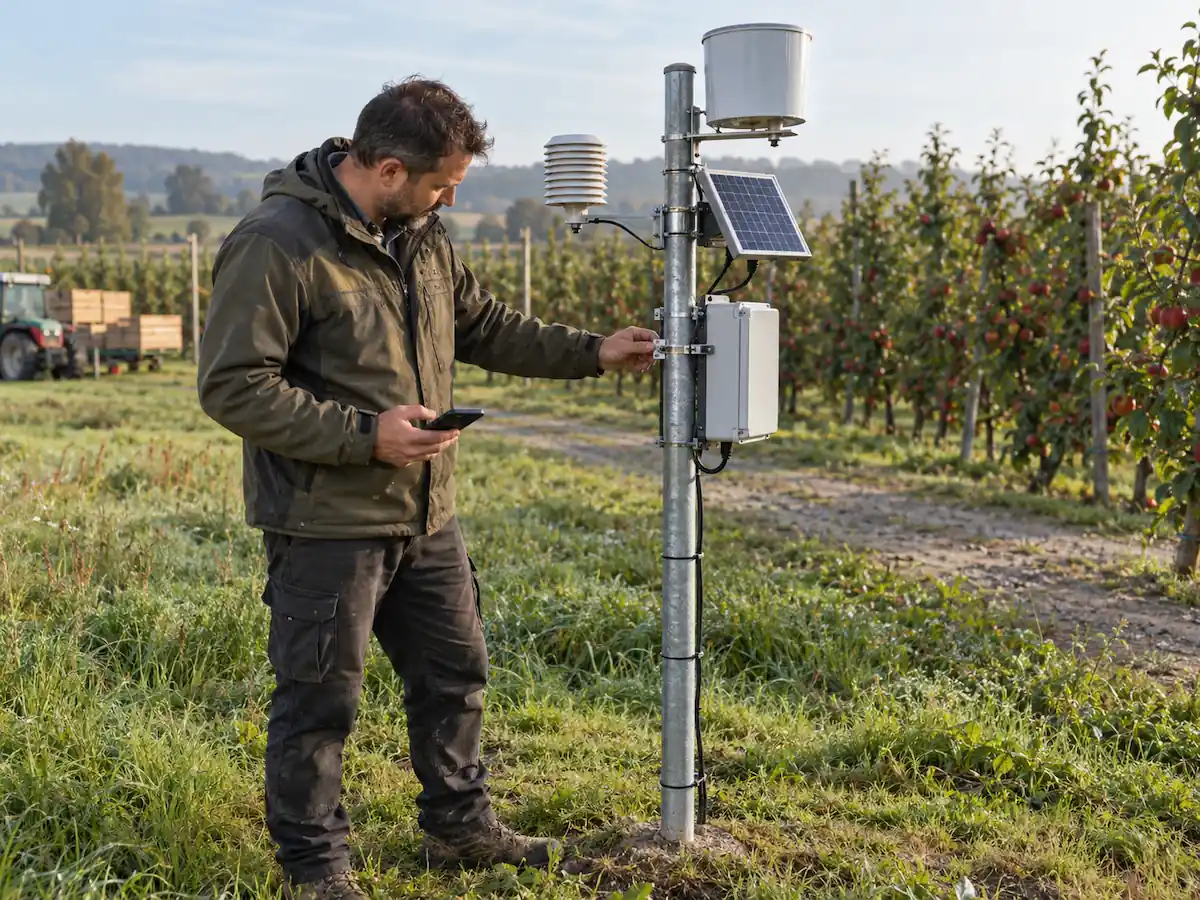
- Weather station as close to the crop as possible: temperature, RH, rainfall; wind and radiation desirable
- Leaf wetness (LWD sensor) or wetness model (less reliable locally)
- Phenology (manual or degree-days) – because risk depends on crop growth stage
- Scouting (field inspections) – for validation, corrections, “ground truth”
Models such as TOMCAST are directly based on humidity/wetness and temperature. (PMC)
“Gold standard” (for high precision and R&D)
- Denser micro-meteo network across blocks/exposures,
- integration with weather forecast (planning treatments in advance),
- aerobiology / spore monitoring (spore traps) – there is work combining TOMCAST with aerobiological data for better prediction.
- integration with spray records, variety/susceptibility, pressure history.
When disease models apply (and when they don’t)
Best use
- Diseases strongly dependent on weather and wetness (e.g. apple scab, blights, Alternaria, downy mildews).
- Farms where fungicide cost and number of sprays matter (orchards, intensive vegetables).
- IPM systems, certifications and regulatory pressure to reduce pesticide risk.
Limitations / when they don’t “work magic”
- Lack of reliable local weather data (the most common quality killer).
- No local validation (a model “from another climate” can mislead).
- Pathogens where factors other than weather dominate (e.g. inoculum sources, seed/planting material, agronomic practices), or when pressure is permanently extreme.
Reviews stress the sensitivity of forecasting systems to climate variability and the need for adaptation/validation.
Effectiveness: statistics from research (spray reduction, impact on yield/disease)
Potato early blight (Alternaria) – infection-based models / TOMCAST
In studies comparing infection-based models vs. standards:
- average 37–49% reduction in fungicide use,
- no yield or economic penalty compared to reference strategies (under the conditions studied).
This is a very “practical” number, as it reflects real DSS ROI: fewer sprays without losing outcome.
Overall DSS vs “calendar” effectiveness
In a meta-analysis / large synthesis (Communications Earth & Environment, 2021) it was shown that:
- DSS can significantly reduce fungicide use, and disease reduction (incidence) compared to no protection is comparable to calendar-based approaches; the work reports median incidence reductions of around ~31–33% for both calendar and DSS vs. untreated control (depending on metrics and conditions). (IPM Decisions)
In practice: DSS usually does not worsen control vs. “calendar”, and often reduces the number of sprays.
Apple scab – Mills/MacHardy logic and warning systems
In orchards, the key is better “hitting” the infection period (coverage + intervention window), which is the basis of systems such as NEWA/MSU/NIAB. Rules based on temperature and wetness (Mills → MacHardy revision) underpin many implementations.
Practical note: in orchards, effectiveness is often reported as “avoided unnecessary sprays” and tighter intervals at key times; hard numbers depend strongly on season (pressure).
Impact on agriculture (operational, economic, environmental)
Operational
- better timing of treatments (prevention vs. intervention),
- less “panic spray” and fewer “just in case” treatments,
- easier planning of spray windows (especially with wind, rain, equipment availability).
Economic
- reduction in PPP cost and labour/fuel,
- better use of more expensive actives (spray when it makes sense).
Environmental and regulatory
- DSS is a practical mechanism for IPM goals and pesticide risk reduction, which is strongly highlighted in EU initiatives.
Who uses disease models (user profile)
- Growers: orchards, intensive vegetables, potato/tomato/vineyard; precision farms
- Agronomic advisors and producer groups: consolidate data, recommendations for many farms
- Research bodies and trial stations: calibration, validation, model development
- Insurance / risk management (less directly, more as part of risk assessment)
- Agrochemical companies (in R&D and demonstrations; DSS as “stewardship”)
IPM DSS platforms have an explicit goal: to make DSS use easier in IPM and to reduce the need for pesticides while maintaining productivity.
Scientific institutions and initiatives that develop/maintain models (reliably sourced examples)
Orchards (apple scab) – Mills/MacHardy-based infection models
- APS / plant pathology community: revisions of Mills criteria (MacHardy et al.) – foundation of many scab models.
- NIAB (UK): maintains and describes apple scab infection forecasting models (Mills-based schemes, application to spray targeting).
- Michigan State University – Enviroweather: tools and apple scab risk models based on weather and infection periods.
Vegetables/potato – TOMCAST and modifications
- TOMCAST validation literature (e.g. work on RH/T parameters and DSV) and modifications with aerobiology (Spain). (PMC)
- Comparative work on infection-based models in early blight (2023) with quantified fungicide reduction. (ScienceDirect)
Europe – DSS platformisation
- IPM Decisions (Horizon 2020): pan-European platform integrating many DSS (25+), improving access to IPM risk assessments.
Trends 2024–2026 (what’s changing in disease models)
- DSS integration in platforms and APIs (easier rollout for advisors and growers; IPM Decisions as an example). (PMC)
- Greater emphasis on model resilience to climate change and updating threshold/biological parameters. (plantprotection.pl)
- Hybrids + ML: ML is growing, but in practice a hybrid approach often wins (interpretable + biologically sensible). (ScienceDirect)
- More biological data (e.g. spore monitoring) to “tell apart” high vs. low pressure seasons. (MDPI)
How to measure effectiveness (methodology accepted by science and market)
DSS effectiveness is usually assessed in three dimensions:
- Plant health outcome: incidence/severity, epidemic progress
- Chemistry outcome: number of applications, kg active ingredient/ha, rates
- Business outcome: yield, quality, economics and risk
For example, in early blight (2023) both fungicide reduction and no yield penalty were shown. (ScienceDirect)
| Aspect | Calendar approach | DSS (models) approach |
|---|---|---|
| Treatment timing | Fixed interval (e.g. every 7–10 days) | Determined by pathogen pressure |
| Costs | High (often unnecessary sprays) | Optimised (only when needed) |
| Environmental impact | Large chemical footprint | Minimised (IPM-aligned) |
| Risk | Possible missed infection | Precise 24/7 alerts |
Glossary of key terms and definitions
- DSS (Decision Support System) – a system that uses data (e.g. weather and biological) to generate recommendations for crop protection.
- IPM (Integrated Pest Management) – integrated pest management; a strategy that minimises pesticide use through forecasts, monitoring and non-chemical methods.
- Leaf Wetness Duration (LWD) – duration of leaf wetness; a key parameter in infection models for many foliar pathogens.
- Infection period – a period when environmental conditions allow effective infection by the pathogen.
- Inoculum – infectious material of the pathogen (spores, conidia, ascospores, etc.) capable of causing disease.
- DSV (Daily Severity Value) – daily disease pressure value calculated from weather conditions; used e.g. in TOMCAST.
- Mechanistic model – a model describing biological processes of the pathogen (e.g. spore germination, infection, incubation).
- Threshold (rule-based) model – a model based on simple logical conditions (if X then Y).
- Hybrid model – a combination of a biological component, weather data and decision rules.
- Scouting (field inspection) – regular monitoring of the crop to assess actual disease pressure and verify model forecasts.
- Spray window – the optimal time to apply a treatment, based on infection forecast and weather conditions.
- Incidence – the percentage of plants or plant organs with disease symptoms.
- Severity – the degree of infection (e.g. percentage of leaf area with symptoms).
FarmPortal in the context of disease models
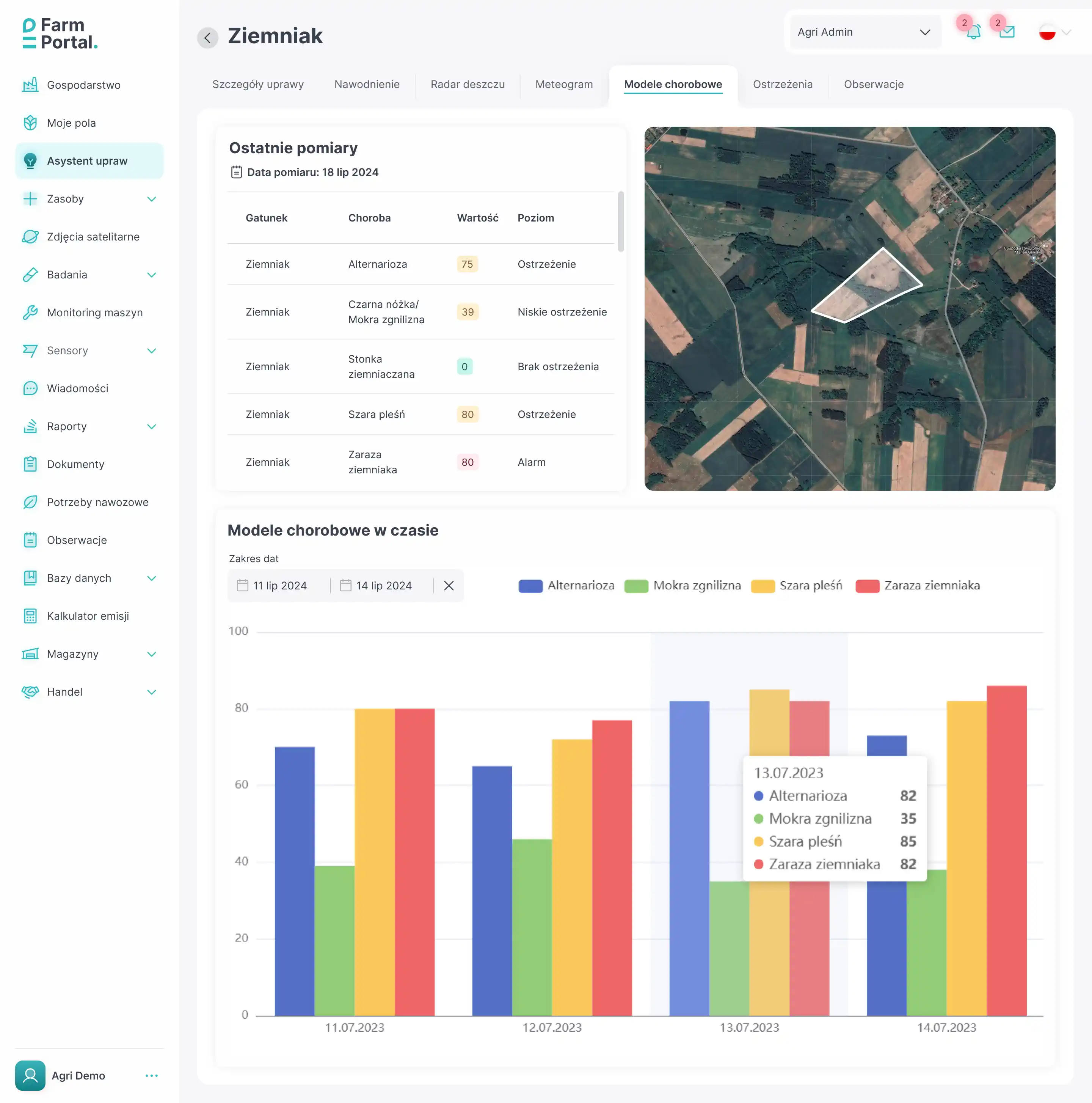
FarmPortal provides one place to manage crops and disease warnings: daily alert checks, integration with weather stations, warning history and a mobile app that always keeps you informed of the current situation.
One of the most advanced features of FarmPortal is the Crop Assistant / Digital Crop Twin, which integrates disease models, disease alerts, spray recommendations, cost analysis, weather forecasting, and artificial intelligence solutions.
FAQ – disease models and DSS
How does a DSS approach differ from a calendar approach?
A calendar approach uses fixed spray intervals (e.g. every 7–10 days), while DSS determines treatment timing from pathogen pressure and infection conditions, reducing unnecessary applications.
What data is critical for disease models?
Most often the critical inputs are: temperature, rainfall, humidity and leaf wetness duration (LWD). Many foliar diseases require a certain wetness duration in a given temperature range for infection to occur.
Do disease models always allow fewer sprays?
The largest savings occur when disease pressure is variable and the “calendar” triggers “just in case” sprays. In very high-pressure seasons, DSS may mainly improve timing and reduce the risk of spraying too late.
What benefits are supported by research?
In a study on potato early blight, 37–49% reduction in fungicide use was shown with no yield loss; meta-analysis of DSS strategies indicated the possibility of reducing sprays by at least 50% compared to calendar programmes without compromising control.
What does practical on-farm implementation look like?
The scheme is simple: local weather station → choose model for crop/disease → thresholds and decision rules → alerts → spray window → scouting and calibration → season-to-season effect analysis.
What is the most common cause of forecast errors?
Lack of reliable weather data from the crop location or lack of field verification (scouting). Models need “ground truth” and calibration to local conditions.
Does FarmPortal include disease models?
FarmPortal integrates crop management and disease warning systems with weather data. In practice it enables daily situation monitoring and warning history, supporting the use of models and alerts in protection decisions.
Summary
Disease models in DSS enable a shift from “calendar” protection to protection based on real pathogen pressure. Research has shown e.g. 37–49% reduction in fungicide use with no yield loss (early blight – potato) and the possibility of reducing the number of treatments by ≥50% globally in DSS strategies compared to a calendar approach, while maintaining control effectiveness. The key to implementation is quality weather data (ideally from a local station), the right choice of model for disease and crop, and ongoing field verification.
Related articles
Follow us!
See what we're doing and be inspired by positive changes.