When recording a spray application in an electronic plant protection treatment register, you may be asked for an EPPO code. What do these letters mean, why is it worth recording them, and does every treatment need a separate pest code? We explain with practical examples, taking account of the rules for 2026 and 2027.
EPPO code is a standardised identifier used in information systems for plants, harmful organisms and certain other plant protection categories. The codes are maintained under the system developed by the European and Mediterranean Plant Protection Organization (EPPO).
At a glance
An EPPO code identifies a crop, pest or another plant protection category. In treatment records, it is particularly useful for identifying the crop unambiguously. It does not replace the reason for spraying, the product name or its authorisation number. Paper records remain permitted in Poland in 2026; requirements for electronic records will apply from 2027.
- Common names can be ambiguous; a code identifies a particular plant or organism.
- The reason for a treatment and its EPPO code are two separate pieces of information.
- FarmPortal links treatment records to a database of more than 3,000 plant protection products.
- When treating several fields, records must reflect each area actually sprayed.
What is an EPPO code and what is it used for?
EPPO codes provide a common language for agricultural databases. They make it easier for advisers, farms and software systems to exchange information, even when different common or scientific names are used.

Codes typically contain five or six characters and cover crops, weeds, insects, pathogens and plant groups. EPPO maintains the list. Official definitions are available in the EPPO Codes database.
A code does not confirm a disease diagnosis or establish whether a spray application is legally permitted.
What do EPPO codes mean in electronic plant protection treatment records?
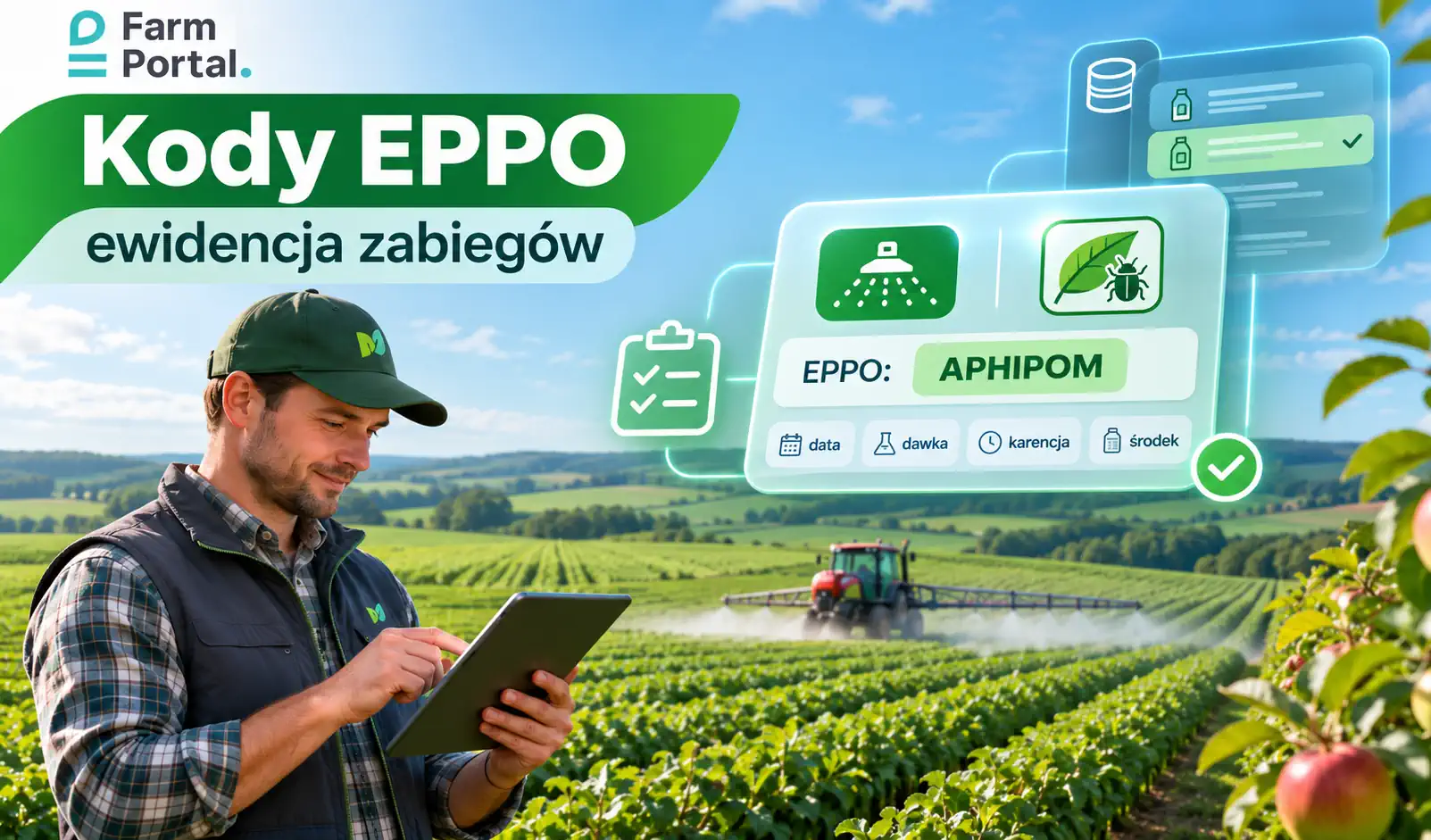
In treatment records, an EPPO code primarily identifies the crop. More detailed records may also use a code for an identified pest or pathogen. For example, the identifier for winter wheat refers to the crop, not the pest. It is important to distinguish between these categories.
| Code | What does it identify? | Practical use |
|---|---|---|
| TRZAW | Common winter wheat (soft wheat) | Identifies the crop on which the treatment was carried out |
| SOLTU | Potato (Solanum tuberosum) | Identifies the crop species |
| MYZUPE | Peach–potato aphid (Myzus persicae) | Identifies a particular pest, if it has been identified |
| BOTRCI | Fungus Botrytis cinerea | Identifies a pathogen, for example in crop scouting records |
Source: EPPO system and the PP 1/248 use classification standard. These example identifiers are not recommendations for selecting plant protection products.
A crop code is not a product authorisation number and does not specify an application rate. Entering TRZAW does not remove the need to record the product name and other treatment details.
Are EPPO codes already compulsory in 2026?
Paper treatment records are still permitted in Poland in 2026. The required record must include the product name, when it was applied, the application rate, the treated area and crop, and at least the reason for treatment under integrated pest management principles. This is confirmed by the Polish State Plant Health and Seed Inspection Service (PIORiN).
From 1 January 2027, the new requirements under Commission Implementing Regulation (EU) 2023/564, as amended by Regulation (EU) 2025/2203, will apply. They include identifying crops or land uses with EPPO codes where applicable, recording BBCH growth stages where relevant, and keeping records in an electronic format. Specific rules govern the deadlines for transferring original records into that format.
Important: the legislation primarily concerns EPPO codes for crops and land use. There is no blanket requirement to provide a code for every pest or pathogen in every spray record. The reason for treatment must still be documented separately, and the product label must be followed.
Legal position as at 9 November 2026. Further details are provided in PIORiN’s guidance on treatment records. Before the 2027 season, check the latest national guidance and the deadlines for converting records into electronic form.
How should you record the reason for treatment and the EPPO code?
Start by recording your crop scouting findings and the reason for your decision, followed by the identifier for the crop or identified organism. The code alone is not evidence of pest pressure, weed infestation or disease.
A note saying “preventative treatment” is often insufficient. A more useful entry would be: “6 May: leaf symptoms observed during crop scouting; decision taken after reviewing weather conditions.” If the pathogen has not been positively identified, do not guess its code. Photographs and advice from an agronomist can help.
We recommend recording three things separately: the crop and its code, the reason for spraying and the product, application rate and conditions of use. This makes the records easier to check.
How does FarmPortal link EPPO codes to its plant protection product database?
FarmPortal links treatment records to the relevant field and crop. When entering a spray application, you can add the EPPO code and the reason for using the product without keeping that information in separate notes.
According to Agri Solutions’ own figures, as of November 2026, the FarmPortal database contains more than 3,000 plant protection products. It includes information on authorised crops, application timings, pre-harvest intervals and authorisation numbers, linked to the Polish Ministry of Agriculture and Rural Development (MRiRW) register. Read more in our article about the fertiliser and plant protection product database.
Selecting a product from the database reduces manual data entry. The field history retains the application date, rate and reason for treatment, and records can be exported as PDF or CSV files. Explore FarmPortal’s digital treatment record features.
The database is no substitute for the current product label or an agronomist’s assessment. You must still check the authorisation, application rate, BBCH stage, pre-harvest interval and restrictions on use.
Watch this video showing how to add a treatment in the FarmPortal mobile app.
How do you plan a treatment across several fields and cadastral parcels?
One spray plan can cover several fields, but the work carried out must be documented for every area actually treated. In FarmPortal, a single farm field may comprise several cadastral parcels.
According to FarmPortal operational data, 15% of users combine two or three cadastral parcels into a single field, while approximately one-third plan a treatment across two or more fields. These are Agri Solutions’ own figures, not statistics for the Polish agricultural sector as a whole.
A common pitfall arises when an operator is due to spray three fields but one is at a different BBCH growth stage. Copying the same application rate and timing without checking the label can lead to both an agronomic error and an inaccurate record.
Before approving the plan, check the crop, EPPO code, BBCH stage, area and conditions of use for each field. Then confirm the completed treatment separately for each one. Further capabilities are described on the FarmPortal features page.
Example: how do you plan a treatment on a 540 ha farm?
A farm covers 540 ha across 26 fields. An agronomist selects four winter wheat fields for treatment, measuring 16, 19, 21 and 24 ha respectively – a total of 80 ha. The agronomist first reviews scouting observations, BBCH growth stages and whether the product is authorised for the intended use.
In FarmPortal, the agronomist selects the four fields, crop code TRZAW, product, application date and reason for treatment. At a hypothetical application rate of 0.8 l/ha, assuming that rate is permitted by the selected product’s label, the total quantity needed is 64 litres. A combined plan does not replace the need to confirm the treatment on each field afterwards.
| Stage | Notes and spreadsheets | Using FarmPortal |
|---|---|---|
| Field selection | A list of four locations and their respective areas | Select four fields from the field register |
| Crop and reason | Repeat descriptions and check consistency | Crop code and reason for each planned treatment |
| Product quantity | 80 ha × 0.8 l/ha = 64 litres | Calculate area and application rate within the plan |
| Treatment confirmation | Four entries in the treatment register | Confirmation of completion and a record for each field |
Source: illustrative editorial scenario based on FarmPortal data. The areas and application rate are used solely to demonstrate the calculation and do not constitute spraying advice.
After the work is done, the key measure is the area for which the date, application rate and reason have been confirmed. If only three fields were sprayed, the fourth must not be recorded as treated.
Common mistakes and limitations of EPPO codes
Common mistakes include guessing a pathogen’s code, confusing it with a product authorisation number, and copying treatment details between fields with different crops or BBCH stages.
Not every EPPO code refers to an individual species. Some identify crop groups or other categories. It is worth checking the meaning of a code against the official database.
A digital form cannot correct inaccurate scouting observations or a record reconstructed several weeks later. Reliable records depend on comparing the plan with the operator’s actual work. FarmPortal’s article on missing treatment records.
What are the benefits for farmers, agronomists and farm managers?
Farmers can see where and when a product was applied. Agronomists can compare the reasons for spraying, while farm managers can distinguish planned work from completed treatments.
On a 500 ha farm, the main advantage is consistent data. Planning treatments across several fields only makes sense if the records preserve differences in application rate, timing and area. This is Agriculture 4.0 in practice.
FAQ: EPPO codes and treatment records
Does an EPPO code identify a plant protection product?
No. An EPPO code identifies a plant, pest or another category within the EPPO system. A plant protection product has its own name and authorisation number. Treatment records therefore need to distinguish the crop, the reason for spraying and the product used. An EPPO code alone cannot establish whether a treatment was authorised or what its application parameters were.
What is the EPPO code for winter wheat?
TRZAW is an example of a code for common winter wheat (soft wheat). However, it should not automatically be assigned to every crop described simply as “wheat”, as the system covers different species and crop groups. Check the crop actually grown before selecting the corresponding entry in the EPPO database.
Does a pest code replace the reason for spraying?
No. Entering a pest or pathogen code identifies the organism, but does not record the scouting findings, the severity of an infestation or the reason for the decision. That reason must be documented separately under integrated pest management principles. If the species has not been identified, do not guess its code.
Are electronic plant protection treatment records compulsory in 2026?
There is no general requirement to keep electronic records for treatments carried out in Poland in 2026; paper records are still permitted. However, the use of plant protection products must still be accurately documented. From 1 January 2027, additional requirements will apply to the information recorded and its electronic format. Check the latest national PIORiN guidance before the new season.
Where can I obtain the official list of EPPO codes?
The official source is the EPPO Global Database, where you can search for plants, pests and pathogens by name. EPPO also makes data available for download and integration with information systems. Use the latest version, as scientific names and taxonomic relationships can change, although the identifiers themselves generally remain stable.
Can I plan one spray treatment across several fields in FarmPortal?
Yes. FarmPortal supports planning treatments across multiple fields. However, the crop, area, BBCH stage and product label requirements must be checked separately for each field. Once the work is complete, the treatment history for every sprayed field must reflect what actually happened. A combined plan is not proof that the treatment was carried out on every field.
Does FarmPortal’s database of more than 3,000 products guarantee the right product choice?
No. FarmPortal’s plant protection product database makes it easier to find products and check authorised uses, application timings and pre-harvest intervals. The final decision must still take account of the current label, authorisation, crop condition, weather and agronomic assessment. The system helps with record-keeping but does not replace the professional user’s responsibility.
Glossary
- EPPO
- European and Mediterranean Plant Protection Organization, which develops a common coding system for plants and pests.
- EPPO code
- A unique identifier for an organism or category, useful for record-keeping and exchanging data.
- Pest
- An organism harmful to crops, such as a pathogen, insect or weed.
- BBCH
- A scale of plant growth stages, used to link treatments to crop development.
- PPP
- Plant protection products, whose use is governed by the product label and authorisation.
- Integrated pest management
- An approach to crop protection decisions based on monitoring, preventative measures and assessing whether treatment is needed.
- Cadastral parcel
- A unit of land recorded in the cadastral register. Several parcels may form one farm field, but the actual area treated must still be established.
Summary: what should you do before your next treatment?
An EPPO code unambiguously identifies a crop and, where needed, an identified pest or pathogen. It does not replace the reason for spraying or the product label. Organising field records and crop names in 2026 will make it easier to prepare for the 2027 requirements.
Before your next treatment, select two fields and check the area, crop code, date, application rate, product and reason for spraying. This simple check can reveal gaps in your records before the busy spraying season.
Follow us!
See what we're doing and be inspired by positive changes.