Short summary
DDIs in ISOBUS are data dictionary identifiers that give specific meaning to the values transmitted between the tractor, terminal, implement, and farm management system. Thanks to them, the number "120" is not just a number, but can mean, for example, fertilizer rate, working speed, moisture, or section status, depending on the assigned parameter.
For farmers, advisors, and companies in the supply chain, this means fewer manual interpretations, better operation records, and a greater chance that application maps, sections, and reporting will work correctly. In practice, DDIs are one of the foundations of interoperability in precision agriculture and digital data workflows.
What DDIs are in ISOBUS
The acronym DDI stands for Data Dictionary Identifier. It is a parameter identifier stored in the ISOBUS data dictionary that describes the meaning of information transmitted during machine operation. The database compliant with ISO 11783-11 contains hundreds of such entities, and each has its own definition, unit, resolution, range, and typical use case.
Simply put, a DDI is a shared vocabulary for agricultural equipment. If a machine sends a value, and the terminal or FMIS system knows the assigned DDI, it can interpret the data correctly. Without that, misunderstandings are easy: the same number may mean liquid rate, mass, area, or function status.
In practice, DDIs are especially important wherever Task Controller, operation documentation, application maps, variable rate application, and section control are involved. That is why the topic is not relevant only to electronics manufacturers. It also matters to farms, advisors, processors, and field data recipients.

If you want to first organize the basics of communication in agricultural machinery, also read the article explaining the difference between ISOBUS and CAN-BUS. It is a good starting point before exploring more detailed concepts such as DDI, Task Controller, or application maps.
Why DDIs matter in practice
Agricultural digitalization is accelerating, but the mere presence of electronics does not guarantee order in data. On farms, terminals, navigation systems, telemetry, operation planning systems, and documentation tools are increasingly working in parallel. The more data sources there are, the more important a common language becomes to clearly describe working parameters.
This is exactly where DDIs come in. They make it possible to describe whether a value is a target rate, actual rate, moisture, output, flow, or function status. Thanks to that, it becomes possible not only to control machine operation, but also to build a reliable record of completed work that can later be used in cost analysis, contract settlement, or audits.
Key benefits of using DDIs
For the end user, the value of DDIs is most visible in the quality of how the full setup works: tractor, terminal, implement, and software. When data is correctly described, the system behaves more predictably and is easier to integrate into the next layers of the digital farm.
- Better interoperability - lower risk that the implement and terminal interpret the same data differently.
- More reliable documentation - easier reconstruction of what was done, where, and at what rate.
- More efficient application maps - correct differentiation between target and applied rate.
- Easier analytics - field data can be compared across seasons, fields, and machines.
- Less manual data correction - less work after the operation and fewer reporting errors.
How DDIs work in machine-terminal-system communication
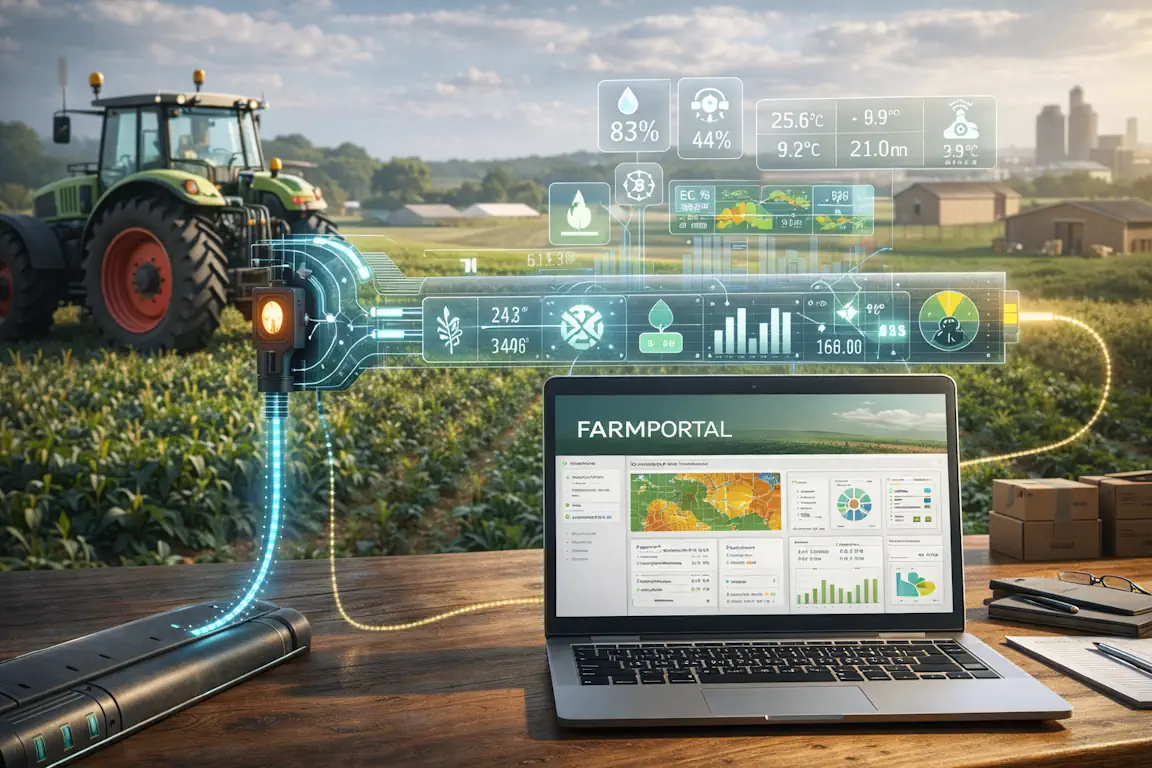
In the ISOBUS model, process data should not be anonymous. Every important working value should be described so that the system on the other side knows what it is and how to interpret it. In practice, this means that the terminal, the implement controller, and the farm system work with the same parameter meaning, even if they come from different manufacturers.
During fertilization, the terminal may send the target rate to the implement according to the application map, while the implement reports the actual rate. At the same time, the system can record working speed, completed area, operating time, and section status. If each of these values has the correct DDI assigned, the post-operation documentation is consistent and suitable for further analysis.
Most common areas where DDIs are used
DDIs are especially important wherever data must not only be read, but also used operationally or as proof. That is why the topic matters both to the farmer and to the recipient of the documentation.
- Task Controller - task control and execution recording.
- Variable Rate Application - variable rate fertilization, seeding, and spraying.
- Section Control - automatic section control.
- Reporting to FMIS - recording completed operations in a system such as FarmPortal.
- Yield and quality analysis - later comparison of field and harvest data.
Comparison: data without DDIs vs. data described with DDIs
On many farms, the biggest problem is not the lack of data, but the fact that the data is inconsistent or difficult to interpret. The comparison below shows why simply having an ISOBUS terminal or implement is not enough if the process data is not properly described and structured.
| Area | Data without proper DDI description | Data described with DDIs |
|---|---|---|
| Value interpretation | Risk of incorrect interpretation of units and parameters | Clear meaning of the parameter and its unit |
| Application maps | Problems distinguishing target rate from applied rate | Better alignment between control and documentation |
| Post-operation report | More manual corrections and explanations | Greater readiness for analysis and audit |
| Multi-brand compatibility | Higher risk of function mismatches | Greater predictability and easier integration |
| Use in FMS | Data only partially usable | Data easier to aggregate, report, and compare |
Source: FarmPortal, based on the ISO 11783 standard and implementation practice in precision agriculture.
Benefits and issues for different stakeholder groups
The topic of DDIs may sound technical, but its effects are very practical. Each group involved in production and data flow sees the same problem from a different angle: the farmer wants to perform the operation correctly, the advisor wants to analyze the data, the processor wants reliable documentation, and the equipment manufacturer wants predictable compatibility.
Farmers
For farmers, the most important things are ease of use, predictable behavior, and confidence that post-operation documentation matches reality. When data is well described, it becomes easier to move from simply completing an operation to analyzing and settling it.
- Benefits: better documentation quality, less manual rewriting, greater usefulness of application maps, easier comparison of operations between fields.
- Problems it solves: inconsistent reports, difficulty reconstructing the actual rate, errors when working with multiple machines and terminals.
Agronomic advisors
An advisor needs data that is not only recorded, but recorded in a comparable way. Without that, even strong agronomic knowledge loses operational value, because it becomes impossible to precisely assess what was done and what the result was.
- Benefits: better analysis of recommendation execution, greater usefulness of data for fertilizer calculations and evaluation of treatment strategies.
- Problems it solves: lack of a shared data format, ambiguous parameter names, difficulty comparing seasons and fields.
Processors and fruit and vegetable distributors
This group does not work directly with a spreader or sprayer, but increasingly needs data confirming how production was carried out. The better the order in source data, the easier it is to build a credible traceability chain.
- Benefits: greater credibility of field documentation, easier audits, better foundation for quality and compliance standards.
- Problems it solves: discrepancies between declaration and execution, data that is difficult to verify, and a large number of attachments and spreadsheets created manually.
Agricultural equipment manufacturers and integrators
For equipment manufacturers, DDIs are part of practical interoperability. The point is not only that the device should "connect" to the terminal, but that the data and functions should behave predictably across different market configurations.
- Benefits: easier integration, fewer implementation disputes, better communication with FMIS.
- Problems it solves: unclear parameter mapping, difficulties in after-sales support, interpretational differences between manufacturers.
Case study: a fruit and vegetable farm using ISOBUS data and FarmPortal
Farm context
A farm covering 186 hectares grows onions, carrots, and cabbage, as well as 24 hectares of apple orchard. Its machinery fleet includes two tractors with ISOBUS terminals, a fertilizer spreader, a sprayer, and a precision seeder. Previously, operation records were maintained partly in terminals, partly in spreadsheets, and partly in paper notes.
Initial problem
The team had machine data, but there was a lack of consistency in parameter interpretation. After two seasons, it turned out that some reports did not sufficiently distinguish between target rate and applied rate, and comparing operations across fields required manual data cleaning. The fertilizer advisor was losing time verifying records, and the production manager did not have a single place to analyze deviations.
Scope of process structuring
- Standardization of how operation data is imported into FarmPortal.
- Verification of which machine parameters are reported consistently.
- Linking execution data with fields, crops, and fertilization plans.
- Comparing target rate against applied rate and response time to deviations.
Results after one season
| Indicator | Before implementation | After implementation | Change |
|---|---|---|---|
| Time needed to prepare an operation report for 1 field | 22 min | 7 min | -68% |
| Share of operations requiring manual data correction | 34% | 11% | -23 p.p. |
| Average deviation of applied rate from plan on variable-rate fertilized fields | 8.9% | 4.1% | -54% |
| Advisor response time to a request for operation history | 1-2 days | up to 2 hours | significantly shorter |
| Number of documentation ambiguities reported by the buyer during the season | 9 | 2 | -78% |
The biggest benefit did not come from a single parameter, but from structuring the entire data chain. DDIs are not visible to the operator like a button on the terminal, but they are what make it possible to reliably connect control, recording, and analysis.
Conclusion from the case study
On farms using several machines and several layers of data, the greatest value comes not from ISOBUS itself, but from the quality of process data interpretation. When data is well described and enters one operational environment, deviations become visible faster, documentation is easier to prepare, and knowledge management between the operator, advisor, and production manager becomes simpler.
User opinions
The following statements are examples based on the typical needs of FarmPortal users from commercial farms. They were prepared to reflect real benefits and challenges related to working with operation data, especially when a farm uses several types of machines and needs fast documentation.
"We run 142 hectares of field vegetables, and previously every fertilization report had to be finalized manually. After structuring machine data and working in FarmPortal, we reduced the time from more than 3 hours per week to less than 1 hour. For me, the most important thing is that I can see the difference between the plan and the execution, not just a note saying the operation was done."
"In our 38-hectare orchard, the biggest challenge was not the lack of data, but its inconsistency. With several operators and an intense season, it is easy to lose control over operation history. After implementing a more structured process, we reduced the time needed to prepare documentation for the buyer by around 60%, and the number of clarification requests from the contractor dropped significantly."
How FarmPortal supports work with ISOBUS data
FarmPortal does not replace the ISOBUS standard, but helps use its potential in real farm practice and in data organization. This is especially important wherever application maps, operation records, fertilizer calculations, cooperation with an advisor, and the need to quickly prepare reports for a buyer or audit are involved.
It is also worth looking at DDI more broadly, not only from the perspective of the ISOBUS standard itself, but from the perspective of the entire farm data flow. In practice, some information comes from the task and application layer of ISO-BUS, while some comes from telemetry and machine performance monitoring. That is why a useful complement to this article is the description of GPS monitoring of agricultural machinery, where FarmPortal shows how to combine vehicle location, route history, working parameters, fuel data, and CAN bus data with operation planning and work reporting. If you also want to better understand the technical background of machine communication, read the article explaining the differences between ISO-BUS and CAN-BUS. It is a good extension for readers who want to better understand the relationship between the communication bus, the agricultural standard, and the practical use of data in the FarmPortal system.
In practice, the greatest value of FarmPortal appears when agronomic data does not stop at office-based analysis, but moves into actual field execution. This is especially true for variable rate fertilization maps and other application maps, which can be prepared based on soil tests, yield history, field zones, and satellite analysis, and then transferred into the machine's working environment.
From the ISOBUS and DDI perspective, this is highly significant. DDIs structure the meaning of parameters in communication and documentation, while FarmPortal helps prepare the input data for the operation and link it with the later execution record. Thanks to this, the farm can not only create a VRA map, but also export it to the ISO-XML format later used by the ISOBUS environment and machine-guidance devices.
You can find a description of system functions here: FarmPortal system functions.
FarmPortal features relevant to ISOBUS data
When working with machines and operation records, the key is not only to save the event, but to connect it with the context of the field, timing, production objective, and recommendations. This is where the role of an FMS becomes operational rather than merely archival.
- Field, crop, and operation registry - makes it easier to link work execution to a specific field, season, crop, and action history. This matters because data later sent to the terminal or received from the implement does not exist without context, but is assigned to a specific plot, production method, and production goal.
- Variable rate application maps - FarmPortal enables the creation, editing, and versioning of application maps based on soil testing, field zones, historical data, and satellite analysis. In practice, this means the rate decision is no longer a single fixed value for the entire field, but can vary spatially and be better adapted to the production potential of individual zones.
- Export of maps to ISO-XML and work in the ISOBUS environment - prepared maps can be exported to the ISO-XML format, which is then used by devices operating in the ISOBUS standard. This shortens the path from agronomic decision to operation execution and limits the risk of errors resulting from manually copying parameters between software, data carrier, and machine terminal.
- Integration with navigation systems and terminals receiving maps - FarmPortal supports transferring maps to guidance and navigation systems. In practice, a farmer can prepare a fertilization plan in the system, export it to ISO-XML, import the data into the navigation unit or terminal, and then carry out a precise operation without manually setting all parameters in the cab.
- Fertilizer calculations and fertilization planning - support the preparation of the planned rate even before the operation is performed. This matters not only from the perspective of fertilization economics, but also data quality, because assumptions can later be compared with actual execution to evaluate whether deviations were caused by field conditions, machine settings, or work organization.
- Import and analysis of execution data - FarmPortal supports structuring data from completed operations, including information on tasks, rates, and areas. For the farm, this means a real comparison of plan versus execution, not just the fact that the operation was launched in the terminal.
- Plant protection product database and operation records - structure operation records, including cases where the farm combines machine data with documentation required for organizational, quality, or contractual purposes. This helps reduce the number of parallel registries and makes it easier to prepare a consistent field history for the advisor, audit, or product buyer.
- Cooperation with the advisor - accelerates the evaluation of completed operations and recommendations, because the advisor does not work only with the operator's declaration, but can use more structured data about the plan, execution, and field history. This increases the usefulness of fertilization and crop protection recommendations in later stages of the season.
- One data environment - reduces the number of spreadsheets, notes, and manual corrections, while also limiting dependence on a single closed hardware ecosystem. This matters for farms that expand their machinery fleet gradually and use solutions from different manufacturers.
Implementation checklist: how to approach DDI data without chaos
When implementing ISOBUS elements, the biggest problems usually arise when the organization focuses only on the physical connection of the equipment. In reality, full value only comes from connecting hardware, data, and workflow. That is why it is worth going through a simple checklist.
- Check which ISOBUS functions are actually used on the farm: terminal, Task Controller, Section Control, application maps.
- Verify which machines report execution data in a way that is useful for further analysis.
- Define which indicators matter most to you: rate, area, time, deviation from plan, section status.
- Connect machine data with the field, crop, and operation date in one system.
- Check report quality after the first 5-10 operations before considering the implementation complete.
- Compare not only the plan, but also execution and deviations.
- Involve the advisor or production manager in reviewing the data, not only at the final reporting stage.
Quick reference
- ISOBUS structures communication.
- DDI gives meaning to parameters.
- Task Controller controls the task and records execution.
- FarmPortal as FMS structures data, documentation, and analysis.
FAQ
Are DDIs in ISOBUS important only for large farms?
No. On large farms the benefit may be more visible because the number of machines and operators is higher, but even on a medium-sized farm the problem of inconsistent data quickly affects documentation, operation analysis, and cooperation with the advisor. The more digital data generated during the season, the more important a shared language becomes.
If a machine is ISOBUS-compatible, will everything work without problems?
Not always. From the user's perspective, ISOBUS compliance is the foundation, but it does not remove the need to verify functions and data quality in the real machine setup. In practice, software versions, function implementation, and integration quality between devices also matter.
Do DDIs help with documentation for fruit and vegetable buyers?
Indirectly, yes. DDIs are not part of a commercial form, but they improve data quality at the source. This makes it easier to prepare a reliable operation history, operational reports, and the data needed for audits or quality standard verification.
Does the topic of DDIs make sense without application maps?
Yes. Application maps are only one area of use. DDIs are also useful for basic operation documentation, execution reports, machine performance analysis, and data structuring between the terminal and the farm system.
Is FarmPortal also useful if I do not have a full ISOBUS machinery setup?
Yes. FarmPortal helps structure fields, operations, recommendations, fertilization, inventory, and documentation regardless of equipment maturity level. As the farm gradually expands its use of ISOBUS and machine data, the value of the FMS usually increases because there is more data to compare and report.
Conclusion
DDIs in ISOBUS are not a minor technical detail, but one of the pillars of data quality in precision agriculture. They give meaning to the parameters transmitted between the implement, terminal, and farm management system. Thanks to this, more reliable application maps, better operation records, and greater comparability of data across seasons, fields, and devices become possible.
For the farmer, this means greater control over work execution. For the advisor, it means more useful data for evaluating recommendations. For the processor and distributor, it means better source data quality. And for the equipment manufacturer, it means a lower risk of implementation misunderstandings. In practice, the greatest value comes from combining structured machine data with a system such as FarmPortal, which turns operational records into real decision support.
Glossary
- DDI - Data Dictionary Identifier, meaning a parameter identifier in the ISOBUS data dictionary.
- ISOBUS - the international ISO 11783 standard defining communication between tractors, agricultural implements, and software.
- ISO 11783-11 - the part of the standard describing the data dictionary used to define process parameters.
- Task Controller - a module responsible for task execution, data exchange with the implement, and recording of completed work.
- Application map - a map defining variable rate across different parts of the field.
- Section Control - automatic switching on and off of working sections in order to reduce overlaps and losses.
- ISO-XML - a data format used to exchange tasks and working information in the ISOBUS environment, especially for application maps and Task Controller.
- VRA - Variable Rate Application, a way of carrying out an operation in which the rate changes depending on field zones or recommendation maps.
- Farm Management System (FMS) - a farm management system that structures operational data, documentation, and analytics. FarmPortal is one example.
Sources
The article uses definitions and industry materials related to ISO 11783, the ISOBUS Data Dictionary, and publications on digitalization and precision agriculture in Europe.
Follow us!
See what we're doing and be inspired by positive changes.