Agriculture 6.0 is not yet a formal standard or a widely accepted definition. However, it can be treated as an interesting direction of development: from field digitalisation, through decision automation, to an autonomous, verifiable and regenerative food production system.
Short summary
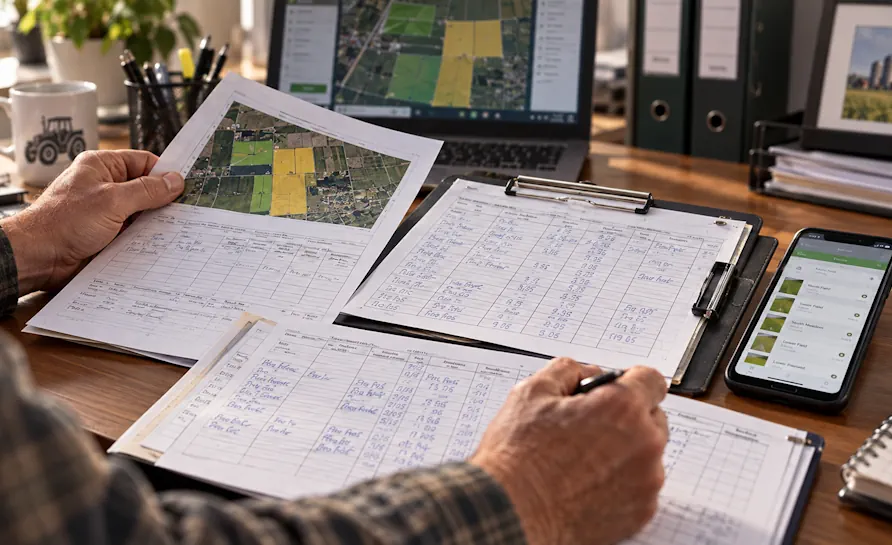
Agriculture 4.0 is already partially present in many farms: GPS, sensors, satellite data, application maps and farm management systems are no longer futuristic concepts. However, adoption remains uneven, and a large part of agricultural data is still scattered across machines, applications, Excel files, notes and paper documents.
Agriculture 5.0 is a transitional stage: artificial intelligence, robotics, autonomous machines, digital twins and decision-support systems are added to precision farming. Agriculture 6.0 can be understood as the next step: verified regenerative intelligence, meaning food production that is efficient, resilient, measurable, auditable and connected with the entire supply chain.

Who this article is for and what problems it solves
Terms such as Agriculture 4.0, 5.0 and 6.0 are often used too loosely in marketing. For processing plant managers, agronomists, distributors or machinery manufacturers, the more practical question is: which decisions, costs and risks can be controlled better with these concepts?
| Audience group | Most common problem | Benefit of the 6.0 approach |
|---|---|---|
| Fruit and vegetable processors | Lack of early insight into quality, volume, harvest timing and crop protection residue risk. | Better planning of production, contracting, storage, laboratories, logistics and audits. |
| Fruit and vegetable distributors | Uncertain deliveries, variable quality, complaints and difficult batch traceability. | More complete information about the batch, origin, quality, delivery date and commercial parameters. |
| Agronomists and agricultural advisors | Too much data in too many places and too little time to analyse every field. | Risk prioritisation, treatment recommendations, crop condition monitoring and decision documentation. |
| Management teams | Strategic decisions based on delayed reports and estimates. | A common operational view: costs, risks, quality, ESG, compliance, efficiency and profitability. |
| Machinery and technology manufacturers | Equipment works well, but its data does not always create value after fieldwork is completed. | Digital services around machinery: telemetry, predictive servicing, application maps and execution records. |
Table 1. Problems and benefits for the main audience groups of the article.
Has Agriculture 4.0 already been adopted?
The answer is: partly yes, but unevenly. Agriculture 4.0, understood as digitalisation, GPS, IoT, sensors, satellite data, precision machinery and farm management systems, is already present in practice. This does not mean, however, that most farms operate as coherent, integrated data systems.
In many agri-food companies, the problem is no longer the absence of a single technology, but the lack of connection between technologies. The field has its own data, the machine has its own data, the agronomist has another data set, the laboratory has another, and the processor often sees the result only when the raw material arrives. This limits the value of Agriculture 4.0, because data without context rarely leads to quick decisions.
What does Agriculture 4.0 usually mean in practice?
Most often, it refers to tools that help measure and perform fieldwork more precisely. This is the first foundation for more advanced management models.
- GPS machine guidance and overlap reduction,
- soil fertility maps and application maps,
- satellite data and vegetation indices,
- weather stations and soil moisture sensors,
- digital records of treatments, costs and resources,
- an FMS, meaning a farm management system.
A good practical example of Agriculture 4.0 is variable rate fertilisation VRA. Instead of applying one dose “per hectare”, the farm uses a dose adjusted to local field conditions, soil fertility and crop condition.
Is Agriculture 5.0 already being implemented?
Agriculture 5.0 is already being implemented, but mainly in selected areas, larger farms, pilot projects, technology companies and supply chains that have a real business interest in decision automation. In the literature, Agriculture 5.0 is described as a stage in which artificial intelligence, machine learning, robotics, big data, digital twins, cloud systems and autonomous systems are added to precision farming.
The difference between 4.0 and 5.0 is important. Agriculture 4.0 primarily measures and supports precision. Agriculture 5.0 begins to analyse, predict and recommend. Farmers, agronomists and production managers increasingly no longer ask: “what does the map show?”, but rather: “what should I do, in what order and with what level of risk?”.
Examples of Agriculture 5.0 applications
The most visible Agriculture 5.0 applications concern areas where there is a lot of repetitive work, a lot of data and a high cost of error.
- AI for detecting water stress, diseases and nutrient deficiencies.
- Field robots for weeding, monitoring or harvesting.
- Yield and quality prediction based on images, weather, field history and variety data.
- Autonomous machines performing treatments according to application maps.
- Risk models for crop protection treatments, irrigation and harvest timing.
- Crop digital twins that simulate production scenarios.
What could Agriculture 6.0 be?
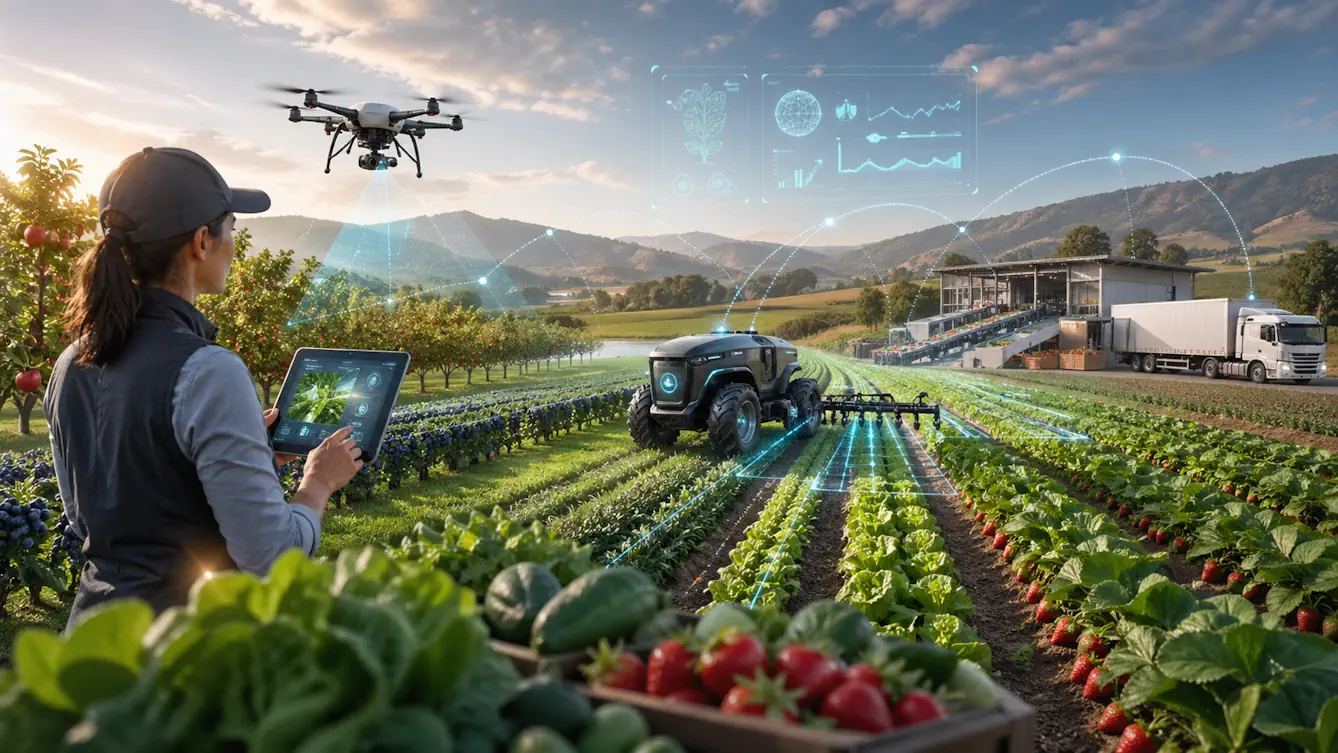
Agriculture 6.0 could be the next stage after Agriculture 5.0. It would not simply be “more digital”. It would be self-learning, regenerative, resilient and integrated with the entire food chain.
A practical proposed definition is:
Agriculture 6.0 is a model in which the farm, machinery, crops, soil, climate, suppliers, buyers, certifications and market data operate as one self-learning system, optimising not only yield and cost, but also environmental footprint, production resilience, food quality and regulatory compliance.
This distinction matters. Agriculture 6.0 would not be only about AI performing a spraying operation or a robot harvesting fruit. It is rather about making the entire food production system more predictable: from the field, through harvesting, transport, storage, sorting, processing, documentation and certification, all the way to the buyer.
Agriculture 6.0 is interoperable data infrastructure for autonomous, regenerative and verifiable food production.
The phrase that best captures this direction is: from precision farming to verified regenerative intelligence.
Agriculture 4.0, 5.0 and 6.0 – comparison
The table below organises the differences. It should not be treated as a rigid academic classification, but as a practical map of technology development and production management.
| Stage | Main logic | Typical technologies | Key business question | Limitation |
|---|---|---|---|---|
| Agriculture 4.0 | Digitalisation and precision | GPS, IoT, sensors, satellite imagery, application maps, FMS | How can a treatment be performed more accurately and at lower cost? | Data often remains scattered. |
| Agriculture 5.0 | Automation and intelligent recommendations | AI, machine learning, robotics, digital twins, autonomous machines | How can a problem be predicted and the best decision selected? | Implementations require good data, integration and user trust. |
| Agriculture 6.0 | Verified regenerative intelligence | MRV, traceability, supply chain digital twin, AI, interoperability, compliance automation | How can food be produced efficiently, resiliently, in line with regulations and with measurable environmental impact? | Common standards, data exchange models and mature adoption are still missing. |
Table 2. Practical comparison of Agriculture 4.0, 5.0 and 6.0.
10 features of Agriculture 6.0
Agriculture 6.0 should be described through specific features, not only through the term itself. The list below shows how such a model could differ from traditional farm digitalisation.
1. Autonomous operational decisions
The system not only displays data, but recommends or triggers actions: irrigation, fertilisation, spraying, quality monitoring, harvesting, logistics and alerts. The farmer still controls the strategy, but the system takes over part of the repetitive analysis.
2. AI as a farm management layer
Artificial intelligence combines data from fields, machinery, weather, satellite imagery, treatment history, costs, workers and the market. The user should not have to analyse ten different screens. They should receive a clear recommendation: what to do, where, when, with what equipment and with what level of risk.
3. Regeneration as a metric, not a slogan
In Agriculture 6.0, yield per hectare is not the only metric that matters. Soil organic matter, water retention, nitrogen balance, erosion, biodiversity, emissions and farm resilience to drought, frost and disease pressure also become important.
4. Full data verifiability
MRV, meaning measurement, reporting and verification, turns documentation from an administrative obligation into a management tool. Every action can have a record: who, when, where, with what, at what dose, on what area and with what result.
5. A digital twin of the farm and crop
The farm has its own digital model: fields, soils, varieties, treatments, machinery, workers, raw material batches, costs, risks and forecasts. Such a model makes it possible to simulate scenarios: drought, delayed harvest, labour shortage, fertiliser price increases or lower raw material quality.
6. Integration of the entire supply chain
Agriculture 6.0 does not end in the field. It connects the farmer, agronomist, input supplier, processor, distributor, logistics operator, laboratory, auditor, bank, insurer and retailer.
7. Production personalised for the buyer
Production can be managed according to specific buyer requirements: crop protection residues, Brix, calibre, firmness, variety, carbon footprint, delivery date, certification and batch documentation method.
8. Resilience instead of efficiency alone
Agriculture 4.0 and 5.0 often focus on efficiency. Agriculture 6.0 should go further: minimising weather, biological, regulatory, logistical and financial risks.
9. Compliance automation
Compliance with buyer, certification and regulatory requirements should not be added at the end of the season. It should be created automatically during work: at the time of treatment, harvest, delivery, quality testing and settlement.
10. Data as shared infrastructure
The biggest change is not a single algorithm, but a shared data layer. If data is consistent, up to date and exchangeable, it becomes possible to build additional services: advisory, financing, insurance, contracting, ESG and batch traceability.
What research and reports show
The term Agriculture 6.0 appears in the literature more as a proposed direction of development than as a formal standard. The publication “Agriculture 6.0: A new proposal for the future of agribusiness” describes this stage as a shift towards sustainability, protection and restoration of ecosystems in agribusiness activity.
A review of Agriculture 5.0 indicates that the key technologies of this stage include artificial intelligence, machine learning, robotics, big data, IoT, digital twins, cloud and autonomous systems. This confirms that Agriculture 5.0 is no longer just a slogan, but a set of technologies being tested and implemented in concrete applications.
The FAO report “The State of Food and Agriculture 2022” analysed agricultural automation based on 27 case studies. It pointed to both the potential of automation and adoption barriers: costs, skills, access to finance, farm scale and the ability of small producers to benefit from new technologies.
| Area | Finding from publications and the market | Meaning for Agriculture 6.0 |
|---|---|---|
| Automation | Automation can improve work precision, working conditions and productivity, but it requires profitability and skills. | Agriculture 6.0 must be implemented as a business process, not as the purchase of a gadget. |
| AI and robotics | AI supports crop monitoring, prediction, field robots and agronomic decisions. | AI should operate on data from the farm, machinery, weather, soil, quality and the market. |
| Regeneration | New Agriculture 6.0 concepts emphasise ecosystem restoration, not only the reduction of harm. | Environmental indicators must be measured, reported and linked to production decisions. |
| Supply chain | Processing and distribution require data on raw material quality, origin, timing and compliance. | Agriculture 6.0 should connect the field with the plant, warehouse, logistics, audit and buyer. |
Table 3. Key findings from research and their meaning for the Agriculture 6.0 concept.
How FarmPortal supports the Agriculture 6.0 direction
FarmPortal does not need to be called an “Agriculture 6.0 system” to support its foundations. What matters most is that it structures operational farm data and makes it possible to connect it with agronomic, environmental and business processes.
In practice, FarmPortal supports the transition from individual applications to integrated production management. The system’s functions include field records, treatments, resources, costs, workers, maps, weather data, documentation and elements related to environmental footprint. More functions are described on the FarmPortal functions page.
Key functions in the context of Agriculture 6.0
Agriculture 6.0 requires a shared data layer. That is why the key functions are not only those that record actions, but also those that make it possible to use them later for analysis, audit and planning.
- Treatment documentation – recording work execution, products, doses, dates and locations.
- Maps and precision farming – preparing data for variable rate fertilisation, spraying and other treatments.
- Crop monitoring – observing plantation condition using weather, satellite and field data.
- Environmental footprint – better planning of water, fertiliser and crop protection product use.
- Traceability – linking farm activities with raw material batches and buyer requirements.
- Collaboration with processors and advisors – structured information flow between production, quality and procurement.
- Integration with FarmCloud and FoodPass – extending farm data into supply chain processes, digital product passports and quality control.
The context of fruit and vegetable processors and distributors is especially important. If a buying organisation only sees raw material on the unloading ramp, it reacts too late. This is why it is valuable to combine farm data with production risks described in more detail in the article production risks for fruit and vegetable processors and distributors.
Excel, point solutions or FarmPortal?
Many companies start with Excel, a single weather app, a messenger and files from machinery. This works at the beginning, but as the number of fields, suppliers, varieties, treatments and quality requirements grows, information chaos quickly appears.
| Criterion | Excel and manual documents | Point applications | FarmPortal and Agri Solutions |
|---|---|---|---|
| Data consistency | Low, dependent on user discipline. | Medium, but often limited to one function. | High, because operational data is managed in one environment. |
| Agronomist’s work | A lot of manual analysis and rewriting. | Better insight into a selected area, such as weather or satellite data. | Combines fields, treatments, maps, weather, costs and documentation. |
| Traceability | Difficult and error-prone. | Partial, depending on the application. | Ability to link actions with batch, supplier, quality and buyer. |
| MRV and ESG | High cost of preparing reports. | Reporting limited to the application’s scope. | Data is created during the process, which facilitates reporting and audit. |
| Integrations | Manual file export and import. | Often lacks openness or integrates with only one ecosystem. | Ability to build interoperable data infrastructure with FarmCloud, FoodPass, machinery, IoT and partner systems. |
| Scaling | Problematic with a larger number of users and suppliers. | Possible, but the number of tools increases. | Well suited to farms, producer groups, advisory services, processing and distribution. |
Table 4. Comparison of approaches to digital production management and supply chain data in agriculture.
Implementation example with KPIs
The following example is a reference scenario for a large producer group and soft fruit processor. It shows which indicators can be measured when moving from scattered digitalisation to a more integrated data model.
Context
The group works with 86 farms that together manage 1,420 ha of strawberry, raspberry, currant and cherry crops. The raw material goes to a freezing and processing plant. The biggest problems before implementation were variable harvest dates, inconsistent treatment documentation, delayed information about quality risk and manual preparation of data for audits.
Scope of digitalisation
The implementation covers digital plantation records, treatment history, weather monitoring, linking deliveries with plantations, a batch quality register, alerts for agronomists and reports for procurement and quality control teams.
| Indicator | Before implementation | After 12 months | Change |
|---|---|---|---|
| Batches with complete field and treatment history | 38% | 91% | +53 pp |
| Time needed to prepare documentation for supplier audit | 2–4 working days | 4–6 hours | reduction of approximately 75–90% |
| Unplanned changes to delivery schedule | average 17 per week at peak season | average 9 per week | -47% |
| Batches rejected due to formal documentation gaps | 3.8% | 1.1% | -2.7 pp |
| Agronomist response time to weather or quality alert | 24–48 hours | 4–12 hours | shorter response cycle |
Table 5. Example KPIs for implementing a data system in a producer group and fruit processing plant.
The greatest effect did not come from simply moving documents into a system. The key was linking field data with raw material batches, quality and production planning. This is the stage that begins to resemble the practical foundations of Agriculture 6.0.
Summary
Agriculture 4.0 has already been partially adopted, but not everywhere and not always in an integrated way. Agriculture 5.0 is being implemented where data, AI, robotics and automation begin to support operational decisions. Agriculture 6.0 is still approaching as a concept, but its elements are already visible: MRV, traceability, digital twins, interoperability, regeneration and the connection of the farm with the entire supply chain.
The most important change is that the farm stops being only a place of production. It becomes an intelligent, connected and auditable element of the food system. For processors, distributors, agronomists and management teams, this means better visibility of risk, quality, costs, compliance and production resilience.
If a company wants to prepare for this direction, it should start with the foundations: consistent data, digital documentation, linking the field with the raw material batch, measurable environmental indicators and a system that can integrate with other participants in the supply chain. This is where FarmPortal, FarmCloud and FoodPass create a practical layer for the future of Agriculture 6.0.
Do you want to check which data in your farm, producer group or processing plant should be structured first? See FarmPortal functions and start with the processes that have the greatest impact on cost, quality and seasonal risk.
Glossary
- Agriculture 4.0
- A stage of agricultural digitalisation based on GPS, IoT, sensors, satellite data, application maps and farm management systems.
- Agriculture 5.0
- A stage in which AI, robotics, machine learning, automation, digital twins and autonomous systems are added to digitalisation.
- Agriculture 6.0
- A proposed development direction: an autonomous, verifiable and regenerative food production ecosystem connected with the entire supply chain.
- FMS
- Farm Management System. It helps manage data on fields, treatments, costs, resources, workers and production.
- MRV
- Measurement, reporting and verification. In agriculture, it refers to documenting actions, emissions, environmental practices, resource use and production outcomes.
- Traceability
- The ability to identify and trace a product batch. It makes it possible to follow raw material origin, treatment history, deliveries, quality and documentation.
- Digital twin
- A digital model of a farm, crop, machine or process that enables current-state analysis and scenario simulation.
- VRA
- Variable Rate Application. A technology that makes it possible to adjust fertiliser, seed or crop protection product rates to local field conditions.
- Interoperability
- The ability of different systems, machines and applications to exchange data in a structured way without manual re-entry.
- Regeneration
- A production approach that not only reduces negative environmental impact, but supports the restoration of soil, water retention, biodiversity and farm resilience.
Frequently asked questions
Is Agriculture 6.0 already a real technology, or just a fashionable term?
Agriculture 6.0 is not yet a formal standard. It is rather a proposed direction of development: the combination of AI, automation, MRV, traceability, regeneration and fuller supply chain integration.
Has Agriculture 4.0 already been implemented in Poland?
Partly yes. Many farms use GPS, weather apps, satellite data, application maps and digital records. The ongoing problem is data fragmentation and the lack of one operational system for the farm and its supply chain partners.
Does Agriculture 5.0 mean full farm automation?
No. Agriculture 5.0 means a greater role for AI, robotics, automation and decision-support systems. Humans still supervise decisions, define goals and remain responsible for the agronomic and business context.
What will Agriculture 6.0 change for fruit and vegetable processors?
A processor can see quality risk, supply forecasts, treatment history, batch compliance and possible logistics problems earlier. This supports planning of production, storage, quality control and contracting.
Does a fruit and vegetable distributor need farm data?
Yes, if they want to reduce complaints, improve delivery predictability and meet buyer requirements. Farm data helps confirm origin, quality, harvest date, production conditions and batch documentation.
How can an agronomist use Agriculture 6.0?
An agronomist can prioritise risks faster, compare plantations, analyse weather and satellite data, prepare recommendations and document decisions. Instead of reacting after the fact, they can manage risk in advance.
Can an agricultural machinery manufacturer build services around Agriculture 6.0?
Yes. Machine data can support predictive servicing, treatment execution records, application maps, calibration, telemetry and integration with farm management systems.
Where should a company start if it wants to prepare for Agriculture 6.0?
It is best to start with basic data: fields, crops, treatments, costs, machinery, workers, deliveries and batch quality. Only on this foundation does it make sense to develop automation, AI, digital twins and MRV reporting.
Sources
- Neves, M. F. et al., “Agriculture 6.0: A new proposal for the future of agribusiness”, 2023. Access the publication.
- Taha, M. F. et al., “Emerging Technologies for Precision Crop Management Towards Agriculture 5.0: A Comprehensive Overview”, Agriculture, 2025. Access the study.
- FAO, “The State of Food and Agriculture 2022: Leveraging automation in agriculture for transforming agrifood systems”, Rome, 2022.
Follow us!
See what we're doing and be inspired by positive changes.