The debate over whether agriculture should be productive or environmentally friendly has been going on for years. It is usually presented as a choice: either high yields and profitability, or low emissions and soil protection. This article explains why that opposition is misleading and where the line between profit and responsibility really lies.
Sustainable intensification is a model of agricultural production that maintains or increases yields while reducing environmental pressure through precise input management. It is neither conventional intensive agriculture nor organic farming. It is a third way, built on data.

In brief
Intensive and sustainable agriculture are not opposites. Most of the environmental footprint of crop production comes from nitrogen and imprecise input management, not from the pursuit of high yields itself. The line between profitability and responsibility runs through the quality of decision-making on the farm. Data from fields, machinery and satellites can reduce inputs and emissions without sacrificing profit.
- Agriculture in Poland accounted for 9.8% of national greenhouse gas emissions in 2023, mainly due to nitrous oxide from soils and livestock farming (KOBiZE, cited by the Ministry of Agriculture and Rural Development).
- Organic farming yields are, on average, 19–25% lower than conventional yields (Seufert et al. 2012; Ponisio et al. 2015).
- Precision agriculture tools increase nitrogen use efficiency by an average of 15.1% and reduce emissions by 9.4% (meta-analysis of 85 studies, 2025).
- The real line does not run between two models of agriculture, but between farms that measure their inputs and those that do not.
How does intensive agriculture differ from sustainable agriculture?
Intensive agriculture seeks to maximise yield per hectare through high use of fertilisers, crop protection products, fuel and capital. Sustainable agriculture treats the protection of soil, water and biodiversity as being on an equal footing with production. In practice, these two approaches are increasingly overlapping.
The problem begins when we treat them as mutually exclusive camps. Intensive does not automatically mean harmful. Organic does not automatically mean climate-safe, because a lower yield means more land is needed to produce the same output. The most important variable lies elsewhere: whether the farmer knows exactly what is being applied to the field and what effect it has.
This is why the concept of sustainable intensification is becoming increasingly important. It is about maintaining production while reducing pressure on the environment, achieved through better decisions rather than abandoning technology. This approach combines the agronomic objective and the climate objective in one calculation.
What is the real environmental cost of intensive agriculture?
Agriculture accounts for around 13% of greenhouse gas emissions in the European Union, and its structure is specific: methane from enteric fermentation represents 49% of the sector’s emissions, nitrous oxide from soils 30%, and methane from manure management 17% (European Environment Agency, 2023 data). It is not the energy sector, but its footprint is real and difficult to reduce.
The picture in Poland is similar. According to KOBiZE, cited by the Ministry of Agriculture and Rural Development, Polish agriculture accounted for 9.8% of national anthropogenic emissions in 2023. The sector is primarily a source of nitrous oxide, with agricultural soils accounting for nearly two-thirds of national emissions of this gas (KOBiZE, National Inventory Report).
The key conclusion concerns nitrogen. In arable crops, nitrogen fertilisation accounts for most of the carbon footprint of an individual field, because both fertiliser production and the N2O emissions triggered in the soil after application are included (IUNG-PIB, based on crop life cycle assessment data). In other words, the biggest environmental problem in intensive agriculture is not the pursuit of yield itself. It is nitrogen applied without precision.
This has direct significance for the farmer. Every kilogram of nitrogen that is not taken up by the plant is both a financial loss and an emission. At this point, the environment and the farmer’s wallet point in the same direction.
Does sustainable agriculture have to mean lower yields?
Not always, but in the case of organic farming, the yield gap is well documented. Three large meta-analyses found that organic yields are, on average, 19–25% lower than conventional yields, although the result depends on the crop, soil and quality of management (Seufert et al. 2012; de Ponti et al. 2012; Ponisio et al. 2015).
These studies also show something more important than the number itself. The main factor limiting yield in organic systems is nitrogen availability. Ponisio and co-authors (2015) showed that good crop rotations and intercropping can reduce the yield gap to 8–9% under selected conditions. The gap is therefore not fixed. It results from management.
This calls for caution around the claim that organic is always more responsible. If a field produces one fifth less, some of the environmental benefit disappears, because the same output has to be produced over a larger area. Organic farming has its place and its customers. It is not, however, a universal answer to the questions of food supply and climate at the same time.
EU policy is moving towards reducing inputs. The Farm to Fork Strategy sets targets for 2030 to reduce the use and risk of pesticides by 50%, reduce fertiliser use by at least 20%, and have 25% of agricultural land under organic farming (European Commission, 2020). This is a direction that will sooner or later affect every commercial farm.
Where is the line between profitability and responsibility?
The line does not run between intensive and sustainable agriculture. It runs between farms that measure their inputs and outcomes and farms that operate “by eye”. That is the strongest argument in this article.
In practice, this means that two farms of the same scale and with the same yield can have a completely different environmental footprint and a different margin. Precision makes the difference: a nitrogen rate matched to the needs of the field, spraying carried out in the right weather window, seed sown at a variable rate where the soil allows it. Environmental responsibility and profitability meet exactly at the point where waste ends.
The table below compares the classic intensive approach with a data-driven approach. This is not a choice between yield and the environment. It is a choice between estimated management and measured management.
| Criterion | Classic intensive agriculture | Data-driven sustainable intensification |
|---|---|---|
| Nitrogen rate | uniform across the whole field, estimated | variable, matched to the needs of field zones |
| Crop protection | treatments based on the calendar | treatments based on disease models and weather windows |
| Decision basis | experience and intuition | field, satellite and machinery data |
| Objective | maximum yield per hectare | maximum margin with controlled emissions |
| Environmental risk | high nitrogen losses, excessive inputs | reduced losses, measured footprint |
Source: own elaboration based on agronomic practice and data from the European Environment Agency and IUNG-PIB. As at June 2026.
How do data and precision agriculture shift that line?
Precision agriculture is a way of managing production that adjusts inputs to field variability using data from sensors, satellites and machinery. Most importantly, it does so profitably. The latest data say this directly.
A meta-analysis of 85 studies and 1,472 observations from farms around the world, published in Sustainability in 2025, found that implementing precision agriculture tools increased return on investment by an average of 22.3% and net profit by 18.5%. At the same time, nitrogen use efficiency increased by an average of 15.1%, crop protection product use fell by 12.8%, and greenhouse gas emissions fell by 9.4%. This is a rare case in which profit and footprint reduction move together.
The strongest effect comes from Variable Rate Application (VRA), a technique for applying fertiliser at different rates in different zones of the field. It works because it directly links input savings with a lower risk of nitrogen losses to water and the atmosphere. The second lever is precision crop protection based on disease models and weather data. Fewer treatments carried out at a better time means lower cost and lower environmental risk.
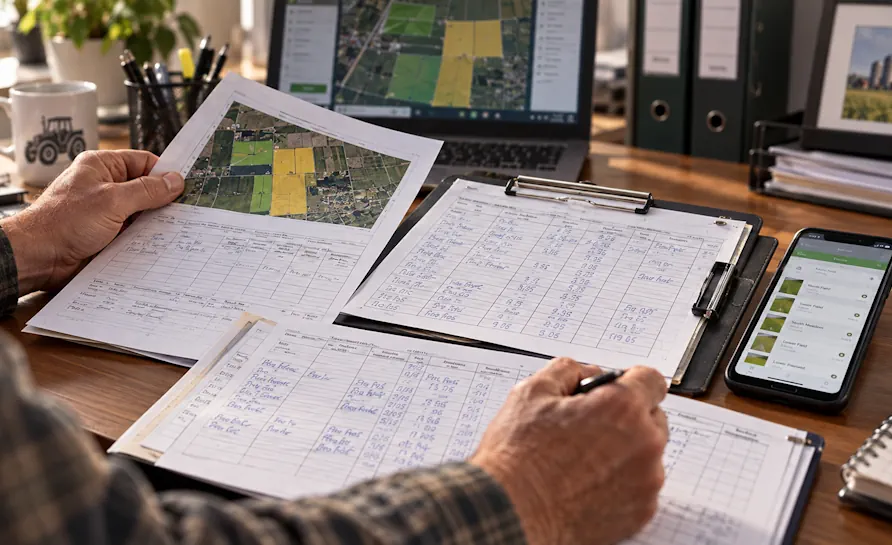
For this to work, the farm has to start with data. Without treatment records, yield maps and soil analysis, it is not possible to calculate either field-level margin or footprint. A digital farm management system is therefore a prerequisite, not an add-on.
| Indicator | Average change | Significance for the farm | Source, year |
|---|---|---|---|
| Return on investment | +22.3% | stronger business case for technology | meta-analysis, 2025 |
| Nitrogen efficiency | +15.1% | less fertiliser lost per hectare | meta-analysis, 2025 |
| Crop protection product use | −12.8% | lower cost and lower environmental risk | meta-analysis, 2025 |
| Greenhouse gas emissions | −9.4% | measurable progress in footprint reporting | meta-analysis, 2025 |
Source: meta-analysis of 85 studies and 1,472 observations, Sustainability 2025. Average values; results on an individual farm depend on crop, scale and region. As at June 2026.
What does this mean for farms, advisers and processors?
Each group sees this line from a different perspective. For the farmer, it is a question of margin. For the adviser, the quality of recommendations. For the processor, data in the supply chain.
Commercial farmers
A farm above 100 ha feels the losses from excess nitrogen and poorly timed treatments most quickly. The first step is simple: start recording treatments, rates and yields in one place, rather than in a notebook and from memory. Only this data makes it possible to calculate margin for a specific field and decide where to implement variable-rate fertilisation. The FarmPortal features for treatment records and field data analysis support this process.
Agricultural advisers and advisory centres (ODR)
An adviser with access to organised farm data provides better fertiliser recommendations and documents compliance with requirements more effectively. Digital records also shorten the preparation of applications and reports for ARiMR, the Agency for Restructuring and Modernisation of Agriculture. It is worth exploring the broader capabilities of the farm management platform.
Processors and agri-food management teams
Processors of fruit, vegetables and cereals increasingly need to demonstrate the origin and footprint of raw materials. This is where traceability and supplier data come in, with FoodPass supporting them as a layer for identification and reporting in the supply chain. The line between profitability and responsibility then moves from the field to the entire chain. You can find more practical perspectives on this subject on the blog on digitisation and data in agriculture.
Practical example: a 220 ha farm in Greater Poland
A commercial farm near Środa Wielkopolska grows winter wheat, oilseed rape and maize on 220 ha of light and medium soils. The problem was typical for the region: varied soil fertility, uniform nitrogen rates and rising fertiliser costs after 2022. Margin was calculated for the farm as a whole, not for individual fields, so it was unclear which hectares were genuinely profitable.
The implementation began with organising data: treatment records, combine yield maps and soil analysis divided into zones. On that basis, variable-rate nitrogen fertilisation was applied on part of the area, and oilseed rape protection was managed according to disease models and weather data instead of a fixed calendar. The input data consisted of nutrient maps, satellite vegetation data and yield history from three seasons.
After one full season, nitrogen use on fields covered by variable-rate application fell by around 12%, and the number of fungicide treatments in oilseed rape was reduced by one. Wheat yield remained at the previous year’s level, at around 7.1 t/ha. Margin on the weakest fields stopped being negative after fertilisation was reduced in areas where it did not translate into yield.
The limitations are important. The effect depends on the quality of soil data and the weather in a given season, while the first year is mainly used for calibration. This is not a ready-made recipe for every farm. For similar commercial farms on light soils, however, the conclusion is clear: input savings and footprint reduction appeared in the same place because they resulted from the same, better decision.
Frequently asked questions
How does intensive agriculture differ from sustainable agriculture?
Intensive agriculture seeks to maximise yield through high use of fertilisers, crop protection products and fuel. Sustainable agriculture treats the protection of soil, water and biodiversity as being on an equal footing with production. In practice, they are increasingly combined in a model of sustainable intensification, where high yield goes hand in hand with control over inputs and emissions.
Is sustainable agriculture less profitable?
Not necessarily. Organic farming produces, on average, 19–25% lower yields (Seufert et al. 2012; Ponisio et al. 2015), which reduces revenue per hectare. Data-driven sustainable intensification works differently: it reduces input waste, so footprint reduction appears together with improved margin rather than at the expense of profit.
How much greenhouse gas does agriculture emit in Poland?
According to KOBiZE, cited by the Ministry of Agriculture and Rural Development, Polish agriculture accounted for 9.8% of national anthropogenic emissions in 2023. The sector is mainly a source of nitrous oxide from agricultural soils and methane from livestock farming. This is less than the energy sector, but these emissions are difficult to reduce quickly.
What data should farms start collecting to reduce inputs without losing yield?
The basis is treatment records with rates and dates, combine yield maps, and soil analysis divided into zones. This is complemented by weather data and satellite vegetation indices, such as NDVI. This set of data makes it possible to calculate margin for an individual field and identify where variable-rate nitrogen makes economic and environmental sense.
Does Variable Rate Application (VRA) pay off on a 100–200 ha farm?
Usually, yes, if the fields vary in terms of nutrient availability. A 2025 meta-analysis indicated an average 22.3% increase in return on investment from the use of precision tools. The profitability threshold depends on field variability and fertiliser prices. On uniform fields, the benefit is smaller, which is why it is worth starting with the most variable fields.
What does the Farm to Fork Strategy mean for an ordinary farm?
The strategy sets targets for 2030 to reduce pesticides by 50%, reduce fertiliser use by at least 20%, and have 25% of land under organic production (European Commission, 2020). For a commercial farm, this means pressure to document and reduce inputs. Earlier implementation of precise data management makes it easier to meet these requirements without a sharp loss of yield.
Why is nitrogen so important for the environmental footprint?
Because in arable crops, nitrogen fertilisation accounts for most of the carbon footprint of an individual field, including both fertiliser production and nitrous oxide emissions from the soil (IUNG-PIB). Every kilogram of nitrogen not taken up by the plant is both a financial loss and an emission. Precise nitrogen application is therefore the fastest lever for improving both financial and environmental performance.
Can a processor require suppliers to provide data on the footprint of raw materials?
Increasingly, yes, especially in export markets and in supply chains covered by sustainability reporting. Data on origin and inputs is needed, in other words traceability. Traceability solutions such as FoodPass organise this data between the field and the processing plant, enabling the processor to demonstrate the origin of raw materials without collecting documents manually.
Glossary
- Sustainable intensification
- A production model that maintains yields while reducing environmental pressure through precise input management. In practice: the same yield with a lower nitrogen rate and fewer treatments.
- Variable Rate Application (VRA)
- A technique for applying fertiliser at different rates in different zones of the field based on nutrient maps and satellite data. It reduces nitrogen losses where the plant does not need it.
- Nitrous oxide (N2O)
- A greenhouse gas with strong warming potential, released from agricultural soils after nitrogen fertilisation. The main component of the climate footprint of Polish agriculture.
- Yield gap
- The difference in yield between organic and conventional systems. It averages 19–25%, but depends on the crop and quality of management, such as crop rotation.
- Nitrogen use efficiency
- The ratio of nitrogen taken up by the plant to nitrogen applied to the field. The higher it is, the less fertiliser enters water and the atmosphere, and the more goes into the crop.
- Traceability
- The ability to trace the origin and history of a product in the supply chain. Increasingly required by processors and export customers.
- NDVI
- A vegetation index calculated from satellite data. It shows crop condition and field variability, providing the basis for variable fertiliser rates.
Summary
The debate around “intensive versus sustainable” distracts from the real question. What matters is not the label attached to the model, but the precision of decisions on the farm. Where nitrogen waste and poorly timed treatments end, profitability and environmental responsibility point in the same direction.
The data confirm this. Organic farming pays for a lower footprint with a yield gap of around 19–25%, while precision tools can reduce emissions by 9.4% while increasing return on investment. The line between profit and the environment therefore runs through the quality of the data available to the farmer. Those who start measuring can manage that line consciously.
Follow us!
See what we're doing and be inspired by positive changes.