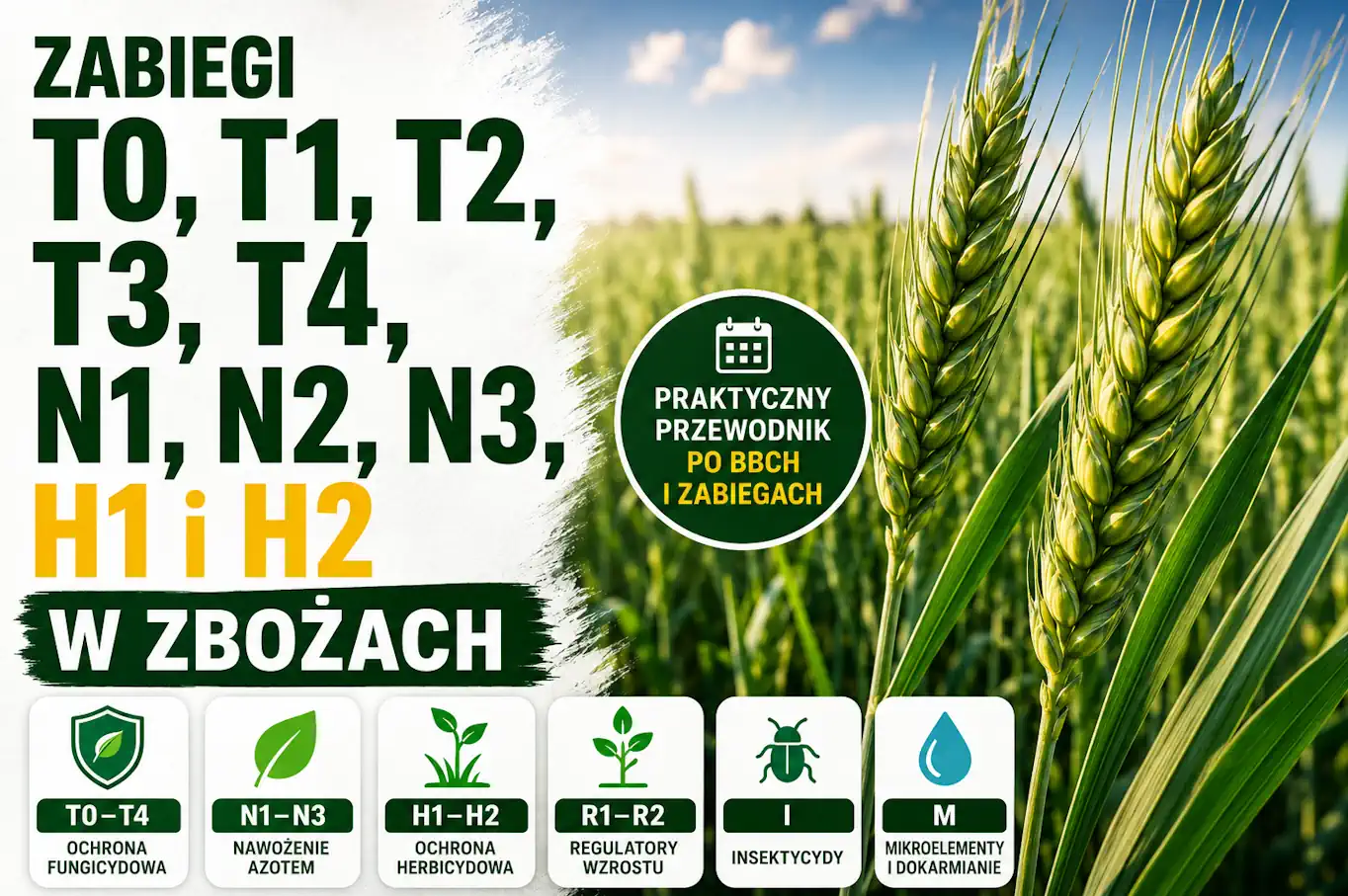
T0, T1, T2, T3, T4, N1, N2, N3, H1 and H2 treatments in cereals are often discussed in advisory recommendations, crop protection product labels and crop management plans, but the abbreviations alone are not enough to make a sound decision. Only when T, N, H, R, I and M are combined with the BBCH stage, weather, crop scouting and field history do they become a practical system for managing the crop.
A cereal agronomic treatment calendar is a structured plan for crop protection, fertilisation and crop regulation, linking crop growth stages with decisions on fungicides, herbicides, nitrogen, growth regulators, insecticides and foliar nutrition. Status: May 2026.
In brief
The abbreviations T0–T4, N1–N3, H1–H2, R1–R2, I and M help plan treatments in cereals, but they do not replace crop scouting or the BBCH scale. The key decisions should be based on crop growth stage, disease pressure, weed pressure, weather, variety, production objective and field history.

- T0–T4 describe the main fungicide timings, from early leaf protection through to ear protection.
- N1–N3 structure nitrogen fertilisation into the starting, production and quality doses.
- H1 and H2 describe a practical split in herbicide strategy into the base treatment and the corrective treatment.
- R1/R2, I and M add growth regulators, insecticides and micronutrients to the treatment calendar.
- FarmPortal helps turn the abbreviation “T2” or “N3” into a complete record: field, crop, BBCH stage, product, dose, operator, machine, cost and documentation.
Why are T, N and H abbreviations more important than the treatment date itself?
T, N and H abbreviations are a practical language for planning cereal treatments, but they only make sense when they are linked to the crop’s growth stage. “I’m doing T1”, “I’m waiting for T2”, “N2 has gone on” or “we need to correct with H2” are useful shorthand, not a complete agronomic decision.
T0–T4, N1–N3 and H1–H2 treatments are not a rigid calendar for spraying and fertilisation. They are a shorthand language for agronomic decisions based on crop growth stage, disease pressure, weed pressure, weather, variety and field history.
The same treatment may fall on different dates depending on the region, soil, variety, winter conditions and spring temperatures. An early spring can bring N1, T1 and N2 forward, while a cold April can delay the flag leaf and the T2 timing. The calendar is useful for organisation. The crop makes the agronomic decision.
That is why a good plan does not begin with the question “when should I spray?”, but with: what is the BBCH stage, what is the disease pressure, what is the crop condition, what weather is coming, and what production outcome are we trying to achieve?
BBCH and Zadoks: why should treatments be planned by growth stage?
Treatments are planned by growth stage because the crop stage describes the real agronomic moment more accurately than a date in the calendar. In cereals, the BBCH scale structures plant development from germination to ripening and senescence, and advisers use it to define timings for crop protection, fertilisation and crop regulation.
AHDB describes the BBCH scale as the main system used in cereals, based on 10 principal growth stages, and used, among other things, on crop protection product labels and in agronomic decision-making. AHDB’s description of cereal growth stages identifies, for example, BBCH 30 as “ear at 1 cm”, BBCH 31 as the first node, BBCH 37 as flag leaf just visible and BBCH 39 as flag leaf fully emerged.
In practice, T1 is most often associated with the start of stem extension, T2 with the flag leaf, and T3 with ear emergence and flowering. This does not mean that every year offers the same treatment window. On lighter soils the crop may enter water stress sooner, while cooler sites may remain at earlier growth stages for longer.
The Zadoks scale serves a similar purpose and is more commonly seen in English-language literature. For this article, the key point is simple: BBCH and Zadoks describe the crop; they do not replace field scouting.
With nitrogen fertilisation, there is also a regulatory layer. Polish government materials on the nitrate programme indicate that, since 2023, fertilisers may be applied earlier, from 1 February to the last day of February, if the average daily air temperature exceeds 3°C for five consecutive days for autumn-sown crops, permanent crops, perennial crops and permanent grassland, and 5°C for other crops. Questions and answers on the nitrate programme on Gov.pl also remind growers that fertilisers must not be applied to frozen, flooded, water-saturated or snow-covered soils.
Abbreviation map: T, N, H, R, I, M and other markings
The abbreviations T, N, H, R, I and M help describe the type and objective of a treatment quickly. Not all of them are equally formal. T1, T2 and T3 are widely used for cereal fungicide programmes, N1–N3 for nitrogen fertilisation, while H1/H2, R1/R2, I1/I2 and M are more of a practical language used by farms, advisers and crop management plans.
| Abbreviation | Meaning | Treatment type | Example objective |
|---|---|---|---|
| T0 | Very early fungicide | Disease protection | Mildew, rusts, early septoria |
| T1 | First main fungicide | Stem-base and leaf protection | Eyespot, septoria tritici blotch, mildew |
| T2 | Flag leaf fungicide | Yield protection | Septoria tritici blotch, rusts, tan spot |
| T3 | Ear fungicide | Quality protection | Fusarium, DON, glume blotch |
| T4 | Late optional fungicide | Post-flowering intervention | Late rusts, seed crops |
| N1/N2/N3 | Successive nitrogen doses | Fertilisation | Recovery, yield, protein |
| H1/H2 | First and corrective herbicide | Weed control | Black-grass, broad-leaved weeds, follow-up corrections |
| R1/R2 | Growth regulators | Lodging risk reduction | CCC, trinexapac, crop structure correction |
| I1/I2 | Insecticides | Pest control | Cereal leaf beetle, aphids, midges |
| M | Micronutrients | Foliar nutrition | Cu, Mn, Mg, S, Zn |
In a digital record, the abbreviation should be just one field in the treatment description. The entry “T2” alone does not say which product was applied, at what dose, on which field, at what BBCH stage or at what cost.
T0–T4 fungicide treatments: what do they mean?
T0–T4 treatments describe the main timings in cereal fungicide programmes. They do not refer to a specific product, but to the moment of protection: from very early disease pressure reduction, through stem-base and flag leaf protection, to ear protection and late interventions.
T0: very early protection before T1
T0 is an optional, very early fungicide treatment, usually applied around BBCH 25–30, at the end of tillering and the transition into stem extension. Its purpose is to reduce disease pressure that appears before the main T1 timing.
A T0 treatment in wheat makes sense on susceptible varieties, in intensive programmes, where there is a large leaf mass after winter, after a mild and wet winter, or when symptoms of mildew, rust or early septoria are already visible. In standard programmes it can often be omitted if the crop is healthy and T1 is applied on time.
The most common mistake is treating T0 as automatic. Not every field needs this early intervention.
T1: the foundation of stem-base and lower-leaf protection
The T1 treatment in cereals is usually applied at BBCH 30–32, meaning the start of stem extension and the first or second node. It protects the stem base and older lower leaves, which can be a source of infections moving upwards through the crop canopy.
T1 is important for eyespot, fusarium stem-base disease, septoria tritici blotch, mildew, yellow rust, brown rust and tan spot. It does not yet protect the flag leaf, but it creates a healthy foundation for effective T2 protection.
If T1 is applied too late or is too weak, T2 has to rescue the situation rather than protect the most important leaves. This increases the risk of costly corrections and weaker disease control.
T1.5: an intermediate treatment between T1 and T2
T1.5 is an additional intermediate treatment between T1 and T2, usually considered between BBCH 32 and BBCH 37. It is not standard practice on every farm, but a corrective tool where the gap between T1 and T2 is long or disease pressure is very high.
T1.5 may be justified in intensive milling wheat, on susceptible varieties, under high septoria tritici blotch pressure and in periods of frequent rainfall. It is not justified in a healthy crop, where the interval between T1 and T2 is short or where there is no economic case for an additional pass.
T2: the flag leaf and protection of yield potential
The T2 flag leaf treatment is one of the most important protection timings in wheat. It is usually applied around BBCH 37–39, when the flag leaf is visible or fully emerged, and its purpose is to protect the flag leaf and the leaf below it.
T2 protects the photosynthetic canopy responsible for grain fill. In practice, it most often targets septoria tritici blotch, brown rust, yellow rust, tan spot and mildew, depending on the season and varietal susceptibility.
This timing should not be delayed. If T2 is too early, it may not fully protect the flag leaf; if it is too late, it often has to act after infection has already developed.
T3: ear treatment, fusarium and grain quality
The T3 ear treatment is usually applied during ear emergence and flowering, roughly BBCH 55–65. Its main purpose is to protect the ear, reduce fusarium ear blight and lower the risk of mycotoxins, including DON.
T3 may be less yield-forming than T2, but it can be critical for grain quality. It is especially important in milling wheat, where maize is present in the rotation, in wet weather during flowering, and where the buyer monitors raw material quality parameters.
T4: late intervention, not standard practice
The T4 treatment in cereals is less common and should be treated as an exception. It refers to a late post-flowering intervention, for example under prolonged disease pressure, in seed crops, with late brown rust infections or in an unusually wet season.
With T4, particular care is needed: check the product label, crop growth stage, pre-harvest interval, residue risk and economic justification. It is not a routine part of cereal protection programmes.
Pathogen resistance and rotation of active substances
A T0–T4 programme should take anti-resistance strategy into account. Repeating the same modes of action increases selection pressure, so the rotation of active substances, appropriate mixtures and the use of multi-site solutions should be based on current recommendations and product labels.
Treatment history is valuable here. If a farm can see which active substances were used on a given field in previous seasons, it is easier to reduce repetition and plan the next protection programme better.
N1–N3 nitrogen fertilisation: three doses, three objectives
N1, N2 and N3 organise nitrogen fertilisation by the function of the dose, not just by the order in which fertiliser is applied. N1 is intended to restart and rebuild the crop after winter, N2 builds yield potential, and N3 supports grain quality, especially protein in milling wheat.
N1: the starting dose after winter
N1 is applied as vegetation resumes, often around BBCH 21–25, depending on crop condition and whether the field is trafficable. Its purpose is to support recovery after winter, stimulate tillering, rebuild weaker plants and secure early growth.
The starting dose may be higher in a weak crop, after delayed drilling, where tillering is poor or where there has been winter damage. In a very dense and strong crop, care is needed to avoid overstimulating plants and increasing the later risk of lodging.
N2: the production dose
N2 is the production dose, usually planned during stem extension, around BBCH 30–32. Its role is to build the number of grains per ear, maintain yield potential and stabilise intensive growth.
The size of N2 should be based primarily on plant population and crop condition, followed by expected yield, fertiliser form, site fertility and the rainfall forecast. In dry years, the wrong timing can be just as costly as the wrong dose.
N3: the quality dose
N3 is the quality dose, most often considered from the flag leaf stage to the start of ear emergence, roughly BBCH 37–49. Its purpose is to support quality parameters, especially protein content in milling wheat.
N3 makes most sense where the farm is targeting milling wheat, the buyer pays a premium for protein, the crop still has yield potential and soil moisture allows nitrogen uptake. In drought or in a weak crop, the quality dose may not deliver the expected effect.
In a digital record, it is worth recording the dose in kg N/ha, fertiliser form, date, field, BBCH stage, rainfall forecast and purpose of the dose. Only then can yield, protein, cost and profitability be compared after harvest.
H1 and H2: how to plan herbicide protection?
H1 and H2 herbicides in cereals describe a practical split of weed control into a base treatment and a corrective treatment. H1 usually means the first herbicide treatment, most often an autumn treatment in winter cereals or a very early spring treatment, while H2 means a follow-up correction for weeds that survived or emerged later.
H1: the first herbicide treatment
H1 aims to reduce weed competition for water, nitrogen, light and space in the crop. In winter cereals, it often targets black-grass, cleavers, field pansy, cornflower, poppy, shepherd’s purse, volunteer oilseed rape and mayweed-type weeds.
H1 efficacy depends on weed growth stage, soil moisture, temperature, active substance and post-treatment conditions. A well-timed H1 often reduces the need for costly spring corrections.
H2: the corrective treatment
H2 is applied in spring after assessing H1 efficacy, where there are later weed flushes or where the autumn treatment could not be carried out. It is a correction, not a reason to postpone the whole herbicide strategy until later.
The most common mistakes include applying H2 too late to overgrown weeds, failing to identify weed species, ignoring the temperature requirements of the product, and combining the treatment with other products without checking compatibility.
Growth regulators, insecticides and micronutrients: what do R, I and M mean?
R, I and M add treatments to the crop protection and fertilisation calendar which may not be used every season, but often determine crop stability, production safety and the use of yield potential. Growth regulators reduce lodging risk, insecticides require pest scouting, and micronutrients support plant physiology.
R1 and R2: growth regulators
R1 is usually applied around BBCH 30–32 and is intended to shorten and strengthen the lower internodes. R2, applied later depending on crop condition and product label, may correct lodging risk before ear emergence.
Growth regulators do not fix a poor nitrogen strategy. R1 and R2 must be aligned with N1, N2, plant population, variety, site fertility, moisture and the weather forecast.
I1 and I2: insecticides based on thresholds
I1 and I2 are not as standardised as T1/T2, but they are sometimes used in crop management plans. Insecticides should be based on scouting and economic thresholds, not added automatically to every pass.
In cereals, decisions may involve cereal leaf beetle, aphids, frit fly, midges, thrips or other regional pests. The product label, temperature, crop stage, pollinator protection and integrated pest management must all be taken into account.
M: micronutrients and foliar nutrition
In practice, M means micronutrients or foliar nutrition. In cereals, copper, manganese, magnesium, sulphur and zinc are often considered, depending on soil, pH, crop condition, field history and analysis results.
Micronutrients do not replace base fertilisation. They work best when they respond to a real crop need, rather than being added to the tank at random.
Tank mix: when should treatments be combined in one pass?
A tank mix, meaning a mixture of several products in one sprayer tank, can reduce the number of passes, fuel cost, soil compaction and time pressure. It should not, however, become an aim in itself.
Sensible combinations, such as T1 + R1 or T2 + micronutrients, first require compatibility and label checks, followed by consideration of temperature, crop condition and mixing order. Some combinations can reduce efficacy, increase the risk of phytotoxicity or compromise crop safety.
The objective is an effective treatment at the right growth stage. Saving a pass only makes sense where it does not reduce efficacy or safety.
The T/N/H/R/I/M calendar in one view
The table below brings the main abbreviations together in one place. The BBCH stages are indicative, because the final decision should be based on scouting, product label, weather, variety, production objective and documentation requirements.
| Code | Indicative BBCH stage | Treatment type | Objective | Priority |
|---|---|---|---|---|
| H1 | Autumn / early spring | Herbicide | Control of early weeds | High in winter cereals |
| N1 | 21–25 | Nitrogen | Recovery and tillering | Critical after crop assessment |
| T0 | 25–30 | Fungicide | Early disease pressure | Optional after scouting |
| T1 | 30–32 | Fungicide | Stem base and lower leaves | Critical in the protection programme |
| R1 | 30–32 | Growth regulator | Lodging risk reduction | Depends on plant population and variety |
| N2 | 30–32 | Nitrogen | Yield building | Critical for yield potential |
| H2 | 25–32 or later according to the label | Herbicide | Weed correction | Depends on weed pressure |
| T1.5 | 32–37 | Fungicide | Maintaining protection before T2 | Optional under high pressure |
| T2 | 37–39 | Fungicide | Flag leaf and leaf below flag | Critical for yield protection |
| N3 | 37–49 | Nitrogen | Protein and quality | Depends on quality objective |
| I1/I2 | According to thresholds | Insecticide | Pests | Depends on scouting and threshold |
| T3 | 55–65 | Fungicide | Ear, fusarium, DON | Important where quality risk is present |
| T4 | 69–75+ | Fungicide | Late intervention | Exceptional, after risk analysis |
Who benefits most from this planning system?
The T/N/H/R/I/M system makes most sense where a farm manages many fields, varieties and timings, and decisions need to be repeatable, documented and comparable after the season. With a few fields, notes may be enough. With several dozen fields, notes quickly stop being sufficient.
- Farmers growing winter and spring cereals gain a clear language for planning treatments by BBCH stage rather than by a random date.
- Agricultural advisers and agronomic sales specialists can use shared T/N/H/R/I/M terminology in recommendations, reports and discussions with clients.
- Intensive farms of 100+ ha can organise treatments by field, operator, machine, cost and production outcome.
- Producer groups and processors can analyse raw material history, mycotoxin risk, grain quality and documentation completeness more easily.
- FarmPortal users can turn T0–T4, N1–N3 and H1–H2 abbreviations into a complete digital field history.
Case study: a T/N/H calendar on a 180 ha farm
A 180 ha winter wheat farm in the Wielkopolskie Voivodeship used to carry out treatments based on habit, operator availability and recommendations recorded in several separate places. The main issues were delayed T2, underestimated N3 and the lack of a consistent BBCH record for treatments.
After the treatment calendar was organised, each field received a T/N/H/R plan with an assigned BBCH stage, treatment objective, product, dose, operator, machine and cost. T2 was planned at BBCH 39, N3 was linked to the milling wheat production objective, and H2 was applied only on fields where scouting confirmed the need for correction.
The figures represent a comparative scenario for treatment organisation and should not be treated as a guaranteed result on every farm. The outcome depends on variety, site, season, rainfall, disease pressure, base fertilisation and the quality of scouting.
| KPI | Before | After | Meaning |
|---|---|---|---|
| T2 timeliness | 6–8 day delay | Treatment at BBCH 39 | Better flag leaf protection |
| Fields with BBCH recorded | 20% | 95% | Easier post-season analysis |
| Milling wheat protein | 11.8% | 12.7% | Better alignment of N3 with the production objective |
| H2 corrections | 6 fields | 2 fields | Fewer unjustified passes |
The key change was not the use of abbreviations itself, but the fact that each abbreviation was linked to a complete technology and field-cost record. This makes it possible to compare decisions after harvest rather than reconstructing them from memory.
How does FarmPortal support digital treatment records?
FarmPortal supports digital treatment records by connecting fields, crops, treatments, costs, employees, machinery, inventory and reports in one environment. As a result, an abbreviation such as T2, N3 or H2 does not remain a loose note, but becomes part of the field history.
On the FarmPortal farm management features page, the system describes, among other things, a detailed field and crop register, work and harvest records, treatment and cost records, employee, machine and building management, inventory management, as well as reports and analytics.
In the treatment and production cost records module in FarmPortal users can record crop-related activities, costs, inputs and documentation. In practice, this is where the T/N/H calendar becomes data that the farmer, adviser, accountant and auditor can use.
In daily work, the most important functions are practical: assigning a treatment to a field and crop, recording the BBCH stage, keeping the history of products used, doses, cost per hectare, operator, machine, documents and scouting photos. This kind of record makes it easier to filter history by field, compare technologies between plots and prepare a treatment report.
FarmPortal also helps reduce a common problem on intensive farms: the separation of agronomist notes, invoices, inventory, operator work and treatment documentation. If T2, N3 or H2 are entered into one record, it is later possible to check not only the date and product, but also the cost, operator, machine and result on a specific field.
ARiMR publishes materials on the register of agri-environmental, organic or agronomic activities for the CAP Strategic Plan 2023–2027. For a farm, this means that the technology plan should be consistent with the documentation, and the documentation should be kept up to date.
Data worth recording for each treatment include: farm, field, parcel, crop, variety, BBCH stage, treatment code, objective, product, active substance, dose, water volume, operator, machine, weather, cost per hectare, documents, scouting photos and post-treatment result.
The most common mistakes in T/N/H treatment planning
The most common mistakes come from treating abbreviations as a ready-made recipe. T1, T2, N2 or H2 do not, on their own, say what should be done on a specific field.
- Planning by date instead of BBCH stage.
- Delaying T2 until visible disease symptoms appear.
- Applying T0 automatically without disease pressure.
- Treating T3 as unnecessary in milling wheat.
- Failing to distinguish between the production N2 dose and the quality N3 dose.
- Applying H2 too late to overgrown weeds.
- Combining many products without checking labels and compatibility.
- Lack of active substance rotation.
- No record of the reason for applying a product.
- No link between the treatment, cost and field result.
How to prepare your own treatment calendar step by step
A treatment calendar should start with fields, varieties and problem history, not with a list of products. The technology should respond to real risk and the production objective.
- Group fields by crops, varieties, sites and disease history.
- Assign indicative BBCH stages to the main T/N/H timings.
- Plan N1, N2 and N3 according to the production objective and nitrate programme rules.
- Check whether H1 was applied in autumn and whether H2 is needed.
- Plan T1 and T2 as critical treatments.
- Decide whether T0, T1.5, T3 or T4 are justified.
- Add R1/R2 growth regulators only where lodging risk is present.
- Plan scouting for insecticide decisions instead of entering them automatically.
- Record every treatment in a digital register.
- After harvest, compare the plan with yield, protein, cost and quality.
FAQ
What is the difference between T1 and T2?
T1 mainly protects the stem base and lower leaves, while T2 protects the flag leaf and the leaf below it. T1 creates a healthy foundation for the crop, while T2 protects the key part of the photosynthetic canopy responsible for grain fill.
Is T0 necessary in every wheat crop?
No. T0 is an optional treatment, justified under high disease pressure, on susceptible varieties, in intensive programmes or after a mild winter. In standard programmes it can often be omitted if the crop is healthy and T1 is applied on time.
Is T2 the most important fungicide treatment?
In wheat, T2 is usually one of the most important treatments because it protects the flag leaf and the leaf below it. This does not mean that T1 or T3 should be treated as unnecessary. Their importance depends on disease pressure, variety, weather and production objective.
When should T3 be applied?
T3 is usually applied during ear emergence and flowering, most often to protect the ear against fusarium and reduce mycotoxin risk. It is most important in milling wheat, in wet weather and where infection risk is high.
Does T4 exist?
Yes, but T4 is not standard practice on every farm. It is a late optional treatment used exceptionally under prolonged disease pressure, in seed crops or in specific seasons. Product label and pre-harvest interval must be checked carefully.
What do N1, N2 and N3 mean?
N1 is the first nitrogen dose after winter, N2 is the production dose during stem extension, and N3 is the quality dose, mainly used in milling wheat to support protein and commercial quality parameters.
Are H1 and H2 official names for herbicide treatments?
They are not as standardised as T1, T2 and T3, but they are practical abbreviations used on farms and in recommendations. H1 usually means the first herbicide treatment, while H2 means a corrective treatment.
Can T1 be combined with the R1 growth regulator?
This is often done, but only where product labels, weather conditions, crop condition and compatibility allow. Treatments should not be combined automatically, because saving a pass must not reduce efficacy or safety.
How does FarmPortal help with T/N/H planning?
FarmPortal can organise treatments by fields, crops, BBCH stages, objectives, products, fertilisers, doses, operators, machines and costs. As a result, “T2” or “N3” becomes a complete entry in the field history and farm documentation.
Glossary
BBCH
A scale describing plant growth stages. In cereals, it helps identify whether the crop is at tillering, stem extension, flag leaf, ear emergence, flowering or ripening.
Zadoks
A cereal growth stage scale used mainly in English-language literature and advisory work. Like BBCH, it helps describe the crop stage precisely.
Flag leaf
The final leaf of wheat before the ear. It is very important for grain fill, which is why protecting it at T2 has significant yield importance.
Fusarium ear blight
A fungal disease of the ear, particularly serious in wet weather during flowering. It can affect yield, quality and mycotoxin levels.
DON
Deoxynivalenol, one of the mycotoxins associated with fusarium infection in cereals. It is an important food and feed safety parameter.
Quality dose
A late nitrogen dose, usually N3, intended to improve grain quality parameters, especially protein in milling wheat.
Retardant
A growth regulator that limits stem elongation and lodging risk. In a crop management plan, it may appear as R1 or R2.
Tank mix
A mixture of several products in one sprayer tank. It can reduce the number of passes, but requires checks on labels, compatibility and application conditions.
Economic threshold
The level of pest or disease occurrence at which a treatment becomes economically justified.
Multi-site
A substance or mode of action acting at multiple sites, used in strategies to reduce pathogen resistance.
Summary
T0, T1, T2, T3, T4, N1, N2, N3, H1 and H2 treatments form a language for crop management. A farmer who understands this language does not apply treatments “because that is what the calendar says”, but plans the technology according to BBCH stages, risk, raw material quality, cost and documentation.
The key is to connect agronomy with records. T2 without BBCH stage, product, dose, field, operator and cost is only a label. T2 recorded in the digital field history becomes data that can be analysed after the season.
In practice, this is the difference between reacting after the event and managing the crop proactively. FarmPortal structures this process by linking the treatment calendar with fields, crops, costs, machines, employees and documents.
Next step
Explore FarmPortal features for treatment records, cost tracking and field history if you want to manage your T/N/H calendar in one system and compare decisions after the season.
Follow us!
See what we're doing and be inspired by positive changes.