Short summary
Choosing an agricultural guidance system should not start with the question of the lowest price for a screen or antenna. In practice, what matters more is installation quality, reliable performance during the season, technical support in Polish, the way data is processed, and whether the system can truly be connected with day-to-day farm management.
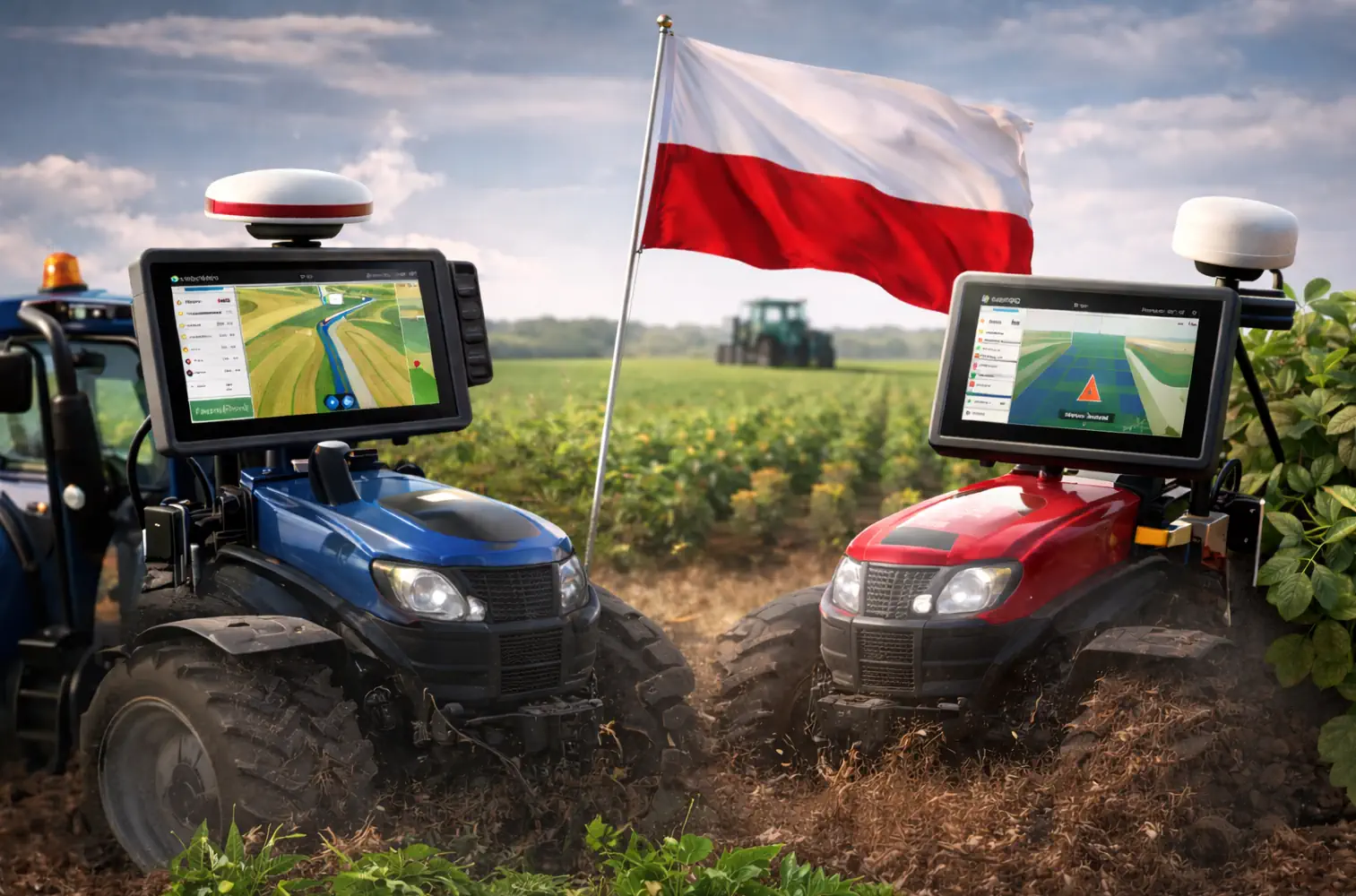
Polish guidance systems have an advantage where local support, faster service, a better understanding of farming realities in Poland, data security, and integration with FarmPortal matter. This is particularly important for farmers, advisors, processors, and distributors who expect not only accurate guidance, but also organised, useful, and secure production data.
Why this topic matters
Agricultural digitalisation is accelerating, but not every technology delivers the same operational value. European data shows that basic IT tools are widely present on farms, while the implementation of more advanced production technologies remains uneven and depends, among other things, on cost, skills, and trust in data. That is exactly why choosing an agricultural guidance system is increasingly becoming not only a hardware decision, but also an organisational one.
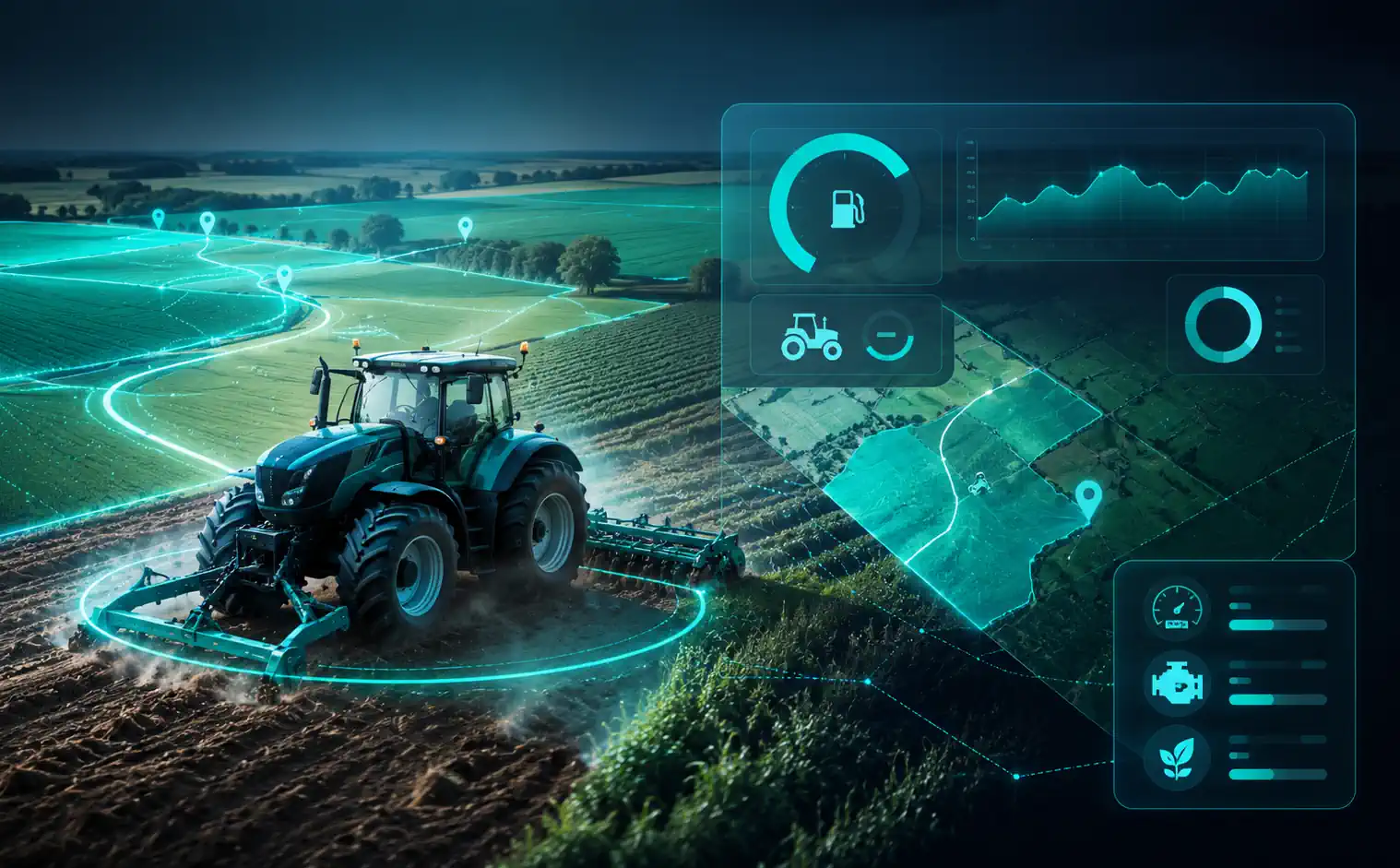
An agricultural guidance system today is no longer just a device for following a path. It is part of a farm’s data infrastructure, collecting information about routes, fields, working widths, completed operations, and performance parameters. From the perspective of Agriculture 4.0, the greatest advantage goes to those who not only steer machinery accurately, but can also turn route data into real operational and business benefits.

7 reasons why Polish guidance systems win in practice
Farmers most often compare RTK accuracy, terminal price, and ease of use. These factors matter, but profitability is determined by the total cost of running the system over several seasons, not just the initial purchase. In practice, the advantage comes from solutions that are quicker to launch in the field, easier to connect with local software, and less likely to create data chaos.
-
Better installation and commissioning quality.
Under Polish conditions, it matters greatly who installs the system, calibrates the valve, sets up the antenna, and takes responsibility for the first launch. Local installers usually know the typical configurations of tractors, sprayers, spreaders, and operate in real farm conditions rather than relying solely on manufacturer documentation.
-
Faster in-season service support.
A breakdown during a weather window costs more than the replacement part itself. A Polish supplier usually has a shorter response path, easier contact, and fewer issues with on-site support and technical help in Polish.
-
Better fit for Polish farming practices.
This is not only about the language of the interface. It is about understanding how a farmer keeps records, imports fields, works with ARiMR, reports operations, and expects data exchange with an advisor, processor, or buyer.
-
Greater control over production data.
Along with a guidance system, the farmer shares information about crop structure, operation dates, route efficiency, and often the entire workflow logic of the farm. For many users, it is crucial that the data can remain in Poland, within the enterprise, or on servers controlled by the customer, rather than flowing into opaque external ecosystems.
-
Integration with FarmPortal and data automation.
This is an operational advantage, not a marketing one. If the guidance system is part of a broader process, field data does not stop at the driver’s screen, but flows into treatment documentation, cost analyses, fertilisation maps, the plant protection product database, and further reporting. A good example of this approach is automatic guidance and a farm management system, where the guidance system and FMS operate as one data workflow.
An additional advantage is the ability to prepare variable-rate fertilisation maps in FarmPortal and export them to ISO-XML, allowing users to move faster from data analysis to the actual field operation.
-
Support for the local market and technology development in Poland.
Choosing a Polish manufacturer or integrator strengthens the domestic ecosystem of implementation, service, and feature development. This means faster fixes, greater flexibility, and a real influence of users on the product roadmap.
-
Lower risk of being locked into a foreign ecosystem.
Cheaper imported solutions can look attractive at the purchasing stage, but later they often tie the user to a single application, a single data format, or a single cloud. On a farm, this means more difficult migrations, weaker integration, and higher switching costs in the future.
Comparison: Polish guidance systems vs foreign solutions
Not every foreign guidance system is bad, and not every Polish one will automatically be the best. The difference lies in whether the system is evaluated from the perspective of long-term work with data, support, and integration. The table below shows where local solutions most often gain an advantage in everyday use.
| Parameter | Polish guidance system with local implementation | Foreign solution, especially mass-market and imported |
|---|---|---|
| Technical support | Fast contact, Polish language, easier access to service teams | Often indirect support, dependent on distributor or importer |
| Installation and calibration | Better fit for local machine configurations | Can be correct, but more often based on a standard template |
| Integration with Polish processes | Easier integration with eWniosek ARiMR, geoportal, and FMS | Usually limited or requires additional workarounds |
| Data security and storage location | Greater chance of clear rules for data storage and control | More often data is sent to external clouds outside local oversight |
| Feature development | Users can influence product development more easily | End users have little influence over the manufacturer’s roadmap |
| Total downtime cost | Usually lower thanks to faster support | May increase during in-season issues |
| Consistency with FarmPortal | High when implemented within one ecosystem | Often requires manual exports and extra work |
Practical conclusion: the cheapest purchase does not necessarily mean the lowest cost of use. In precision agriculture, the advantage comes from a system that reduces overlaps, skips, service downtime, and manual data re-entry.
What farmers, advisors, processors, distributors, and equipment manufacturers gain
The value of a guidance system does not end with the tractor operator. Route and operation data affect advisory quality, production traceability, delivery planning, and compliance with buyer requirements. That is why each stakeholder group looks at the system from a different angle.
Farmers
Farmers gain above all greater repeatability of work, fewer overlaps, lower fuel consumption, and easier operation documentation. The problem local systems solve is not only machine steering itself, but also data chaos and the lack of time to manually complete records after work.
Agronomic advisors
Advisors gain better-quality input data for fertilisation recommendations, crop protection, and operation assessment. In many farms, the problem is inconsistent data and the lack of a shared information format. Integration with FMS reduces that barrier and shortens the path from observation to recommendation.
Fruit and vegetable distributors
Distributors gain greater production predictability and more structured supplier data. The usual problem is fragmented information spread across notebooks, messengers, photos, and files from different devices. A consistent ecosystem reduces that fragmentation.
Equipment manufacturers and integrators
For equipment manufacturers, a local ecosystem means easier testing, faster feedback loops, and a greater chance to develop features tailored to specific market needs. This matters especially where compatibility with ISOBUS, telemetry, operation documentation, and data exchange with farm software is essential.
For agricultural equipment manufacturers and onboard electronics suppliers, it is also important that FarmPortal can act as a mature integration layer, not just an end-user application for farmers. This means a manufacturer can connect its device, telemetry, controller, sensor, or guidance system quickly and easily to the most advanced farm management software, instead of building its own FMS backend, operation documentation, application maps, geoportal integrations, or farm data services from scratch. This model shortens time to market and increases the value of the equipment for the end customer.
How FarmPortal strengthens the value of guidance systems
A guidance system alone solves the routing problem. FarmPortal solves the problem of working with data after the route is completed. The greatest advantage appears when the guidance system and the farm management system operate within one consistent information workflow, rather than as two separate tools.
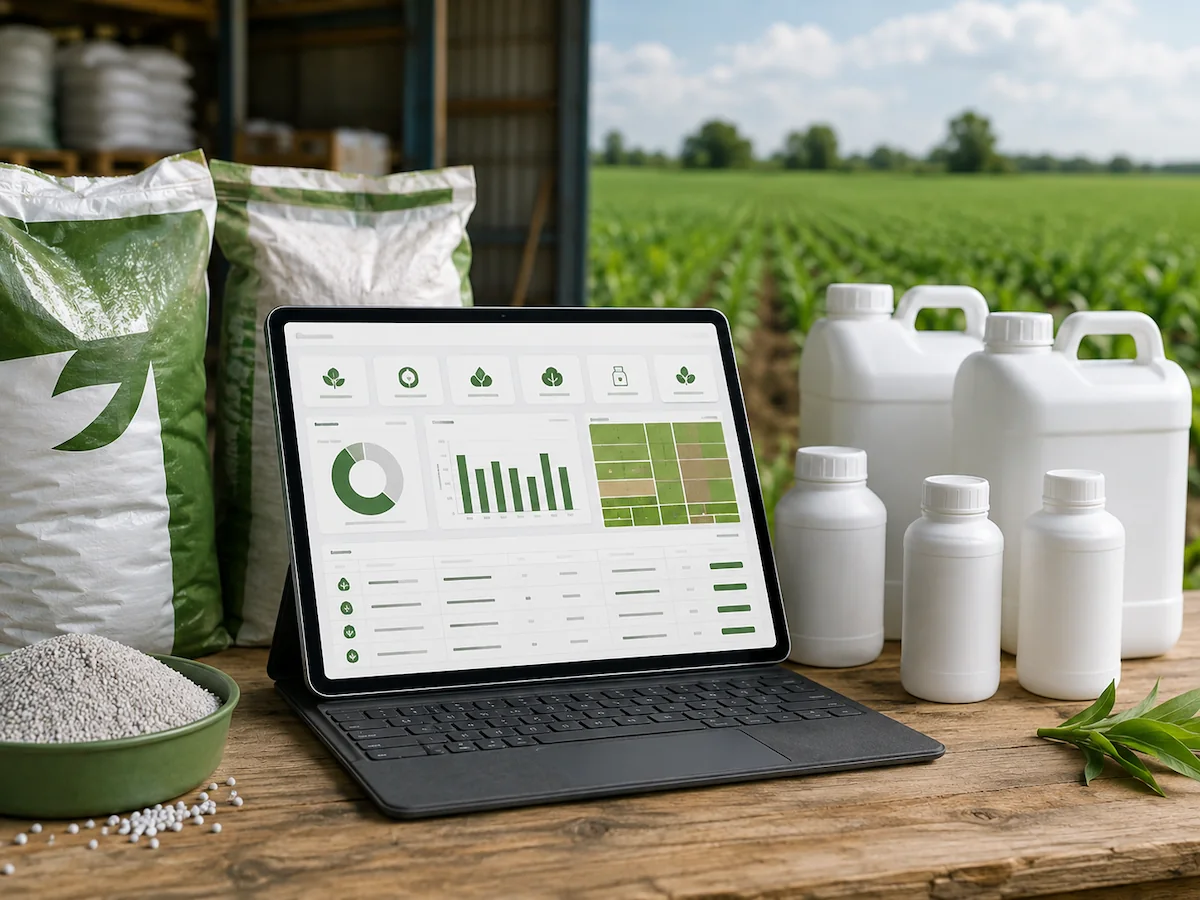
In practice, this means that field data does not stop at the in-cab terminal. It flows into the farm system, where it can be used for operation documentation, cost control, planning of future work, year-to-year analyses, settlements, and the preparation of application maps and recommendations for future operations. FarmPortal also supports the creation of variable-rate fertilisation maps and their export to ISO-XML, so a plan prepared in the office can be sent directly to the guidance system and executed in the field without manually re-entering parameters.
-
Field import from eWniosek ARiMR and geoportal integration.
This means the farm does not have to build its field structure manually from scratch. It saves time and reduces implementation errors.
-
Fertiliser database, fertilisation calculator, and VRA maps.
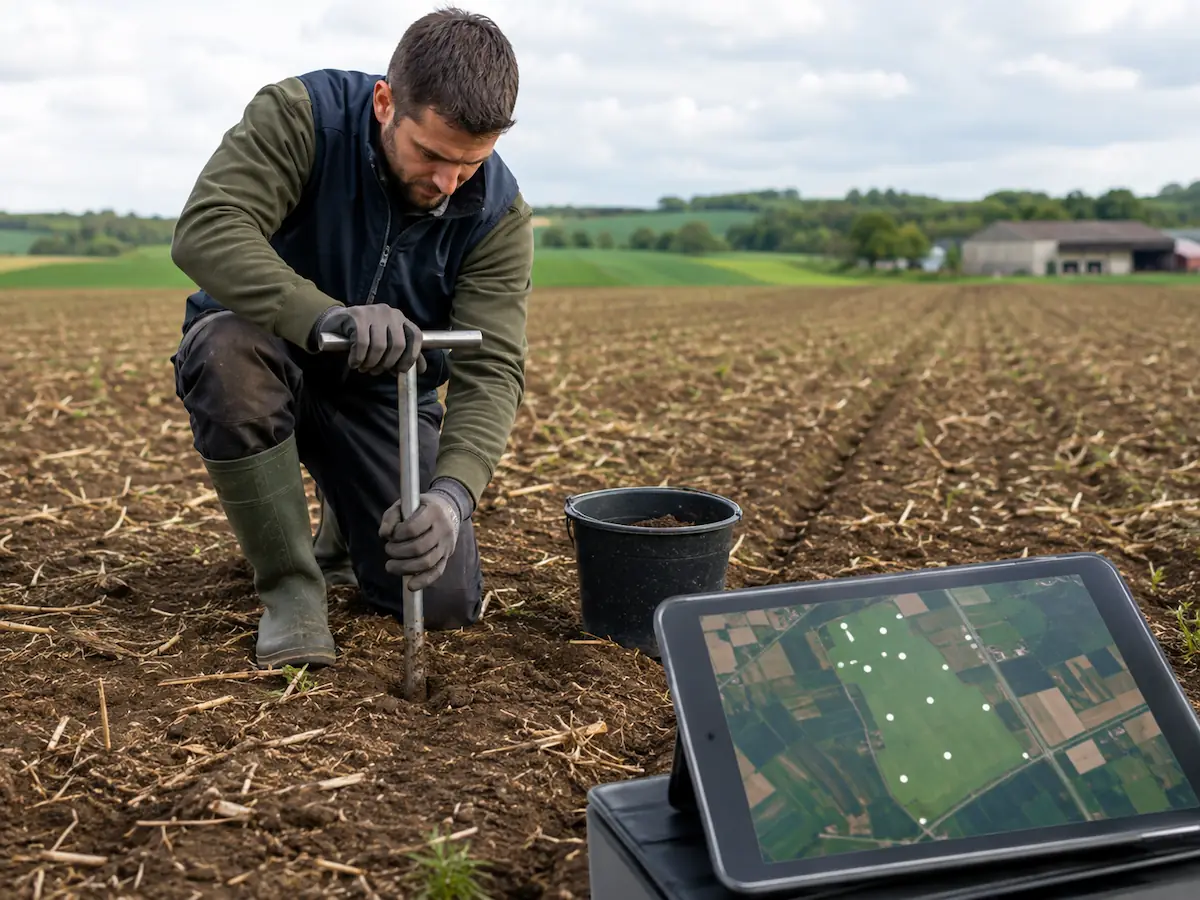
Combining field data, soil tests, satellite analyses, and production history makes it possible to prepare precise recommendations and variable-rate fertilisation maps. FarmPortal also enables the export of such maps to ISO-XML, which shortens the path from analysis to field execution on the machine.
-
Plant protection product database and operation documentation.
This reduces administrative work and lowers the risk of recordkeeping errors. For farms working with buyers, it also has quality and commercial value.
-
Field, crop, and work history management.
A structured farm setup makes it easier to compare results across fields, seasons, and crop management technologies.
-
Machinery fleet management.
FarmPortal supports machinery records, equipment usage, service history, operating costs, and the organisation of work across multiple machinery sets.
-
Data standards and integration support.
In precision agriculture, what matters is whether the data can be exported and used further, not just displayed on the screen of a single device.
You can find more about the system’s capabilities on the FarmPortal functions – farm management software page. In the context of this article, it is also worth seeing the post automatic guidance and a farm management system, the article precision agriculture in FarmPortal – maps, data, and automation, the material vegetation indices and variable fertilisation in FarmPortal, and the post why a smartphone is not enough and how to move towards Agriculture 4.0.
AgroOsa, bidirectional integration with FarmPortal, and Agriculture 4.0
The best example of how a modern guidance system should work is the integration of AgroOsa with FarmPortal. This is not a simple connection where the device only records a route trace. It is a model of bidirectional integration in which the machine and the farm system exchange data both ways.
On the one hand, route paths, work reports, and the machine’s current position are sent to FarmPortal. On the other hand, FarmPortal can send variable-rate fertilisation maps, tasks, and the data needed to perform an operation to the guidance system without manual rewriting. This model shortens work preparation time, reduces the number of errors, and organises the flow of information between the office and the field.
In practice, bidirectional integration is especially valuable when a farm wants to move from basic path guidance to full precision agriculture. FarmPortal makes it possible to prepare variable-rate fertilisation maps based on field data and export them to ISO-XML, then send them to the guidance system or machine. This means that the agronomic decision, the operation plan, and field execution are connected within one digital process.
This is the practical dimension of Agriculture 4.0. The guidance system stops being a standalone device and becomes part of the farm’s wider operating system. Field data is immediately ready for further analysis, planning, settlement, reporting, and collaboration with an advisor, producer group, or processor.
What this kind of integration delivers in practice
-
Bidirectional data flow.
Machine data returns to FarmPortal, while the plan prepared in FarmPortal is sent to the terminal and guidance system. This reduces manual file copying and the risk of mistakes.
-
Variable-rate fertilisation maps and precise execution of operations.
FarmPortal can prepare zones and application maps, while AgroOsa helps execute the operation accurately in the field. Thanks to ISO-XML export, the process is faster and more structured.
-
Route and work history in one place.
Routes are not separated from the rest of the documentation. They create one consistent history of the field, operations, and equipment use.
-
Better organisation of work across multiple machines.
In farms with several machines, the manager sees more than the operator alone. They have access to information on completed work, routes, equipment use, and work progress.
-
Advantage in orchards and vegetable production.
In specialty crops, repeatability, precise turns, and stable row guidance matter. Here, the benefits of integration are often even more visible than in conventional field crops.
If you want to highlight this aspect more strongly through internal linking, a good reference is the post automatic guidance and a farm management system – AgroOsa and FarmPortal integration.
Case study
The example below shows how a guidance system implementation should be evaluated: not as a one-time device purchase, but as part of a wider process of organising data and field work. It is a model scenario based on typical parameters of orchard and vegetable farms and on real precision agriculture implementation practice.
67 ha orchard and vegetable farm, Lower Silesia
The farm produces apples, pears, and field vegetables. Before implementation, it used an imported guidance system without deep integration with the farm management system. Data on fields, operations, and routes was fragmented between the terminal, spreadsheets, and operator notes.
| Indicator | Before implementation | After 1 season | Change |
|---|---|---|---|
| Average time to prepare fields and seasonal data | 18–22 hours | 6–8 hours | -64% |
| Manual rewriting of data after operations | approx. 9 hours per week at peak season | approx. 3.5 hours per week | -61% |
| Estimated overlaps in fertilisation and spraying | 4.5–6.0% | 1.5–2.5% | improvement of 2–3.5 p.p. |
| Accuracy and completeness of operation documentation | incomplete, fragmented | consistent documentation in one system | clear organisational improvement |
| Number of service incidents blocking work > 24 h | 3 per season | 1 per season | -67% |
Business context: the greatest benefit did not come solely from route savings, but from connecting the guidance system with field import, operation documentation, the plant protection product database, fertilisation calculations, and remote task transfer between the office and the machine.
User opinions
“We farm 132 hectares of vegetables and cereals and operate several tractors in parallel. Previously, the biggest problem was not the driving itself, but organising the data afterwards and transferring variable-rate fertilisation maps to the terminals. After switching to AgroOsa — a guidance system integrated with FarmPortal — we reduced post-operation administration time by more than half, and operators adapted to the workflow faster. The greatest benefit is not only path guidance itself, but the fact that the data stays with us and immediately continues to work inside the system.”
“In a 78-hectare orchard, every route and every weather window matters. We previously had a system where service support during the season was too slow, and data export ended with manual file corrections. After switching to a local solution and integrating it with FarmPortal, we reduced overlaps in spraying and prepare documentation for buyers faster. For me, the key factor was that the supplier understands the realities of orchard farming in Poland. In addition, it matters to us that we can support Polish companies in building an innovative economy.”
How to choose a system step by step
Buying a guidance system is worth treating as a decision about the architecture of working with data, not only as a hardware purchase. This way of thinking helps avoid situations in which the device works, but delivers no organisational or economic advantage.
- Define the main implementation goal. Is the objective to reduce overlaps, reduce operator workload, document operations, integrate with FMS, or prepare for variable-rate application?
- Check the installation and service model. Ask who is responsible for commissioning, calibration, and in-season response.
- Ask about the data. Where is it stored, who has access to it, can it be exported, and does the customer retain control over work history?
- Verify integration. Does the system connect with FarmPortal, operation documentation, ARiMR fields, the geoportal, the fertiliser database, VRA maps, and the plant protection product database?
- Compare total cost. Consider not only the purchase price, but also downtime, service, administrative work, and operator time.
- Test the implementation in a real scenario. Ideally on a specific farm, with a specific machine, and a typical seasonal task.
Checklist before purchase
This short checklist helps quickly eliminate solutions that look good in an offer, but perform poorly after implementation.
- Does the supplier provide installation and calibration on the farm?
- Is technical support available in Polish and during the season?
- Can the data remain under the control of the farm or company?
- Does the system integrate with FarmPortal or another FMS without manual data re-entry?
- Is it possible to import fields from eWniosek ARiMR?
- Does the solution support variable-rate fertilisation maps and ISO-XML export?
- Does the system support further work with fertilisation calculations and operation documentation?
- Are the data export formats practical and useful?
- Can the user influence product development and submit improvement requests?
- Besides guidance, does the system support agricultural weather stations and weather forecasts?
Summary
A Polish agricultural guidance system wins when it is part of a well-designed local ecosystem of hardware, implementation, service, and data workflows. The advantage is not only about buying local, but about shorter response times, better installation, greater control over production information, and better alignment with the realities of work in Poland.
For many farms, the best choice will not be the cheapest system, but the one that combines vehicle guidance with real data automation. This is exactly where the connection between a Polish guidance system and FarmPortal creates an advantage — a farm management platform that supports field import, operation documentation, fertilisation calculations, variable-rate fertilisation maps in ISO-XML, a plant protection product database, and further data analysis without unnecessary manual work.
If the goal is not only to drive straight, but also to manage the farm, data, and supply chain collaboration more effectively, a local hardware and software ecosystem is simply the more rational choice today.
FAQ
Can a Polish agricultural guidance system really be better than a cheaper foreign one?
Yes, because the value of the system is determined not only by the hardware, but also by installation, service, integration, and data security. During the season, faster support and better data organisation often have greater value than a lower purchase price.
Why does data security matter when choosing a guidance system?
The guidance system collects data about field structure, operations, and work performance. This is business-sensitive information. If the user does not know the rules of data processing, they surrender part of their control over production knowledge.
What does AgroOsa’s bidirectional integration with FarmPortal provide?
It allows data to be sent from the machine to FarmPortal and from FarmPortal to the machine. As a result, a plan prepared in the office can be carried out in the field without manually re-entering settings and files.
Can FarmPortal generate variable-rate fertilisation maps in ISO-XML?
Yes. This is one of the practical benefits of integrating precision agriculture with FMS. It allows a plan developed in the system to be transferred more quickly for execution on the machine.
Does integration with FarmPortal make sense for smaller farms?
Yes. On smaller farms, saving time and reducing manual data entry are especially important. The organisational benefit can be just as valuable as the savings from reducing overlaps.
Can equipment manufacturers easily integrate with FarmPortal?
Yes. It is a beneficial solution for manufacturers who want to enter the market faster with a ready-made FMS, documentation, and data workflow layer, instead of building everything from scratch.
Glossary
- FMS
- Farm Management System. It combines data about fields, operations, machinery, costs, and production in one place.
- RTK
- A satellite signal correction method that enables very high guidance accuracy, usually at centimetre level.
- ISOBUS
- A communication standard between the tractor, terminal, and machine. It facilitates data exchange and interoperability between devices from different manufacturers.
- ISO-XML
- A data exchange format used in precision agriculture, including for task files, application maps, and machine work documentation.
- Agriculture 4.0
- A model of agriculture based on connecting machinery, data, automation, analytics, and digital systems that support operational decisions.
- Bidirectional integration
- Two-way data exchange between systems, for example between a guidance system and an FMS. Machine data returns to the system, while tasks and maps from the system are sent to the machine.
- VRA
- Variable Rate Application. This means applying fertiliser or another treatment at different rates in different field zones.
- Fertilisation calculator
- A tool that helps determine fertiliser rates based on soil data, crop type, and nutrient requirements.
- Plant protection product database
- A structured set of information about approved products, their uses, and the parameters needed to plan crop protection operations.
Sources
- European Commission, Joint Research Centre, The state of digitalisation in EU agriculture, 2025. Source
- FarmPortal, Automatic guidance and a farm management system, 2026.
Follow us!
See what we're doing and be inspired by positive changes.