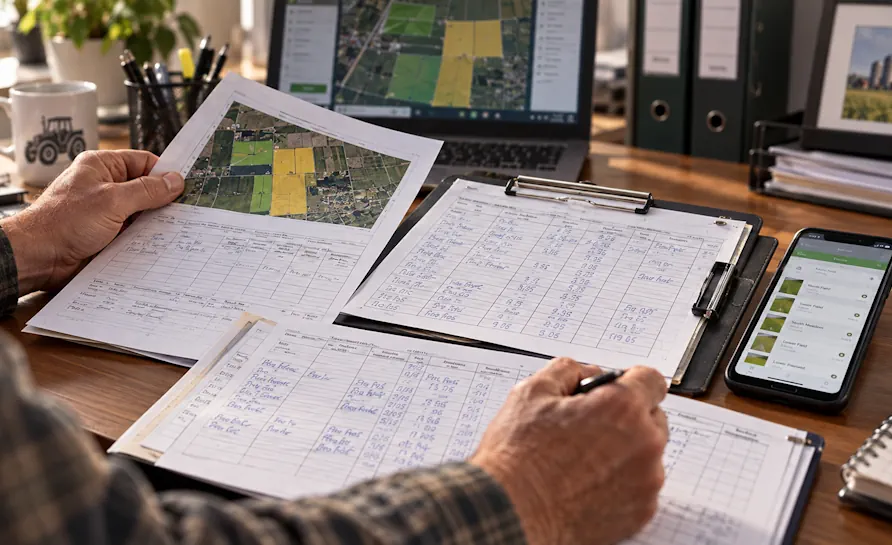
After a spring frost, the most expensive issue is not only the yield loss itself, but also delayed decision-making. In practice, you need to assess the damage, revise the marketable yield forecast, recalculate cost per tonne, and decide which expenses still build value and which only deepen the loss.
Who this article is for and which problem it solves
A spring frost does not end with the loss of some flowers or fruitlets. It also hits unit cost, work scheduling, contracting plans, and supply predictability. That is why a cultivation cost report after frost is needed not only by the farmer, but by the entire value chain.
Farmers and orchard growers
The most common mistake is running the farm as if nothing had happened. In that scenario, cost per tonne rises faster than the yield loss, because some expenses remain unchanged and some treatments are still performed out of habit.
- benefit: faster decisions on whether to maintain the full crop management program,
- benefit: a realistic forecast of marketable yield and quality,
- benefit: better control of margin, cash flow, cost per hectare, and cost per tonne.
Agronomic advisors
After frost, an advisor must combine agronomy with economics. It is not enough to know that flowers were damaged. What matters is the scale of the damage, how it is distributed across varieties, and how it affects fertilization, crop protection, and the rest of the crop management program.
- benefit: a consistent standard for field inspection and documentation,
- benefit: better justification for recommendations given to clients,
- benefit: the ability to work with data from multiple farms at the same time.
Fruit and vegetable processors
For a processor, frost means the risk of a raw material gap, greater quality volatility, and pricing pressure on procurement. The sooner a reliable report arrives from farms, the sooner procurement plans and production balancing can be corrected.
- benefit: earlier forecasts of supply and delivery windows,
- benefit: better planning of procurement and processing capacity,
- benefit: lower risk of emergency purchases at higher prices.
Fruit and vegetable distributors
A distributor needs to know quickly whether volume, size, commercial quality, and delivery timing will change. A cultivation cost report after frost helps assess whether the supplier will maintain the contract and how early a backup plan needs to be activated.

- benefit: earlier delivery forecasts,
- benefit: better logistics and planning of alternative sources,
- benefit: fewer unexpected shortages during the season.
7 most important decisions after a spring frost
After frosty nights, what matters is not only rescue treatments, but the sequence of decisions. First, you need to determine what has actually been lost. Only then should you make decisions about cost and sales.
- Do not assess losses on the same night. In many crops, the real picture of the damage becomes clearer only after 24-48 hours.
- Assess damage by block. Do not average the whole farm. Lower-lying blocks, earlier varieties, and areas with cold air accumulation behave differently.
- Separate biological yield from marketable yield. The fact that some fruit may still set does not mean it will have full market value.
- Recalculate cost per tonne under the new scenario. After frost, this indicator changes faster than cost per hectare.
- Adjust fertilization and manual work in proportion to the new production potential. Less is not always better, but failing to adjust often increases the loss.
- Update contracts and supply forecasts. Processors and distributors must receive the updated seasonal outlook earlier than the competition.
- Document everything. Photos, samples, minimum temperatures, the operating time of protection systems, and block descriptions matter operationally, for insurance, and for management.
The most common mistake after frost is not the incorrect assessment of damage itself, but keeping the full cost program in place despite a clearly lower marketable yield.
What the data say about spring frosts and losses
In mid-April 2026, IMGW-PIB reported ground frosts and warnings for parts of Poland. This is important background for operational decisions, but even more important is the fact that the risk of damage depends on local microclimate, phenological stage, and exposure time, not only on the general regional forecast.
The scientific literature emphasizes that once early spring warming occurs, plants lose cold hardiness more quickly. An analysis of the April 2021 event in France showed very severe losses in orchards and vineyards. The authors pointed to estimated production declines of around 50% for pears and cherries, around 25% for peaches, and around 20% for apples at national level, with major regional variation.
From an economic point of view, this is not just a local problem. A report by the European Scientific Advisory Board on Climate Change indicated that EU agriculture currently loses an average of around EUR 28 billion per year due to extreme weather events, and that this may rise to around EUR 40 billion per year by mid-century. For orchard and vegetable growers, this means they need to move quickly from a weather response to a financial response.
| Species | Stage | Approx. 10% damage | Approx. 90% damage | Practical notes |
|---|---|---|---|---|
| Apple | Full bloom | -2.2°C (28°F) | -3.9°C (25°F) | Assess king bloom and side blooms separately. |
| Pear | Full bloom | -2.2°C (28°F) | -4.4°C (24°F) | The assessment should account for differences between varieties and sites. |
| Cherry | Full bloom | -2.2°C (28°F) | -3.9°C (25°F) | In small-fruit crops, even partial damage usually reduces yield significantly. |
| Peach | Full bloom | -2.8°C (27°F) | -4.4°C (24°F) | Do not assess damage based only on petal appearance; the pistil and ovary matter most. |
| Plum | Full bloom | -2.2°C (28°F) | -5.0°C (23°F) | An assessment after 24-48 hours is usually more reliable than one made immediately after a cold night. |
For strawberries, the practical risk threshold for an open flower begins at around -1.1°C (30°F), and most open flowers may be damaged at around -3.3°C to -2.2°C, depending on conditions and exposure time. This shows how quickly the safety margin narrows once the plantation enters flowering.
How to assess damage step by step
Damage assessment only makes sense if it leads to decisions. That is why a post-frost field inspection should end not with a photo archive, but with a new plan for yield, treatments, and costs.
Step 1. Wait until the symptoms are clear
In many crops, visible symptoms develop within several hours, but a more reliable picture usually appears after 24-48 hours. Dead tissues turn brown or black. An assessment made too early may overstate or understate the scale of the damage.
Step 2. Take a sample from each block and variety
A few random flowers near the orchard entrance are not enough. A good practice is to open 10-20 flowers per tree and inspect 5-10 trees in each block or acre, distinguishing between upper and lower canopy zones and between areas with and without cold air accumulation.
Step 3. Assess the organ that determines the fruit, not just the petals
Brown or black petals do not always mean the ovary is dead. In orchards, you need to inspect the pistil and ovary, and in apples, assess king bloom and side blooms separately. In strawberries and some vegetables, the condition of the central flower tissues or growing point is what matters.
Step 4. Calculate the percentage of living and dead organs
Do not stop at a description such as “moderately damaged.” A report should contain numbers: for example, 18% living king blooms, 52% living side blooms, 35% damage in the lower part of the block. That is already enough to build a yield forecast.
Step 5. Link the damage to crop stage and compensation potential
Losing some flowers does not always mean the same percentage of yield loss. In apples, pears, or peaches, part of the loss can act like natural thinning. In cherries, grapes, or blueberries, the safety margin is usually smaller.
Post-frost field inspection cheat sheet
- record the minimum temperature at ground level and at flowering-zone height,
- note the phenological stage for each variety,
- take photos from the same perspective and with geolocation,
- open samples taken from lower and upper canopy zones,
- separate king bloom from side blooms where relevant,
- enter the result directly into the block report instead of loose notes.
Cultivation cost report after frost: what needs to be recalculated
A cultivation cost report after frost is not just a list of expenses. It is a decision-making tool: whether to maintain the full production technology, whether to reduce some inputs, how cost per tonne will change, and whether contracts are still economically justified.
First update marketable yield, then costs
The most important figure is not the percentage of damaged flowers, but the new forecast of marketable yield. That figure should be calculated separately for blocks, varieties, and sales channels. A block intended for the fresh market must be recalculated differently from a block intended for processing.
| Report element | What you update | Why it matters |
|---|---|---|
| Marketable yield forecast | t/ha, t/block, share of quality classes | Without this, cost per tonne is misleading. |
| Fertilization program | rates, timing, blocks with reduced potential | With a major yield reduction, some inputs may no longer pay back through revenue. |
| Crop protection program | mandatory treatments and conditional treatments | Damaged tissue increases the risk of secondary problems, but not every treatment delivers the same return. |
| Manual work | thinning, tying, sorting, harvest | This is an area of rapid savings, but also of costly overcuts. |
| Logistics and packaging | number of crates, pallets, transports, delivery slots | Volume and harvest pace both change. |
| Sales and contracts | timing, quantity, sales channel, renegotiation | Slow correction increases the risk of penalties, claims, and shortages. |
| Financial liquidity | expense shifts, financing needs | A yield loss usually also means delayed inflows. |
How to calculate post-frost cost
In practice, three simple equations are enough, as long as the data are up to date:
- Cost per hectare = direct costs + share of fixed costs.
- Cost per tonne = total cultivation cost / new forecast marketable yield.
- Post-frost margin = revenue after correcting for quality and volume - total cost after adjusting the program.
When reducing costs makes sense
Not every cost should be cut. Priority should go to expenses that protect plant health, the quality of the remaining crop, and the condition of the plantation in the next season. Adjustments more often concern fertilization aimed at yield, certain treatments applied only for high-volume scenarios, manual work, and harvest logistics.
In advisory materials, MSU indicated that where fruiting is completely lost after frost, nitrogen rates may be reduced in proportion to the yield loss, and in some apple orchards and vineyards even quite substantially, depending on soil fertility and site type. In practice, the decision must be based on soil analysis, recovery potential, and the new production target, not on automatic rate cuts.
Paper and Excel or an integrated data system
After frost, what matters is not only agronomic knowledge, but time. A farm that keeps weather data, treatment history, photos, and costs in one place moves from emotion to decision faster. That has a direct impact on financial performance.
| Area | Paper / fragmented spreadsheets | Integrated data system, e.g. FarmPortal |
|---|---|---|
| Data sources | Weather, photos, and costs stored separately | One work environment for crop data, cost data, and documentation |
| Report preparation time | Usually from many hours to several days | Usually shorter thanks to ready-made registers, photos, and event history |
| Damage assessment by block | Often descriptive and hard to compare | Possible to compare blocks, varieties, and field inspection results |
| Cost decisions | Often made without linking to the new marketable yield | Easier recalculation of cost per hectare and cost per tonne |
| Cooperation with advisor, processor, and insurer | Photos and tables sent in multiple versions | A consistent report and one shared version of the data |
A practical farm example
The example below presents an orchard farm in central Poland after a spring frost event. The data have been anonymized, but they show a real method of calculating a cultivation cost report after a weather event and the impact of decisions on the farm’s economic performance.
26 ha apple orchard in central Poland
The farm grew dessert apples in several varieties. During the frosty night, the minimum temperature at 2 m was -2.6°C, while in the coldest near-ground zones it periodically fell to around -3.8°C. Field inspection was carried out 36 hours after the event.
| Indicator | Before the frost | After inspection and report update | Business significance |
|---|---|---|---|
| Forecast marketable yield | 54 t/ha | 44 t/ha | Down by 18.5% |
| Inspection coverage | none | 100% of blocks within 36 h | Full visibility before making cost decisions |
| Average share of dead king blooms | not applicable | 34% | The strongest effect on premium fruit potential |
| Planned total cultivation cost | PLN 1,500,000 | PLN 1,390,000 after adjustments | Cost reduction of PLN 110,000 |
| Cost without correcting the program | PLN 1,068/t | PLN 1,311/t | Strong increase in unit cost |
| Cost after correcting the program | PLN 1,068/t | PLN 1,215/t | Improvement of PLN 96/t versus the no-response scenario |
| Time needed to prepare a report for management and buyer | approx. 2 days | approx. 5 hours | Faster discussions with buyers and the bank |
What was done well: the damage was not assessed on the same night, blocks with cold air accumulation were separated from the rest, marketable yield rather than biological yield was updated, selected variable costs were reduced, and buyers were informed earlier about the revised delivery forecast.
What would have been a mistake: leaving the full manual work plan in place, maintaining the full fertilization program “for a normal yield,” and sending buyers only a vague message that “there was frost, but the situation is still uncertain.”
How FarmPortal supports post-frost decisions
After frost, the advantage comes not from weather information alone, but from connecting multiple data layers. In practice, you need, at the same time: temperature history, field sensor data, field inspection results, costs, work records, and fast reporting for the advisor, management, processor, or distributor.
This is exactly the kind of scenario in which FarmPortal - farm management software and FMS delivers value. The system combines crop data, field sensors, treatment and cost records, photographic documentation, and reports and analytics. This means the cultivation cost report after frost does not have to be built from scratch.
Features that matter most after frosty nights
- Frost alerts and weather data: local temperature history, weather stations, and virtual weather points.
- Treatment and cost records: fast correction of direct costs and the seasonal plan.
- Fertilizer calculations and fertilizer calculator: easier adjustment of the program to reduced yield and soil test results.
- Collaboration with an agronomic advisor: an advisor app and shared work on a single version of the data.
- Notes with photo documentation: material for damage assessment, commercial discussions, and possible claims.
- Crop protection product database: decision support when damaged tissue increases the risk of secondary infections.
For intensive farms and producer groups, it is also important that FarmPortal helps build a digital crop twin, a practical data-based reflection of field conditions. This accelerates decisions not only on the farm itself, but also in the relationship with the buyer. Where batch traceability and communication across the supply chain matter, FoodPass can also complement the workflow.
In the context of this article, it is also worth reading: an article on crop risks related to spring frosts, an article on agricultural weather stations, and a data-driven model of advisor-farmer cooperation.
Voices from practical use
The statements below reflect typical experiences of farms working with field data, photo documentation, and cost reports after frost events.
“We manage 42 hectares of apple and pear orchards. In the past, after frost, we spent two days gathering photos, notes, and phone updates from field supervisors. This time, we had a block report on the same day as the inspection and knew immediately where to cut costs and where to keep the full program. The most important thing was that we recalculated cost per tonne from scratch instead of relying on the plan prepared in March.”
Indicators for this farm: report preparation reduced from around 16 hours of fragmented work to around 4 hours on one data base, 100% of blocks covered with one inspection method, delivery forecast updated 48 hours earlier.
“On our 18 hectares of strawberries, the biggest threat was not only the temperature, but the information chaos. After the frost, I had to quickly separate damaged blocks, update the number of workers needed for harvest, and inform the buyer that the first supply window would be smaller. The biggest benefit was being able to work with the advisor on the same data, without retyping anything.”
Indicators for this farm: earlier reduction of excess harvest staffing by 12%, delivery plan corrected 2 days sooner, fewer decisions made “by feel.”
Checklist for 6 hours, 24 hours, 48 hours, and 7 days
A well-structured checklist helps organize work after a stressful event. It also creates material that can be easily used in advisory work, management, and commercial communication.
Within 6 hours of the event
- secure the record of temperature, humidity, wind, and frost protection operating time,
- mark the highest-risk blocks,
- avoid making hasty conclusions about the full scale of the losses.
After 24 hours
- start field inspection of representative samples,
- take comparison photos in the same points,
- record the first differences between varieties and block locations.
After 48 hours
- close the percentage assessment of living and dead flowers or fruitlets,
- update the marketable yield forecast,
- launch the new version of the cultivation cost report,
- inform the advisor, processor, distributor, or producer group.
Within 7 days
- adjust fertilization, crop protection, and manual work,
- update harvest and packaging schedules,
- transfer the data into the management report and sales plan,
- keep full documentation for seasonal analysis.
Summary
After a spring frost, the winner is not the one with the most data, but the one who turns data into decisions the fastest. In practice, this means four moves: a reliable damage assessment, an updated marketable yield, a recalculated cost per tonne, and an adjusted crop management program.
For the farmer, this means protecting margin. For the advisor, it means better justification for recommendations. For the processor and distributor, it means earlier information about supply and quality. In that sense, a cultivation cost report after frost is not an accounting document. It is a risk management and commercial decision-making tool.
Glossary
- Marketable yield
- The part of the crop that can be sold according to the quality requirements of a given sales channel.
- Cost per tonne
- Total cultivation cost divided by the forecast or actual marketable yield.
- King bloom
- The most developed flower in an apple cluster. It usually produces the largest fruit and is often the most exposed to frost damage.
- Phenological stage
- The plant’s stage of development, for example green bud, pink bud, full bloom, or fruitlet stage.
- Radiation frost
- Cooling caused mainly by nighttime heat loss under calm winds and clear skies.
- Advective frost
- The arrival of a cold air mass, usually harder to mitigate with local protection methods.
- FarmPortal - FMS
- A farm management system that combines records, crop data, costs, agricultural advisory, and reporting.
FAQ
When can I reliably assess the scale of frost damage in an orchard or plantation?
It is worth carrying out an initial assessment after several hours, but a more reliable picture of the damage usually appears after 24-48 hours. At that point, browning or blackening of the pistil, ovary, or young tissues is easier to identify.
How should I recalculate a cultivation cost report if I expect lower marketable yield after frost?
First, update the marketable yield and quality structure, and only then the costs. If you do it the other way around, cost per tonne will be misleading. In practice, you need to recalculate the expenses that still protect crop value, as well as those that are no longer economically justified under the new scenario.
Should fertilizer and crop protection rates be cut immediately after frost?
Not automatically. Any correction only makes sense after assessing living flowers or fruitlets, recovery potential, and the production target. In some blocks, reducing rates will be justified, but in others, maintaining the program may protect the remaining crop and plant health.
Which data matter most to an agronomic advisor after frosty nights?
The most important data are: local minimum temperature, duration of the temperature drop, phenological stage, field inspection results broken down by block and variety, photo documentation, and the updated marketable yield forecast. Those are the data that turn an opinion into a recommendation.
When should a processor update the procurement plan after frost?
An initial update should usually be made within 24-72 hours of the event, and then refined after inspecting blocks and varieties. Delay means a weaker procurement plan, poorer sourcing, and greater production uncertainty.
How can a fruit and vegetable distributor use a cultivation cost report after frost?
The report provides an earlier answer to whether the supplier will maintain volume, timing, and quality. This makes it possible to activate a contingency plan earlier, adjust the delivery grid, or change the purchasing structure.
Does the loss of some flowers always mean a proportional drop in yield?
No. In many large-fruit crops, part of the loss can be partially compensated, and part may act like natural thinning. However, in crops that require a high number of small fruits, the safety margin is usually much smaller.
Which data from frost protection equipment should a manufacturer or integrator collect?
The most valuable data are: system start and stop time, temperature at different heights, humidity, dew point, wind speed, device operating status, and assignment of the data to a specific block and variety. Such a record matters both operationally and as evidence.
Sources
- Vautard R. et al. (2023), Human influence on growing-period frosts like in early April 2021 in central France, Natural Hazards and Earth System Sciences. Online source
- Murray M. (2020), Critical Temperatures for Frost Damage on Fruit Trees, Utah State University Extension, based on Washington State University tables. Online source
The text also drew on: IMGW-PIB warning and meteorological situation reports from April 2026; Michigan State University Extension materials on assessing flower and bud damage after frost; Rutgers Plant & Pest Advisory guidance on sampling after cold injury; and the 2026 report of the European Scientific Advisory Board on Climate Change on the cost of extreme weather events for the EU agri-food system.
Follow us!
See what we're doing and be inspired by positive changes.