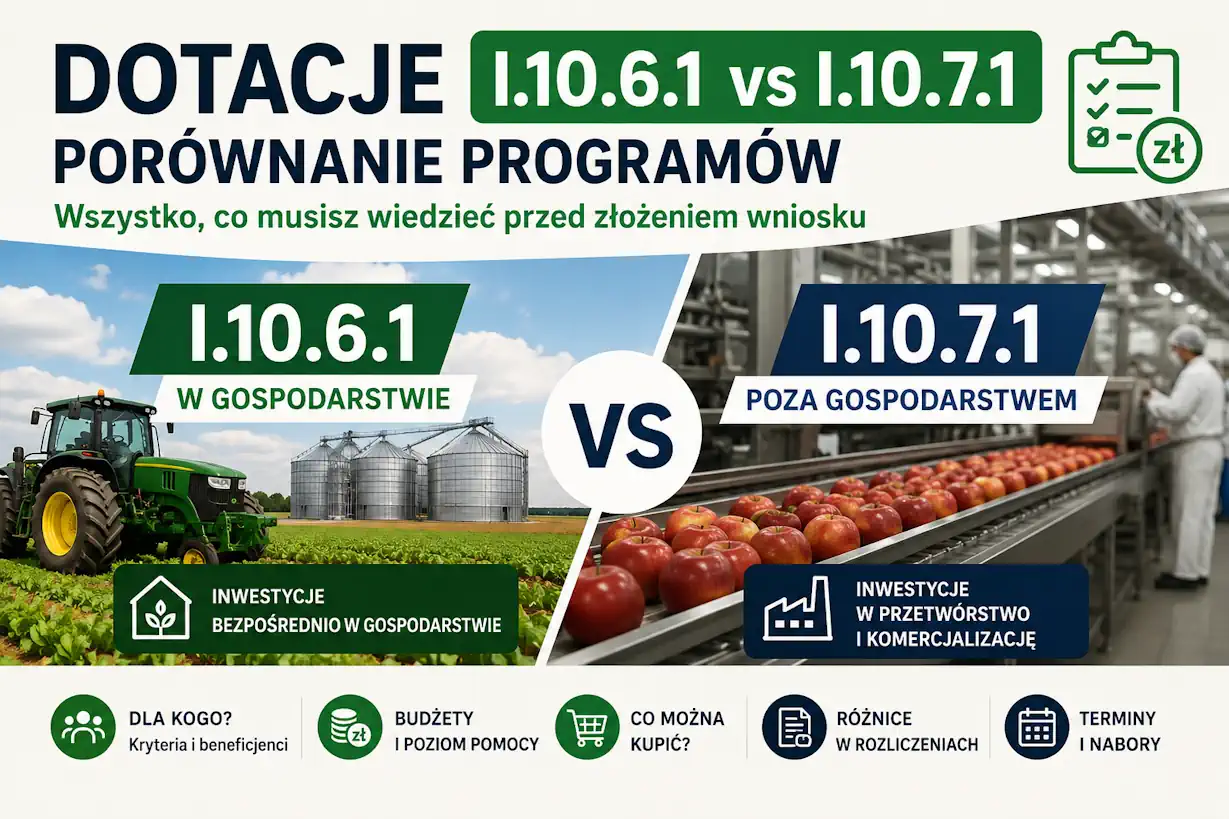
Interventions I.10.6.1 and I.10.7.1 support the development of cooperation within the value chain, but they are intended for different beneficiaries and different investment scales. The first mainly concerns on-farm activities, Polish Retail Agricultural Trade (RHD), marginal, local and limited activity (MOL) and small-scale processing, while the second is a tool for SMEs operating outside the farm, including processing plants, packing facilities, sorting facilities and companies developing cooperation with farmers.
A comparison of grants I.10.6.1 and I.10.7.1 is an analysis of two interventions under the CAP Strategic Plan 2023-2027, helping farmers, micro-enterprises and SMEs choose the right funding route for investments in processing, sales, documentation and cooperation within the food value chain.
In brief
As of : I.10.6.1 is closer to the farm, RHD and MOL activities, while I.10.7.1 is closer to processing plants, SMEs and contractual cooperation with farmers. The difference is not only about the grant amount. The key factors are: beneficiary status, investment location, project scale, settlement method and delivery documentation.
- I.10.6.1 has a budget of EUR 51 million, while I.10.7.1 has a budget of EUR 204 million, according to information from the Polish Ministry of Agriculture and Rural Development on support for processing and placing products on the market.
- I.10.6.1 provides a flat-rate payment of up to PLN 120,000 for establishing RHD or business/MOL activity, and reimbursement of up to PLN 500,000 for continuing business/MOL activity.
- I.10.7.1 provides reimbursement from PLN 100,000 to PLN 10,000,000 for SMEs, with aid intensity of up to 50%, 60% for organised forms of cooperation in area A, and 60% in area B.
- FarmPortal and FoodPass can support the preparation of operational data: production records, traceability, deliveries, batches, quality, treatment documentation and reporting.

What are interventions I.10.6.1 and I.10.7.1?
I.10.6.1 and I.10.7.1 are investment interventions under the CAP Strategic Plan 2023-2027, aimed at developing cooperation within the value chain. In practice, they address the same public policy direction: shortening the food value chain, increasing the added value of agricultural production and improving the link between farmers, processing and sales.
They differ in the level of operation. I.10.6.1 is a tool for a farmer, a farmer's spouse or a micro-enterprise linked to a farm. I.10.7.1 is a tool for micro, small and medium-sized enterprises that carry out investments outside the farm, most often in processing, sorting, packing, storage, placing products on the market or developing processing infrastructure.
This matters. Choosing the wrong intervention can lead to wasted time, a poorly prepared investment scope and documentation that does not match the call criteria. That is why the decision should start with one question: is the investment a development of activity on the farm, or a project carried out by a company operating outside the farm?
The primary sources for the limits and rules described in this article are the pages of the Polish Ministry of Agriculture and Rural Development: intervention I.10.6.1 on the farm and intervention I.10.7.1 outside the farm. Call dates and budgets should be checked again before submitting an application, as the ARiMR schedule is indicative.
What are the main differences between I.10.6.1 and I.10.7.1?
The most important difference is that I.10.6.1 finances smaller-scale investments linked to a farm, while I.10.7.1 finances larger SME projects outside the farm. The choice of programme depends on the applicant's status, type of activity, place of operation, cost scale and model of cooperation with suppliers.
| Criterion | I.10.6.1 on the farm | I.10.7.1 outside the farm |
|---|---|---|
| Main recipient | Farmer, farmer's spouse, micro-enterprise linked to a farm. | Micro, small and medium-sized enterprise meeting the eligibility conditions. |
| Investment logic | Development of processing, RHD, MOL, sales and marketing of agricultural products in connection with a farm. | Development of processing, placing products on the market, storage, sorting, packing and SME infrastructure. |
| Intervention budget | EUR 51 million, Ministry of Agriculture and Rural Development, 2026, information on support for processing and placing products on the market. | EUR 204 million, Ministry of Agriculture and Rural Development, 2026, information on support for processing and placing products on the market. |
| Planned call | - , according to the ARiMR schedule and information from the Ministry of Agriculture and Rural Development. | - , according to the ARiMR schedule and information from the Ministry of Agriculture and Rural Development. |
| Form of aid | Flat-rate payment for establishing RHD or business/MOL activity, reimbursement for continuing business/MOL activity. | Reimbursement of eligible costs for SME investments. |
| Maximum aid | Up to PLN 120,000 as a flat-rate payment or up to PLN 500,000 as reimbursement, depending on the type of operation. | Up to PLN 10,000,000 per beneficiary during the programme implementation period. |
The conclusion is simple: I.10.6.1 suits a farmer who wants to enter small-scale processing or organise the sale of farm products, while I.10.7.1 suits a company operating at a larger scale and needing to manage suppliers, batches, quality, traceability and logistics. These programmes are not interchangeable.
Who is I.10.6.1 for, and who is I.10.7.1 for?
I.10.6.1 is intended for entities closer to the farm, while I.10.7.1 is for SMEs operating outside the farm. Legal status and the actual operating model matter more than the name of the investment itself, because the same washing, sorting or packing line may be classified differently depending on the beneficiary and the place of implementation.
Under I.10.6.1, the Ministry of Agriculture and Rural Development indicates the farmer and the farmer's spouse, who declare that they will establish and run the activity covered by the operation under Polish Retail Agricultural Trade for 5 years from the payment of aid. For RHD operations, there is also a requirement for the farm to have an economic size of at least EUR 25,000, or for the operation to be carried out on the farm of a beneficiary of the "Premiums for young farmers" intervention.
A micro-enterprise under I.10.6.1 should run business activity or MOL activity for 5 years from the payment of aid, own an agricultural holding independently or dependently, and use agricultural products from its own farm for processing for at least 50% of the agricultural products processed. This restriction directs the programme towards businesses strongly connected with their own raw material base.
I.10.7.1 is for SMEs. That is a different situation. A company may process agricultural products, place them on the market, develop infrastructure and work with farmers as raw material suppliers, but it must prepare the project according to the logic of an enterprise, contracting, delivery documentation and eligible costs typical of a larger investment.
Farmer and farm
For a farmer, the basic challenge is moving from selling raw material to selling a product with greater added value. I.10.6.1 may suit a farm that wants to launch a simple processing line, cold store, packing, labelling or direct sales channel.
The farmer should start collecting data on raw material origin, batches, agronomic treatments, unit costs and sales. Such data helps assess whether the investment makes operational sense, rather than simply looking good in the cost estimate.
Micro-enterprise linked to a farm
A micro-enterprise linked to a farm usually sits between a farmer and a small processing plant. Its decision concerns whether it is developing the business as a logical extension of its own production, or building a processing company that works more broadly with the market.
If most of the raw material comes from the company's own farm, I.10.6.1 may be the natural choice. Where the company's model is based on buying raw material from many suppliers and investing in larger infrastructure, I.10.7.1 should be analysed.
Processor, packing facility, sorting facility or distributor
For a processor, the main challenge does not end with machinery. The company must link the investment with deliveries, raw material quality, batches, suppliers, documentation, quality systems and the ability to demonstrate cooperation within the value chain.
I.10.7.1 rewards projects that are not merely technology purchases. A stronger project shows the process: from the agreement with the farmer, through raw material intake, quality control, storage, processing and labelling, to batch traceability and reporting.
What can be financed through the grants?
Both interventions cover tangible and intangible investments, but the scope must be matched to the beneficiary type and the objective of the operation. Under I.10.6.1, the key focus is the processing or sale of agricultural products in connection with a farm, while under I.10.7.1 the greater emphasis is on SME investments in a plant, technology, storage, sorting, packing and placing products on the market.
Under I.10.7.1, the Ministry of Agriculture and Rural Development indicates the construction of buildings or structures, the purchase of technology for processing agricultural products or placing them on the market, environmental protection and infrastructure for processing food waste or by-products. Storage, sorting, packing and preparation for sale are listed within this scope only in the case of organised forms of cooperation between farmers.
Intangible investments also matter in both programmes. In practice, these may include elements related to software, data integration, batch tracking, quality documentation, supplier management or reporting, provided they are directly linked to the operation and meet the eligibility conditions of the call.
| Investment type | Most relevant intervention | Input data to prepare | Interpretation risk |
|---|---|---|---|
| Small line for processing products from the farm | I.10.6.1 | Raw material source, production volume, recipes, batches, sales plan, RHD or MOL. | The link with the farm and the correct activity status must be demonstrated. |
| SME processing plant | I.10.7.1 | Suppliers, contracts, batch flow, production capacity, technology, quality, waste. | A machine alone, without a description of cooperation within the value chain, may be a weak justification. |
| Sorting facility, packing facility or preparation for sale | I.10.7.1, especially in organised forms of cooperation | Batches, quality classes, labels, suppliers, traceability, warehouse flow. | Under I.10.7.1, this scope needs to be checked particularly carefully against the conditions concerning forms of cooperation. |
| Production and batch record system | I.10.6.1 or I.10.7.1 as part of the operation | Fields, treatments, harvests, batches, deliveries, quality, warehouse, customers. | Software should be linked to the investment process, not described as a loose add-on. |
| Environmental investment | I.10.6.1 or I.10.7.1 | Energy, water and fuel consumption, waste, by-products, indicators after the investment. | An environmental preference requires an investment cost component related to environmental protection of at least 20% of eligible operation costs. |
The weakest investment description is: "we are buying a machine because it is needed". A better description shows the flow of data and goods: which field the raw material comes from, which batch goes to intake, how it passes through quality control, how it is stored, processed and labelled.
How do the amounts, aid intensity and settlement methods differ?
I.10.6.1 has lower limits and combines two mechanisms: flat-rate payment and reimbursement. I.10.7.1 operates as reimbursement for SMEs and has a much higher maximum limit, so it requires stronger financial, cash-flow and documentation preparation.
Under I.10.6.1, for establishing and running RHD, the flat-rate amount is a maximum of PLN 30,000, PLN 60,000 or PLN 120,000, depending on the size of the operation. The same flat-rate limit applies to establishing business/MOL activity in the processing of agricultural products. The flat-rate amount is a maximum of 65% of the operation costs.
For the continuation of business/MOL activity by a micro-enterprise, I.10.6.1 provides reimbursement of up to PLN 500,000 per beneficiary during the programme implementation period. The reimbursement intensity is up to 50% of eligible operation costs, and the minimum aid amount is PLN 10,000.
Under I.10.7.1, the maximum reimbursement is PLN 10,000,000 per beneficiary, and the minimum aid amount is PLN 100,000. In area A, the aid intensity is up to 50% of eligible operation costs and up to 60% for beneficiaries operating in organised forms of cooperation between farmers. In area B, concerning the processing and placing on the market of organic agricultural products, the aid intensity is up to 60%.
| Element | I.10.6.1 | I.10.7.1 |
|---|---|---|
| Minimum aid amount | PLN 10,000 | PLN 100,000 |
| Maximum aid | PLN 30,000, PLN 60,000 or PLN 120,000 as a flat-rate payment; up to PLN 500,000 as reimbursement for continuing business/MOL activity. | Up to PLN 10,000,000 in reimbursement per beneficiary. |
| Intensity | Flat-rate payment: maximum 65% of operation costs. Reimbursement: up to 50% of eligible costs. | Area A: up to 50%, up to 60% for organised forms of cooperation between farmers. Area B: up to 60%. |
| Settlement mechanism | Flat-rate payment or reimbursement, depending on the operation type. | Reimbursement of eligible costs. |
| Importance for cash flow | Lower limits, but own contribution, payment schedule and proof of implementation still need to be planned. | A larger investment scale means greater importance of bridge financing, purchase documentation and cost control. |
The practical difference is substantial. A project based on a PLN 120,000 flat-rate payment and a project involving several million PLN in reimbursement do not require the same organisation. In a larger project, procurement, contracts, delivery schedules, start-up planning, team responsibilities and data archiving methods must be organised in advance.
What data should be prepared for the project?
The best grant projects describe the investment as a process, not a shopping list. The data should show where the raw material comes from, how it will be processed, how it will be labelled, how the company or farm will document quality, what waste or by-products will arise, and how cooperation with customers or suppliers will change.
Under I.10.6.1, the most important data concerns the farm: area, crops, raw material, treatments, harvests, batches, sales and costs. For RHD or MOL, this is supplemented by data on the finished product, labelling, basic recipes, storage conditions, sales channels and process compliance with sanitary requirements.
Under I.10.7.1, data typical of a plant or SME should be prepared: supplier list, delivery contracts, intake structure, quality classes, warehouse batches, technologies, processing capacity, customers, complaints, waste, by-products and documents confirming cooperation within the value chain. Without this, it is difficult to convincingly show that the investment strengthens the position of farmers and shortens the food value chain.
What KPIs can be used in the project?
KPIs should follow from the process. In a small farm, sensible indicators include the number of batches with full origin identification, the number of products sold under RHD, the share of own raw material in processing, the time needed to prepare records or the number of sales documents linked to a batch. In an SME, the more important indicators are: the share of deliveries covered by contracts, the number of suppliers in the system, the time from intake to batch identification, the number of batches with complete quality data and the share of waste sent for further use.
Not every KPI has to be financial. Sometimes an operational indicator is more credible: "95% of batches with an assigned harvest date, supplier and quality control result" sounds better than a general promise of improved efficiency. The only requirement is that the indicator must be measurable.
Which mistakes appear most often?
The first mistake is failing to distinguish between an on-farm investment and an investment outside the farm. The second is describing technology without showing the flow of raw material, batches and documents. The third is treating the IT system as a separate add-on, rather than as a tool that connects production records, deliveries, quality and settlement.
Small farms often collect data in notebooks and spreadsheets, which works until the number of batches, customers and documents increases. Processing companies face a different problem: data exists in ERP systems, scales, warehouses, spreadsheets, emails and quality documentation, but there is no single logical traceability model.
How do FarmPortal and FoodPass support grant-funded projects?
FarmPortal and FoodPass support I.10.6.1 and I.10.7.1 projects by organising production, delivery and quality data. They do not replace the call regulations or ARiMR decisions, but they help build the digital layer of the process needed for processing, sales, traceability, quality control and reporting.
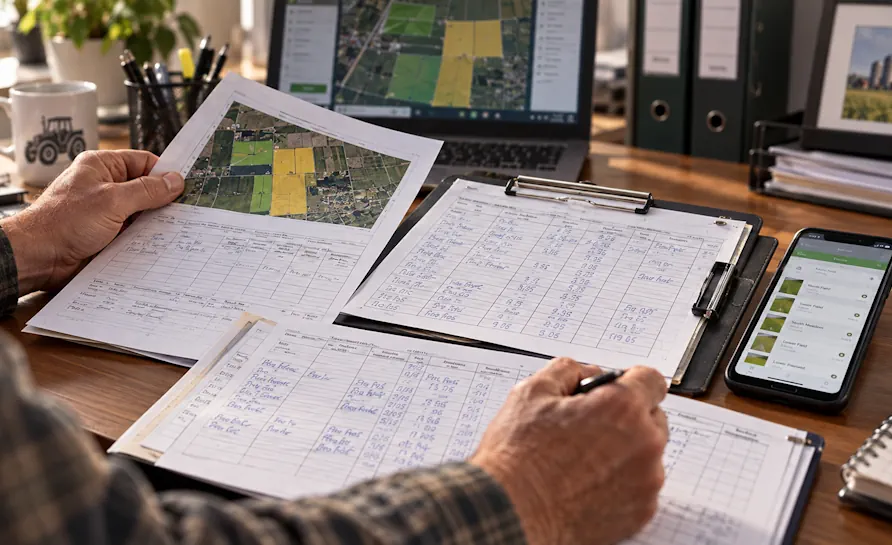
On the farm, FarmPortal can organise fields, crops, agronomic treatments, plant protection product records, fertilisation, harvests, employees, machinery and costs. In an I.10.6.1 project, farm data helps demonstrate the origin of raw material and prepare the operational foundation for RHD, MOL or the sale of processed products.
In a processing company, FoodPass can support supplier records, contracting, batches, deliveries, quality control, traceability documentation, audits, supplier blocking, compliance registers and reporting. Under I.10.7.1, it is particularly important to connect farmer data with raw material intake, warehouse, technology, product batch and customer.
The description of FarmPortal features can be expanded by referring to the page FarmPortal features for farm management. For topics closer to processors, useful materials also include traceability in agriculture and agri-food, the article on grant I.10.7.1 for fruit and vegetable processing and the text on digital agriculture in I.10.7.1 projects.
Where does the role of the IT system end?
An IT system does not guarantee that a grant will be awarded. It also does not replace the cost estimate, permit, construction documentation, sanitary requirements, environmental decisions or the assessment of eligibility of a specific expense. Its role is different: it helps collect, connect and document data showing that the investment will operate as a process, not as a single purchase.
This boundary matters for credibility. FarmPortal and FoodPass should be described in the project through features, data and processes: treatment records, batch identification, supplier register, quality control, reports, API integrations, data from scales, sensors, weather stations, GPS and ERP systems. Not through slogans.
Case study: how to match the intervention to the investment scale?
The choice of intervention is easiest to understand through a specific scenario. The same development direction, namely increasing the added value of fruit, may lead to a different programme if the scale, beneficiary status and raw material source change.
Model case study: a fruit farm in Lubelskie Voivodeship, with 38 ha of apple and berry orchards, plans to launch a small facility for washing, simple processing, packing and selling short-series products under RHD. The estimated operation cost is PLN 180,000, and the planned scope includes technological and refrigeration equipment, labelling, basic batch records and sales documentation.
In this variant, the logical starting point is I.10.6.1, because the beneficiary is a farmer, the investment is linked to the farm and sales are intended to operate within a short supply chain. The key input data includes area, crop structure, harvest volume, product plan, raw material source, sales schedule, batches and RHD requirements.
The second variant concerns an SME company that purchases fruit from 45 suppliers, carries out sorting, packing and sales to retail chains, and plans to expand its cold store and packing line. The investment cost is PLN 4,800,000, and the company wants to link raw material intake with quality control, warehouse batches, labels and traceability documentation.
In this variant, I.10.7.1 is the more appropriate direction for analysis, because the investment is carried out by an SME outside the farm and requires work with many suppliers. The most important KPIs are: 100% of deliveries assigned to a supplier and intake date, at least 95% of batches with complete quality data, full assignment of product batches to raw material batches, and a delivery contract register in one system.
The interpretation limit is clear: the figures above are used to show the decision logic and do not replace an eligibility analysis. Every project must be checked against the call regulations, ARiMR documents, beneficiary status, activity codes, financing sources and investment implementation conditions.
Checklist before choosing an intervention
The choice between I.10.6.1 and I.10.7.1 should start with eligibility, and only then move to the shopping list. A good checklist prevents a situation in which the beneficiary prepares a project around an attractive aid limit but does not meet a basic programme condition.
- Define the applicant's status: farmer, farmer's spouse, micro-enterprise linked to a farm, or SME outside the farm.
- Determine the place of investment implementation and its link with the farm.
- Describe the source of raw material: own farm, external suppliers, organised form of cooperation, organic products.
- Check whether the project concerns RHD, MOL, processing, placing products on the market, sorting, packing, storage or environmental infrastructure.
- Calculate the operation value, aid amount, own contribution and required bridge financing.
- Prepare data on batches, quality, suppliers, treatments, warehouse, sales and costs.
- Define measurable KPIs: number of batches with full traceability, share of own raw material, number of suppliers in the system, time to prepare a report, share of digital documents.
- Check whether the environmental or innovative component is genuinely reflected in eligible costs and in the process.
- Verify the current call regulations, annexes, forms and ARiMR schedule before submitting the application.
The decision should be documented. A one-page comparison covering beneficiary status, investment scope, raw material source, settlement mechanism and operational data is often enough to quickly identify whether the project is moving in the right direction.
FAQ
What is the difference between I.10.6.1 and I.10.7.1?
I.10.6.1 concerns investments on the farm or activity strongly linked to the farm, including RHD, MOL and small-scale processing. I.10.7.1 concerns SME investments outside the farm, most often in processing, placing products on the market, infrastructure, quality, batches and cooperation with farmers as suppliers.
When should a farmer choose I.10.6.1?
A farmer should analyse I.10.6.1 when the investment is linked to the farm, the processing of own products, RHD, MOL activity or sales in a short supply chain. The programme suits smaller-scale operations, especially where the raw material mainly comes from the farmer's own holding and the project does not require multi-million infrastructure.
When should an SME analyse I.10.7.1?
An SME should analyse I.10.7.1 when it operates outside the farm and plans an investment in processing, placing products on the market, technology, buildings, sorting, packing, storage or environmental infrastructure. The programme is particularly relevant for plants working with many agricultural suppliers and batch documentation.
What are the maximum aid amounts?
Under I.10.6.1, aid may amount to up to PLN 120,000 as a flat-rate payment for establishing RHD or business/MOL activity, or up to PLN 500,000 as reimbursement for continuing business/MOL activity. Under I.10.7.1, reimbursement for SMEs may amount to a maximum of PLN 10,000,000 per beneficiary.
What are the minimum aid amounts?
The minimum aid amount under I.10.6.1 is PLN 10,000. The minimum aid amount under I.10.7.1 is PLN 100,000. This difference shows the scale of the two interventions: the first is closer to small on-farm projects, while the second is closer to SME investments.
Can an IT system be part of the project?
An IT system can be part of the project if it is linked to the operation and meets the eligibility conditions. In practice, this means production records, batches, traceability, supplier registers, quality control, reporting, integrations with scales, warehouse systems, ERP or processing documentation. Eligibility must be checked in the call documentation.
How does FarmPortal help with I.10.6.1?
FarmPortal helps organise farm data: fields, crops, treatments, plant protection products, fertilisation, harvests, employees, machinery, costs and batches. Under I.10.6.1, such data supports the description of raw material origin, production plans, sales, RHD or MOL documentation and later process control.
How does FoodPass help with I.10.7.1?
FoodPass helps processing and distribution companies organise suppliers, deliveries, batches, quality, traceability, audits and compliance documentation. Under I.10.7.1, it is particularly important to show cooperation with farmers, raw material flow and batch control from intake to finished product.
Does I.10.7.1 require contracts with farmers?
I.10.7.1 promotes cooperation in the value chain through the obligation to sign supply contracts between farmers and the processing industry, according to the description provided by the Ministry of Agriculture and Rural Development. The company should therefore organise its supplier list, contract scope, volumes, raw material quality and method of documenting intakes in advance.
Are the call dates final?
Call dates indicated in ARiMR schedules are indicative and may change. According to information from the Ministry of Agriculture and Rural Development and the ARiMR schedule, I.10.7.1 was planned from 1 to 30 September 2026, and I.10.6.1 from 1 October to 2 November 2026. The current call announcement must be checked before publishing an application.
Glossary
- CAP Strategic Plan 2023-2027
- The Strategic Plan for the Common Agricultural Policy for 2023-2027. This is the programme document from which interventions such as I.10.6.1 and I.10.7.1 arise.
- RHD
- Polish Retail Agricultural Trade. In practice, it refers to a form of food sales by a farmer, relevant to small-scale processing and the sale of farm products.
- MOL
- Marginal, local and limited activity. This operating model is important for some small entities that process and sell food locally.
- SME
- Micro, small and medium-sized enterprises. Under I.10.7.1, this is the main group of beneficiaries carrying out investments outside the farm.
- Reimbursement
- A settlement mechanism in which the beneficiary receives a refund of part of the eligible costs after meeting the programme conditions and documenting the expenditure.
- Flat-rate payment
- A form of aid based on a fixed amount, used under I.10.6.1 for establishing RHD or business/MOL activity, within the limits of PLN 30,000, PLN 60,000 or PLN 120,000.
- Traceability
- The ability to identify a product, batch and raw material within the supply chain. In agri-food, it includes linking the field, supplier, harvest date, intake, quality, warehouse, processing and customer.
- Eligible costs
- Costs that may be covered by aid if they meet the conditions of a given call. Their eligibility should be assessed on the basis of programme documentation, not only the investment description.
- Organised forms of cooperation between farmers
- Forms such as agricultural producer groups, cooperatives, producer organisations and interbranch organisations. Under I.10.7.1, they may be relevant to preferences and aid intensity in area A.
Summary
I.10.6.1 and I.10.7.1 share the same objective: the development of cooperation within the value chain. However, they do not finance the same type of beneficiary and do not suit the same project scale. I.10.6.1 is closer to the farm, RHD, MOL and micro-processing. I.10.7.1 is closer to SMEs, processing plants, sorting facilities, packing facilities, storage, contracting and traceability systems.
The most practical recommendation is this: first establish the beneficiary status and raw material model, then choose the intervention, and only then build the shopping list. The project should show the process from the field or supplier to the product, batch, quality, document and customer. This is precisely where digital tools such as FarmPortal and FoodPass can genuinely strengthen the preparation of the investment.
Follow us!
See what we're doing and be inspired by positive changes.