1. Who this article is for — benefits for each audience group
This article is addressed to growers, agronomic advisors, processors, and fruit and vegetable distributors. Each of these groups views seasonal labor from a different angle, but they all face the same reality: without well-organized labor, it is difficult to maintain profitability, quality, and delivery reliability.
| Audience group | Main challenges | What this article delivers |
|---|---|---|
| Growers and orchard owners | Labor shortages, settlement chaos, weak cost and quality control | Practical hiring rules, a checklist, comparison of settlement models, and a labor cost reporting framework |
| Agronomic advisors | The need to support farms not only in agronomy, but also in work organization and documentation | A structured resource for advising farms and strong arguments for digital process management |
| Processors | Uneven raw material quality, traceability issues, unpredictable deliveries | A better understanding of how field labor organization affects raw material quality and cost |
| Distributors | Quality and documentation pressure, complaints, and the need to trace batches | A clearer view of how harvest and workforce data support traceability and supplier collaboration |
2. The problem: seasonality, labor shortages, and rising costs
Seasonal labor demand in orchards, vegetable production, and berry farming rises sharply over a short period of time. A farm that relies on only a few people for most of the year may suddenly need dozens or even over a hundred workers during peak harvest. Today, the issue is no longer just labor availability, but also the ability to calculate the real cost of labor and its impact on quality.
In practice, the challenge does not end with recruitment. Higher wage rates, accommodation and transport costs, turnover risk, communication barriers, and increasing pressure around documentation and compliance all add to the burden. That is why a crop cost report should cover not only fertilization, crop protection, and fuel, but also the full cost of labor: wages, contributions, work organization, quality loss, and inefficiencies caused by operational disorder.
“This season, we recruited workers from three countries at the same time. Each group required a different legal procedure, a different onboarding process, and a different accommodation setup. Without a system to manage all of this, we would have been stuck.”
3. Legal forms of seasonal employment in 2026
The choice of employment model determines cost, risk, and the level of administrative workload. In practice, farms most often consider a harvest assistance agreement, a mandate contract, or cooperation with a temporary work agency.
3.1. Harvest assistance agreement
This is a typically agricultural solution intended for assistance with harvesting specific groups of agricultural products. It works well where the scope of duties is consistent with the legal definition and covers the harvest itself together with directly related tasks. Its main advantage is a simpler structure and lower burden than a standard mandate contract, although the permitted scope of work and annual time limit remain important constraints.
3.2. Mandate contract
A mandate contract may be safer when the worker performs a broader range of tasks than harvesting alone, such as support work, warehouse handling, packing, or other operational tasks. It offers greater flexibility, but requires more detailed recording, settlement, and compliance with minimum pay rules.
3.3. Temporary work agency
In the agency model, part of the formal responsibility is transferred to an external partner. The grower pays a higher unit cost, but reduces internal organizational and legal risk. This option can be particularly useful during major spikes in labor demand or when the farm lacks its own administrative capacity.
4. Comparison table of seasonal employment models
The differences between employment models are easiest to understand when they are compared not only by wage level, but also by scope of work, documentation requirements, risks, and indirect costs.
| Parameter | Harvest assistance agreement | Mandate contract | Temporary work agency |
|---|---|---|---|
| When it makes sense | For harvesting and directly related activities | For broader task scopes and longer cooperation | When scale is needed quickly and some formalities should be outsourced |
| Level of formality | Moderate | Higher | Highest on the agency side |
| Flexibility | Limited to defined tasks | High | High |
| Unit cost | Usually lower | Medium | Highest |
| Risk for the farm | Medium if duties are incorrectly defined | Medium if documentation is weak | Lower formally, but higher operational cost |
| Practical conclusion | Good for standard harvesting work | Good for more complex work organization | Good for larger scale or when in-house HR capacity is limited |
5. Hiring foreign workers — procedures and changes in 2025–2026
For many farms, hiring workers from abroad has become a necessity rather than an add-on. In practice, this means earlier planning, better document management, and proper preparation of accommodation, onboarding, and communication.
The three most important areas are the work legalization path, the timeliness of document preparation, and the farm’s ability to onboard the worker efficiently after arrival. The later this process starts, the higher the risk that the most critical moment of the season will arrive without enough people available.
5.1. What needs to be planned in advance
- the number of required workers and the target start date,
- the legalization path for a given worker group,
- accommodation and transport logistics,
- contracts, identity documents, and organized employee records,
- work instructions and settlement rules that are understandable to workers.
5.2. Where growers make the most expensive mistakes
The most common mistakes are starting procedures too late, incomplete documentation, failure to assign contracts and documents to individual people, and operational chaos after the worker arrives. That is why a system with structured employee records and deadline alerts is now a management tool rather than just an administrative add-on.
6. Everyday operational challenges
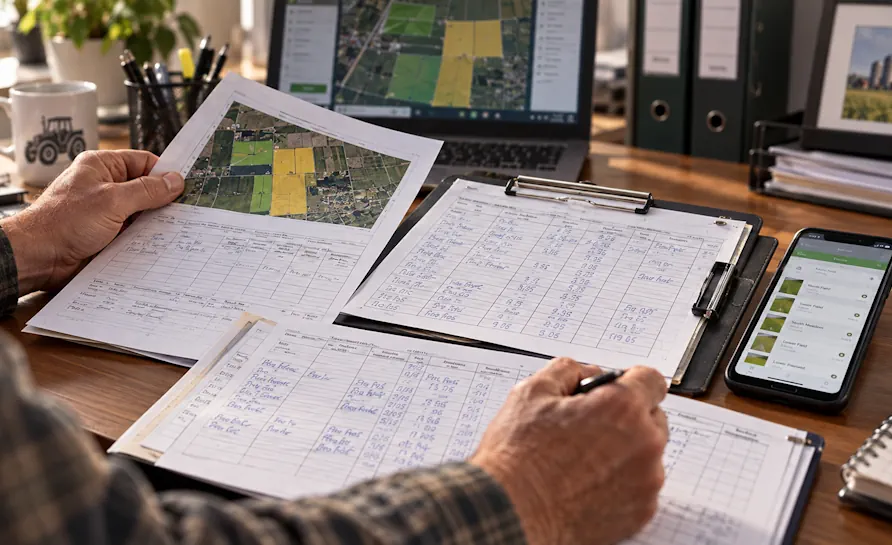
Many farms lose money not because they pay too much per hour, but because they do not measure the process closely enough to see where margin is disappearing. Lack of quality control, weak communication with team leaders, waste, disputes over pay, and downtime all create real costs that are not obvious at first glance.
6.1. Lack of transparency in settlement
The worker does not know how much they earned that day, while the grower does not know how much harvesting a given batch of fruit actually cost. This is a classic flashpoint. Daily transparency of results reduces disputes and builds trust.
6.2. Turnover and lack of accountability
A worker who arrives for one week and leaves without notice destabilizes the entire harvest plan. Turnover is reduced by clear rules, timely payments, a sensible bonus system, and better work organization by the team leader.
6.3. Accommodation and logistics
Accommodation, field transport, equipment, and coordination are very often underestimated. In practice, these hidden costs raise the real labor cost more than the nominal wage rate.
6.4. Language communication
When employing workers from different countries, it is no longer realistic to assume that everything can be explained verbally in Polish. Clear instructions, pictograms, fixed forms, and a repeatable way of communicating rules work much better.
6.5. Work quality and losses
Piece-rate work without quality control very easily rewards speed at the expense of quality. Damage, lack of sorting, and waste should be measured and linked to a worker or team, because only then can strong performance be rewarded fairly.
7. Piece-rate, hourly work, and mixed systems — how to settle harvest work
There is no single universal settlement model for every farm and every crop. A well-chosen system should support performance without reducing quality.
| Model | When it works best | Advantage | Risk |
|---|---|---|---|
| Piece-rate | For work that is easy to count in kg, crates, or pallets | Strong performance incentive | Quality may drop if waste is not controlled |
| Hourly work | For preparatory, maintenance, or precision tasks where care matters | Simpler organization | Weaker incentive for quantity |
| Mixed system | When security of base pay and a performance bonus need to be combined | Better balance between volume and quality | More complex settlement |
For strawberries, settlement in kilograms or crates combined with parallel waste control usually makes sense. In apples, a model based on the number of crates or bins per day often works better, but it should still include a quality adjustment. In cucumbers and other repeated harvest systems, it is crucial to compare results in the context of day, field block, and working conditions.
8. Work quality and productivity — measurement and linking to pay
Productivity without quality does not generate profit. A worker who harvests quickly but generates a high level of waste may be less profitable for the farm than someone working slightly slower but more accurately.
That is why it is worth measuring several variables at the same time: the quantity harvested over time, the number of crates or kilograms, the level of waste, quality complaints, and the labor cost assigned to a given batch. Only this combination gives a fair basis for bonuses, team comparison, and decisions about changing work organization.
9. Labor cost per tonne and per hectare
The most important question from a crop cost report perspective is not “how much do I pay per hour,” but “how much does a marketable tonne and a hectare cost me once the full work organization is included.” This is a fundamental difference.
7 elements that should be included in a labor cost report
- base wages,
- contributions or insurance,
- accommodation cost,
- transport and logistics cost,
- coordination and team leader cost,
- quality, waste, and complaint cost,
- production result: marketable mass or area.
Practical formula:
labor cost per tonne = (wages + contributions/insurance + accommodation + transport + coordination cost + waste cost) / marketable product mass
Practical formula:
labor cost per hectare = total labor cost assigned to the field block / production area of the field block
| Crop | Indicative harvest productivity | Estimated labor cost under piece-rate | Estimated labor cost under hourly work |
|---|---|---|---|
| Strawberries | 8–15 kg/h/person | PLN 2,500–4,000/t | PLN 3,500–5,500/t |
| Raspberries | 5–10 kg/h/person | PLN 3,500–6,000/t | PLN 5,000–8,000/t |
| Blueberries | 4–8 kg/h/person | PLN 4,000–7,000/t | PLN 5,500–9,000/t |
| Apples | crates or bins per day | PLN 300–600/t | PLN 450–800/t |
| Cucumbers | 15–25 kg/h/person | PLN 1,500–2,500/t | PLN 2,000–3,500/t |
Note: these are indicative values. The actual result depends on variety, cultivation technology, work organization, quality, and season conditions.
10. Case study: a 35 ha berry farm with 130 seasonal workers
Context: a family-run farm in the Lublin region specializing in blueberries and raspberries. At peak season it employed 130 seasonal workers, while before process organization, settlements were based mainly on paper lists and Excel.
Situation before process organization
- average waste: 17%,
- worker turnover during the season: 35%,
- average blueberry labor cost: PLN 5,800/t,
- pay disputes: 3 per season,
- owner’s administrative time: 3 hours per day.
Situation after organized recording and settlement
- average waste dropped to 9%,
- turnover dropped to 18%,
- average blueberry labor cost dropped to PLN 4,200/t,
- pay disputes dropped to 0,
- owner’s administrative time dropped to 30 minutes per day.
| Indicator | Before | After | Change |
|---|---|---|---|
| Average waste | 17% | 9% | −47% |
| Worker turnover | 35% | 18% | −17 pp |
| Blueberry labor cost | PLN 5,800/t | PLN 4,200/t | −PLN 1,600/t |
| Pay disputes | 3 | 0 | −100% |
| Daily administration time | 3 h | 0.5 h | −83% |
“The biggest change was that workers could see their own results. They stopped questioning settlements, and we could finally see which field blocks and teams were actually pulling down the performance of the whole farm.”
11. How FarmPortal supports workforce management on the farm
FarmPortal is a system developed by Agri Solutions Sp. z o.o. that combines crop management, harvests, workers, warehouse operations, and costs in one environment. In the context of seasonal labor, its value lies in organizing data not only for accounting purposes, but above all for farm management.
11.1. Employee records
Each worker can have an individual record containing personal data, documents, employment history, country of origin, photo, and information about held qualifications. This is the right place for passports, visas, contracts, medical examinations, H&S training, consents, and other documents relevant to the farm.
11.2. Worker IDs — printing and scanning
FarmPortal enables quick generation of worker IDs that can be printed in-house and used for fast field registration. This simple solution scales well for larger labor groups and does not require expensive infrastructure.
11.3. Working time, piece-rate, and harvest settlement
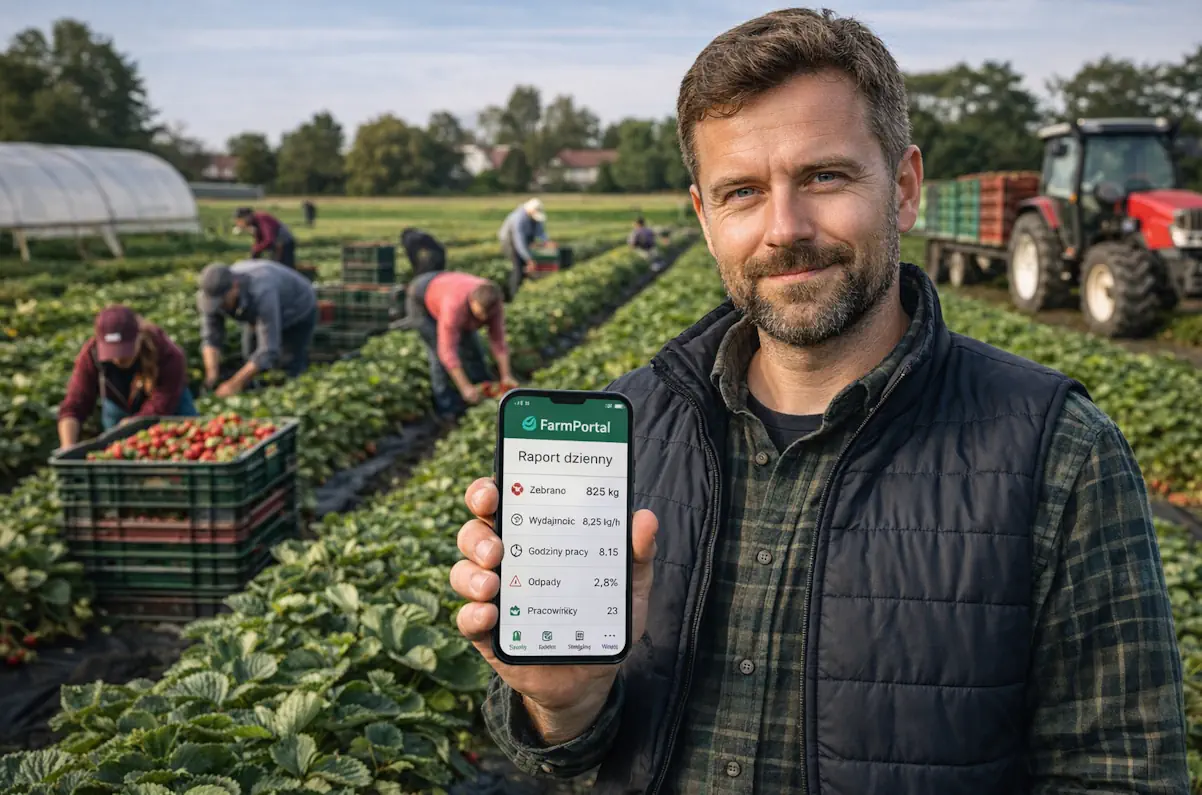
The system supports hourly work, piece-rate, and mixed models. Different rates can be defined depending on the type of task, workers can be assigned to jobs and operations, and results can then be analysed by worker, field block, row, day, and variety.
11.4. Productivity and cost reports
Reports show how much each person harvested, how much waste occurred, how many crates were filled, what productivity looks like across the plantation, and what labor cost per tonne and per hectare actually is. This level of detail turns basic payroll settlement into a real management tool.
11.5. Product passporting and batch traceability
Recording harvests with reference to place, day, and worker supports batch traceability. This data can later serve not only settlement purposes, but also warehouse, packing, traceability, and reporting processes.
11.6. Packing and contractor management
Harvests can be linked further with warehouse operations, sorting, packing, and contractors. This allows the system to connect data from field to further commercial and quality processes.
| Area | Paper / Excel | FarmPortal |
|---|---|---|
| Work records | Scattered, difficult to audit, error-prone | One place for time, piece-rate, tasks, and harvests |
| Piece-rate settlement | Often without location and quality links | Linked to worker, field block, row, day, and waste |
| Employee record | Documents stored in binders and messengers | Data, scans, expiry alerts, and employment history |
| Labor cost per tonne | Usually estimated only after the season | Can be analysed on an ongoing basis together with field reports |
| Traceability | Difficult to reconstruct during complaints | Links harvest, batch, worker, and production location |
Related FarmPortal resources:
12. Employer checklist: before, during, and after the season
The employer checklist is one of the most practical additions to the article. It makes the material easier to scan for both readers and language models.
Before the season
- determine the number of required workers and work dates,
- choose an employment model for each work type,
- prepare contract templates, piece-rate rules, and bonus systems,
- plan accommodation, transport, and onboarding,
- organize employee files and documentation,
- prepare work instructions and H&S training,
- configure the settlement system and worker IDs.
During the season
- show workers their daily result,
- monitor productivity and waste,
- react to drops in quality or performance,
- control document deadlines and work legality,
- pay wages on time,
- record reasons for departures and absences.
After the season
- calculate labor cost per tonne, hectare, and field block,
- compare teams in terms of both quantity and quality,
- check which field blocks were the least productive,
- assess bonus effectiveness and its impact on turnover,
- prepare an improvement plan for the next season.
13. Trends and future directions: robotics, digitalization, demographic change
13.1. Robotics and automation
In the short term, the biggest gains still come not from fully replacing people with robots, but from automating selected stages of the process: internal logistics, sorting, packing, and operational data capture.
13.2. Digitalization of workforce management
This is where farms can currently achieve the fastest return. A digital settlement system makes it possible to close weekly payroll faster, reduce disputes, calculate labor cost, and plan labor demand more effectively.
13.3. Specialized agricultural labor agencies
The growing role of agencies means greater flexibility in sourcing workers, but it does not remove the need for the farm to measure performance, quality, and labor cost at field level.
13.4. Demographic changes
The ageing rural population and the outflow of younger people from seasonal work mean that competition for workers will increasingly be based on organization, transparency, and operational efficiency, rather than just nominal pay rates.
14. The worker’s perspective — why they leave and what motivates them
This is one of the most underestimated perspectives. Seasonal workers do not leave only because of wage rates. The real reasons often include lack of transparency in settlement, delayed payments, poor accommodation standards, weak communication, and a general sense of disorder.
On the other hand, what works best is daily visibility of results, timely payments, clear bonus rules, decent living conditions, and the feeling that work is being settled fairly and without arbitrary decisions.
“I return to places where I know how much I earned each day and do not have to guess how my pay will be calculated.”
Voice from practice: Anna Wiśniewska, 22 ha plantation
“We have around 80 seasonal workers. When settlements were handled manually, our evenings disappeared into checking lists, crates, and corrections. Once we organized harvest registration and daily results, waste dropped, and workers stopped disputing payments because everything was visible.”
Indicators: 22 ha of strawberries and blueberries, 80 workers, waste reduction from 14% to 7%, savings of around PLN 800/t, and payback from process organization already within a single season.
15. Step-by-step guide: implementing a digital workforce settlement system
A step-by-step implementation guide is a useful addition from both a GEO and practical usability perspective.
- Build the farm structure — plots, field blocks, varieties, and work types.
- Create employee records — personal data, documents, qualifications, and expiry dates.
- Print worker IDs — so that work can be registered quickly in the field.
- Configure pay rates — separately for harvest, grading, packing, and other tasks.
- Train team leaders — a simple registration process matters more than complex theory.
- Start daily recording — time, piece-rate, waste, and assignment to place.
- Analyse reports — cost, productivity, quality, and differences between field blocks.
16. Comparison of IT systems for workforce management in agriculture
Before choosing a tool, it is worth comparing not only price, but above all how well it fits the realities of farm work. General time-tracking solutions do not always handle piece-rate work, field blocks, waste, and batch traceability.
| Function | FarmPortal | Excel / spreadsheet | Simple HR application |
|---|---|---|---|
| Piece-rate recording | Yes | Manual | Usually not |
| Working time recording | Yes | Manual | Yes |
| Employee records with documents | Yes | Limited | Partly |
| Linking to field block and variety | Yes | Manual | Usually not |
| Waste and quality parameters | Yes | Manual | Usually not |
| Warehouse, packing, and batch linkage | Yes | No | No |
| Scalability to hundreds of workers | High | Low | Medium |
17. Summary
Hiring and managing seasonal workers can no longer be treated as a side administrative issue. It is one of the most important elements of a crop cost report and an area that directly affects quality, timeliness, profitability, and legal security on the farm.
The greatest advantage belongs to farms that not only hire people legally, but can also measure working time, piece-rate output, waste, labor cost per tonne, and differences between field blocks with precision. That is exactly why FarmPortal makes sense not only as a record-keeping tool, but as a system supporting production management, workforce management, traceability, and farm economics.
Related content: FarmPortal features, Farm Management System (FMS), What traceability means in agriculture.
18. Frequently asked questions
- What type of contract should be used for a seasonal worker harvesting strawberries?
- The most common options are a harvest assistance agreement or a mandate contract, depending on the scope of work and how the farm is organized.
- How should piece-rate work be settled in an orchard or berry plantation?
- The best approach is to record the harvested amount and assign it to a worker, field block, and day, while also measuring waste and quality.
- How much does it cost to hire a foreign seasonal worker?
- Not just wages. You also need to include work legalization, accommodation, transport, onboarding, coordination, and indirect costs.
- What documents should be prepared before the season?
- Contracts, employee files, identity and residence documents, H&S documentation, settlement rules, and work records.
- How can seasonal worker turnover be reduced?
- Through transparent earnings, timely payments, clear bonus rules, and better work and accommodation organization.
- What kind of workforce settlement software works best?
- Software that combines time tracking, piece-rate records, documents, performance, waste, field block assignment, warehouse linkage, and further batch flow.
19. Glossary
- Piece-rate
- A pay system based on a measurable work result, such as kilograms, crates, or pallets.
- Hourly work
- Compensation based on working time, usually effective hours worked.
- Employee record
- A set of data and documents related to a worker, their employment history, qualifications, and expiry dates.
- Traceability
- The ability to track a product batch from the place of production to further trade and logistics stages.
- FMS
- Farm Management System, meaning software for farm management.
- MRV
- Monitoring, Reporting and Verification — a structured system of data measurement, reporting, and verification.
- Field block
- A defined part of a plantation or orchard used as a management and cost analysis unit.
- Waste
- The part of the harvest that does not meet quality or commercial requirements.
20. Sources
- Central Statistical Office, Statistical Yearbook of Agriculture 2025. stat.gov.pl
- Legal acts and official information regarding employment of foreign workers. biznes.gov.pl
Additional foundations used in the text include farm operational practice, implementation experience, observations from labor organization on plantations, and FarmPortal functions and assumptions described in the source materials.
Follow us!
See what we're doing and be inspired by positive changes.