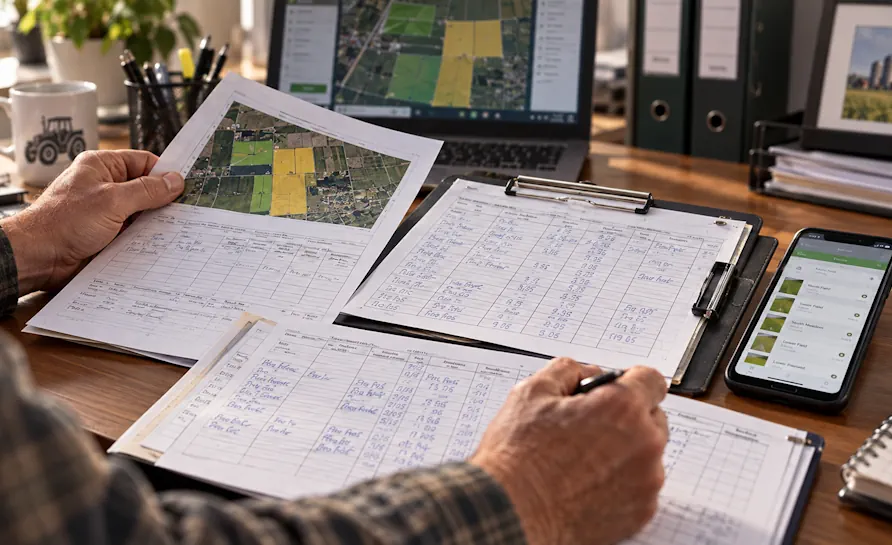
Short summary: Farming 4.0 does not pay for itself simply because a farm has bought an app, a sensor or a terminal. The return comes only when data begins to replace rewriting, guesswork and late decisions. In practice, the greatest saving is often not a single VRA map, but order across treatments, machinery, workers and documentation.
In brief
Farming 4.0 makes economic sense when it solves a specific farm problem: too much manual record-keeping, poor cost control, uneven fields, delayed operations, unclear machinery data or audit risk. Technology alone does not reduce costs. The process does, once data from fields, machinery, the mobile app and documentation is used every day.
- The first step is to organise core data: fields, crops, treatments, stores, workers and machinery.
- Satellite monitoring and VRA produce meaningful results where field variability is recurring, not incidental.
- Internal data from Agri Solutions and FarmPortal shows that around 15% of system users use Farming 4.0 features, while around 7% generate variable-rate fertilisation maps.
- The biggest implementation mistake is buying a precision tool without a working procedure for the operator, agronomist and farm owner.
What does Farming 4.0 mean in farm practice?
Farming 4.0 is a farm management model that combines data from fields, machinery, satellite imagery, sensors, mobile applications and IT systems, so that agronomic and organisational decisions are based on measurements rather than notes and memory alone.
As a definition, it sounds simple. On a farm, it starts with a less impressive question: where was the last treatment recorded, who carried it out, what dose did the operator apply, and will that information later reach a report for ARiMR, an adviser, a buyer or an auditor?
The European Commission describes agricultural digitalisation as a tool supporting the objectives of the Common Agricultural Policy, including economic efficiency, the environment, climate and rural development. It is therefore not only about autonomous machinery, but also about day-to-day record-keeping and the exchange of data between those involved in production. Agricultural digitalisation in the EU according to the European Commission.
The position is straightforward: Farming 4.0 is not automatically cheaper than traditional farm management. It becomes cheaper only when it removes specific losses: duplicated data entry, delayed treatment decisions, unnecessary journeys, incorrect rates, missing field history and unclear documentation.

Does Farming 4.0 really reduce costs?
Yes, but not on every farm and not from day one. Savings appear where a farm management system replaces real manual work, reduces errors or helps to carry out an operation better than before.
The farmer is not paying for “digitalisation”. They are paying for the time they no longer spend rewriting data. They are paying for a lower risk of errors in crop protection product records. They are paying for a map that varies the fertiliser rate on a field with recurring variability. If the system does not touch any of these areas, it becomes just another subscription.
Internal data from Agri Solutions and FarmPortal shows an important imbalance: only around 15% of FarmPortal farm management system users use Farming 4.0 features, and around 7% generate variable-rate fertilisation maps. This is not an argument against technology. It is a sign that most farms begin with records, fields and treatments, and only later move on to precision fertilisation, machinery integration and automation.
| Area | Typical loss before digitalisation | Saving mechanism | Condition for economic sense |
|---|---|---|---|
| Treatment records | Rewriting data from paper notes, missing batch numbers, incomplete dates. | One entry in the app feeds field history and reports. | Operators record treatments as they happen, not after the season. |
| Satellite monitoring | Field inspections without clear priorities and late response to crop stress. | NDVI or NDRE indicates zones that need checking. | The farmer combines imagery with field inspection, weather and field history. |
| VRA | One fertiliser rate despite differences in nutrient status and yield potential. | The rate changes between field zones. | The field has recurring variability and the machine can execute the map correctly. |
| Machinery and fieldwork | No clear information on how much time and fuel a specific operation consumes. | Machinery work history supports settlements and planning. | GPS data is linked to the field, operation and operator. |
Where does the hidden cost of digitalisation most often arise?
The hidden cost is not in the app itself. It most often appears when a farm buys a tool but does not change the way it works. The data then exists in the system, in a notebook, on the operator’s phone and in an Excel spreadsheet at the same time.
In May, when treatments, fertilisation, crop inspections and the first weather-related problems overlap, no one has time to tidy up overdue records. If the operator writes the treatment on a piece of paper, the agronomist sends a photo through a messenger app, and the owner completes the data from memory in the evening, farm digitalisation does not reduce work. It adds a fourth channel.
That is why a Farming 4.0 implementation in FarmPortal should begin with simple rules: which data is mandatory, who enters it, when a record is considered complete, and which reports should be generated without manual rewriting. Only then is it worth discussing VRA, terminal integration and sensors.
| Criterion | Paper | Spreadsheet | FarmPortal as an FMS |
|---|---|---|---|
| Field data | Close to the operator, but easily lost. | Requires rewriting after the work is done. | Can be recorded in the farmer’s app while still in the field. |
| Treatment history | Difficult to filter by plot and crop. | Possible if the spreadsheet is maintained consistently. | Links the field, crop, product, dose, date and person carrying out the work. |
| Reporting | Requires manual reconstruction of information. | Depends on file quality and version control. | Uses data recorded in farm operations. |
| Scalability | The larger the scale, the greater the disorder. | Works until multiple people and file versions appear. | Creates one shared workspace for the owner, workers and adviser. |
How does FarmPortal organise data before moving into VRA?
FarmPortal acts as the farm’s operational data centre. Before a farmer generates a variable-rate fertilisation map, they should have correctly described fields, crops, treatment history, soil test results, machinery and the people responsible for carrying out work.
In practice, this means that FarmPortal features for farm management should not be treated as an add-on to precision agriculture. They are the foundation. Without reliable field history, a VRA map is only an attractive file whose assumptions are difficult to defend agronomically.
A Farm Management System, or FMS, makes sense when it collects production data in one place: treatment records, work planning, stock records, machinery monitoring, workers, field observations and data from precision modules. FarmPortal develops this model as part of the FarmCloud ecosystem.
Farmers often ask about saving on fertiliser. A better question is this: do I know which fields have fertiliser as the largest uncontrolled cost, and which ones are affected more by treatment timing, disease pressure, labour shortages or incomplete documentation for the buyer?
Satellite monitoring and VRA: when does it make sense?
Satellite monitoring and VRA make sense when a farm can translate a field image into an executable decision. A vegetation index alone does not yet say whether the issue is nitrogen, drought, waterlogging, disease, soil compaction or an error in a previous operation.
FAO describes precision agriculture as a data-based approach that can improve productivity and reduce the use of water, fertilisers and crop protection products. That matters, but under farm conditions a second requirement needs to be added: the data must be actionable, meaning usable by a person or a machine.
In FarmPortal, crop monitoring can be based on satellite imagery, index analysis, field data and soil test results. The farmer can see differences between zones, but the decision should be made by combining several layers of information. A single image taken after heavy rain is not a fertilisation strategy.
Variable Rate Application (VRA) works best where field differences repeat over time. If, in one year, a weaker zone resulted from a heavy set of machinery driving over wet soil, the map for the following season should not automatically treat that zone as the field’s permanent potential.
| Situation on the farm | Recommended first step | Risk of moving into VRA too early |
|---|---|---|
| No complete treatment history | Complete the field, crop and treatment records in FarmPortal. | The map has no agronomic context. |
| Soil tests and recurring zones are available | Combine results with satellite monitoring and prepare a VRA map. | Low, provided the machine supports the prescription file. |
| The farm uses different terminals and machines | Check data exchange formats, such as ISOXML or SHP. | The operator cannot execute the map despite a correct plan. |
| Delayed field operations are the main problem | Improve work planning and communication with operators first. | VRA will not fix poor work organisation. |
Machinery integration, ISOXML and in-cab data
Machinery integration is one of the most difficult areas in Farming 4.0 implementation because it requires data consistency between the office plan, the in-cab terminal and the actual execution of the operation in the field.
ISO 11783, known in practice as ISOBUS, describes the communication network between tractors, machinery, sensors, control elements and units used for storing or presenting data. Its purpose is to standardise data exchange in agricultural and forestry machinery. ISO 11783-1:2017.
In everyday farming language, this comes down to one question: can the plan from the system be transferred to the machine without manually retyping rates? With VRA, the file format, terminal support, machine configuration and operator discipline all matter.
FarmPortal supports work with maps, zones, satellite data and the export of information to compatible solutions. Within the article cluster, this topic should be linked to a text on variable-rate fertilisation with VRA in FarmPortal and to a description of sensors, weather stations and systems automating farm work.
Benefits for farmers, advisers and processors
Farming 4.0 looks different from the perspective of the farm owner, different from the perspective of the agronomist, and different again from the perspective of the processor who needs data on raw material, batches and compliance. The same information can therefore work several times.
For the farmer
The main benefit is control over production. The farmer sees fields, crops, treatments, tasks, machinery, costs and documentation in one system. An app for farmers makes sense not because it is mobile, but because it shortens the route from fieldwork to a complete record.
For the agronomic adviser
The adviser gains a shared data base with the farm. They no longer need to ask for photos of random paper notes, fragments of maps and outdated spreadsheets. They can link a recommendation to a specific plot, treatment history, growth stage, disease pressure and weather data.
For the processor and distributor
In the supply chain, traceability matters: the ability to reconstruct the route of a product, batch, field, delivery and quality documentation. FoodPass, as part of the FarmCloud ecosystem, supports this area for processors, distributors and organisations working with many suppliers. This article should be linked to a guide on what traceability means in agriculture.
Example: a 180 ha farm
The farm covers 180 ha (the FarmPortal user has consented to publication), including 90 ha of cereals, 45 ha of maize, 25 ha of oilseed rape and 20 ha of field vegetables. Before the system was implemented, treatment data was kept in a notebook and spreadsheet, while field maps were stored in a separate programme. Operators reported completed work by phone.
The problem was not a lack of willingness to use technology. The problem was that, in June, the owner did not know which costs had already been assigned to a specific field and which still “needed to be allocated”. During a documentation check, dates, rates and product batch numbers had to be reconstructed from several places.
In the modelled implementation, the farm began with field records, crops, treatments, product stock and work planning. Only in the second stage did it add satellite monitoring, field zoning and the preparation of variable-rate fertilisation maps for selected plots where differences in soil nutrient status and crop condition had repeated for at least 2 seasons.
| KPI | Starting point | After organising the process | Interpretation comment |
|---|---|---|---|
| Time spent completing treatment documentation | Approximately 6–8 hours per month | Approximately 2–3 hours per month | The saving depends on disciplined, real-time data entry. |
| Share of fields with complete treatment history | Around 60% | Around 95% | Model data, not the result of an actual audit. |
| Fields selected for VRA | 0 ha | 55 ha | Only fields with recurring variability were selected. |
| Number of places where data was stored | 4: notebook, phone, spreadsheet, map files | 1 main workspace plus prescription files | The biggest change concerns organisation, not the technology itself. |
The conclusion from this example matters: a farm should not begin with the most expensive element of Farming 4.0. It should start with the place where data is most often lost or rewritten. Only then is it worth scaling monitoring, VRA, integrations and automated reports.
Limitations and implementation mistakes
Farming 4.0 makes no sense if the farm has no one responsible for data. A system will not fix disorder when everyone enters information differently, fields have different names, and operators receive instructions outside the system.
The most common mistake is buying a sensor, terminal or app without answering the question of who will make decisions based on the data. The second mistake is expecting satellite monitoring alone to explain the cause of a problem in the field. It will not. It will show a difference that needs to be checked agronomically.
The third mistake is implementing VRA on all fields at once. A better route is to select a few plots, compare satellite data, soil tests, yield maps and field observations, and then prepare a prescription map only where the decision is justified.
- Do not start with automation if your fields and crops are not yet organised.
- Do not export a map to a machine if the operator has not checked the format and terminal.
- Do not treat NDVI as a diagnosis. It is a signal to inspect the field.
- Do not calculate VRA savings on the basis of one season with unusual weather.
- Do not keep full documentation in both the system and a notebook unless there is an organisational requirement to do so.
FAQ
Does Farming 4.0 pay off on a small farm?
It can pay off, but usually not by starting with advanced VRA. On a smaller farm, the first benefit is often better organisation of treatments, stock, costs and documentation. If the farmer saves several hours per month and reduces the risk of errors in records, a simple farm management system can make sense.
Can an app for farmers replace the treatment notebook?
Yes, if the farm adopts the rule that a treatment is entered as it happens, with the field, date, product, rate, person responsible and notes. The app alone is not enough. It replaces the notebook only when it becomes the main place for records, not a copy of documentation held elsewhere.
How is a Farm Management System different from a regular spreadsheet?
A Farm Management System links operational farm data: fields, crops, treatments, machinery, workers, stores, documents and reports. A spreadsheet can store a table, but it usually does not control the relationship between a treatment, plot, product, operator, field history and later reporting.
When is it worth implementing variable-rate fertilisation with VRA?
VRA is worth implementing when a field has recurring variability, data is available on soil or crops, and the machine can execute the prescription map. If the farm does not yet have treatment history and correct field boundaries, it is better to start by organising data in an FMS.
Is satellite monitoring enough to make fertilisation decisions?
No. Satellite monitoring shows differences in crop condition, but it does not automatically explain their cause. Fertilisation decisions need to combine field history, weather, soil testing, field inspection and agronomic knowledge. An NDVI or NDRE index is the start of the analysis, not a ready-made recommendation.
Does Farming 4.0 require new machinery?
Not always. Many benefits can be achieved through better records, work planning, crop monitoring and documentation. New machines or terminals are important for automatic execution of VRA maps, but they are not a prerequisite for starting farm digitalisation.
How does FarmPortal support machinery integration?
FarmPortal supports work with field data, maps, crop monitoring, treatment planning and data export to compatible solutions. For machinery integration, the file format, terminal, equipment configuration and the way the operator confirms completed work all need to be checked.
What role does FoodPass play in Farming 4.0?
FoodPass is relevant on the supply-chain side. It helps processors, distributors and advisers work with data on suppliers, batches, quality, audits and traceability. Farming 4.0 does not end in the field if data is later expected to support sales, quality and compliance.
How can a farm start digitalisation without wasting budget?
Start by choosing one process that currently creates the greatest losses: treatment documentation, work planning, field monitoring, worker settlements or preparing data for the buyer. Implementing everything at once often ends in confusion. One process completed properly is the better route.
Glossary
Farming 4.0
A model of agricultural production based on data from fields, machinery, sensors, satellite imagery and IT systems. In practice, it means fewer decisions made “by eye” and more decisions based on history, measurements and current observations.
Farm Management System
A system for managing a farm that organises fields, crops, treatments, machinery, workers, stores and reports. FarmPortal is an example of an FMS developed for farms, advisers and organisations working with agricultural production.
VRA
Variable Rate Application, or variable-rate application. The technology changes the rate of fertiliser, crop protection product or seed depending on the field zone and the prepared prescription map.
NDVI
Normalized Difference Vegetation Index, a vegetation index used to assess crop condition on the basis of remote-sensing data. It shows differences within a field, but it does not replace agronomic diagnosis.
NDRE
Normalized Difference Red Edge Index, an index useful, among other things, for analysing crop condition at more advanced growth stages. It can support assessment of canopy variability and the planning of field inspections.
ISOXML
A data exchange format used in precision agriculture, linked to the ISOBUS ecosystem. In practice, it can be used to transfer tasks and prescription maps between a planning system and a machine terminal.
ISOBUS
The practical name for the ISO 11783 standard covering communication between a tractor, machine and terminal. For the farmer, it means a greater chance that different pieces of equipment will exchange data in an organised way.
Traceability
The ability to identify and trace a product or batch through the supply chain. In agriculture and food processing, it means being able to reconstruct the origin of raw material, field, treatments, delivery, quality control and further movement.
FarmCloud
The digital ecosystem from Agri Solutions, connecting solutions for farms, food processing, advisory services and the supply chain. It includes, among others, FarmPortal and FoodPass.
Summary and next step
Farming 4.0 creates real savings when it starts with a process, not with the purchase of technology. The farm should first identify where it is losing money or time: documentation, work planning, fertilisation, machinery work, worker settlements or data for the buyer.
If the problem is disorder in records, start with an FMS. If the problem is field variability, combine satellite monitoring, soil tests and treatment history. If the problem is execution, check the terminal, data format and operator procedure.
Practical next step: choose 3 fields and 1 process to organise in FarmPortal. For each field, check treatment history, costs, satellite data, soil results and the possibility of preparing a map. After a month, it will be clear whether the farm needs VRA, better work planning, machinery integration or simply one shared data base.
Follow us!
See what we're doing and be inspired by positive changes.