In brief
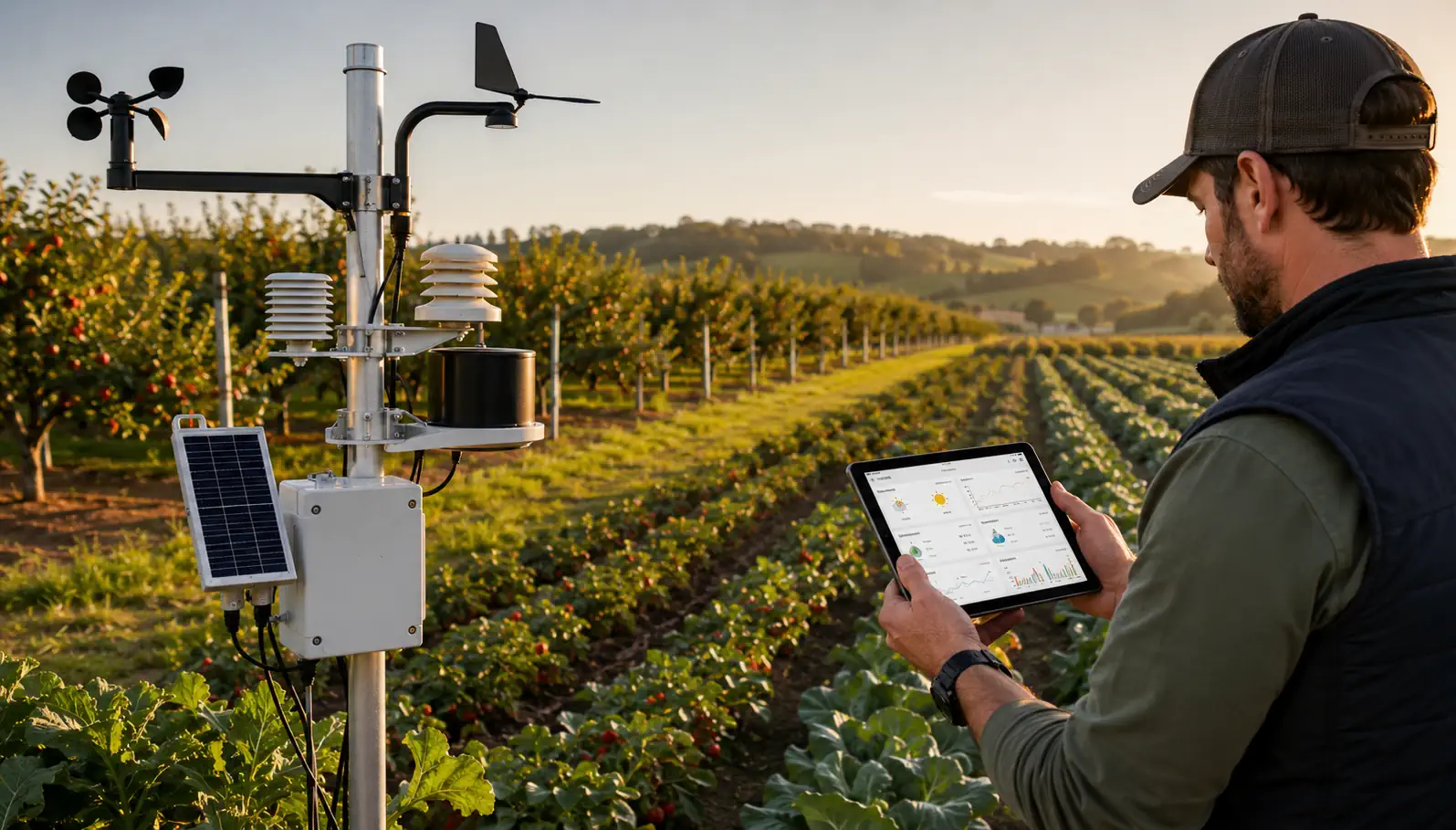
Treating a weather station as a more expensive thermometer is the most common mistake. In fruit, berry and vegetable production, the device has to pay for itself – through well-timed sprays, frost protection and precise irrigation. In extensive crops, a virtual station connected to reliable field history is often perfectly sufficient at the beginning.
- Physical equipment in the field performs best in high-margin crops and wherever disease pressure is greatest.
- Calculate return on investment through avoided mistakes, not attractive charts on a smartphone screen.
- FarmPortal connects weather data with the work calendar, alerts, disease models and documentation.
Does an agricultural weather station really pay off?
The short answer is yes, but on one condition: the data must be used regularly. Do not buy a station “just in case”. It should solve a specific problem: missed spray timings, unexpected frost pockets in lower parts of the field or lack of control over soil moisture.
The issue is straightforward: if station data does not change even one decision during the season, the device is only a cost. On many farms, the charts look professional, but operators still spray when there happens to be a gap in the schedule. In that set-up, the station does not earn its keep. What earns money is the change in habits.
The fastest payback will come in crops where a weather-related error hits the margin immediately. In orchards, this means apple scab infection risk and blossom protection. In berry production, precise water management is added to the equation, while in vegetables the key is choosing the right moment for sowing and machinery entry after rainfall.

Which decisions does field-level weather data change?
A local station helps growers stop relying solely on general forecasts from television or the internet. The point is to capture the microclimate that determines whether a spray, sowing operation or frost protection action will succeed.
In May, the temperature difference between a slope and a hollow within the same orchard can be decisive. The general forecast may not predict a temperature drop, but a ground-level sensor in the lowest part of the block can show a critical value. That is the moment when local measurement protects yield.
During spraying, the station answers three questions: will the wind carry spray away, will humidity keep droplets on the target, and will rain arrive within the next hour? The IPM guidance from the University of California clearly shows the risks linked to wind that is too strong (or too weak), temperature inversion and spraying shortly before rainfall.
For irrigation, the farm moves away from the “by eye” method. Using the FAO-56 Penman-Monteith method, the system calculates reference evapotranspiration. The best results come from combining this weather data with the crop growth stage and readings from soil moisture probes. Source: FAO, Irrigation and drainage paper 56.
In plant protection, the station supplies the input data for disease models. Remember: models do not replace going into the field. They work as an early-warning system, effectively saying: “check this block, because conditions for fungal development have been ideal”. This is also how MRiRW approaches the subject, pointing to the rational use of plant protection products based on signalling. Source: MRiRW, Integrated Plant Protection.
| Decision | Data required | Typical cost of error | How FarmPortal helps |
|---|---|---|---|
| Spraying | Wind, rainfall, humidity, temperature, Delta-T | Product wash-off, poor coverage, spray drift | Connects the recommendation with a weather alert for the specific field |
| Irrigation | Rainfall, temperature, radiation, soil moisture | Overwatering, drought stress, high electricity bills | Helps optimise the irrigation dose and timing |
| Frost | Ground-level temperature, downward trend, humidity, wind | Frozen blossoms, damaged fruitlets and yield loss | Sends immediate notifications with risk assigned to field blocks |
| Sowing or planting | Soil temperature, rainfall, short-term forecast | Poor and uneven emergence, expensive corrective work | Supports work planning and organises schedules by field |
How much does an agricultural weather station cost and how should ROI be calculated?
Calculate the profitability of a station based on the mistakes you can avoid. Buying the device is only the starting point. Add to the equation the cost of data transmission, installation, regular sensor cleaning, additional probes and, quite simply, the time needed to analyse alerts.
Market prices vary. A simple set (temperature, rainfall and humidity) costs in the region of PLN 3,000–6,000 net. A more advanced station with an anemometer, a solar radiation sensor and a leaf wetness sensor costs from PLN 7,000 to PLN 15,000 net. Professional systems with multi-depth soil probes can exceed PLN 20,000 net.
Instead of believing marketing promises about “savings of 30%”, calculate the figure using specific situations from your own farm. How much does one unnecessary spray, washed off by rain, cost you? How much do you lose because people are idle after poor work organisation following a downpour? Adding up three such failures gives a much more realistic picture.
| Element | Financial assumption | Annual balance | Notes |
|---|---|---|---|
| Station purchase | PLN 11,000 net | initial cost | Set: rainfall, wind, radiation, leaf wetness |
| Transmission and service | PLN 1,800 net per year | -PLN 1,800 | GSM subscription, inspections, cleaning and calibration |
| Avoided incorrect spray | 18 ha × PLN 220/ha | +PLN 3,960 | Saving on chemicals, fuel and operator time |
| Hitting the right window | 12 ha × PLN 280/ha | +PLN 3,360 | Treatment carried out in optimal conditions (no repeat work) |
| Water optimisation | Correction of two cycles + 20 h of work | +PLN 2,100 | Lower energy and water use, fewer phone calls |
| Annual net effect | After deducting fixed costs | +PLN 7,620 | Payback after approximately 1.4 seasons |
When should you choose a physical station, and when is a virtual one enough?
A physical station wins wherever the terrain creates a specific microclimate. A virtual version (based on satellite and radar data) is enough when you need a general view of conditions and your crops do not require precise measurement of leaf wetness or temperature just above ground level.
Virtual stations are an excellent entry point. They require no installation or servicing, provide a ready forecast for the field coordinates and give access to weather history. The problem appears when a local cloud drops rain over one block and the grid-based model does not detect it.
In fruit-growing practice, a good compromise is to install one full base station and place cheaper wireless temperature sensors in the spots where frost most often settles. On berry plantations, a good soil probe in a representative row will be more important than a wind sensor.
Before buying, check how data transfer works: the refresh frequency, whether the supplier offers an open API and whether the station will integrate smoothly with your software. It is also worth reading about the difference between physical and virtual weather stations.
| Criterion | Physical station | Virtual station | What to choose? |
|---|---|---|---|
| Microclimate | Measures real conditions on a specific field | Estimates data based on mathematical models | Physical: orchards, berry plantations, field vegetables and tunnels |
| Upfront cost | Higher (equipment purchase + subscription) | Low (often included in a management system) | Virtual: a good starting point for smaller farms |
| Disease models | Very accurate (thanks to the leaf wetness sensor) | Indicative (depends on interpolation quality) | Physical: essential for expensive and precise treatments |
| Operation | Requires inspection, cleaning and protection from machinery | Maintenance-free – no physical equipment in the field | Physical: only if you have time to look after the equipment |
Which parameters should an agricultural weather station measure?
The absolute basics are air temperature, rainfall total, humidity, and wind speed and direction. If you have an orchard or berry plantation, you should add a leaf wetness sensor, solar radiation, ground-level temperature and soil moisture probes at different depths. Without these, most disease models will be working partly blind.
Rather than following the rule that “the more sensors in the specification, the better”, choose them for specific problems. Do you struggle with frost? Invest in an accurate temperature sensor placed at the right height in the lowest part of the plot. Do you want to optimise water costs? Invest in good soil probes.
From implementation experience, one thing is clear: data most often fails not in the cloud, but in the field. A station placed too close to a building wall, an overgrown rain gauge, a dirty solar panel or a mast shifted during grass cutting – these are standard problems. The chart in the app will still look professional, but you will be making decisions based on incorrect data.
It is worth checking how FarmPortal management functions integrate these measurements with day-to-day treatment planning.
How do FarmPortal and FoodPass use weather data?
In FarmPortal, weather is not just a neat tab with charts. It is a working tool. Meteorological data is automatically linked to a specific block, treatment history, advisor recommendations and cost calculations.
What does this look like in practice? The system sends a frost alert to a mobile phone. Before sending a spray recommendation, the advisor checks the disease model and the date of the last treatment in the system. The manager approves the sprayer’s departure only when the weather window (wind and humidity) allows it, and the operator confirms completion of the work in the mobile app.
The system supports key areas: from forecasting treatment windows, through infection models, to setting sowing dates and monitoring drought stress. A detailed module overview is available on the page about crop health and safety in FarmPortal.
The FoodPass module, in turn, supports communication across the supply chain. A processor or buyer can see clearly which field a batch of raw material came from, what weather-related risks occurred during the growing season and whether plant protection was conducted in line with safety standards.
Case study: orchard and berry plantation
Let us look at a real implementation example (data simplified for business analysis purposes).
A 35 ha farm (18 ha of apple orchards, 12 ha of irrigated blueberries and 5 ha of field vegetables) had previously relied on a general weather forecast and notes in a notebook. The main problems? Repeated corrective sprays after unexpected rain, disputes with workers about whether entering the field made sense, and a delayed response to May frosts.
As part of the implementation, one base station was installed, together with two wireless temperature sensors in low-lying parts of the site and two soil moisture probes. Everything was connected to FarmPortal, with SMS alerts and a digital treatment register for employees activated.
The effect after the first season? The number of necessary repeat sprays fell from three to one over the year. Thanks to the probes, irrigation doses were matched to the real needs of the plants, and the manager saved around 20 hours on unnecessary phone calls and logistics. The success was not only due to the sensors themselves, but above all to the discipline of checking data before every field operation.
Limitations and implementation mistakes
A weather station will not fix poor work organisation. If nobody on the farm responds to alerts, checks Delta-T before treatment or analyses field history, the device will be nothing more than an expensive gadget.
Another issue is measurement representativeness. Trying to cover an 80 ha farm with varied relief and different soil types using one station is not a sound approach. Data from such a station will be too general to control, for example, irrigation with any precision.
A common mistake is buying equipment without checking integration options. Before signing a contract, verify whether the manufacturer allows free data export through an API and whether you can connect the station to FarmPortal without difficulty.
Finally, remember the limitations of disease models themselves. An algorithm is only as good as the quality of its input data. A dirty or poorly levelled leaf wetness sensor may distort results and shift the infection alert. Walking the crop and assessing it with your own eyes remains a basic agronomist’s duty.
Checklist before buying a weather station
Before you start comparing device prices, write down 5 specific decisions you want to improve with data. Only then should you choose sensors and software.
- Identify the crops and blocks where weather-related mistakes cost you the most over the year.
- Decide what is the priority: a full physical station, frost sensors or soil probes.
- Check the integration conditions with FarmPortal (data refresh frequency, API access, disease model support).
- Assign someone on the farm to be responsible for sensor cleaning and daily alert monitoring.
- Calculate potential ROI using real losses from previous years (washed-off sprays, frost losses, wasted water).
FAQ
Does a weather station make sense on a smaller farm?
It does, but it does not necessarily need to be expensive physical equipment. For a few hectares of arable crops, such as cereals, a virtual station will usually be enough. Install physical equipment when your margin depends on microclimate – in orchards, vegetables or berry plantations.
How much does a farm weather station really cost?
A basic, simple set can be bought for around PLN 3,000–6,000 net. Professional stations with a complete set of sensors (wind, radiation, leaf wetness) cost in the region of PLN 7,000–15,000 net. Remember to add the annual subscription cost for the telemetry card and access to disease models.
Which weather station will be best for my farm?
One that matches your production profile. Fruit growers need precise ground-level temperature measurement and a leaf wetness sensor. In berry production, soil probes will be key, while in intensive vegetable growing an accurate rain gauge and irrigation control module matter most.
Does a private weather station replace the traditional forecast?
No. These tools complement one another. The station tells you exactly what is happening at that moment in your field, while the forecast shows what to expect in the days ahead. The best results come from combining both sources in one system, such as FarmPortal.
How quickly does an investment in a weather station pay off?
In intensive vegetable or fruit production, payback may be possible after 1–2 seasons, provided you actually start using the data. Avoiding even one washed-off treatment over a dozen or so hectares can cover a significant part of the equipment purchase cost.
Which sensors are essential for disease models?
Most models, for example for apple scab or grey mould, require accurate data on temperature, air humidity, rainfall total and, crucially, leaf wetness duration. Without the last of these parameters, computer simulations rarely perform well.
Can a processor view weather data from growers?
Yes, and this is becoming an increasingly common practice that improves supply transparency. Through the integration of FarmPortal and FoodPass, processing plants can track the conditions in which raw materials were grown, making it easier to assess quality and traceability for a given batch.
When is it definitely not worth buying a physical weather station?
If you do not intend to check the app regularly, analyse notifications and clean devices in the field, do not buy one. Without your involvement, the station will only generate costs. In that case, a virtual version is a safer and cheaper choice.
Does FarmPortal offer ready-made weather alerts on a phone?
Yes. The system supports the configuration of mobile notifications, including warnings about an approaching frost or information that critical wind parameters have been exceeded during spraying. The precise scope of integration depends on the station model used.
Glossary
Agricultural weather station
In practice: An autonomous set of field sensors that measures weather parameters directly where crops are growing. It provides hard data for treatment planning.
Virtual station
In practice: A digital weather point generated for the coordinates of your field using satellite and radar data. A good starting option, although it will not detect the microclimate in an orchard hollow.
Leaf wetness
In practice: A key plant protection parameter. It shows how long a film of water remains on the leaf surface (for example from dew or drizzle), which, combined with temperature, helps predict fungal infections.
Delta-T
In practice: An indicator describing the relationship between air temperature and humidity. It is a key parameter for sprayer operators because it indicates whether spray droplets may evaporate before reaching the target.
Reference evapotranspiration
In practice: An indicator showing how much water evaporates from the soil surface and plants under given conditions. It allows the water balance to be calculated mathematically and helps plan the irrigation dose precisely.
DSS (Decision Support System)
In practice: A module in software, for example FarmPortal, that processes raw weather data and suggests specific actions, such as the optimal window for carrying out a treatment.
Disease models
In practice: Algorithms that analyse the course of weather in relation to the biology of a specific pathogen. They warn the farmer about a high risk of infection on the plantation.
FoodPass
In practice: A platform for managing quality and traceability in the supply chain. It enables processors and retailers to verify production history and raw material safety.
Summary and next step
A weather station does not earn money simply because it stands in a field and looks impressive. It earns money when it helps you replace intuition with facts. The first step should always be to identify where weather is causing the biggest financial leaks on the farm: whether through washed-off sprays or wasted water.
In intensive fruit or vegetable production, physical equipment connected to FarmPortal is a standard tool for cost optimisation. If your crops are less demanding, start calmly with a virtual station and learn to work with digital field history.
What should you do now? Choose one field and one specific problem, for example missed spraying windows. Then see which weather station functions in FarmPortal can help you solve that problem in the coming season.
Follow us!
See what we're doing and be inspired by positive changes.