Agriculture 4.0 and 5.0: what is changing in the field and why data is critical
Agriculture has always been the art of making decisions under uncertainty: weather, disease pressure, markets, the availability of people and machinery, narrow treatment windows, and delivery schedules. For decades, advantage came from mechanisation, later from intensification, and today more and more the winners are those who can turn scattered signals from the farm into a clear answer: what to do, where, when, and how much, with minimal risk and maximum return. That is exactly what the concepts of Agriculture 4.0 and Agriculture 5.0 are about. They are not trendy buzzwords, but shorthand for the path most farms follow: from digitally structuring fields and operations (Agriculture 4.0) to automation, robotics, and decision support powered by artificial intelligence (Agriculture 5.0). To better understand these and other digital agriculture concepts, see our Digital Agriculture Glossary 2026.
The most important point is that you cannot skip this path with a single purchase. Autonomous equipment or a new sensor will not solve the problem if you lack field maps, operation history, agronomic context, and processes that connect data into one source of truth about each field. That is why, at FarmPortal, we treat digitalisation as a system rather than a set of devices: FMS + field map + records + integrations + analytics + automation. Only with such a foundation can you build the capabilities typical of Agriculture 5.0.
Agriculture 4.0: a digital farm that runs on data
Agriculture 4.0 is the stage where a farm starts operating like a well-managed operation: it has an organised structure of fields, crops, and resources, records work, treatments, costs, and execution, and uses external data (weather, satellites, analyses) and internal data (machines, people, inventory) for planning and optimisation. In practice, 4.0 starts with very concrete questions: what does a hectare cost on a given field, where am I losing yield, which treatments am I repeating out of habit, how can I shorten my response time to risk, how can I avoid documentation errors, and how can I generate reports without manual rewriting.
The answers do not come from a single data source. They come from having information in one place, consistent, and comparable season to season. FarmPortal, as a farm management system, is built to support this: it structures operational data, reduces the time needed to record events, and simplifies performance analysis.
The most important elements of Agriculture 4.0 and their practical value
Agriculture 4.0 is primarily a data-driven decision loop: observation, analysis, decision, execution, recording, and verification of outcomes. For that loop to work, you need a few elements that deliver the highest real-world return:
- a field map and consistent plot identification, because without this everything is approximate
- records of treatments and field work, because without history there is no analysis or control
- planning and work organisation, because farming is logistics of time and resources
- reporting and cost accounting, because optimisation without numbers is guesswork
- data integrations, because the biggest losses come from manual rewriting and errors
A typical implementation scenario looks like this: order in fields and the map, then records of work and treatments, then adding data layers (weather, satellites, sensors, machines), and finally implementing precision actions and automated reporting.
Agriculture 5.0: AI, robotics and autonomy, with people at the centre
Agriculture 5.0 continues 4.0, but goes further in two directions. First, artificial intelligence stops merely displaying data and begins supporting decisions: it predicts risks, detects anomalies, recommends priorities, and suggests the best actions under specific conditions. Second, robotics and autonomy take over part of the execution: selective treatments, weeding, monitoring, targeted interventions, and in some cases autonomous driving or work during very short weather windows.
In 5.0, people remain essential, but their role changes: less manual checking and rewriting, more risk management, quality management, and profitability control. Technology is meant to work with the farmer, not only replace them.
Differences between Agriculture 4.0 and 5.0 in practical terms
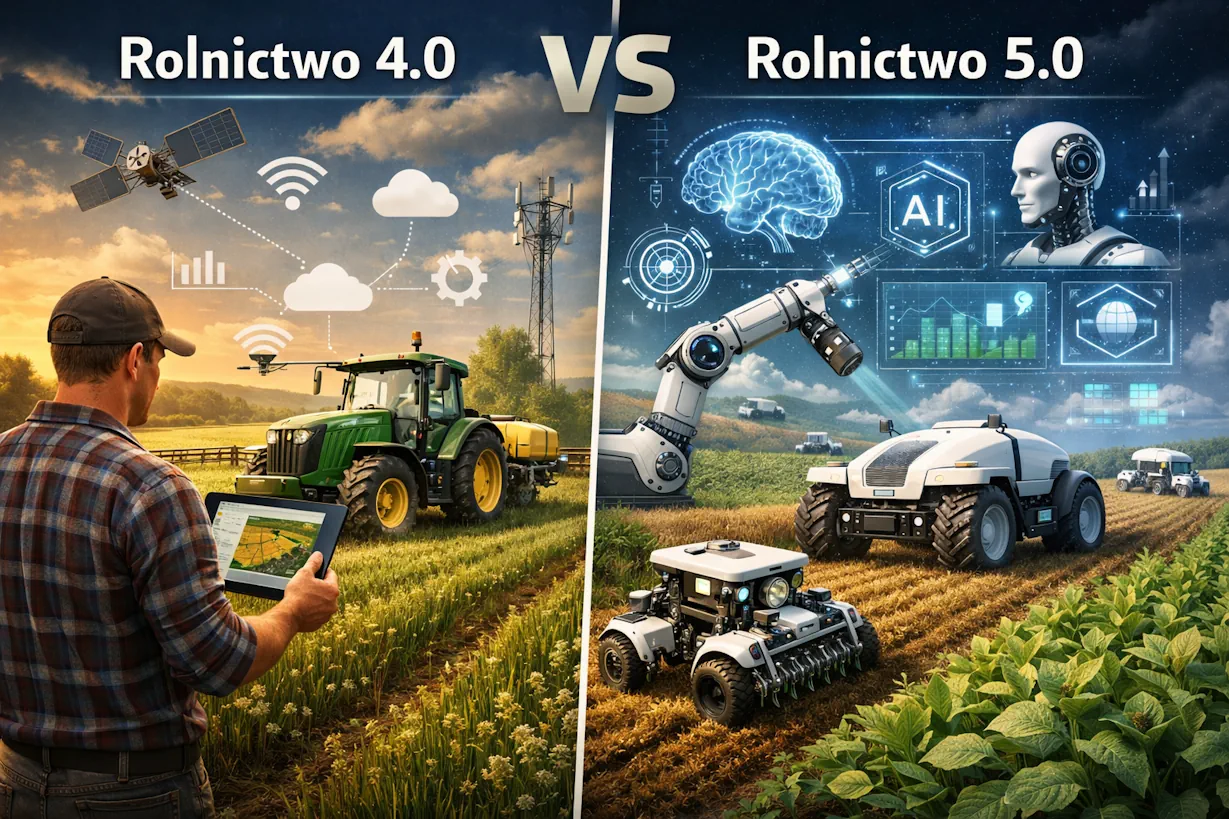
Agriculture 4.0 answers the question: what is happening and what should we do, based on structured data. Agriculture 5.0 adds: what does the system recommend and how can we execute it quickly, precisely, and as automatically as possible.
In 4.0, the key building blocks are the FMS, maps, registers, telematics, monitoring, and analytics. In 5.0, predictive models, computer vision, automated anomaly detection, robots, selective application, and autonomous field platforms are added (see Agriculture 5.0 in practice).
Agriculture 4.0 use cases: examples you can see in the budget
The most tangible 4.0 implementations are those that shorten decision time and reduce waste.
Example 1: variable-rate application and zone management
A farm that collects yield history and uses satellite data can see that part of a field has consistently lower productivity while another part has high potential. Variable-rate application moves inputs to where they pay back and reduces them where they do not, improving cost efficiency and environmental balance.
Example 2: risk-based plant protection
Combining weather data, field history, and monitoring enables better planning of treatment windows and helps avoid interventions made out of caution rather than actual need. The result is fewer passes, lower product use, and more predictable quality.
Example 3: in-season work and resource logistics
With one system, you see the work plan, equipment availability, and crop-critical deadlines. This makes prioritisation easier, reduces resource conflicts, and shortens downtime.
Example 4: profitability per field and per crop
Two fields of the same crop can have completely different economics. Only cost and performance data enables rational changes to technology, variety selection, fertilisation or plant protection strategy, and sometimes even a shift in cropping structure.
Agriculture 5.0 use cases: a new level enabled by AI and robotics
In 5.0, solutions appear that were difficult or uneconomic in the traditional model.
Example 1: selective treatments and spot spraying
A vision system identifies weeds or symptoms and applies product only where needed. This reduces active ingredient use while increasing precision and operational safety.
Example 2: robotic weeding in specialist crops
A robot performs repetitive tasks while a person supervises quality and handles exceptions. This is especially valuable where labour is scarce or labour costs are rising fastest.
Example 3: AI as an early-warning system
Risk models can suggest scouting and action priorities. Instead of driving fields blindly, the farmer gets guidance: where the risk is highest, what to check, and which scenario is most likely.
Example 4: autonomy in short weather windows
In some cases, autonomy can enable work when the window is very short and organising people and equipment is difficult. The condition is a coherent data context, operational safety, and quality control.
Where we are today: three barriers that most often slow implementation
The first barrier is data quality and consistency. If fields are poorly defined, operations are not recorded, and data from different sources lacks shared context, even the best analytics will not help much. The second barrier is integration: agriculture is full of devices and systems, and value emerges only when data flows between them. The third barrier is process and habits: technology must fit the rhythm of the season, otherwise it becomes extra work.
How FarmPortal supports the 4.0 to 5.0 journey
We develop FarmPortal so that farm digitalisation is practical, automated, and easy for system users. We start with maps and fields, then build mobile-friendly records of work and treatments that can be captured in the field, and then add data layers, reports, and automations that reduce manual rewriting. The goal is a single, coherent decision process and a single source of truth about the field, which can support precision agriculture, decision support, and future integrations with autonomous solutions. FarmPortal was designed to be easy to use while providing modern capabilities for precision farming, regenerative practices, Agriculture 4.0 and Agriculture 5.0. FarmPortal also serves as an innovative operating system for agricultural equipment manufacturers and data providers, enabling them to integrate their products faster with the FarmPortal digital farm management platform.
The future: less manual record-keeping, more automated decisions, and more proof of quality
The most realistic direction for the coming years is automating what currently consumes time without creating value: manual notes, scattered files, a lack of consistent reports, and difficulty proving what happened, where, and when. At the same time, prediction and recommendation will matter more, because weather variability and disease pressure are increasing. In specialist crops, robotics and selective treatments will accelerate. Data will also become increasingly important as a currency of trust in the supply chain: for advisors, buyers, and processors, transparency, compliance, and auditability matter.
Agriculture 4.0 is the foundation, and Agriculture 5.0 is acceleration. Both share the same core: structured information that works inside a process, not data that sits idle in files.
Follow us!
See what we're doing and be inspired by positive changes.