Farm Management Systems (FMS) have long been identified as the foundation of precision agriculture, Agriculture 4.0, and Agriculture 5.0. Nevertheless, their actual adoption on farms is progressing much slower than digitalization strategies anticipated. This article identifies exactly where the barriers lie, what the FMS implementation process looks like in practice, and what farmers actually expect from such systems—based on scientific research, industry reports, and insights from our users who share their observations and suggestions with us.
Key Facts
- According to research on the adoption of digital tools in agriculture, 30% to 50% of FMS implementations are abandoned or only partially used.
- The main barriers are system complexity, lack of data interoperability, and low short-term return on investment (ROI).
- Farmers accept FMS when it simplifies daily work, rather than just generating reports.
- Effective FMS implementation is an organizational process, not just a software installation.
- Implementing a farm management system also involves a change in habits and workflows.
1. What is FMS – An Operational Definition
An FMS (Farm Management System) is an IT system used for:
- Collecting data on fields, crops, treatments, and costs.
- Integrating data from machinery, sensors, and soil tests.
- Supporting the planning, execution, and documentation of agricultural production.
Important Distinction: An FMS is not a "digital notebook." It is intended to be the decision-making layer of the farm. For definitions of FMS, precision agriculture, and related terms, see our Digital Agriculture Glossary 2026.
2. What the FMS Implementation Process Looks Like in Practice
Research on digital system implementations in agriculture shows a repeatable pattern, which also forms the basis for FarmPortal or the entire FarmCloud platform implementations. Based on experience, we can identify 4 main stages.
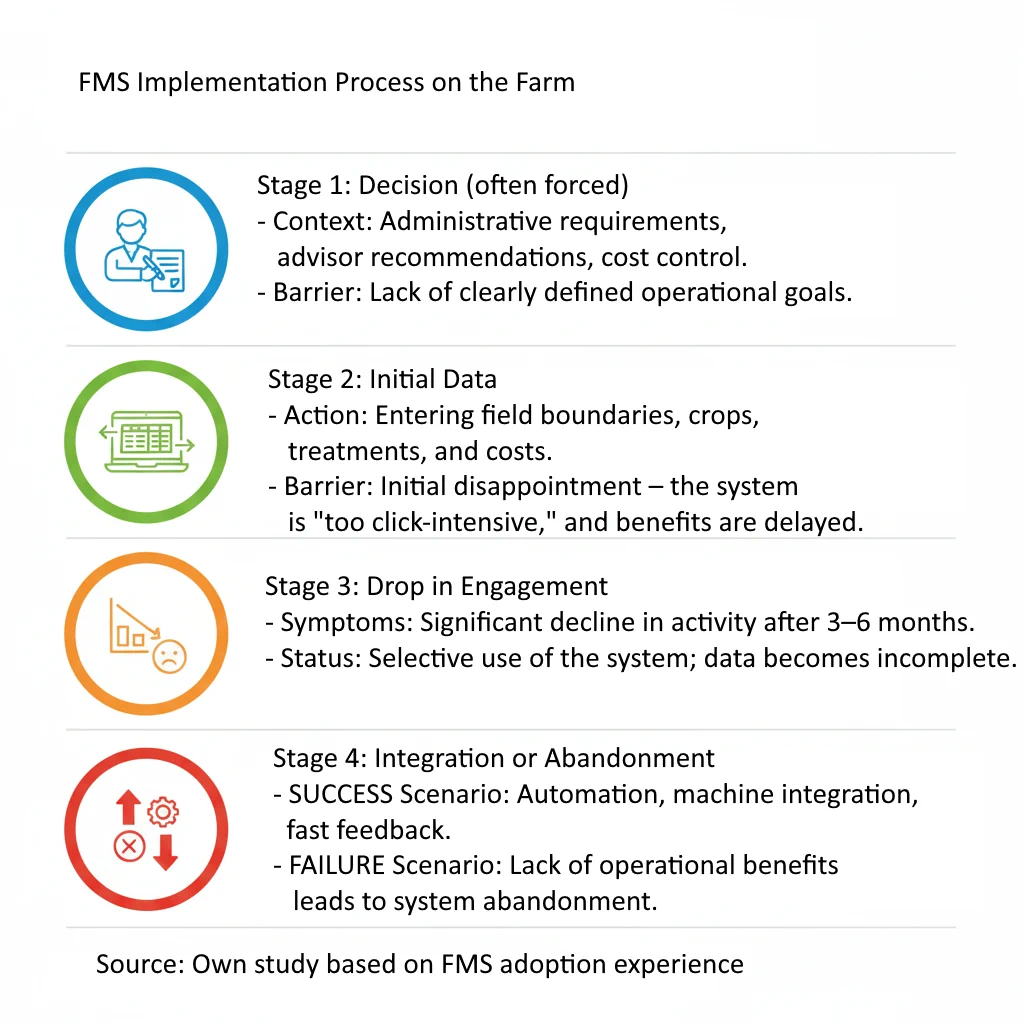
2.1 Stage 1 – The Decision (Often Forced)
Most common reasons for starting implementation:
- Administrative or contractual requirements.
- Pressure from an advisor, fertilizer company, or processor.
- The need for "better cost control" (this is the best, most conscious reason).
- New incoming regulations.
Problem: The decision rarely stems from a clearly defined operational goal.
2.2 Stage 2 – Initial Data
The farmer begins to enter:
- Fields and crops.
- Treatments.
- Sometimes costs.
At this point, the first disappointment occurs – the system "requires too much clicking," and the benefits are deferred.
2.3 Stage 3 – Drop in Engagement
According to research on FMS adoption:
- After 3–6 months, user activity drops significantly.
- The system is used selectively (e.g., only for logging treatments, checking weather, or tracking paths).
- Data becomes incomplete.
This is the most common moment for abandoning the implementation.
2.4 Stage 4 – Integration or Abandonment
Systems that:
- Integrate data from machinery and sensors.
- Automate parts of the workload.
- Provide fast feedback (alerts, recommendations).
These have significantly higher user retention.
3. Main Problems in FMS Implementation – What Research Says
3.1 Excessive System Complexity
Literature reviews on FMIS/FMS show that an excess of functions and "heavy" data entry processes are among the most frequently reported obstacles.
Farmer feedback (from qualitative studies and reviews):
"The system is good, but only on paper. During the season, I don't have time to fill everything in."
3.2 Lack of Data Interoperability
One of the most cited barriers:
- Data from machines, sensors, and laboratories are in different formats.
- Import/export is manual or unreliable.
- The farmer becomes a "data integrator."
Reports on agricultural digitalization point to interoperability as a prerequisite for further automation and the reduction of "data bottlenecks."
3.3 Low or Delayed ROI
Analyses of management system adoption at the farm level show that:
- Benefits appear over time.
- The initial period is a cost of learning and organizing data.
- Without integration with decisions (e.g., fertilization, irrigation), ROI is poorly visible.
3.4 Lack of Alignment with Real Processes
In studies on the acceptance of agricultural technologies (TAM/UTAUT and related), it is repeatedly noted that adoption drops when the solution does not fit the work rhythm and the context of the farm. This leads to users bypassing the system or using it only partially.
4. Why FMS Adoption Progresses Slowly – A Scientific Perspective
Research on technology adoption in agriculture – in the context of digitalisation and Agriculture 4.0 and 5.0 – points to four key factors:
- Perceived Usefulness – Does the system realistically help here and now?
- Ease of Use – Can it be operated during the busy season?
- Trust in Data – Are the recommendations understandable?
- Implementation Support – Is the user left alone?
In agriculture, these factors are stronger than in other industries because an error can cost an entire production season.
5. What Farmers Complain About vs. What They Like – A Synthesis
Most common complaints:
- "Too much manual data entry."
- "Reports are too complicated."
- "Lack of machinery integration."
- "The system is good for the government, not for me."
Most appreciated elements:
- Automated data collection.
- Alerts (weather, frost, treatment windows).
- Maps and visualizations instead of tables.
- A single place instead of multiple apps.
6. What a Good FMS Should Contain – Findings from Research and Practice
6.1 Essential Basic Functions
- Simple field and crop registry.
- Fast logging of treatments.
- History of actions and changes.
6.2 Adoption-Boosting Functions
- Integration of machinery and sensor data.
- Automated alerts and reminders.
- Data visualization (maps, timelines).
6.3 Decision-Making Functions (Crucial)
- Linking data with recommendations.
- Comparison of plan vs. execution.
- Learning from historical data.
Research indicates that an FMS without a decision-making layer is treated as a cost, not a production tool.
7. Case-based Insight – What Works Best
Implementation analyses show that the best-adopted systems are:
- Implemented in stages (not "all at once").
- Starting with one real problem (e.g., frost, fertilization).
- Offering fast feedback (alert, recommendation, savings).
8. Key Takeaways
- FMS implementation is an organizational process, not just a technical one.
- Main barriers are complexity, lack of integration, and delayed benefits.
- Farmers accept systems that save time, rather than just documenting it.
- Data integration and automation are key to adoption.
- FMS must support decisions; otherwise, it remains a "digital binder."
- FarmPortal minimizes the "complexity" barrier by prioritizing machine data automation, pulling data from external sources like Geoportal, ARiMR eWniosek, file imports, and integrating information in one central location.
FAQ
Why are farmers reluctant to use FMS? Most often because the systems are too complicated and do not provide immediate operational benefits.
Is FMS worth it for smaller farms? Yes, provided the implementation is simple and data entry is automated. Scale is not the primary limitation.
What is the biggest mistake in FMS implementation? Attempting to implement all functions at once without a clearly defined goal.
How to increase the chances of successful implementation? Start with one specific problem, automate data, and gradually expand the scope.
Sources
- Tummers, J. et al. (2019). Obstacles and features of Farm Management Information Systems: A systematic literature review. Computers and Electronics in Agriculture.
- Giua, C. et al. (2021). Management information system adoption at the farm level (literature review). British Food Journal.
- Dibbern, T. et al. (2024). Drivers and barriers to the adoption of Digital Agriculture (review of factors).
- Farm Foundation (2021). Data Interoperability in Agriculture (report on interoperability barriers).
- JRC / European Commission. The state of digitalisation in EU agriculture (interoperability and implementation constraints).
- Cimino, A. et al. (2024). Research on the intention to adopt digital platforms among small farmers based on UTAUT (context of "ease of use" and "usefulness").
- Gouroubera, M.W. (2026). Meta-analysis of digital technology adoption in agriculture within TAM (factors: usefulness, ease, context).
Author: The FarmPortal Team – Farm management systems and data integration in practice.
Follow us!
See what we're doing and be inspired by positive changes.