Key benefits of Agriculture 5.0 – facts upfront
- Better operational decisions – a single, coherent view of the farm through the integration of data from fields, machinery, and sensors into one decision environment.
- Lower fuel and energy costs – studies cited in Agriculture 5.0 reviews indicate that optimizing driving routes, treatment schedules, and eliminating unnecessary operations can reduce fuel consumption by 10–20% in commercial farms.
- Reduced yield losses – faster response to critical events (frosts, water stress, disease pressure windows) thanks to automated alerts and response procedures.
- Greater operational resilience – improved readiness for weather variability and cost pressure through planning based on historical and real-time data.
- Organizational scalability – growth in acreage and number of fields without a proportional increase in administrative workload, enabled by automated records and reporting.
Answers to key questions
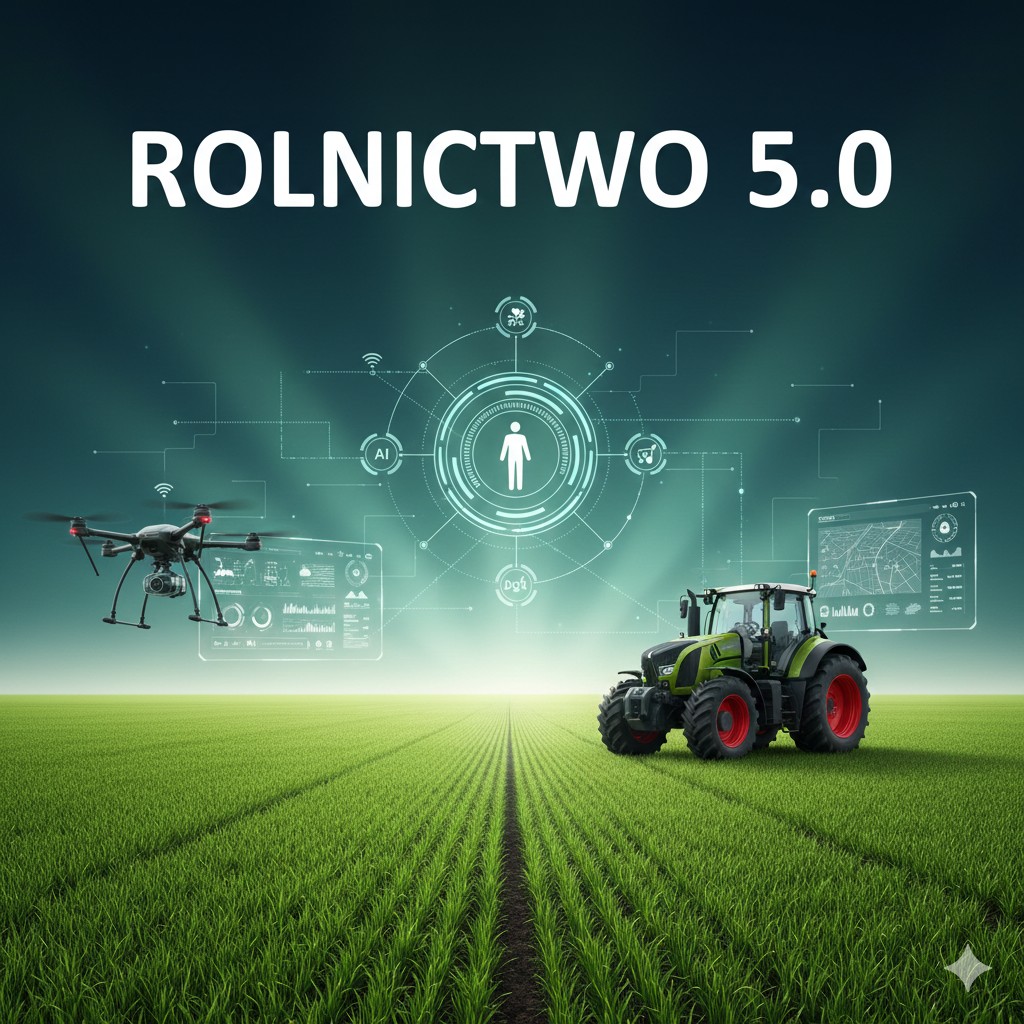
- What is Agriculture 5.0? It is a farming model in which AI, automation, and data operate as a single decision system with humans at the center.
- Does it mean full machine autonomy? In most cases, no – supervised autonomy dominates, where the system performs tasks and raises alerts in exceptional situations.
- What is the foundation of implementation? Consistent data and a Farm Management System (FMS) that connects fields, operations, machinery, and sensors. For key digital agriculture concepts (FMS, Agriculture 4.0/5.0, smart farming), see our Digital Agriculture Glossary 2026.
- How does it differ from Agriculture 4.0? Agriculture 4.0 digitizes and automates; Agriculture 5.0 integrates data and actively supports decision-making across the entire system.
1. Definitions of key concepts
1.1 Precision farming
An approach based on adapting agronomic operations to within-field variability (e.g. variable fertilizer rates based on field maps).
1.2 Agriculture 4.0
The stage of agricultural digitalization characterized by large-scale data collection (GPS, IoT, telemetry), partial automation, and electronic documentation. The main limitation is that data often remains fragmented.
1.3 Agriculture 5.0
A farming model based on integrating data, automation, and AI into a single decision system, with emphasis on:
- human-centric design,
- system resilience,
- resource and energy efficiency.

2. Where Agriculture 5.0 comes from and why now
2.1 Context
Modern farms operate under high variability: weather, disease pressure, energy prices, labor availability, and market requirements. Traditional, fragmented tools are no longer sufficient.
2.2 Scientific background and evolution
- Saiz-Rubio and Rovira-Más describe the transition from smart farming to Agriculture 5.0 as a shift from "precision tools" toward AI- and robotics-supported execution systems.
- Ragazou et al. indicate that Agriculture 5.0 approaches can deliver double-digit improvements in energy efficiency, mainly through reducing unnecessary operations and better planning.
- Bissadu et al. (systematic review) emphasize that the greatest value lies in integrating data and decisions, not merely increasing the number of sensors or machines.
2.3 Core takeaway
Agriculture 5.0 is a response to growing production complexity, not an additional technology layer placed on top of Agriculture 4.0.
3. What Agriculture 5.0 changes compared to 4.0
3.1 From data to decisions
- 4.0: data is collected and reported.
- 5.0: data is combined into recommendations and action scenarios.
3.2 From automation to supervised autonomy
- 4.0: automation of functions (sections, guidance, reports).
- 5.0: automation of processes (monitoring, alerts, scheduling) with human intervention when needed.
3.3 From tools to systems
- 4.0: multiple applications and devices.
- 5.0: a single data and decision architecture (system-of-systems).
4. Four pillars of the future of farming
4.1 Human-centric
The system supports decisions and reduces cognitive load, but responsibility remains with humans.
4.2 Supervised autonomy
Machines and algorithms execute tasks, while the system detects exceptions and escalates them to the operator.
4.3 Energy efficiency
Energy, fuel, and water are treated as controllable process parameters, not just end costs.
4.4 FMS as the farm's brain
A Farm Management System (FMS) integrates data, processes, and decisions in one place.
5. How to prepare a farm for Agriculture 5.0 – practical steps
- Organize core data – fields, crops, operations, history.
- Choose an FMS with integrations – data from machines, sensors, and partners.
- Automate repetitive processes – alerts, schedules, checklists.
- Keep decision control – the system recommends, humans approve.
6. Examples of Agriculture 5.0 in FarmPortal (operational practice)
The following examples show how Agriculture 5.0 is implemented in FarmPortal in a human-centric way, based on supervised autonomy and system integration, rather than isolated features.
6.1 Intelligent frost alerts with action recommendations
Definition:
A frost alert in FarmPortal is a decision mechanism that combines temperature sensor data, weather forecasts, and crop context to detect actual risk of crop damage, not just sub-zero temperatures.
How it works:
- Monitoring near-ground temperature and hourly forecasts (see physical and virtual weather stations).
- Considering crop type and growth stage.
- Detecting field-specific critical conditions.
- Triggering an alert with a suggested response procedure.
- User approval and logging of the decision.
Why this is Agriculture 5.0:
The system initiates the process and recommendation, while responsibility remains with the human (supervised autonomy).
6.2 Sensor monitoring with decision context
Definition:
FarmPortal interprets sensor data (soil, weather, temperature) in the context of the field, operation history, and current conditions, rather than displaying raw charts.
Example inputs:
- soil moisture,
- soil temperature,
- rainfall and forecast,
- recent agronomic operations.
Outcome:
The user receives information on whether and why action is needed, not just numbers.
6.3 Digital field timeline
Definition:
Each field in FarmPortal has a continuous timeline combining operational and environmental data.
The timeline includes:
- completed operations,
- weather conditions,
- sensor readings,
- alerts and critical events,
- user decisions.
Why this is Agriculture 5.0:
The field is treated as a process over time, not a set of isolated records.
6.4 Crop technology templates and decision checklists
Definition:
FarmPortal allows the creation of repeatable crop technology templates (procedures) that the system enforces and monitors.
How it works:
- Create a technology template (e.g. fertilization, protection, frost response).
- Assign it to fields or field groups.
- Automatic reminders and completeness checks.
- User confirmation of execution.
Why this is Agriculture 5.0:
Agronomic knowledge is formalized in the system and actively supports decisions instead of remaining only in the operator's experience.
6.5 Central decision log
Definition:
FarmPortal records not only executed actions but also the reasons behind decisions.
Example entry:
"Treatment postponed by 48 hours due to frost risk – decision based on alert and hourly forecast."
Why this is Agriculture 5.0:
It enables accountable, auditable autonomy and supports analysis of "why" in future seasons.
6.6 Data integration as a system-of-systems
Definition:
FarmPortal acts as an integration layer for data from multiple sources.
Data sources include:
- manual entries and observations,
- field sensors and weather stations,
- machinery and telemetry data (where available),
- external systems.
Outcome:
A single source of truth, automated processes, and no manual data stitching.
6.7 Compliance and traceability readiness
Definition:
Structured data in FarmPortal enables analysis of production history, events, and decisions over time.
Practical value:
- easier reporting,
- better risk control,
- readiness for market and regulatory requirements.
Why this is Agriculture 5.0:
System resilience includes not only weather resilience but also business and regulatory resilience.
6.8 Conclusion
FarmPortal delivers Agriculture 5.0 by:
- structuring data,
- connecting it into processes,
- supporting real-time decisions,
- keeping responsibility with humans.
This approach aligns with the literature definition of Agriculture 5.0 as human-centric, integrated, resilient, and scalable.
7. Summary
- Agriculture 5.0 integrates data, processes, and decisions.
- The greatest benefits come from reducing unnecessary operations and improving planning.
- Autonomy in agriculture is supervised, not absolute.
- An FMS is a prerequisite for scalability and resilience, which is why FarmPortal is designed to support thousands of devices and farms.
- Practical implementations start with concrete functions such as intelligent alerts and response procedures.
8. FAQ
What is Agriculture 5.0?
A farming model in which AI, automation, and data support human decision-making within an integrated system.
Does Agriculture 5.0 mean full machine autonomy?
No. In practice, supervised autonomy with human intervention dominates.
What role does a Farm Management System play?
It acts as the central "brain" of the farm, connecting data, processes, and decisions.
Is Agriculture 5.0 only for large farms?
No. The main value lies in data and process organization, which scales with the farm.
9. Sources
- Saiz-Rubio, V., Rovira-Más, F. From Smart Farming towards Agriculture 5.0.
- Bissadu, K.D., et al. Society 5.0 enabled agriculture: Drivers, enabling technologies, opportunities and challenges.
- Ragazou, K., et al. Agriculture 5.0: A New Strategic Management Mode for a Cut Cost and an Energy Efficient Agriculture Sector.
- Haloui, D., et al. Bridging Industry 5.0 and Agriculture 5.0.
Follow us!
See what we're doing and be inspired by positive changes.