Why is Bury integrating with FarmPortal?
Bury Maszyny Rolnicze has been building its position for years as a Polish agricultural machinery manufacturer. Its offer includes field sprayers, orchard sprayers, specialist sprayers, tillage machines and machine parts. The natural next step is to connect the machine with the digital layer of farm work.
In practice, this means that the role of the machine does not end at the moment of sale. What happens later is becoming increasingly important: service, work history, field operation documentation, access to parts, user support, data analysis and the ability to develop new functions. This is why integration with FarmPortal has strategic significance.
FarmPortal - an FMS, or farm management system - makes it possible to move data from fields, operations, machines and advisory services into one environment. For Bury, this is an opportunity to strengthen its position as a technological leader. For Bury customers, it means simpler farm management and better use of the machine’s potential.
You can read more about what an FMS is in the article Farm Management System - what it is and what it is used for.

FarmPortal - farm management software closer to Bury machine users
The most important benefit for farmers is simple: less scattered data and more control over the farm. Instead of keeping separate notes, spreadsheets, service books, field photos and operation histories, users can gradually move this information into one system.
The integration of Bury with FarmPortal is particularly important for farms that perform many crop protection treatments, work across many plots or need better documentation for an advisor, buyer, audit or inspection. This applies to arable farms, orchard farms, and fruit and vegetable producers.
5 key benefits for Bury machine users
- Better documentation of agronomic operations. Farmers can structure information about the field, crop, operation date, product used, dose and operator.
- Greater readiness for inspections and audits. Digitally stored data is easier to find, compare and share with an advisor or person responsible for documentation.
- Machine telematics and operational data. In the next stages, machine data can support analysis of work, equipment use, operating hours, location and the history of completed operations.
- Service and maintenance reminders. The system can support planning of inspections, replacement of consumable parts and regular maintenance activities.
- Development of precision spraying. FarmPortal can support precision agriculture, application maps, ISOBUS data and better operation planning based on field data.
Which functions will matter most for Bury customers?
The cooperation is not just about adding a logo to an application. Its purpose is to give machine users practical functions that help them in everyday work. Farmers need tools that save time, reduce mistakes and make production management easier.
The areas below show how FarmPortal can increase the value of a Bury machine after purchase and throughout its entire operating life.
| Area | What does it mean for the farmer? | Example use on the farm |
|---|---|---|
| Digital field operation records and reporting | The history of operations, products, doses, fields and operators is structured in the system. | The farmer quickly checks when spraying was carried out, which product was used and on which plot. |
| Support for compliance with requirements and regulations | The system helps maintain data needed for inspections, audits or discussions with advisors. | The farm prepares a crop protection treatment report without searching through paper notes. |
| Machine telematics and operational data | Machine data can support analysis of equipment use, location and work history. | The farm owner sees where the machine worked and how it was used during the season. |
| Service and maintenance reminders | The farmer receives support in planning inspections, technical checks and service activities. | The system reminds the user about a sprayer inspection before the crop protection season. |
| Access to parts and service support | The user can move more easily from a machine problem to service contact or part identification. | The farmer reports a support need faster or prepares information for the service team. |
| Machine-to-application integration | The machine becomes part of the digital farm, not a separate device without a data history. | Machine work data can be linked to the field, operation, crop and costs. |
| ISOBUS integration and machine data exchange | ISOBUS supports communication between the tractor, machine, terminal and farm management system. | The farmer can make better use of sprayer work data, application maps, doses, passes and the history of completed operations. |
| Predictive maintenance | Predictive maintenance means forecasting service needs based on data before a failure stops work. | In the future, the system may indicate a risk of a problem based on usage history and signals from the machine. |
| Precision spraying | The farmer can develop work with maps, doses, sections and better crop protection planning. | The farm uses field data to perform operations more precisely. |
| Farm cost control | The costs of operations, products, labour and machines can be assigned to fields and crops. | The farmer checks which crops and fields generate the highest crop protection costs. |
Table 1. Key value areas for Bury machine users after integration with FarmPortal. The scope of functions may depend on configuration, machine type and implementation stage.
Bury as an OEM: machine plus application as a new standard of customer support
OEM stands for original equipment manufacturer. In agriculture, this means a company that supplies the machine but increasingly also provides a digital service around that machine. This is the direction in which the modern agricultural machinery market is moving.
Today, a farmer does not buy only steel, a pump, a boom, a tank and electronics. They buy a work tool that should help organise the season, reduce downtime, meet documentation requirements and improve efficiency. The integration of Bury with FarmPortal fits into this model: machine plus digital support on the farm side.
“For a machinery manufacturer, technological advantage is no longer only about the machine’s construction. It increasingly depends on whether the machine can work with farm data, service, advisory and documentation processes. This is the direction of modern agriculture.”
This also matters from a brand-building perspective. Bury shows that a Polish manufacturer can implement solutions known from Western machine ecosystems, but adapted to the realities of Polish farms. In other words: together, we create Polish technologies for Polish agriculture.
Comparison: machine alone, general app or FarmPortal integrated with an OEM?
Farmers can document work in many ways: in a paper notebook, Excel, a general application, a closed manufacturer system or an FMS integrated with a machinery manufacturer. The difference appears when field, machine, operation, cost and service data need to be connected.
The greatest value comes from a solution that does not lock the user into one fragment of the process. FarmPortal works as an FMS, or farm management system, so it can connect records, fields, crops, machines, operations, costs, maps, weather data and elements of precision agriculture.
| Criterion | Notebook or Excel | Separate manufacturer app | FarmPortal integrated with an OEM |
|---|---|---|---|
| Field operation records | Possible, but manual and prone to missing data. | Depends on the scope of the application. | Connected with fields, crops, products, doses and farm history. |
| Machine data | No automation. | Often limited to a specific brand or device. | Can become part of the wider farm ecosystem. |
| Service and parts | Notes, phone calls, paper service book. | Service support may be available, but often without field and operation context. | Possibility to connect the machine, work history, service requests, inspections and support. |
| ISOBUS, ISO-XML and machine data | No practical use of machine data. | Possible, but often limited to a selected ecosystem. | Possibility to connect machine data with fields, operations, maps and documentation. |
| Precision agriculture | Difficult to manage without additional tools. | Depends on the specific technology. | Possibility to work with maps, satellite data, VRA and operation history. |
| Farm scaling | The larger the farm, the harder it is to keep data organised. | Good for a selected area, but less flexible. | Best for farms that want to manage production, costs, machines and documentation in one place. |
Table 2. Comparison of farm data management methods. The assessment is practical and refers to typical needs of arable, orchard and vegetable-producing farms.
Plant protection product documentation: why does digitalisation matter?
On farms that use plant protection products, documentation is not an add-on. It is part of safe and responsible production. Farmers need to know what was applied, when, at what dose, on what area and for what reason.
According to the announcement of the Provincial Inspectorate of Plant Health and Seed Inspection, in 2026 the rules for documenting plant protection product treatments in Poland remain unchanged compared with previous years. However, from 1 January 2027, paper documentation and future electronic documentation are expected to comply with the requirements of Commission Implementing Regulation (EU) 2023/564. Source: WIORiN announcement of 13 February 2025.
This shows that digital field operation records are not a short-term trend. They are a direction that will become increasingly important for farmers, fruit growers, advisors and buyers of agricultural produce. FarmPortal helps farms prepare for this way of working today.
A practical guide to inspections and record keeping is available in the article ARiMR inspection checklist - 10 points every farm should check.
Precision spraying and precision agriculture in practice
Precision spraying means using data to better plan and perform an operation. This may concern the operation date, weather conditions, dose, application maps, sprayer sections, field history or analysis of disease and pest pressure.
International organisations indicate that precision agriculture is a data-driven approach that can improve productivity and profitability while reducing the use of resources such as water, fertilisers and plant protection products. Source: FAO, Precision Agriculture for Smallholder Farmers.
In FarmPortal, this approach is developed through functions related to maps, satellite imagery, crop monitoring, the plant protection products database, field operation records and machine data integration. You can read more about machine data and machinery communication standards in the article What are DDIs in ISOBUS and why do they matter in precision agriculture?.
ISOBUS integration: machine data in the digital farm
ISOBUS is a communication standard used in modern agricultural machinery. In practice, it allows the tractor, machine, terminal and software to exchange data more effectively. For farmers, this means less manual data entry and greater consistency between what happens in the field and what appears in the farm’s documentation.
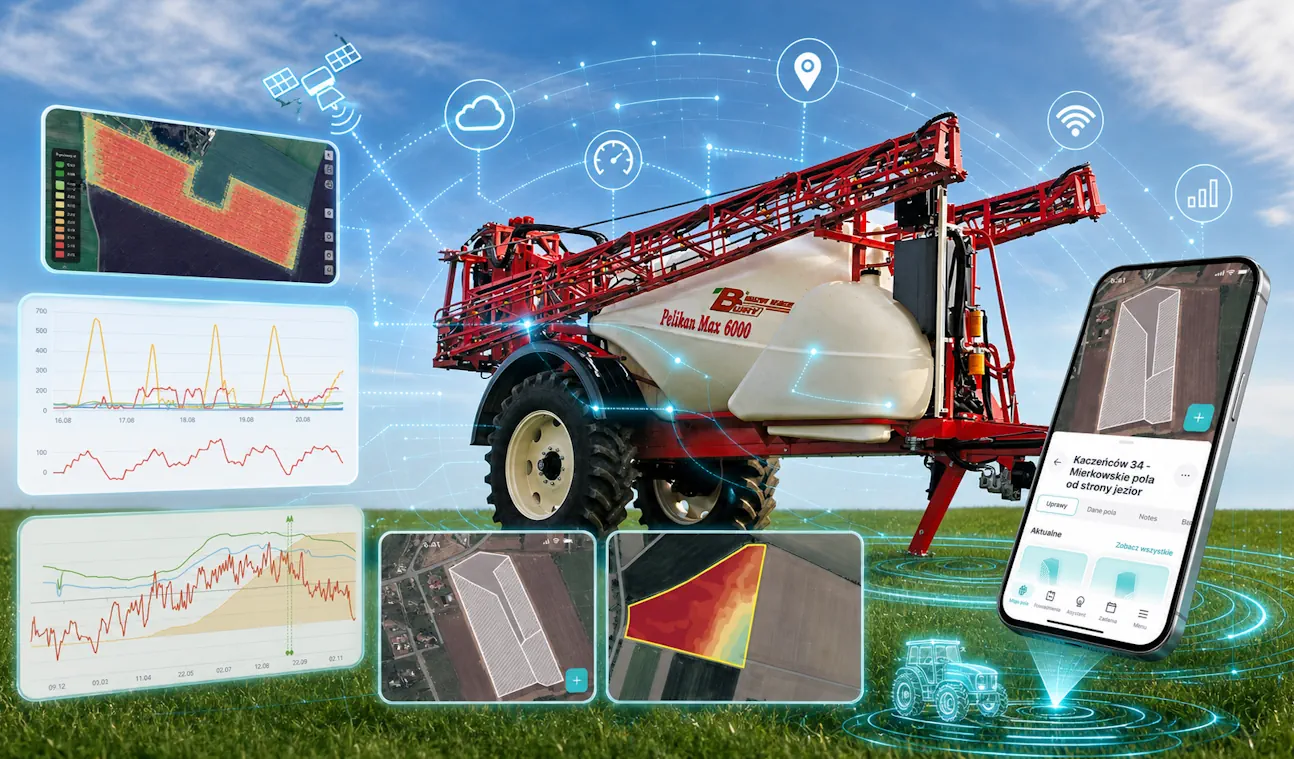
For sprayers and machines used in agronomic operations, ISOBUS integration is particularly important. Data on machine work, passes, doses, sections, working area or application maps can become part of the broader farm management process. This matters both for precision spraying and for documenting completed operations.
FarmPortal develops functions related to machine data handling, ISOBUS standards, ISO-XML and DDI, which are data identifiers used in agricultural machinery communication. Thanks to this, the system can support not only field operation records, but also more advanced scenarios: preparing application maps, analysing completed work, linking an operation with a specific machine and developing precision agriculture.
For Bury, this means the possibility to build additional value around machines. The sprayer is no longer only a device for carrying out an operation. It can become a source of data that helps farmers plan work better, control costs, maintain documentation and use digital support after purchasing the machine.
| Integration element | Meaning for the farmer | Example use |
|---|---|---|
| ISOBUS | Supports communication between the tractor, machine and terminal. | The sprayer can operate in a more structured data environment. |
| ISO-XML | Helps transfer tasks, maps and work data between systems. | The farmer can prepare a task in the system and use it during field work. |
| DDI | Allows machine data such as doses, areas, sections or work parameters to be described more precisely. | Operation data can be better linked with field and crop documentation. |
| Application maps | Support variable-rate application and more precise operation execution. | The farm can vary the dose depending on field needs. |
Table 3. The significance of ISOBUS, ISO-XML and machine data integration for Bury machine users and FarmPortal.
Practical farm scenarios
Orchard farm: less chaos in spray documentation
“In an orchard, we carry out many operations within short weather windows. For me, the greatest value is that spray history does not disappear into notebooks and phone photos. I can return to a specific orchard block, date and product.”
Arable farm: the machine as a source of data, not only a cost
“For me, it is important that the sprayer is connected with field history and costs. Then I can see not only that the operation was completed, but also how much it cost and how it affected work organisation.”
Machinery manufacturer: digital customer relationship after the sale
“Machine data, work history, service requests and inspection reminders make it possible to build a better relationship with the user. The sale of a machine does not end the contact with the customer. It starts a longer support cycle.”
What comes next?
The start of cooperation between Bury Maszyny Rolnicze and FarmPortal is another step towards Polish Agriculture 4.0. For Bury, it means developing digital value around machines. For users, it means easier access to tools that help manage the farm, documentation, service, costs and precision operations.
This is what it means to be a leader in your segment: not waiting until technology becomes the standard, but implementing it earlier and building an advantage that benefits customers. Bury and FarmPortal are joining forces to develop Polish technologies for Polish agriculture.
More information about the scope of cooperation, dedicated functions for Bury users and the next stages of integration will be announced soon.
If you want to see how FarmPortal can support your farm, visit FarmPortal - farm and crop management system.
FAQ
As a farmer using a Bury machine, will I be able to use FarmPortal to record field operations?
Yes. The purpose of the cooperation between Bury Maszyny Rolnicze and FarmPortal is to bring farmers closer to digital tools for farm management, including agronomic operation records, spray treatment documentation and reporting.
Will FarmPortal help me prepare documentation for inspections related to plant protection products?
FarmPortal supports structured documentation of field operations, field history, doses, dates, plant protection products and the reason for carrying out a treatment. This makes it easier to prepare data for inspections, audits or discussions with an agronomic advisor.
Can fruit and vegetable producers use FarmPortal to better control field operations and costs?
Yes. Fruit and vegetable producers can use FarmPortal to plan field operations, control crop protection history, monitor costs, manage fields and better prepare documentation for buyers, advisors or audits.
What does an agronomic advisor gain when a farm uses FarmPortal?
The advisor receives structured data about fields, crops, treatments, weather, costs and the history of decisions. This makes it easier to analyse the farm situation and prepare more specific recommendations.
Why does an agricultural machinery manufacturer integrate with an FMS such as FarmPortal?
For a machinery manufacturer, integration with an FMS means developing digital services around the machine: telematics, work history, service reminders, customer support, access to parts, data analysis and the ability to build a technological advantage on the market.
Can FarmPortal support precision spraying?
Yes. FarmPortal develops precision agriculture functions, including application maps, use of field data, machine integrations and tools supporting better planning of spraying and other agronomic operations.
Does ISOBUS integration mean that data from the sprayer will be able to reach FarmPortal?
This is the direction of machine integration development with FarmPortal. ISOBUS, ISO-XML and machine data can support the transfer of information about sprayer work, application maps, doses, passes and completed operations into the farm’s digital documentation.
Follow us!
See what we're doing and be inspired by positive changes.