In brief
Autonomous agricultural robots have the greatest potential where work is repetitive, labour costs are high, workers are scarce, crop value is significant or a very precise treatment is required. This applies mainly to vegetable production, orchards, soft fruit plantations, greenhouses, vineyards, large arable farms and dairy production.
In Polish conditions, the main barriers remain purchase price, service availability, fragmented farm structures, varying field quality, limited local technical expertise and regulatory uncertainty. That is why the most rational implementation path is: data → decisions → automation → robot.
- First, calculate the process. A robot makes sense when it replaces costly, repetitive or risky work.
- Not every task is ready for robotisation. Weeding, spot spraying, monitoring, transport and tasks in controlled environments are usually the easiest to automate.
- The greatest value comes from data integration. A robot should use field maps, treatment history, schedules, weather data and reports.
- A service model may be more reasonable than ownership. Smaller farms can use robots as a seasonal service.
- People do not disappear from the farm. Their role changes from physical worker to operator, supervisor, technician and data analyst.
Main thesis of the article
Autonomous robots can be an important tool for modernising Polish agriculture, but they are not the first step for every farm. Deployment makes sense when the farmer can identify a specific process, calculate current costs, estimate downtime risk and secure technical support.
In practice, robotisation works best when the farm already has a digital foundation: field maps, treatment history, labour costs, machinery data, employee records, tramlines and safety procedures. Without this, a robot may become an expensive, isolated machine that does not improve the overall production system.

Who is this article for and what problems does it solve?
This article is intended for people considering the purchase, rental, production, integration or advisory support related to autonomous agricultural robots. Each target group looks at this topic differently, so the table below presents the benefits and problems from their perspective.
| Target group | What does this article provide? | What problem does it help solve? |
|---|---|---|
| Farmers | Practical criteria for assessing whether a robot makes economic sense on their farm. | The risk of buying an expensive machine without a calculated return on investment. |
| Machinery manufacturers | A better understanding of what farms expect from autonomy, data integration and service. | Designing robots as standalone machines disconnected from farm processes. |
| Agronomists | A framework for assessing where a robot supports a precision treatment and where expert judgement is still needed. | Separating demonstration technology from real improvement in agronomic decision quality. |
| Agricultural advisors | Arguments for discussing data, costs, implementation and employee training with farms. | The lack of a simple model for moving from digitalisation to automation and robotisation. |
| Management teams | A way to assess robotisation as an operational investment, not only as a technology investment. | Difficulty comparing CAPEX, OPEX, seasonal risk and margin impact. |
Table 1. Target groups for the article and the practical problems addressed by the robotisation analysis.
Why are autonomous robots becoming relevant now?
Agriculture in Poland and across the European Union is under simultaneous pressure from several trends: rising labour costs, shortages of seasonal workers, environmental requirements, the need to reduce plant protection products and growing documentation expectations from buyers and regulators. Robots answer some of these challenges, but only when they are embedded in a well-designed process.
According to Eurostat, in 2023 there were 8.8 million agricultural holdings in the European Union, of which 62.8% had less than 5 ha. Poland accounted for approximately 14% of the total number of EU farms. According to ARiMR, the average area of agricultural land per farm in Poland in 2024 was 11.59 ha. These figures provide important context: some farms have the scale required for automation, but a very large group will need service models, shared technology or phased digitalisation instead of immediately purchasing a robot.
Review studies on agricultural robotics indicate that the most commonly analysed applications include monitoring, weeding, spraying, harvesting, autonomous navigation, plant recognition, trajectory planning and human–robot collaboration. The practical conclusion is clear: robotics is developing quickly, but technological maturity depends on the task and the working environment.
Arguments in favour of deploying autonomous robots
The rationale for robotisation is not that a machine is “modern”. The rationale appears when a robot reduces a specific cost, risk or production loss. Therefore, a farm should start with the process, not with a manufacturer’s catalogue.
1. Reducing the seasonal labour problem
In orchards, vegetable production, soft fruit plantations and greenhouse production, access to people for harvesting, crop care, sorting, internal transport and weeding is one of the key constraints. A robot can stabilise work execution when labour is unavailable or when the task must be completed within a short time window.
2. Plant-by-plant treatment precision
Robots equipped with cameras, sensors, artificial intelligence and RTK can perform treatments selectively. This includes weed recognition, spot spraying, mechanical weeding, crop condition monitoring and water stress mapping. Manufacturers of precision sprayers declare significant reductions in plant protection product use in selected applications, but the result always depends on the crop, growth stage, weed pressure, weather and calibration quality.
3. Lower soil compaction and fewer passes
Lightweight autonomous platforms can reduce pressure on the soil, especially compared with heavy tractor-based sets. Lower weight, fixed tramlines and precise route planning can improve work organisation and reduce unnecessary field passes.
4. Better work documentation
A robot can record its route, working time, dose, energy consumption, detected weeds, treatment locations, downtime and alerts. This matters for the farmer, advisor, processor, auditor and machinery manufacturer, because evidence of work execution is becoming increasingly important compared with a simple declaration that the work was performed.
5. Safety and work ergonomics
A robot can take over monotonous, heavy tasks carried out in dust, heat, chemical exposure or at night. However, this does not mean there is no risk. New hazards emerge: collisions, sensor errors, signal loss, unauthorised system access, incorrect configuration and liability for machine decisions.
Limitations and implementation risks
An autonomous robot is a combination of machine, software, sensors, safety system, connectivity and operational process. This makes the implementation risk higher than when buying a standard machine. The biggest mistake is treating a robot like a regular tractor with an additional automatic driving function.
- High entry cost. The farmer must account for the robot, working tools, RTK, transport, implementation, training, service, subscriptions and insurance.
- Not every task is ready for automation. The most difficult tasks are those requiring delicate gripping, quality assessment, flexible response and work in variable conditions.
- Fragmented fields reduce profitability. Small, irregular plots, access routes and field obstacles extend implementation time and reduce machine utilisation.
- Service determines the value of the technology. Downtime during peak season may cost more than the planned labour saving.
- New competencies are required. The operator must understand the app, maps, errors, calibration, safety procedures and basic diagnostics.
- Field conditions are difficult. Mud, dust, rain, high biomass, weak GNSS signal, slopes and obstacles may limit autonomy.
7 types of agricultural robots and their applications
Agricultural robots are not a single category. An autonomous platform for soil cultivation is assessed differently from a weeding robot, and differently again from a milking system or greenhouse harvesting manipulator. The overview below helps organise the topic.
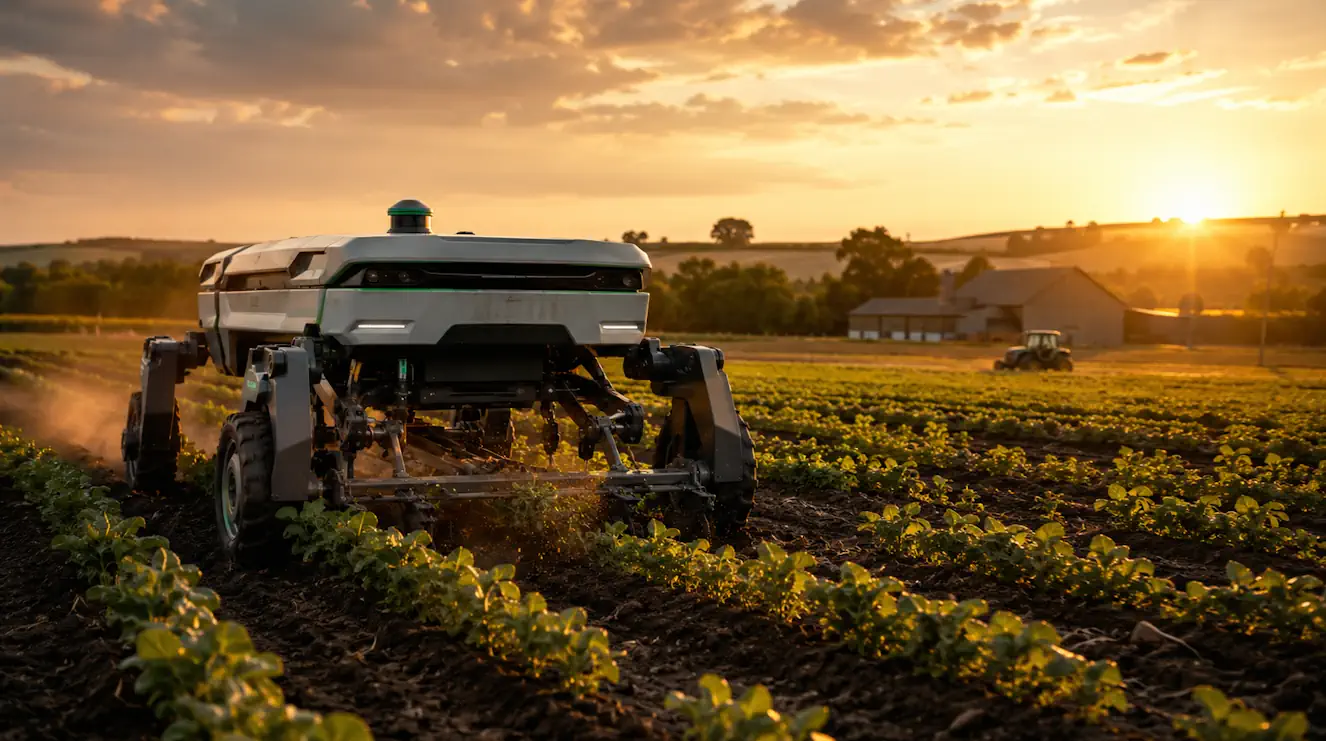
- Autonomous tractors and field platforms. They perform driving, cultivation, sowing, harrowing, spraying or tool transport without continuous steering by an operator.
- Weeding robots. They operate mechanically, electrically, with lasers or through spot spraying. They are most relevant in vegetable production, organic farming and high-value crops.
- Spraying and fertilising robots. They recognise weeds, crops or disease symptoms and apply the product only where it is needed.
- Harvesting robots. They are promising in specialised crops, but remain difficult in soft fruit, where ripeness, delicacy and commercial quality are crucial.
- Transport robots. They move crates, tools, produce or inputs in orchards, greenhouses, warehouses and farms.
- Greenhouse robots. They operate in a more controlled environment, making monitoring, spraying, transport, harvesting and quality assessment easier to automate.
- Drones and monitoring robots. They do not always perform treatments, but collect data on crop condition, disease, drought, weed pressure and damage.
Where do robots make the most sense?
Robot profitability depends on production value, working hours, cost of errors, labour availability and process repeatability. The higher the crop value and the more repetitive the work, the easier it is to justify robotisation.
| Production segment | Most relevant applications | Potential level | Main limitation |
|---|---|---|---|
| Field vegetable production | Weeding, precision sowing, spot spraying, row monitoring. | High | Requires well-organised rows, maps and repeatable passes. |
| Orchards and soft fruit plantations | Monitoring, mowing, crate transport, spraying, disease detection. | High | Soft fruit harvesting remains technologically difficult. |
| Greenhouses | Harvesting, monitoring, pollination, spraying, transport, quality assessment. | High | High integration cost and the need to standardise the environment. |
| Large arable farms | Autonomous cultivation, sowing, harrowing, night work, tool transport. | Medium to high | Profitability depends on scale and machine utilisation time. |
| Small mixed farms | Robotic services, monitoring, seasonal rental, shared equipment. | Low to medium | Direct ownership usually has too long a payback period. |
| Dairy production | Milking robots, feeding, cleaning, animal monitoring. | High | Requires reorganisation of herd management and technical infrastructure. |
Table 2. Agricultural segments with the highest implementation potential for autonomous robots.
Costs, profitability and the service model
Cost analysis should include more than the robot’s catalogue price. In practice, the farmer must calculate the total cost of ownership: purchase, implementation, service, training, energy, software, downtime and seasonal risk. Only then can the robot be compared with labour, a tractor, an external service or digitalisation alone.
| Cost category | What does it include? | What should be checked? |
|---|---|---|
| CAPEX | Robot, working tools, charging station, RTK, sensors, transport and implementation. | The purchase price does not show the full cost of readiness for work. |
| OPEX | Service, energy, fuel, parts, updates, data transmission, subscriptions and insurance. | Operating costs must be calculated seasonally and annually. |
| Downtime cost | Lost treatment window, delayed harvest, lack of replacement labour, in-season service. | The most important cost in crops with short agronomic windows. |
| Competence cost | Operator training, procedures, diagnostics, documentation, supervision. | A robot requires an employee profile different from standard field work. |
| Data cost | Field maps, boundaries, routes, treatment history, FMS integration. | Lack of data increases implementation cost and error risk. |
Table 3. Main cost categories when deploying autonomous robots on a farm.
When does direct ownership make sense?
Direct ownership is justified when a farm has many repetitive working hours, high manual labour costs, high crop value or several seasonal applications for the same platform. A good example may be a vegetable farm using a robot for sowing, weeding, spot spraying and monitoring.
When is robot-as-a-service better?
A service model is often better for smaller farms. In this model, the farmer does not buy a robot but purchases a service: weeding per hectare, spot spraying, plantation monitoring, inter-row mowing or crate transport. This lowers the entry barrier and transfers part of the technical risk to the service operator.
Farm digitalisation vs robotisation
Digitalisation and robotisation are not the same. Digitalisation organises data, processes, decisions and documentation. Robotisation adds the physical execution of work by a machine. If a farm does not know exactly what fields, costs, treatments, employees, machines and results it has, a robot will not solve the management problem.
| Area | Farm digitalisation | Farm robotisation |
|---|---|---|
| Objective | Better data, cost control, documentation, planning and decisions. | Automatic execution of selected physical work. |
| Example | Records of treatments, costs, fields, machinery, employees and inventory. | A robot performing weeding, spot spraying, transport or monitoring. |
| Risk | Low data quality, inconsistent records, lack of procedures. | Failure, downtime, incorrect configuration, collision, lack of service. |
| Best implementation moment | Before major technology investments. | After organising data and selecting the process with the highest return. |
| Effect for management teams | Better control over production, costs and risk. | Less dependence on manual labour and greater process repeatability. |
Table 4. Comparison of farm digitalisation and farm robotisation.
A good implementation path looks as follows: first data, then decisions, then process automation, and only then a robot performing physical work. This approach reduces the risk of purchasing technology that does not fit the farm’s real operating model.
To learn more about why an FMS is the foundation for data-based farm operations, read the article Farm Management System — what it is, what it is used for and whether it pays off. In the context of precision treatments, it is also worth reading the guide VRA — how variable-rate fertilisation and spraying work step by step.
Step-by-step implementation process
Robot deployment should resemble an operational project, not the purchase of a technology gadget. First, the problem must be defined, profitability calculated, data prepared, people trained and only then should the solution be scaled.
- Select a process that generates cost or risk. This may be weeding, spraying, crate transport, monitoring, mowing, harvesting or night work.
- Calculate the current process cost. Include labour hours, fuel, inputs, quality losses, downtime and error costs.
- Check work repeatability. A robot works best where the field, rows, tracks and procedures are repeatable.
- Prepare farm data. Field boundaries, crops, treatment history, maps, travel routes and weather data are needed.
- Test the robot at a small scale. The pilot should cover one crop, one task and clearly defined success indicators.
- Prepare safety procedures. Rules for start-up, stopping, supervision, failure, service and liability must be described.
- Train operators. The operator should understand the app, calibration, alerts, maps, diagnostics and the robot’s limitations.
- Integrate data with the farm management system. The robot’s work report should feed into field history, costs, treatments and farm analytics.
Reference case study: 180 ha vegetable farm
The case study below is a reference scenario prepared for economic analysis. It shows how the rationale for deploying a robot for weeding and spot spraying can be assessed in a vegetable farm large enough to test automation.
Farm context
The farm operates 180 ha of field vegetable production, including onion, carrot, beetroot and brassicas. The biggest problem is access to workers for weeding and pressure to reduce the number of herbicide treatments. The farm has fixed tramlines, RTK in some machines and digital treatment records.
| Indicator | Situation before implementation | After the robot pilot | Change |
|---|---|---|---|
| Manual weeding cost per 1 ha of vegetables | PLN 1,100–1,600/ha | PLN 450–750/ha in a mixed model | decrease of 35–55% |
| Herbicide use in selected blocks | 100% broadcast dose | 35–55% of the dose thanks to spot application | decrease of 45–65% |
| Number of corrective passes | 3–4 per season | 2–3 per season | decrease by 1 pass |
| Work documentation | Operator notes and spreadsheet | Route report, work map, time, cost and task status | full audit trail |
| Response time to local weed pressure | 5–10 days | 2–4 days | faster operational response |
Table 5. Reference KPIs for a robot pilot on a 180 ha vegetable farm. The data represent an analytical scenario and should be replaced with data from a specific farm before making an investment decision.
Conclusion from the case study
A robot does not completely eliminate human work, but it reduces dependence on manual labour in critical windows. The greatest effect appears where the robot combines precise treatment execution with reporting into a farm management system. In this scenario, ownership would make sense only with high seasonal utilisation or by combining the robot with a service offer for neighbouring farms.
How FarmPortal supports farm preparation for robotisation
FarmPortal is not an autonomous robot, but it can serve as the data and management layer without which robotisation becomes more difficult. In practice, a robot needs information about fields, crops, treatments, employees, machinery, weather, costs and reports. These are the data points that make it possible to assess where automation makes sense.
From the farm’s perspective, FarmPortal helps build the foundation for robotisation through:
- detailed field and crop records — the basis for planning routes, treatments and work schedules,
- treatment and cost records — the data needed to calculate return on investment,
- work and harvest records — comparison of manual work, machinery work and potential robot work,
- machinery management — work history, GPS monitoring, fuel reports and resource planning,
- reports and analytics — assessment of crop production costs, plantation performance and treatment effectiveness,
- satellite imagery, weather and sensors — data supporting decisions on where the robot should perform a task,
- central documentation — a place for procedures, notes, photos, service documents and implementation history.
Explore the system features: FarmPortal — farm management system features. The broader context of automation and data is also described in the article Agriculture 6.0 — what the next stage of digital food production could be.
FarmPortal vs a standalone robot application
A robot application usually shows the work of one machine. An FMS shows the farm as a whole: fields, treatments, people, costs, machinery, inventory and reports. That is why the best model is integration, where the robot performs the task and FarmPortal stores its production and economic context.
Regulations, safety and liability
An autonomous agricultural robot is a machine operating in an environment where people, animals, other machines, obstacles, power lines, roads, ditches and variable weather conditions may appear. For this reason, safety must be designed from the beginning, not added after implementation.
In the European Union, EU Machinery Regulation 2023/1230 is highly relevant. It replaces Machinery Directive 2006/42/EC and strengthens the approach to machinery safety, including machines using digital solutions. In practice, manufacturers, importers, distributors and users should pay attention to risk assessment, technical documentation, instructions, emergency stop procedures, machine supervision, software updates and cybersecurity.
- The machine must have a safe stop mode. The operator should know how to stop the robot locally and remotely.
- The system should detect obstacles. Cameras, lidar, radar or other sensors must be selected for the working conditions.
- Procedures must be documented. This applies to start-up, operation, failure, service and working near people.
- Data and access must be protected. The operator account, app, API, cloud and connectivity are part of machine safety.
- Liability must be clear. The farmer, operator, manufacturer, service provider and software supplier should have clearly described roles.
Checklist before buying or renting a robot
The checklist below helps quickly assess whether a farm is ready for an autonomous robot. The more “no” answers there are, the greater the risk that the farm should first implement digitalisation, organise the process or choose a service model.
Economic checklist
- Do we know the current cost of the work the robot is meant to replace?
- Do we know how many hectares or hours the robot will work per season?
- Have we calculated CAPEX, OPEX, service, insurance and downtime?
- Do we have a backup plan if the robot fails during a critical window?
- Have we compared ownership with rental or an external service?
Technical checklist
- Do we have up-to-date field and crop boundaries?
- Do the fields have repeatable tramlines?
- Do we have access to RTK or another precise positioning system?
- Is there a person on the farm responsible for app operation and diagnostics?
- Does the manufacturer provide local service, spare parts and in-season support?
Organisational checklist
- Do we have a start-up, stop and supervision procedure?
- Do employees know how to behave near the robot?
- Will robot work data be transferred into the farm management system?
- Do we know who is responsible for treatment errors or collisions?
- Does the implementation start with a pilot rather than full scale?
Market voices and implementation insights
“On a 160 ha vegetable farm, the biggest problem is not the robot’s price itself, but the certainty that it will complete the work within a 3–4 day window. If the robot reduces manual weeding by 40% but stops for a week during the season, the economics no longer work. That is why we first look at service, field data and emergency procedures.”
“In a 95 ha orchard, a transport robot and inter-row monitoring make more sense than full harvest automation. Harvesting still requires people, but automatic crate transport can reduce crew downtime and improve work organisation. The biggest benefit is visibility: we know which block, which team, how many crates and at what time.”
Expert insight
The most underestimated element of implementation is usually not technology, but work organisation. A robot requires data, procedures, liability rules and rapid response. If the farm does not have digital records of treatments, costs and machinery work, it is difficult to assess whether the robot has actually improved economic performance.
Summary
Autonomous robots can support Polish agriculture, but their implementation should be selective and data-based. They have the greatest potential in vegetable production, fruit production, specialised crops, greenhouses, large arable farms and dairy production. They make the least sense where scale is small, fields are fragmented, processes are not repetitive and the farm lacks technical infrastructure.
In Polish conditions, the safest path is gradual implementation: farm digitalisation, data organisation, cost analysis, decision automation, robot pilot and only then scaling. A robot should not be the beginning of digital transformation, but its next stage.
For the farmer, return on investment is the priority. For the machinery manufacturer, safety, service and integration matter most. For the advisor, the key issues are data quality and the implementation process. For management teams, the focus is impact on cost, risk and margin. That is why agricultural robotisation should not be treated as a technology trend, but as part of a broader production management system.
FAQ
Is an autonomous robot profitable for a 20–50 ha farm?
Usually not as a direct purchase, unless the farm runs intensive vegetable, fruit, nursery or other specialised production. In a typical arable farm of this scale, it is often more cost-effective to first implement digital records for fields, costs, treatments, machinery work and field variability mapping, while purchasing robotic services seasonally.
Can a robot replace seasonal workers in fruit and vegetable harvesting?
Partly yes, but not in every crop. Robots are better suited to repetitive tasks, transport, monitoring, weeding and spot spraying than to delicate soft fruit harvesting, where ripeness, quality, damage and commercial selection are critical.
Does a farm need a farm management system before buying a robot?
It is not a formal requirement, but in practice it is very helpful. A robot needs field boundaries, route maps, treatment history, crop information, work schedules, weather data and reporting. Without an FMS, the robot operates as a separate machine rather than part of an integrated production process.
What regulations should be considered for autonomous agricultural machines?
Farmers and manufacturers should consider machinery safety, CE marking, operating manuals, risk assessment, occupational health and safety, liability for accidents, cybersecurity, plant protection product rules, road traffic regulations and the new requirements under EU Machinery Regulation 2023/1230.
Should machinery manufacturers integrate robots with FMS platforms?
Yes. For the farmer, the greatest value is not autonomous driving alone, but the complete data flow: work order, execution, dose, route, time, cost, fuel or energy consumption, service alerts and the final report. Integration with an FMS improves usability, service, analytics and documentation.
Glossary
- Autonomous robot
- A machine that performs a task with limited operator involvement, using sensors, positioning, control algorithms and safety procedures.
- FMS, or Farm Management System
- A farm management system that stores data on fields, crops, treatments, costs, machinery, employees and reports.
- RTK
- A precise GNSS positioning technology that allows machine guidance with centimetre-level accuracy, provided that signal conditions and configuration are correct.
- VRA
- Variable-rate application of fertilisers, plant protection products, seeds or water according to field variability, instead of one uniform rate for the entire area.
- CAPEX
- Capital expenditure, meaning the investment cost of purchasing the robot, equipment, infrastructure and implementation.
- OPEX
- Operating expenditure, meaning ongoing maintenance, energy, service, parts, software, data transmission and insurance.
- Spot spraying
- Application of a product only where a weed, disease, pest or specific treatment need has been detected.
- Digital twin of a farm
- A digital model of fields, crops, machinery, resources, costs and processes that supports farm situation analysis and action planning.
Sources and references
Below are selected statistical, regulatory and scientific sources used in the preparation of this article. External links have been limited to public and professional sources.
- Eurostat, Farms and farmland in the European Union — statistics.
- EUR-Lex, Regulation (EU) 2023/1230 on machinery.
Additional references used bibliographically: ARiMR, “Average area of agricultural land per farm in 2024”; Statistics Poland, “Agriculture in 2023”; Spagnuolo M. et al., “Agricultural Robotics: A Technical Review Addressing Challenges in Sustainable Crop Production”, Robotics, 2025; Upadhyay A. et al., “Advances in ground robotic technologies for site-specific weed management”, Computers and Electronics in Agriculture, 2024; OECD, “Labour and Skills Shortages in the Agro-Food Sector”.
Follow us!
See what we're doing and be inspired by positive changes.