Since the beginning of November 2026, FarmPortal has received 8–11 enquiries a week about electronic treatment records. The team has also recorded an 87% increase in the number of farmers entering BBCH growth stages over the periods compared. Farmers are starting to prepare, yet at industry conferences they still ask whether paper records will be allowed and whether the new rules will apply to small farms.
Published: | Author: Kamil Korne, FarmPortal blog contributor | Publisher: FarmPortal / Agri Solutions Sp. z o.o.
Kamil Korne writes about pesticide treatment records, EPPO codes and regulatory requirements for farms.
Electronic plant protection treatment records document the products applied, treatment dates, application rates, treated areas and crops in a machine-readable format.

Here are five things to understand before the 2027 growing season. Figures for the 8–11 enquiries and the 87% increase are from FarmPortal's own data; the comparison period and method used to calculate the BBCH figure should be confirmed before publication.
At a glance
From 1 January 2027, Poland will require more detailed records of plant protection treatments. In addition to the usual entries, records must include information such as the product authorisation number and precise identification of the treatment location. EPPO codes, BBCH growth stages and treatment start times must be recorded where applicable. Records for treatments carried out in 2027 may be converted into electronic format by 31 January 2028, but the initial record must still be made without undue delay.
- The requirement applies to all professional users, regardless of farm size.
- A PDF or a scan of a paper notebook is not, in itself, a machine-readable format.
- Records must be kept for at least three years.
1. Who must keep electronic plant protection treatment records in 2027?
The requirement covers all professional users of plant protection products, including arable farmers, fruit growers, horticultural producers and agricultural contractors, regardless of the size of their holding. There is no blanket exemption for small-scale growers.
One misconception we regularly hear at industry events is that the changes will not begin until 2030. In fact, the wider range of information must be recorded from 1 January 2027. The year 2030 marks the end of a special transitional arrangement for converting records, not the start of the obligation itself.
Position as at 21 November 2026: The Sejm, the lower house of the Polish parliament, has passed a bill providing for more lenient penalties until the end of 2029 where records are kept but not in electronic form (Parliamentary Paper No. 3040). The bill is not yet law and is still being considered by the Senate. This does not remove the obligation to maintain the required records.
2. What must an electronic pesticide spraying record contain from 2027?
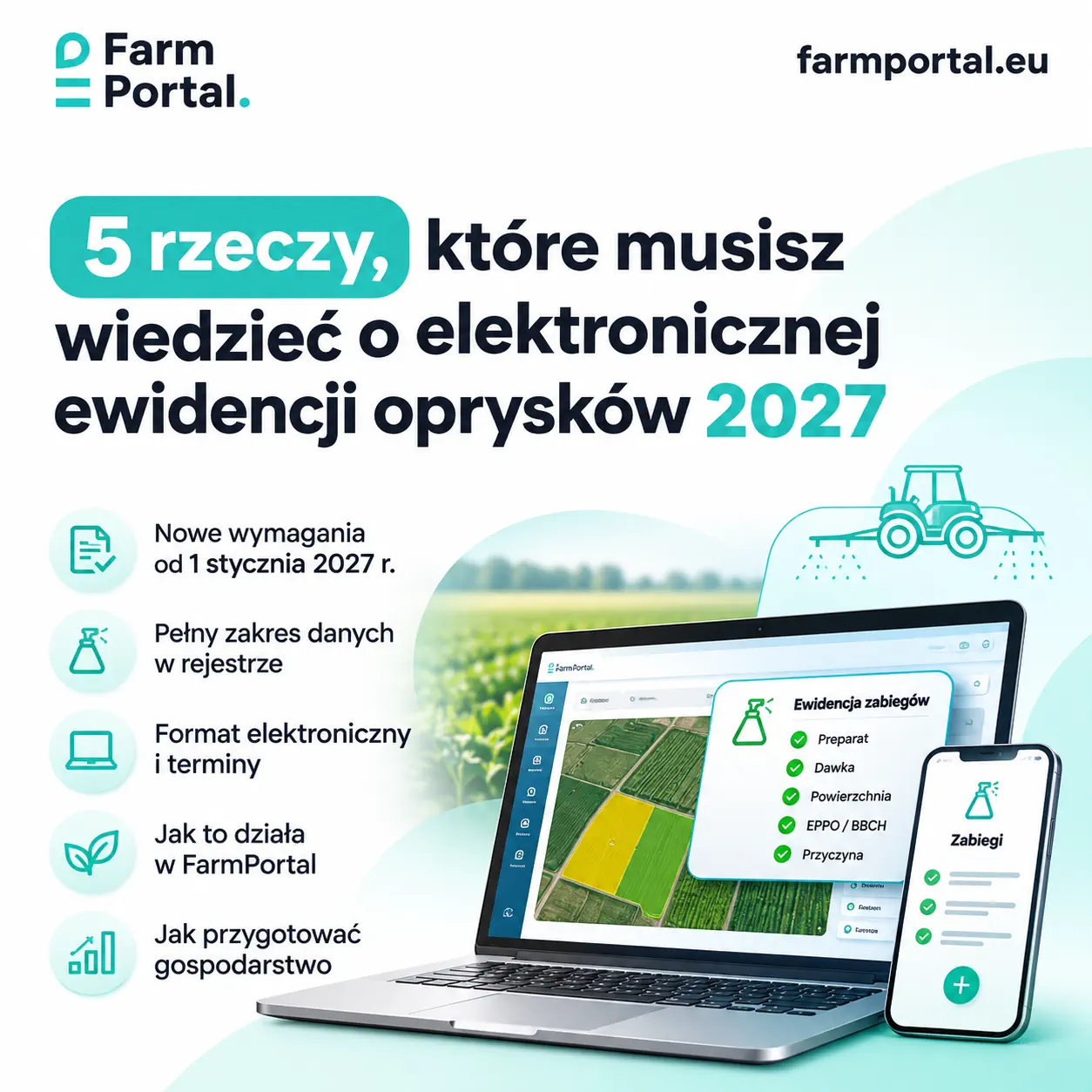
For a field application, you must record the product and its authorisation number, the date, application rate, location, actual area treated and crop. EPPO codes, BBCH growth stages and the treatment start time must also be included where relevant to the application. In Poland, the reason for carrying out the treatment must be recorded as well.
| Field | Information to record | Required? |
|---|---|---|
| Type of use | Type of treatment, e.g. field spraying | Yes |
| Product | Product name and authorisation number, separately for each product | Yes |
| Timing | Date and, where applicable, treatment start time | Date: yes; time: conditional |
| Application rate | Quantity of product applied, e.g. 0.75 l/ha | Yes |
| Location | Unit identified in the geospatial application or another appropriate identification method | Yes |
| Area | Actual number of hectares sprayed | Yes |
| Crop and EPPO code | Crop name and the relevant code, where applicable | Crop name: yes; code: where applicable |
| BBCH | Growth stage, if relevant to the treatment | Conditional |
| Reason | Justification under integrated pest management principles | Yes, in Poland |
If 6 ha of a 24 ha field are sprayed, the record must show 6 ha, not the entire field. For a tank mix, each product must have its own application rate and authorisation number. An EPPO code can identify the crop, while BBCH describes its growth stage. We explain the distinction in our guide to EPPO codes.
Treatments in storage facilities and greenhouses are recorded differently (using m² or m³), as is seed treatment (quantity of seed, application rate and batch number, where applicable). A single field-spraying form cannot adequately cover every type of application.
3. Are paper records or Excel enough? What are the deadlines and format requirements?
The final record must be machine-readable. A scanned notebook, a photograph of handwritten notes or a standalone PDF is not the same as structured data. Excel may be used if it contains all the required information and allows the data to be processed electronically in the prescribed way.
Treatments must be recorded without undue delay. Under a Polish derogation, records for 2027 may be converted into electronic format by 31 January 2028. If requested by the competent authority, electronic records may need to be supplied sooner: by the normal deadline or within 10 working days, whichever comes first. Records must be retained for at least three years.
The legal basis is Regulation (EU) 2023/564, as amended, together with the Polish Act of 21 November 2025 (Journal of Laws 2025, item 1697). See also the WIORiN notice on the transition from 2026 to 2027.
4. How can you keep spraying records in FarmPortal without entering the same data twice?
With FarmPortal, you can record a treatment on your phone against a specific field and crop. The system links the field record to the plant protection product database, supporting documents and weather information, so some details can be drawn from existing records.
- Field: import fields from ARiMR or use the farm map; you can select just the part of a field being sprayed.
- Products: choose from a database of more than 3,000 products linked to MRiRW, including authorisation numbers and pre-harvest intervals, with support for multiple products in a single treatment.
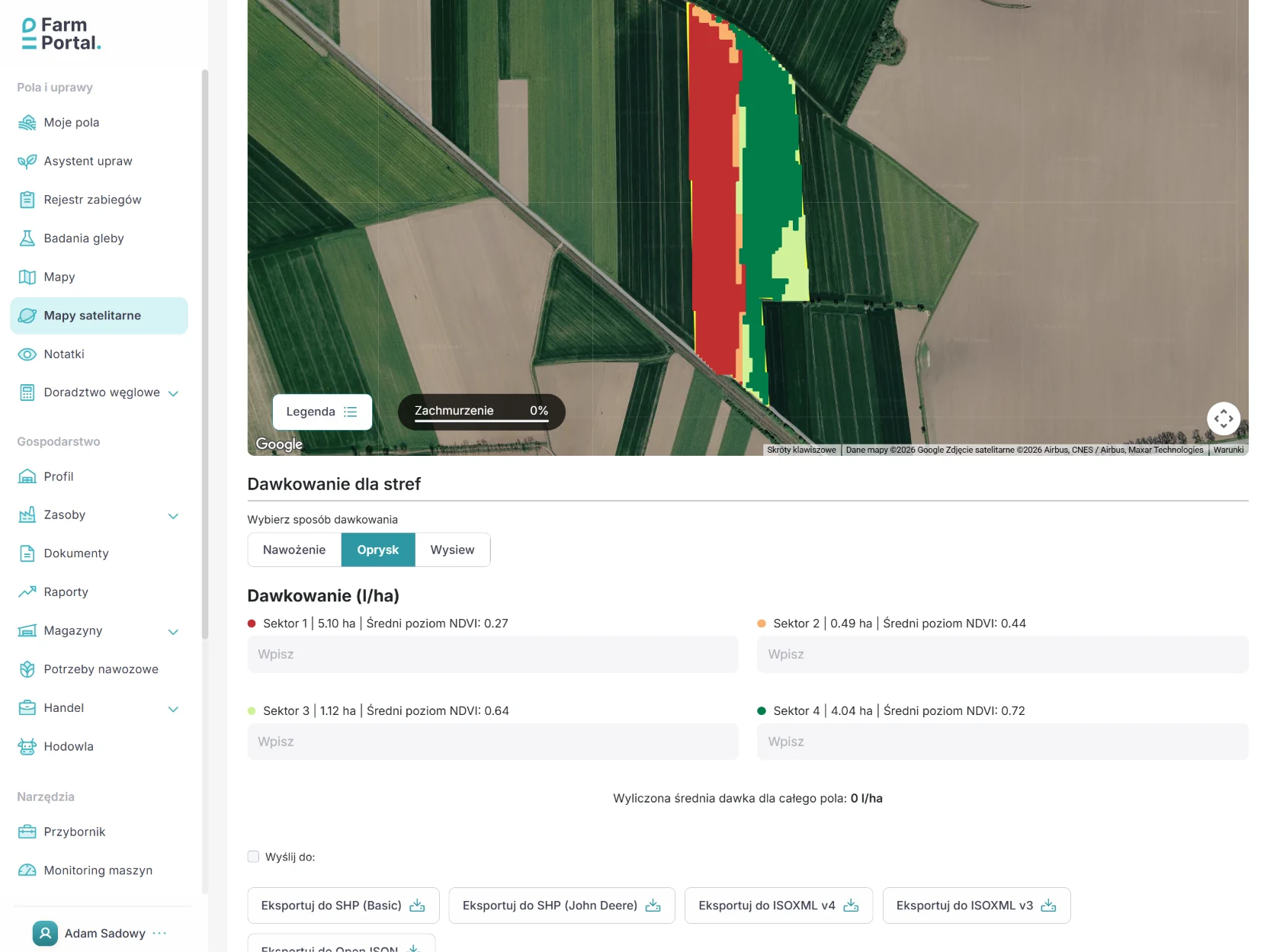
- Treatment record: enter the date, application rate, reason for treatment, crop and BBCH stage; the system calculates the product quantity based on the treated area.
- Supporting records: add photographs, attachments, machinery and vehicles; where virtual or physical weather stations are assigned, temperature and humidity readings can be added automatically.
- Reports: produce reports for PIORiN and ARiMR inspections and export PDF or CSV files, including for contract spraying work.
With compatible telemetry or guidance equipment, the system can link an operation to the vehicle's route and fuel consumption. The operator must still confirm the actual product and application rate. Crop protection monitoring, disease models, Delta-T and variable-rate application (VRA) maps for ISOBUS terminals can support treatment decisions, but they do not replace the product label.
Find out more about the FarmPortal digital plant protection treatment records module.
5. How should you prepare your farm for spraying records in 2027?
Start by looking at how information moves through the business: where does the operator record a spray application, who approves the application rate and who exports the records? There is little point investing in new software if nobody is responsible for data quality.
| Task | Notebook / spreadsheet | FarmPortal |
|---|---|---|
| Fields | Manual descriptions | Field maps and cropping history |
| Product | Details copied from the label | MRiRW database; labels must still be checked |
| Multiple products | Separate entries made by hand | Multiple products in one treatment record |
| Weather and photos | Separate notes | Information attached to the treatment record |
| Inspection | Transcribing and scanning | Reports and data exports |
Consider a common problem during the spraying season: an operator treats three separate blocks but, that evening, records only the combined area and product name. A week later, they cannot remember how many hectares were covered by each application. During an inspection, simply saying that the same spray was used is not enough.
Before the season begins, test field imports, recording a treatment on part of a field, entering two products, selecting a BBCH stage and exporting data. Advisers should also check that records from different farms are kept separate. For other tools, see the overview of FarmPortal features.
Example: two products applied to part of a field
A 180 ha farm grows wheat and oilseed rape. The operator identifies a need for crop protection on 12 ha of a 24 ha field. Assuming the proposed use complies with both product labels, they record two products: Product A at 0.75 l/ha and Product B at 0.40 l/ha.
The system calculates 9 litres of Product A and 4.8 litres of Product B, and records separate authorisation numbers, BBCH stage 31 and the reason for treatment. An attached crop inspection photograph and weather station readings, such as 18.2°C and 65% relative humidity, help explain the circumstances behind the decision.
Outcome: the record shows the 12 ha actually treated, rather than the whole field, and the data can be used in a report. This does not establish that the treatment saved money or was effective. Application rates and the use of product mixtures must always comply with the relevant labels.
What are the benefits for farmers and agricultural advisers?
Farmers gain a treatment history linked to their crops, pesticide stocks, costs and pre-harvest intervals. Advisers can review treatments alongside field inspections, BBCH growth stages and pest and disease monitoring, including across multiple farms. No application, however, can correct an inaccurate application rate or a treatment that does not comply with the product label. Digital records must reflect what actually happened.
Frequently asked questions about electronic treatment records
Do the 2027 electronic plant protection treatment record requirements apply to small farms?
Yes. The obligation to document professional use of plant protection products does not depend on the number of hectares farmed. It also applies to fruit growers, horticultural producers and contract spraying businesses. Farm size may affect other inspection rules or the conditions attached to agricultural payments, but a small holding is not exempt from keeping treatment records.
Must I record the BBCH growth stage for every treatment?
Not in every case. Regulation (EU) 2023/564 requires the BBCH stage where it is relevant to the particular use, for example when the product label restricts application to a specified crop growth stage. To maintain reliable records, it is worth selecting the BBCH stage when planning a spray and checking it against observations in the field.
Does an EPPO code replace the reason for spraying?
No. EPPO codes provide unambiguous identifiers for crops and other relevant categories. The reason for treatment, by contrast, explains why the product was applied, in line with Polish integrated pest management requirements. A code alone does not show whether the farmer observed disease symptoms, found a pest or identified a need for treatment during a field inspection.
What is the deadline for converting paper treatment records from 2027?
Treatments must be documented without undue delay. However, Polish transitional provisions allow records of treatments carried out in 2027 to be converted into the required electronic format by 31 January 2028. If requested by the authorities, electronic records may have to be provided earlier under Article 4 of Regulation (EU) 2023/564.
Is Excel sufficient for electronic pesticide spraying records?
A spreadsheet may be suitable if it contains all the required information and supports storage in a machine-readable format. A standalone PDF or a photograph of a paper record does not meet that requirement. Nor will Excel automatically populate authorisation numbers, accurate location data or pre-harvest intervals without the necessary source information.
Is there free software for keeping digital treatment records?
Yes. Some platforms, including FarmPortal, offer a free account. When comparing options, check more than just whether you can enter a spray application: consider what the free plan includes, how treatment history is stored, data export options, support for multiple products and mobile app availability. The pricing plan does not change the farmer's responsibility for keeping accurate records.
Can a contractor provide treatment records to the farm commissioning the work?
Yes. Regulation (EU) 2023/564 requires a professional user who carries out a treatment under contract to provide the client with the records, or a copy, without undue delay or restrictions. FarmPortal helps users share treatment history and prepare an export, but both parties should agree who is responsible for ensuring the entry is complete.
Glossary
- Plant protection products (PPPs)
- Products used to protect crops in accordance with their authorisations and labels.
- EPPO
- An identification code from the European and Mediterranean Plant Protection Organization's coding system, used to standardise names of crops and pests.
- BBCH
- An international scale of plant growth stages, such as BBCH 31, used to describe the crop's stage of development when a treatment takes place.
- Electronic records
- Records containing data that computer systems can read and process, rather than information available only as a scanned image.
- PIORiN
- Poland's State Plant Health and Seed Inspection Service, which oversees, among other things, plant protection product use and treatment documentation.
- MRiRW
- Poland's Ministry of Agriculture and Rural Development, which publishes the register of plant protection products and information about their authorisations.
- VRA and ISOBUS
- Variable-rate application and an agricultural machinery communication standard. In FarmPortal, they help connect treatment maps to compatible sprayers.
- FarmCloud
- Agri Solutions' ecosystem of products, which includes FarmPortal and connects data from farms, equipment and agricultural processes.
Summary: start by recording one treatment correctly
A digital treatment record can replace the scrap of paper in a tractor cab, the text message to an agronomist and the notebook in the office. But it must accurately reflect the treatment carried out.
Before 1 January 2027, choose a field and enter a test spray application. Add the application rate, treated area, reason for treatment, authorisation number and relevant EPPO code or BBCH stage. Then check that you can export the records in a machine-readable format.
Follow us!
See what we're doing and be inspired by positive changes.