Find out what to prepare before a station goes missing and how to use the available data when you suspect theft.
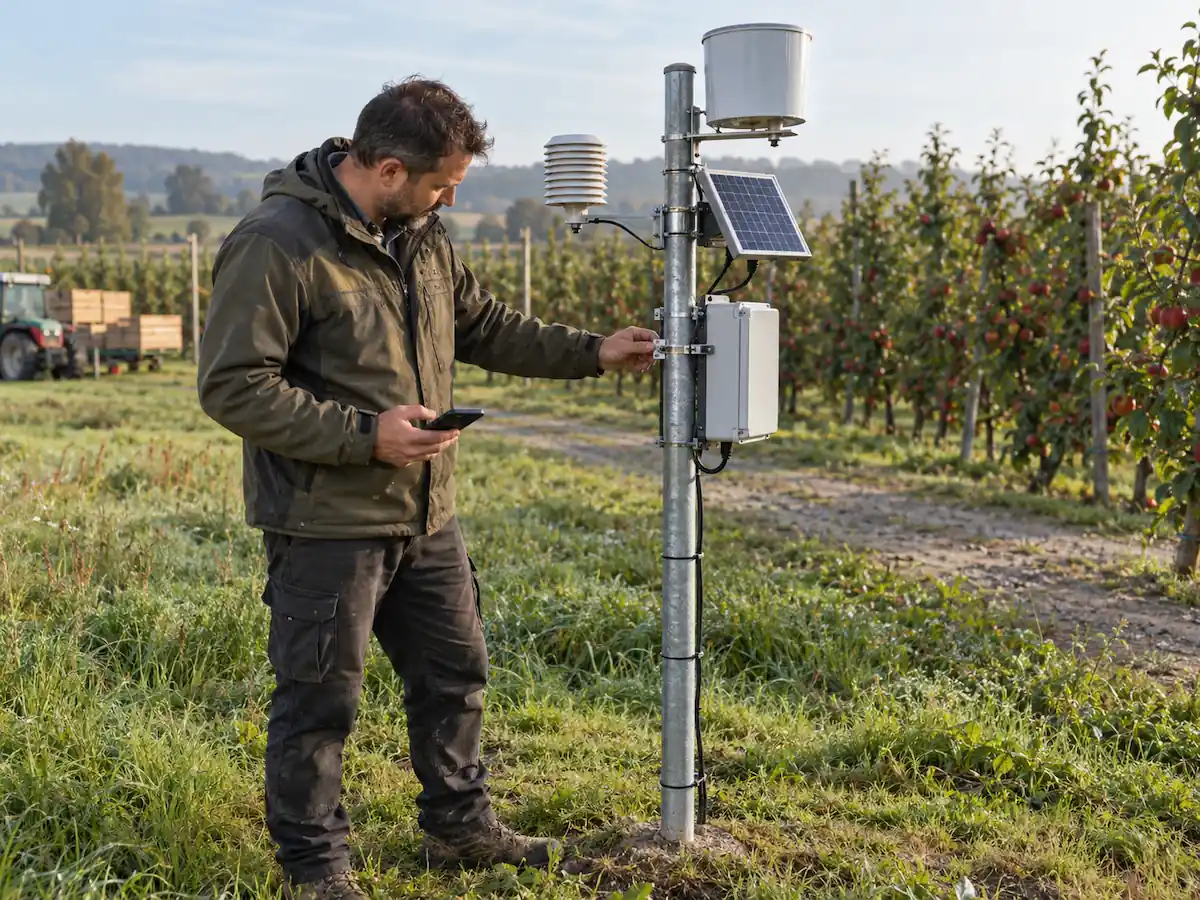
A GPS-equipped weather station is a field monitoring device that uses satellite signals to determine its position as well as collecting weather data.
At a glance
A GPS receiver does not turn a weather station into a fully fledged anti-theft tracker. Reporting its position also requires power, connectivity and software that can receive updated location data. Systems that flag a change in the device’s position are the most useful. Secure mounting, serial number records, transmission checks and a response plan remain essential.
- GPS determines a device’s position but does not send it to the owner on its own.
- A weather alert is not a theft alert.
- Missing data may indicate theft, a fault, a flat battery or loss of network coverage.
- Weenat documents an event triggered when a sensor has moved at least 500 m.
- Confirm the configuration of the specific model before buying.

Why are weather stations vulnerable to theft?
A station needs to measure conditions around the crop, so it often stands at a field edge, between orchard blocks or on a remote growing site. Good sensor exposure also makes the device easy to spot. A mast, solar panel and telemetry enclosure may look like valuable equipment that can simply be unbolted.
After harvest, fewer staff pass through the site and the days grow shorter, but the station continues to collect data. It could disappear in the evening without the owner noticing until the following morning’s rounds.
This is where a common misunderstanding arises. A gap in the readings is not proof of theft. Poor NB-IoT coverage, a damaged aerial, a flat battery, a modem fault or a station switched off for servicing can all produce the same symptom. The system should help users distinguish between these situations quickly.
Can GPS help locate a weather station after it has been stolen?
Sometimes, but the GPS receiver is only one part of the chain. It determines the coordinates. For the owner to see the new position, the station must remain switched on, receive a satellite signal, connect to a network and send a message to the app or cloud platform.
If the device is switched off, its battery is disconnected or it loses coverage, the user may see only the last reported position. A functioning GNSS module is not enough if the software records the location only during installation.
Our buying advice is therefore straightforward: ask how often the station reports its position and whether it provides movement alerts, rather than simply checking whether it has GPS. These two features determine whether agricultural equipment location data will be useful after the device has been moved.
| Component | What does it do? | Limitation | What to ask before buying |
|---|---|---|---|
| GPS/GNSS | Determines the device’s coordinates. | Does not transmit data on its own. | How often is the position updated? |
| LTE-M, NB-IoT or LoRa | Sends readings and messages. | Requires coverage from the relevant network. | Which network is available at the installation site? |
| Rechargeable or replaceable battery | Keeps the device running if the panel is disconnected. | May be disconnected or run flat. | How long can it operate without recharging? |
| Movement alert | Reports a change in position. | Triggers once the threshold is met and the data is transmitted. | What is the threshold, and how is the notification delivered? |
Which stations in the FarmPortal range have features that may help after a theft?
Weenat provides the clearest documentation of location-change detection. The iMETOS 3.3 and METOS 5 ranges use GPS, data transmission and their own power supplies, although their public documentation does not confirm a theft alert. For Atmesys, the precise GPS and tamper-input configuration needs to be confirmed for the package being ordered.
| Device range | Location | Connectivity and power | Movement alert | Practical assessment |
|---|---|---|---|---|
| Weenat | Integrated GPS | NB-IoT, LTE-M, Sigfox or LoRa; battery | ‘Moved sensor’ event after movement of at least 500 m and receipt of updated location data | Useful after a change in position; does not mean continuous tracking |
| iMETOS 3.3 | GPS receiver | Modem, rechargeable battery and solar panel | Not confirmed | Position can be determined; tracking mode requires confirmation |
| METOS 5 | GPS depends on the module configuration | Mobile network, rechargeable battery and solar panel | Not confirmed | Check the configuration before ordering |
| Atmesys Basic and PRO | GPS/GNSS available on the platform | LTE-M, NB-IoT, Wi-Fi; rechargeable battery | The platform has a tamper input; activation requires confirmation | Capabilities depend on the specific package supplied |
| nMETOS, STREMO, miniMETOS | Not confirmed in the shop’s product listings | Wireless transmission and field power supply vary by model | Not confirmed | Should not be described as offering tracking functionality |
METOS confirms that iMETOS 3.3 includes GPS, a rechargeable battery and a solar panel. Details are provided in the iMETOS 3.3 technical documentation. Weenat describes an event triggered after a sensor has moved at least 500 m and updated location data has been received. The mechanism is explained in the Weenat sensor event documentation.
How can you protect a weather station from theft?
Effective protection has three layers: detecting an incident quickly, making the station harder to remove and keeping the records needed to identify it. GPS alone cannot replace any of these. First, check that the security measures you choose will not affect measurement quality.
1. Set up technical notifications and check for gaps in the data
Decide how long the station can go without a new reading before someone checks it. If it transmits every 60 minutes, a single gap may be caused by poor coverage, but several consecutive gaps warrant investigation.
2. Enable any movement-detection features available in the system
For Weenat, check whether ‘Moved sensor’ is supported by the specific device and subscription. The message may arrive some time after the station has been removed.
3. Make quick removal more difficult
Use security screws, a protective enclosure cover and fixings that require a specialist tool. The structure must not obstruct the rain gauge, radiation sensor or aerial.
4. Choose a site that preserves measurement quality
Moving the station next to a wall to bring it within camera range can distort temperature, rainfall and wind readings. A better approach is to monitor the access track while keeping the station in a representative location.
5. Record the equipment’s identifying details
Record the manufacturer, model, serial number, modem identifier, purchase date, value and installation location, and keep photographs. Not having a photograph of the identification plate can delay reporting a theft.
6. Check your insurance terms
Check whether the policy covers electronic equipment operating outdoors and whether it specifies particular mounting requirements. Keep the invoice and serial number.
What should you do if transmission stops or a movement alert appears?
First, establish whether the system has reported a change in location, a power failure or simply a break in communication. Then preserve the data and check the installation site. If the station’s position is changing on the map, do not attempt to recover the equipment yourself.
- Record the time of the last valid reading and the last transmission.
- Take screenshots of the last reported position, the alert and the device identifier.
- Check other sensors using the same network to rule out a network operator outage.
- Check the installation site from a safe distance, or ask someone nearby to do so.
- Report the theft to the police, providing the serial number, photographs and any available location data.
- Notify the platform provider and insurer in accordance with your contract terms.
- Do not reset the device or account before saving the event history.
A station disappears from a remote orchard block
A 42 ha fruit farm uses three weather-monitoring devices. A station 2.4 km from the farm buildings transmits data every 60 minutes. The equipment register includes its serial number, photographs and the person responsible for responding to an incident.
At 04:38, the system records a tilt event, followed by a change in location of more than 500 m. At 05:12, a member of staff saves the position and identifier while a colleague checks footage from the camera by the access track.
At 05:35, the owner confirms that the station is missing and provides the police with a complete set of information. The measurable outcome is 57 minutes from the first event to the report, with no time lost searching for the invoice or serial number. No system can guarantee recovery of the equipment.
The new location appeared only when the next message arrived. If the device had been switched off earlier, the available evidence would have been limited to its last reported position, the event time and footage of the access track.
How does FarmPortal support weather station monitoring?
FarmPortal brings weather data together with field records, crops, field operations and production history. Users can analyse readings and set alerts for weather parameters exceeding defined thresholds. These features help users monitor station operation, but a standard weather alert should not be presented as an anti-theft measure.
The FarmPortal farm management system features page describes the integration of weather stations, soil sensors and IoT devices. A separate section on weather stations in FarmPortal explains how the data supports field operation planning, irrigation and weather analysis.
Before buying a physical station, compare the sensor options, data transmission and running costs. Useful reading includes articles on the differences between physical and virtual weather stations and the cost of a farm weather station.
Who benefits most from these security measures?
Farms with equipment installed away from operators’ daily routes stand to gain the most. An orchard grower can identify a missing frost-monitoring station sooner, while an adviser can check that readings are still coming through without visiting the site every day.
- Arable farms: monitoring stations installed on remote parcels of land.
- Orchards and soft fruit plantations: maintaining continuous frost and leaf wetness data.
- Vegetable growers: protecting sensors used for water balance calculations and irrigation planning.
- Advisers: distinguishing missing data from a genuine change in growing conditions more quickly.
- Producer groups: keeping shared records of equipment, serial numbers and the people responsible for responding to incidents.
Frequently asked questions
Does GPS prevent a weather station from being stolen?
No. GPS determines the device’s position but does not stop it from being removed. It can help establish the last known or a new location if the station still has power, network coverage and the ability to send coordinates to the app. Movement alerts, secure mounting, equipment records and monitoring of the access route provide additional protection.
How can I protect a weather station from theft in a remote field?
Combine fixings that require specialist tools with movement alerts, checks on transmission continuity and a record of the serial number. If a camera cannot cover the station itself, it can monitor the access track. Do not move sensors somewhere that distorts wind, rainfall or temperature readings simply to bring them closer to buildings.
Does missing weather station data mean the device has been stolen?
Missing data may result from loss of coverage, a flat battery, an aerial fault, servicing or theft. Check the last reported position, battery status and other devices on the same network. Once you have done that, arrange for the installation site to be checked safely.
Which weather stations in the FarmPortal shop have GPS?
GPS is confirmed for Weenat devices and the iMETOS 3.3 range. The METOS 5 platform supports GPS, but the equipment supplied depends on the communications module. Atmesys offers GPS/GNSS on its platform; the configuration of Basic and PRO packages should be confirmed before purchase. The nMETOS, STREMO and miniMETOS product listings do not confirm this feature.
Does Weenat work as a real-time GPS tracker?
Weenat can report an event after a sensor has moved at least 500 m and updated location data has been received. This does not mean continuous tracking at intervals of a few seconds. Check how frequently location updates are sent for the chosen device and subscription.
Does FarmPortal send an alert if a station is stolen?
FarmPortal displays data from integrated stations and supports alerts based on measured parameters. A standard weather alert should not be confused with a theft alert. Movement notifications depend on the features of the specific device and how it is integrated.
What information should I prepare when reporting a theft?
Prepare the manufacturer, model, serial number, invoice, photographs of the equipment, installation location, time of the last reading and last reported GPS position. Save screenshots of alerts and any CCTV footage as well. Do not change the account settings until the event history has been saved.
Glossary
- GPS
- The US satellite navigation system used to determine a device’s coordinates.
- GNSS
- Global navigation satellite systems: the wider category that includes GPS, Galileo and other systems.
- Geofencing
- A virtual boundary on a map. A system can generate a notification when a device leaves the defined area.
- NB-IoT
- Narrowband mobile connectivity for Internet of Things devices, designed to transmit small data packets with low energy consumption.
- LTE-M
- Mobile connectivity for IoT devices, combining energy-efficient operation with mobile data transmission.
- Telemetry
- The automatic collection and remote transmission of measurements and technical information from a device.
- Last known location
- The most recent position transmitted before power, network coverage or communication with the platform was lost.
GPS helps, but protection needs planning
Protecting a weather station from theft starts with its specification. Confirm how often GPS updates are sent, the transmission method, battery life and whether the system reports a change in position. Simply listing ‘GPS’ on a specification sheet is not precise enough.
The next step is straightforward: create an inventory of all stations and sensors, add their serial numbers, photograph the installations, check notification channels and agree with the supplier how to test movement detection. This will show you what the user actually sees in the app.
If you are planning a purchase, compare the weather stations available in the FarmPortal shop and ask for confirmation of the location features in the exact configuration you intend to order. This matters particularly for METOS 5 and Atmesys, where the equipment supplied may depend on the chosen module.
Follow us!
See what we're doing and be inspired by positive changes.