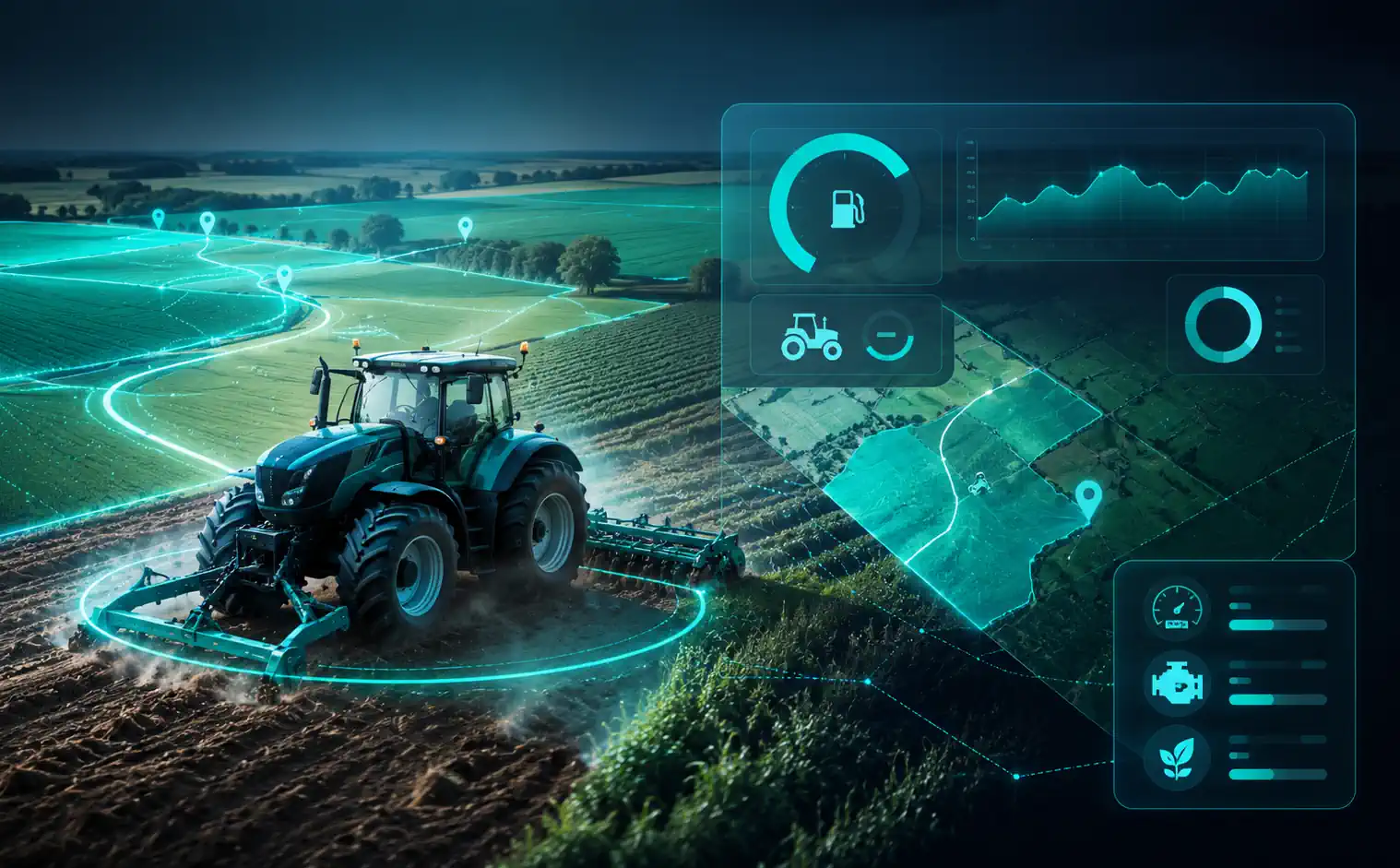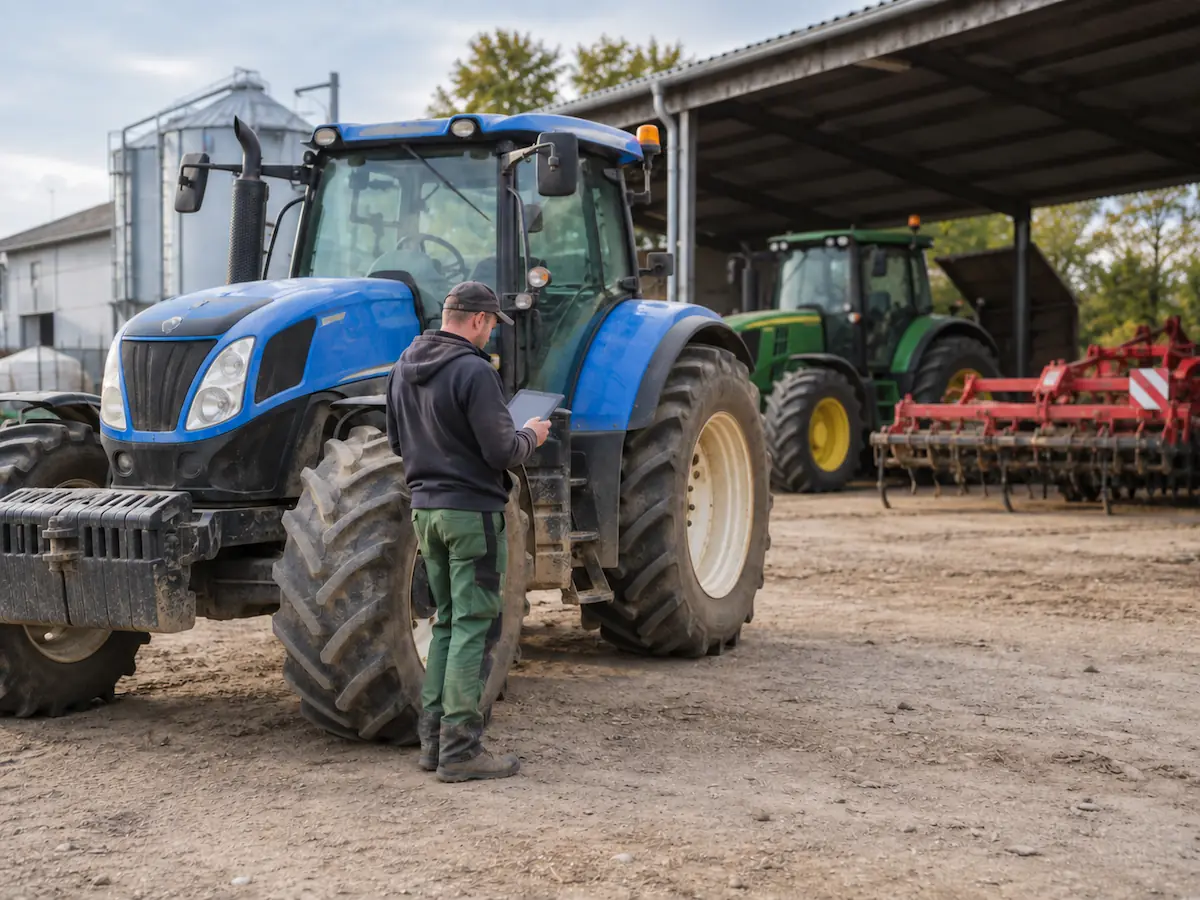
Farm machinery management starts with a simple question: which tractor can you send out into the field tomorrow, and how much will it cost to run? FarmPortal brings together machinery records, tasks and servicing and, when suitable devices are connected, data on machine location and operation.
Farm machinery management involves organising the use and upkeep of equipment, bringing together work planning, machinery records, maintenance and cost control.
At a glance
FarmPortal helps link each machine to a specific field operation, its service history and operating costs. Monitoring adds vehicle data to these records. To calculate work rates, separate fieldwork, transport and waiting time, and compare similar operations on comparable fields. Start by keeping complete records and setting a clear objective, then choose the measurements you need. This will help your reports answer specific questions about work organisation or costs.
- Separate fieldwork, travel and stationary time.
- Account for fuel over the same period as the operation carried out.
- Schedule servicing in line with the manufacturer’s recommendations.
- Fuel is only one part of the cost of running machinery.

Where should you start with farm machinery management?
Start with a shared machinery register, assign responsibility for keeping records up to date, and decide which decisions the data should support. In FarmPortal, machinery records, tasks and service records provide the starting point. Choose your monitoring setup once these are in place. If missed services are the problem, organise the maintenance schedule first; if journey times are unknown, consider GPS route tracking.
When assessing tractor utilisation, first look at how much of the total task time is spent on fieldwork. A long working day may be due to scattered fields, waiting to load or a poorly planned sequence of jobs. Before buying another machine, check these three factors and establish whether the constraint is the capacity of the tractor and implement combination or the way the day’s work is organised.
Farm machinery records and task allocation
A machinery record in FarmPortal keeps identification and technical details in one place: manufacturer, model, serial number, registration number, purchase date and purchase price. Operating parameters include working width, average operating cost and the unit used to express that cost. Always specify whether a rate is per hour, per hectare or based on another unit.
Assigning a machine to a field operation links the equipment to the work carried out. The record should reflect what was actually done, the machinery combination used and the operator. If a tractor switches to another job halfway through the day, create separate entries. A single entry covering cultivation, transport and drilling will make cost comparisons more difficult later.
| Area | Separate notebook or spreadsheet | FarmPortal |
|---|---|---|
| Machine details | Records can be organised, but different versions need to be reconciled. | A machinery record with technical details and operating parameters. |
| Field operation | Linking an operation to a machine requires consistent labelling of entries. | Machines can be assigned to tasks or field operations. |
| Servicing | Service history and due dates may be kept in separate documents. | A service record with dates and costs, plus notes on damage. |
| Work in the field | The operator records the time and route. | GPS data and reports are available once a suitable device is connected. |
What do GPS and machinery telemetry show?
GPS monitoring of farm machinery shows its location and route history. Telemetry can add operating parameters, fuel data and diagnostic signals. In FarmPortal, the information available depends on the Tracky device, the vehicle’s equipment and the configuration. Before installation, agree which parameters can be read from the specific model, rather than assuming the same capabilities across the fleet.
The Global Positioning System (GPS) is used to determine location. Telemetry is the remote collection and transmission of measurements. The Controller Area Network (CAN) bus is the communications network for a vehicle’s electronic systems; signals read from it provide information such as engine speed or fuel consumption. The available parameters are established when selecting a device for the machine.
When analysing routes, consider the vehicle’s location alongside the time and type of task. Our guide to farm machinery telemetry explains how this data is collected.
A GPS track across a field does not, on its own, confirm that an operation was carried out: the tractor may have travelled with the implement raised. Compare the route with the task record and the operator’s account. Record the reasons for stops in the same way: filling a sprayer, adjusting a drill and waiting for grain to be collected have different implications for work planning.
A clock hour measures elapsed time, while an engine hour is a unit recorded by the engine’s hour meter. How engine hours are counted depends on the machine’s design. Use the same unit and measurement basis when comparing reports.
How can you monitor fuel use and machinery operating costs?
Monitoring fuel consumption on a farm means linking the amount of fuel used to a working period and a completed task. In FarmPortal, refuelling records and fuel reports help bring this information together. Charge a field operation for the fuel consumed while carrying it out, allowing for fuel left in the tank for subsequent jobs.
A common pitfall arises when a tractor changes jobs: it finishes cultivation, switches to trailer work and is only refuelled in the evening. Allocating the entire refuelling amount to cultivation will overstate the cost of that operation. In this situation, I would account for fuel over a longer period and record how it was allocated between tasks. This makes the calculation easier to repeat for the next comparison.
The fuel balance is the opening stock plus refuelling, less the closing stock and any documented fuel removed. The resulting difference needs to be interpreted: it may include engine consumption, an unrecorded leak or a reading error. An alert about an unusual drop in fuel level is a prompt to check the records and the vehicle, rather than proof of theft in itself.
Fuel cost per hectare = fuel consumption allocated to the operation × price per litre ÷ area covered. A full cost calculation for a tractor and implement combination also includes the operator, servicing, repairs, wear and tear on both tractor and implement, and ownership costs. Do not add fuel separately if it is already included in the hourly rate used.
Iowa State University Extension and Outreach distinguishes between machinery ownership and operating costs in Estimating Farm Machinery Costs, updated in March 2026. This is a methodological guide; US rates should not be treated as a price guide for a Polish farm.
A Polish reference point is the February 2026 winter wheat cost calculation from WODR in Poznań (a regional agricultural advisory centre), published in a compilation prepared by Ewa Wilczek. For seedbed preparation using an 80 hp tractor and a 2.8 m cultivator, it assumes 0.70 h/ha and PLN 72.64/h, giving PLN 50.85/ha. These are variable machinery costs for the specified production system; the full cost of the machinery combination in our example covers a wider range of items. Source: WODR cost calculation: winter wheat, February 2026.
Planning farm machinery servicing before the season
FarmPortal’s service record brings together maintenance dates and costs, including parts. Notes with photographs help document damage and repairs. When adding a photograph of a leak, record the machine, the date, the location of the fault and the action taken. The next person to use the equipment will then know what needs checking before setting off.
Set service intervals according to the manufacturer’s instructions, taking account of time, hour meter readings and operating conditions. Combine reminders with daily checks of hoses, bearings and working parts. Record completed maintenance and the next service due date so that work planning takes machinery availability into account.
When repairing a hydraulic hose, record which component was replaced, the hour meter reading, and the cost of parts and labour. If the leak returns, the service history will help establish whether it is in the same place. In FarmPortal, a description and photograph linked to the machine make it easier to pass this information between the operator and the person arranging the repair.
Example: how much did it cost to cultivate 24 ha?
The following example illustrates the calculation method using simplified, illustrative figures.
A 180 ha arable farm growing cereals uses three tractors. After cultivating 24 ha, the manager wants to assess the work rate of the tractor and cultivator combination. Initially, the only information available is that eight hours elapsed between starting and finishing the task. There is no breakdown between fieldwork and other activities.
The tractor and cultivator are assigned to the operation in FarmPortal. The monitoring report, operator’s record and fuel accounting allow the time to be divided into six hours of fieldwork and two hours of travel and waiting. The 120 litres consumed cover the whole task. For this calculation, we use a fuel price of PLN 6/l and the rates shown in the table; for your own calculation, use the price on your invoice and the costs of your own machinery combination.
| Item | Assumption or calculation | Result |
|---|---|---|
| Fuel | 120 l × PLN 6/l | PLN 720 |
| Operator’s labour | 8 h × PLN 40/h | PLN 320 |
| Machinery combination costs excluding fuel and operator | 8 h × PLN 100/h | PLN 800 |
| Total task cost | PLN 720 + PLN 320 + PLN 800 | PLN 1,840 |
| Cost per hectare | PLN 1,840 ÷ 24 ha | PLN 76.67/ha |
| Fuel consumption per hectare | 120 l ÷ 24 ha | 5 l/ha |
| Work rate during fieldwork | 24 ha ÷ 6 h | 4 ha/h |
| Work rate over the whole task | 24 ha ÷ 8 h | 3 ha/h |
The PLN 100/h rate includes an allocated share of ownership costs, wear and tear, repairs and servicing for the tractor and cultivator. All hours in this example are clock hours, and all amounts use a consistent cost basis. The result of PLN 76.67/ha represents the cost under these specific assumptions.
The two hours spent on activities other than fieldwork account for 25% of the total task time. Before deciding to buy a wider cultivator, the manager examines the order in which fields are worked and the reasons for waiting. Necessary travel and servicing are separated from delays that could be reduced through better preparation.
Who uses the data, and how do you get started?
The farm owner can use machinery records and cost data to assess equipment upkeep. The work supervisor needs to link machines to field operations, while the person responsible for servicing needs fault histories and due dates. Whoever calculates production costs will benefit from consistent cost units. All of these uses depend on records being consistently assigned to the right equipment.
FarmPortal is a farm management system (FMS) within the FarmCloud ecosystem developed by Agri Solutions. FarmPortal Worker supports the management of employees, machines and tasks on mobile devices. Assigning responsibility should go hand in hand with managing staff and recording their work on the farm, so that everyone knows who updates task completion records.
Advanced telemetry has limited value if nobody analyses the reports or if the only problem is missing service dates. Before buying devices, identify the decision they are intended to support. When choosing farm machinery management software, also consider the work involved in keeping the data accurate.
Questions and answers
What does farm machinery management in FarmPortal cover?
It covers machinery records, assigning machines to tasks and field operations, service documentation, and work and fuel reports. Connecting suitable devices adds location data and operating parameters. The scope of automatically collected data is agreed when monitoring is configured for the vehicle.
Can you get started without GPS trackers?
Yes. Machinery records, technical details, equipment assignments to field operations and service documentation can all be organised before monitoring is introduced. Users then enter details of completed work themselves. Choose trackers to meet an identified need, such as recording journeys between fields.
Can an older tractor be monitored?
An older tractor can use a tracker suited to its power supply and installation requirements. When selecting a device, establish whether CAN data and fuel measurements are available, and how operating activity will be recorded. This ensures that the monitoring setup matches the equipment fitted to that particular vehicle.
How do you calculate machinery operating costs per hectare?
Add up the costs allocated to the task and divide them by the area actually covered. Include fuel, the operator and the allocated share of machinery combination costs, counting each component only once. In the article’s example, PLN 1,840 divided by 24 ha gives PLN 76.67/ha.
Will monitoring detect every fuel loss?
The effectiveness of fuel loss detection depends on measurement quality, reading frequency and alert settings. Check a reported event against the refuelling and work history, then inspect the vehicle. This sequence helps establish whether the cause is an actual loss, a measurement error or a missing record.
How can you compare the work rates of two operators?
Compare similar operations carried out with comparable machinery combinations in similar conditions. Take account of area, working depth, soil, transport and the reasons for stops. Consider the figure in ha/h alongside the quality of the work. A FarmPortal report can then help identify specific differences in work organisation.
Glossary
- Machinery fleet
- The equipment used on a farm, such as tractors, combine harvesters and implements. Each machine has its own record in FarmPortal.
- FMS
- A farm management system, such as FarmPortal. It connects records of farm resources with work activities and production documentation.
- Telemetry
- The remote collection and transmission of measurement data. The measurements available depend on the device and the signals it can access.
- CAN bus
- A communications network for a vehicle’s electronic systems. It can supply operating parameters for monitoring.
- Engine hour
- A unit recorded by the engine’s hour meter. Check how engine hours are counted on the particular machine.
- Overall work rate
- The amount of work completed over a defined period, for example ha/h including travel time. Comparisons require the same definition of time.
Summary: link machinery to completed work
FarmPortal organises information about each machine, its servicing and its use on the farm. These records become more valuable when they can be linked to a specific field operation and area. GPS and CAN data help build a fuller picture of the work, but need to be configured and interpreted correctly.
Start with one tractor and implement combination: complete its service history, assign the next field operation and decide how to account for fuel. If you need route data or engine parameters to assess its work, check the machinery monitoring options in FarmPortal and choose a device suited to the vehicle.
Follow us!
See what we're doing and be inspired by positive changes.