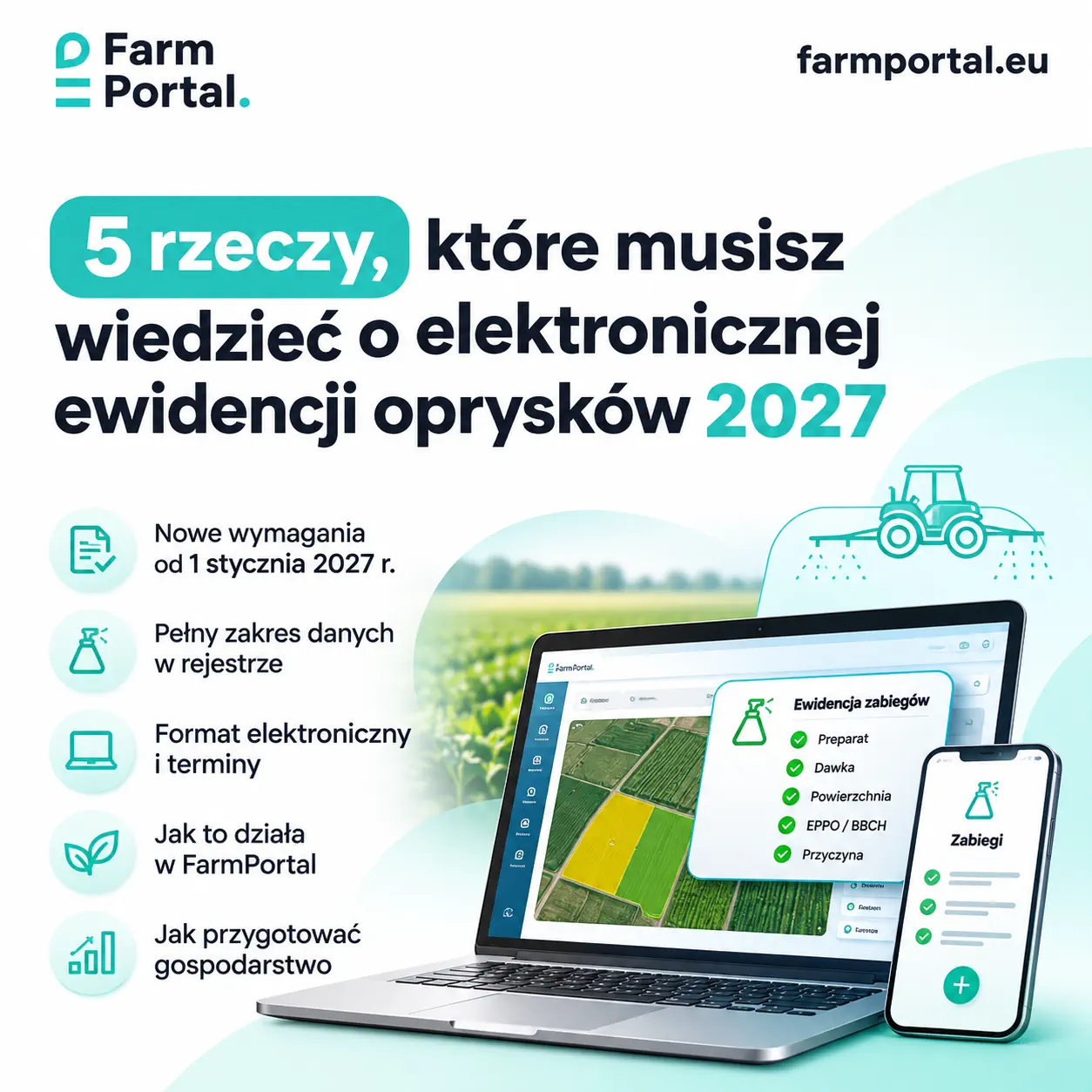
From 1 January 2027, the requirements for keeping plant protection treatment records are changing. Farmers will have to document more information and provide access to data in a machine-readable electronic format.
What exactly needs to be recorded? Which data is already mandatory, and what is being added from 2027? We have prepared a practical comparison for farmers, fruit growers, agronomists and spraying contractors.
FarmPortal already lets you record all the information presented below – both mandatory and additional. By connecting records with field maps, crop records, a product database and weather data, much of the information is available without having to enter it again.

At a glance
- In 2026, the existing scope of record-keeping applies in Poland; paper records are permitted.
- From 2027, the scope of information to be documented expands and the required electronic format applies.
- Records for 2027 can be transferred to this format by 31 January 2028, subject to earlier requests from the competent authority.
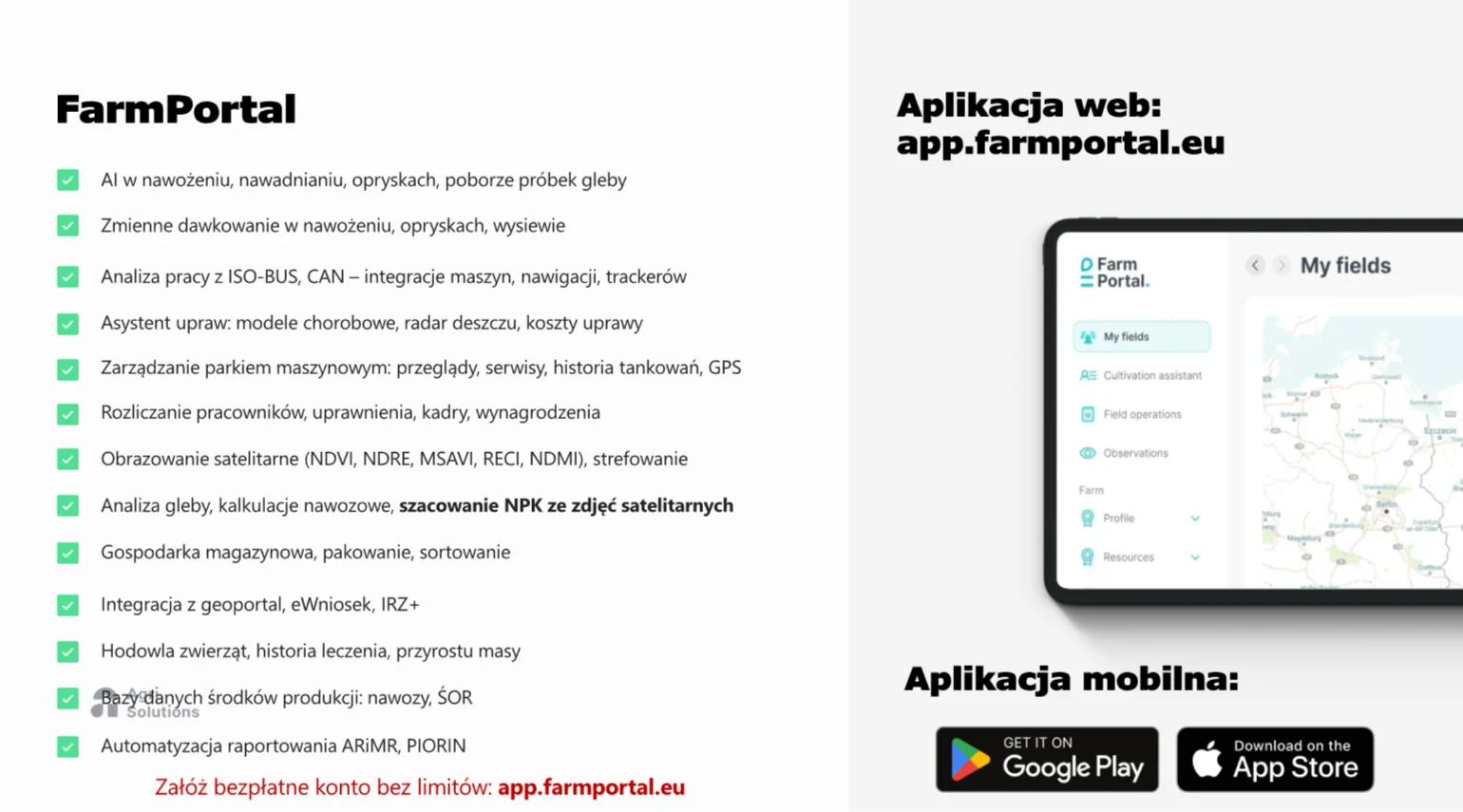
- FarmPortal allows you to keep records free of charge, regardless of the number of hectares, using a database of over 3,000 plant protection products with information on pre-harvest intervals.
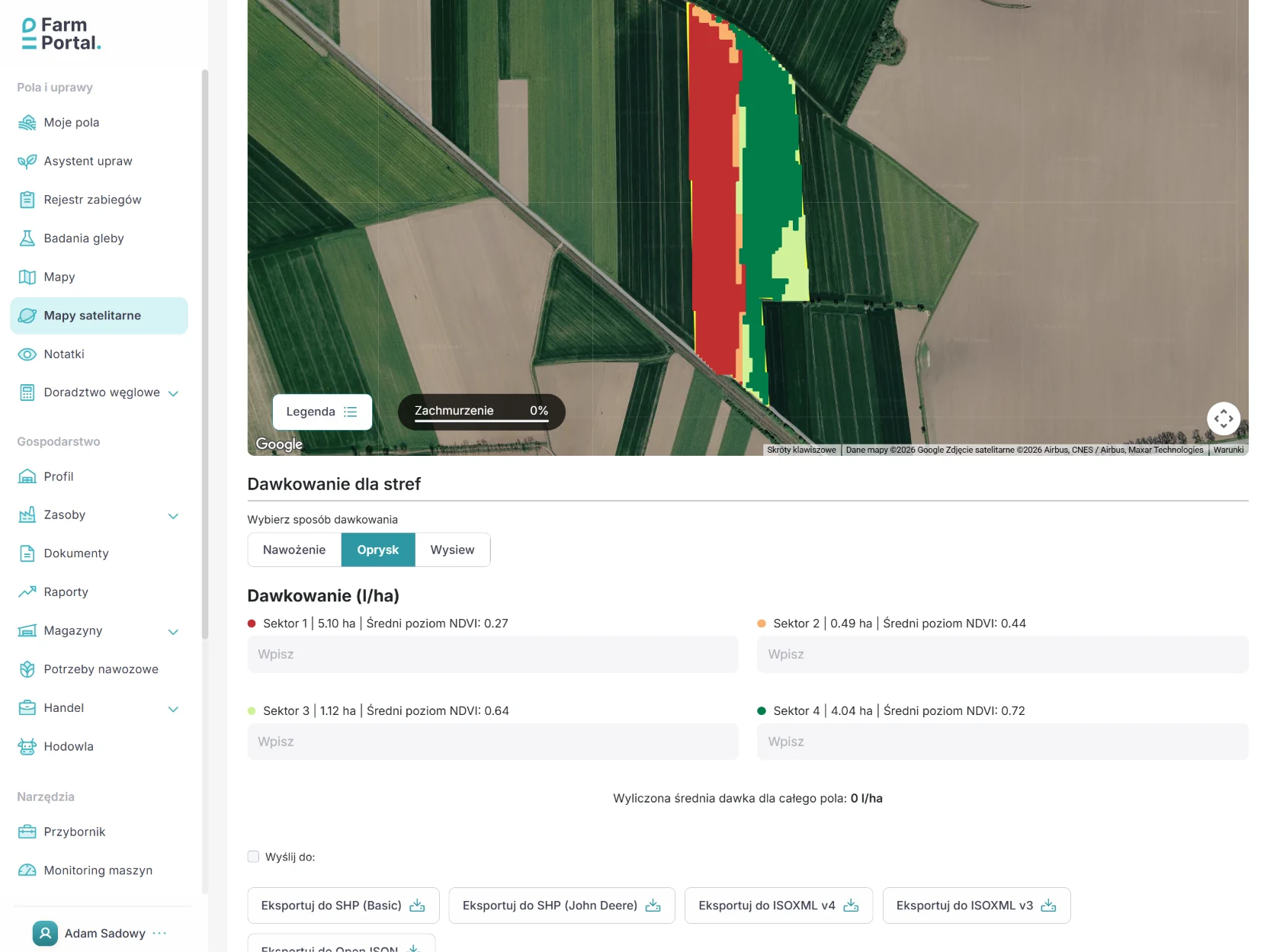
- You can record spraying of an entire field or part of it, create variable-rate application (VRA) maps, send them to compatible machinery and generate reports for ARiMR and PIORiN inspections.
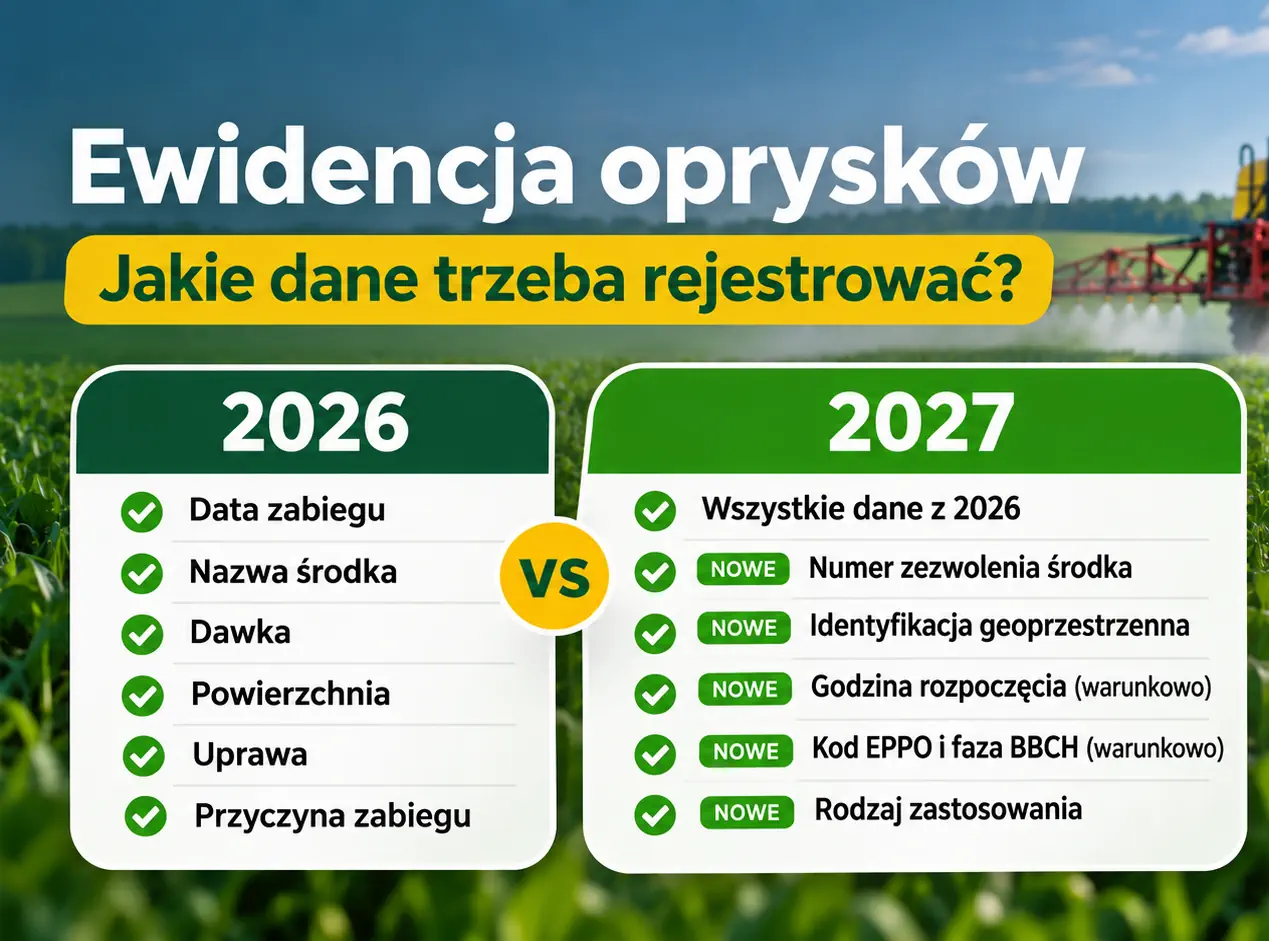
What data is mandatory in spraying records? Comparing 2026 and 2027
The following table covers standard surface treatments in Poland, including fields, orchards and plantations. It shows the minimum documentation requirements and the availability of information in FarmPortal.
| Information | Mandatory in 2026 | Mandatory from 2027 | Available in FarmPortal |
|---|---|---|---|
| Treatment date | Yes | Yes | Yes – Actual date of application |
| Treatment start time | No | Conditional | Yes – Work start time |
| Trade name of the plant protection product | Yes | Yes | Yes – Selection from the plant protection product database |
| Plant protection product authorisation number | No | Yes | Yes – Product details in the plant protection product database |
| Application rate (e.g. l/ha or kg/ha) | Yes | Yes | Yes – Rate and unit for each product |
| Treated area (ha) | Yes | Yes | Yes – An entire field or part of it |
| Location / identification of the treatment area | Yes – indication of the area | Yes – extended identification | Yes – Field map and parcel data |
| Crop name | Yes | Yes | Yes – Linked to the crop record |
| Crop EPPO code | No | Conditional | Yes – Code linked to the crop |
| Plant growth stage (BBCH) | No | Conditional | Yes – Growth stage at treatment |
| Reason for treatment | Yes | Yes | Yes – Reason for using the product |
| Type of product use | Not as a separate classification | Yes – use category | Yes – Type of treatment recorded |
What does “conditional” mean? The start time and BBCH stage are recorded when the application time or growth stage is relevant to the particular use, for example because of restrictions on the label. The relevant EPPO code is provided where applicable. More information: EPPO codes in electronic records.
From 2027, the treatment location must be identified using the land unit from the geospatial application, where available, or an appropriate alternative method provided for in the regulations. If spraying covers only part of a field, the area actually treated must be indicated. The type of use means the documentation category under the annex to the regulation, for example surface treatment; it does not mean that the product type (herbicide, fungicide, etc.) must be entered as a separate field.
For tank mixtures, the name, rate and – from 2027 – authorisation number of every product applied must be retained. The reason for treatment remains mandatory under Polish integrated pest management regulations.
What additional information is worth recording in spraying records?
Documentation can be useful not only during PIORiN inspections, but also for assessing application conditions, managing costs and analysing crop protection effectiveness. FarmPortal also allows you to collect the following information.
| Additional information | Why is it worth recording? | Available in FarmPortal |
|---|---|---|
| Operator / employee | Identification of the person performing the work | Yes |
| Employee qualifications for applying plant protection products | Documentation of operator qualifications in the HR module | Yes |
| Air temperature | Documentation of weather conditions | Yes |
| Wind speed and direction | Assessment of conditions and drift risk | Yes |
| Air humidity | Documentation of application conditions | Yes |
| Water volume per hectare | Parameters for preparing the spray mixture | Yes |
| Active substance | Analysis of the products used | Yes |
| Pest EPPO code | More precise identification of the treatment target | Yes |
| Product batch number | Traceability of the product used | Yes |
| Sprayer used | Linking work to a machine | Yes |
| Pre-harvest interval | Planning a safe harvest date | Yes |
| Re-entry / safety interval | Information about restrictions after treatment | Yes |
| Treatment cost | Analysis of crop protection costs | Yes |
| Treatment effectiveness | Assessment of results through post-treatment observations | Yes |
| Variable-rate spraying prescription map (VRA) | Spatial plan of product application rates and treatment zones | Yes |
| As-applied map | Documentation of execution when machine data is available | Yes |
| Photos and attachments | Documentation of field scouting and execution | Yes |
| Total quantity of product used | Accounting for consumption and stock | Yes |
Additional information can be recorded in the treatment record, linked modules or supplementary documentation. Automatic retrieval of weather data and as-applied maps depends on data availability and the configuration of compatible devices. Not every piece of information has to be a separate form field.
Note: the data in this table is not generally required as separate entries in basic field spraying records in either 2026 or 2027. Holding the qualifications required to apply plant protection products is a separate obligation from keeping treatment records. Additional obligations may arise from labels, other regulations, certification (e.g. GLOBALG.A.P.) or customer requirements. Seed treatment is subject to a separate scope of documentation, including the material batch number where applicable.
All treatment information in one place – FarmPortal
The digital plant protection treatment register in FarmPortal is connected to other farm management functions. Instead of keeping separate spreadsheets and notes, farmers can record treatments directly against fields and crops.
FarmPortal connects crop protection planning, preparation of machine tasks, recording completed work, stock management, costs and documentation needed during inspections. All data can be collected in a single web and mobile application for Android and iOS.
A database of over 3,000 plant protection products – authorisations, application rates and pre-harvest intervals
FarmPortal has a database of over 3,000 plant protection products, linked to the register of the Polish Ministry of Agriculture and Rural Development (MRiRW). When planning and recording spraying, you can select a product from an existing catalogue instead of entering its details from scratch.
- Product trade names and authorisation numbers.
- Information on authorised uses, crops, pests and application rates.
- Pre-harvest intervals taking account of the product's use – help with planning a safe harvest date.
- The ability to record several products in one treatment and account for their consumption and costs.
Before treatment, check the current label and authorisation conditions. More information: the fertiliser and plant protection product database in FarmPortal.
Spraying an entire field or only part of it
Not every treatment has to cover the entire field. In FarmPortal, you can plan and record spraying across the whole crop area or only a selected part of a field. The system calculates the required product quantity based on the application rate and the treated area. This allows you to document the area actually sprayed more precisely, account for product consumption and allocate costs to the crop.
Field boundaries can be imported from ARiMR, Geoportal or supported spatial files. Field data, crop data and treatment history remain connected.
Variable-rate spraying (VRA) and prescription maps – from FarmPortal to the sprayer
FarmPortal enables the creation of variable-rate spraying prescription maps (VRA – Variable Rate Application). Instead of applying a uniform rate across the entire field, a farmer or agronomist can define treatment zones and assign different rates where field conditions justify it. Satellite imagery, vegetation indices including NDVI and NDRE, and field observations help with map preparation.
Prepared maps and tasks can be exported to compatible agricultural devices:
- Rootsey – transferring prescription maps to compatible sprayer computers. See FarmPortal integration with Rootsey computers.
- AgroOSA – transferring maps and tasks to compatible agricultural guidance configurations. See AgroOSA guidance integration with FarmPortal.
- agrirouter – transferring data and tasks to other compatible agricultural terminals and machines.
- ISO-XML and SHP – exporting maps in a format supported by the target equipment, including for manual file transfer.
Variable-rate maps help match product consumption to the needs of individual zones, reduce unnecessary applications and analyse differences between the plan and execution if the machine provides as-applied data. Rates and zones must comply with the current product label and agronomic assessment. Having an ISOBUS terminal alone does not guarantee VRA support; the scope of integration depends on the device model, software and equipment.
Read also: variable-rate spraying – how do prescription maps and variable-rate application of plant protection products work? and variable-rate seeding, fertilisation and spraying in practice.
Treatment record reports for ARiMR and PIORiN inspections
Instead of assembling documentation on the day of an inspection, FarmPortal users can use data collected on an ongoing basis in the digital field record. The system enables treatment record reports to be generated for inspections by ARiMR (the Agency for Restructuring and Modernisation of Agriculture) and PIORiN (the State Plant Health and Seed Inspection Service).
- A history of completed treatments assigned to fields and crops.
- Summaries of products applied, rates, dates, areas and reasons for treatments.
- Export of documentation to PDF and data to CSV.
- Access to records from previous seasons and supplementary documentation.
In 2024, FarmPortal users generated 10,682 reports, rising to 42,303 in 2025 – according to FarmPortal's own data. A PDF report makes it easier to share documentation, while CSV data export supports working with a machine-readable format. Generating reports does not mean automatically sending records to authorities; users are responsible for the completeness and accuracy of the data they submit.
More about inspections and the consequences of missing documentation: penalties for failing to keep plant protection treatment records.
Employee qualifications for spraying – the HR module
On farms employing sprayer operators, it is important not only to record completed treatments, but also to document the qualifications of people applying plant protection products. The FarmPortal HR module can store information about employees' qualifications for carrying out plant protection treatments, including details of completed training, certificates and their expiry dates.
Linking an employee to a completed treatment makes it easier to identify the operator, check qualification documents and prepare the farm for an inspection. Information on qualifications is not an additional mandatory field in every entry in basic plant protection product records, but operator qualifications are subject to separate legal requirements.
FarmPortal also supports selecting spraying times based on weather data, Delta-T parameters and disease models. More: software for precision crop protection and fieldwork planning.
Prepare your farm for the 2027 season today. Create a free FarmPortal account and start keeping digital spraying records, regardless of your farm's area.
When do electronic spraying records become mandatory?
In Poland, a transitional period has been provided for treatments carried out in 2027–2029. If records were originally prepared in another form, they must be transferred to the electronic format by 31 January of the following year. For the 2027 season, this is 31 January 2028. This does not mean that documenting treatments can be postponed until the end of the season.
From 2030, as a general rule, records must be transferred to the required format no later than 30 days after the product is applied. Documentation must be retained for at least three years. A scan or an ordinary PDF report alone does not replace the required machine-readable data.
More about the changes: electronic plant protection product records – changes in 2027.
FAQ – frequently asked questions about spraying records
What new data must be recorded from 2027?
The product authorisation number and extended identification of the application location are added to the existing data. Documentation also includes the use category and, where applicable, the start time, EPPO code and BBCH stage.
Does every spraying operation need a recorded time and BBCH stage?
No. They are required when relevant to the particular use, for example when the label restricts application to a specific time of day or growth stage.
Can spraying still be recorded on paper in 2027?
Yes, during the transitional period. Treatments must be documented without undue delay, and records from 2027 must be transferred to the required electronic format by 31 January 2028. Earlier provision of data may be necessary at the request of the competent authority.
Does FarmPortal allow all mandatory data to be recorded?
Yes. FarmPortal enables the recording of data required for field treatments by connecting records with the field record, crop and plant protection product database. The user is responsible for the accuracy of entries.
Can spraying of only part of a field be recorded in FarmPortal?
Yes. A treatment can be recorded for an entire field or a selected part of it. FarmPortal calculates the product quantity based on the application rate and the treated area.
Does FarmPortal support variable-rate spraying and exporting maps to machinery?
Yes. FarmPortal enables the creation of VRA prescription maps and their transfer to compatible Rootsey computers, AgroOSA guidance systems and other devices via agrirouter or in supported formats such as ISO-XML and SHP. The scope depends on the equipment configuration.
Does FarmPortal generate reports for ARiMR and PIORiN inspections?
Yes. FarmPortal enables treatment record reports to be generated and documentation to be exported to PDF and CSV. This does not mean that data is automatically sent to authorities.
Can spraying qualifications be stored in FarmPortal?
Yes. The HR module can store information about employees' qualifications for applying plant protection products and documentation of their qualifications.
Basic record-keeping is free of charge regardless of farm area. Specialist VRA and HR modules and hardware integrations may be subject to separate terms.
Legal basis and sources
- Regulation (EC) No 1107/2009, Article 67.
- Commission Implementing Regulation (EU) 2023/564, as amended by 2025/2203.
- Act of 21 November 2025 amending the Act on Plant Protection Products (Journal of Laws 2025, item 1697).
- PIORiN – plant protection treatment records.
Follow us!
See what we're doing and be inspired by positive changes.